20150602

How Raymond Wong sees Tian'anmen Massacre Vigil in HK (2013)

How Raymond Wong sees Tian'anmen Massacre Vigil in HK
Translated by LegCo Translation and Interpretation Dept, spoken by Raymong Wong Yuk-man
Original: http://www.legco.gov.hk/yr12-13/english/counmtg/hansard/cm0529-translate-e.pdf 

(29 May 2013)

 Deputy President, commemoration of the 4 June incident has taken root on our land. 

 The motion on the 4 June incident is an annual expression of political stance. The pan-democrats perform the ritual every year, while the royalists dodge it year after year. It has already become a routine gesture and model response. However, such division has also led to a lazy mindset. Having considered themselves as the embodiment of justice for a long period, the pan-democrats have always marginalized internal disagreements. As the oppression of the Chinese Communist Party (CCP) on the masses in Hong Kong becomes increasingly severe and internal disagreements become stronger, they have no idea how to respond except to demonize them. 

 The Hong Kong Alliance in Support of Patriotic Democratic Movements of China (the Alliance) has almost monopolized the whole commemoration of the 4 June incident held in Hong Kong. The formulaic procedure of its vigil and the centralization of power inside the Alliance have already drawn criticisms from a lot of participants. Ten years ago, when I wished to go onto the stage in the vigil to appeal to the public to take to the streets to "topple TUNG" and oppose the introduction of legislation for Article 23 of the Basic Law, I had to beg sorely the seniors in the Alliance led by SZETO Wah and bargain with them repeatedly in order to get their "gracious approval". 

 Local consciousness has emerged since last year, and the Alliance drew up the puzzling slogan of "Love the country, love the people; Hong Kong spirit" which had evoked a tide of adverse comments. Then CHIN Wan posted an article on Facebook which says, "Commemoration of the 4 June incident must go into the community. The Alliance must draw a clear line between itself and the democratic camp. Otherwise, Hong Kong people should not participate in the vigil on 4 June". A stone tossed into the water has raised a thousand ripples. However, criticisms and responses have often been degenerated to giving vent to sentiments, and the obsolete moral judgment still applies, that is, "attendance in the candlelight vigil is a distinction between humans and beasts". 

 Today, we need to examine deeply into the issues of the commemoration of the 4 June incident. Since the airwaves era, I have strongly advocated abandoning the use of the word "vindication". Firstly, "vindication" implies recognition of the CCP's legal ruling status. Secondly, people with some knowledge of the CCP's history will understand that "vindication" and "reform of the political system" are not necessarily related. In 1978, DENG Xiaoping took advantage of the people's wish to vindicate the 5 April Tiananmen Incident to defeat the "yes-men", but after he had seized power, he turned his back and suppressed the Xidan Democracy Wall. There is the chance that such a historical event will recur in the future. 

 As for the new slogan of "Love the country, love the people; Hong Kong spirit", after the 1989 pro-democracy movement, there was a similar slogan in Hong Kong ― "If China has no democracy, Hong Kong will have no future" ― and after the 4 June incident, it became a defeatist statement which said, "If China has no democracy, Hong Kong will have no democracy either". During the pro-democracy movement, Hong Kong people had a rather complicated mental state …… right now we are discussing the motion on the vindication of the 4 June incident. The Honourable colleagues in the pan-democratic camp should find it very serious, but I do not know what Dr Helena WONG is laughing at. What are you laughing at? Is it very funny? We are discussing the vindication of the 4 June incident here. What are you laughing at? 

(...)

 Let me borrow HUNG Ho-fung's words on Facebook: "4 June 1989 was an important landmark in the establishment of Hong Kong people's subject identity, though it concurrently had the contradictory effects of stimulating Hong Kong's subject consciousness (that means disillusion with the "liberal CCP") and suppressing such subject consciousness (that means tying up democratization in Hong Kong with democratization on the Mainland)." On the other hand, for many Hong Kong people, that was the point of awakening their sense of identity as "Chinese people". 

 However, after the 4 June tragedy, it became an endless misery of "unrequited love". Looking back 24 years later, the 4 June tragedy marked the CCP's failure to grasp the last golden opportunity to mend its way. The so-called "reform within the CCP system" is just a fantasy. In addition, since DENG Xiaoping's inspection in the south in 1992, the whole country only has eyes on money. Corruption is entirely out of control, and the quality of the masses on the Mainland is as low as it can get. Judging from this, even the "civilized China" is gradually dying out in the north of the Shenzhen River. The CCP continues to occupy China by foul means. Competing with a political regime which has monopolized "love for the country" by showing "we love the country more", and cherishing unrequited love for a country which does not deserve our love, will be futile. 

 Every year I will attend the candlelight vigil for only two reasons: first, all beings grieve for their fellows' misfortunes; second, I wish to denounce the "butcher" regime through attending the vigil, in the hope that Hong Kong people will not forget the definite relationship between the 4 June tragedy and the "butcher" regime. 

 Now some people have queried whether the number of people attending the candlelight vigil would actually scare the Community Party, I think they have really set the focus wrong. If the Alliance is willing to make the memorial activities completely local and leave out the theme about love for the country, the Community Party will be more scared. However, requesting them to mend their way, I am afraid, is like expecting the Democratic Party to apologize to the public for betraying the voters three years ago, on which no high hopes can be placed. I hope that people who decide to boycott the candlelight vigil of the Alliance can organize activities on their own to commemorate the 4 June incident with local perspectives. They should not boycott the so-called "memorial activities". 

 The civic society in Hong Kong is a forgotten "casualty". The 1989 pro-democracy movement had awakened the idealistic sentiment of many Hong Kong people, but the following suppression had shattered their ideals and made most Hong Kong people more cynical. Owing to the time constraint, I cannot finish delivering this speech. 

 The 4 June tragedy is a humanitarian disaster. By the standard of the International Criminal Court in The Hague, it is a "crime against humanity". From this angle, we demand the Communist Party to take responsibility. 

20150528

Atsuna: Knowing Our Priority Is Necessary

Knowing Our Priority Is Necessary
Translated by Chen-t'ang 鎮棠, edited by Kristee Q, written by Atsuna
(Source: Pentoy)
China has been described after 1949 as: "Relaxed control results in chaos, chaotic society causes stringent control, stringent control results in bitterness [or death], and once bitterness is realised, control is released." (一放就亂,一亂就收,一收就死,一死就放。) On the 1st July 2003, 500,000 protesters took to the streets against the legislation of Article 23, and Tung Chee-hwa, the first Chief Executive stepped down. What Hongkongers deemed as victory was seen as chaos - the result of "relaxed control", was "stringent control" being imposed which paved the way for "economic colonisation" by the Individual Visit Scheme (2003); playing China's National Anthem before Chinese News Reports (2004) and removing the Central Star Ferry Pier and Queen's Pier (2006) were ways to remove the collective memory of Hongkongers, so as to further China's cultural aggression. After Donald Tsang, CY Leung was appointed -- a metamorphosis from "AO ruling HK" to "Party member ruling HK". Donald is but a classic toady who very cautiously nurtured his self-interest; CY is a more daring person who confront Hongkongers by squeezing Hongkongers' necks. He waits to see whether Hongkongers are strong enough to withstand such "bitterness".

People can be reckless when they are forced into corners and the Umbrella Revolution is almost the last attempt of Hongkongers to display their beliefs. Yet "Kongformists" will support slogans like "being rational and tolerant" in these moments. Charging is too radical, breaking glass is too radical, so they mentally masturbate themselves by the number of protesters and the peace and order during and after the protest (like not burning vehicles and picking up rubbish). I am not saying that being tolerant, rational or picking rubbish is bad, but Hongkongers perhaps do not know the priority of action against tyranny.

Tong Tekong, a renowned Chinese scholar in the US, says there are different "main and sub-themes" in different eras of China's modernisation. The main theme is the "most urgent issue" of the era, and the sub-theme is the "less pressing issue". Sometimes the methods of accomplishing the main and sub-theme might contradict each other. So, those who wholeheartedly want to accomplish the main theme might add burden to the solution of sub-theme; but those who forget the main theme and focus on the sub-theme will certainly be spurned.

This is what Mrs Chan thought. When Hong Kong is at the brink of its death, these "Kongformists" are still obsessed with rationality and tolerance - sub-themes that contradict with the main theme.

Hongkongers have lost the best moment for negotiation with China after decades. China does not allow the autonomy of Hong Kong, yet they put "High degree of autonomy" in the Sino-British Joint Declaration (High degree of autonomy DOES NOT EQUAL  AUTONOMY). Although holding the upper hand, China did not rise up, and knowing that Hong Kong would fall into its hands sooner or later, so it pretended to be kind and gentle. Even Mao Zedong promised "As long as the people have oversight of the government, then government will not slacken in its efforts. (July 1945)" Turning their back on the people and failing their promises are good reasons why the Communist Party will succeed. In only 18 years, Hong Kong has "deserved" a lot. It is possible that in a few years to come, given the present dissent the Red Army may come out and suppress protests in Central.

When the last emperor of Ming dynasty, Chongzhen, died, the funeral lament cried, "Keeping cowardly ministers in court, and timid generals in fields of battle, and now nothing has left in our dynasty but our cries and laments." I am immediately reminded of the inabilities of the cowardly HKSARG officials and the pan-dems, and the "caring mothers"  (police) mishandling my tax money. I wonder when we "have nothing left", will my friends or relatives cry to Victoria Harbour, which has long been polluted by Dongjiang water? After the cries and laments,  are Hongkongers ready for any sacrifices?

After all, Mao has said, 
"A revolution is not a dinner party, or writing an essay, or painting a picture, or doing embroidery; it cannot be so refined, so leisurely and gentle, so temperate, kind, courteous, restrained and magnanimous. A revolution is an insurrection, an act of violence by which one class overthrows another."

20150522

Maron: HKers Are Not Morally Obliged to Save Depraved Chinamen

Hongkongers Are Not Morally Obliged to Save Depraved Chinamen
Translated by Chen-t'ang 鎮棠, Edited by Karen L., Written by Maron (瑪倫)
Original: http://www.passiontimes.hk/article/03-15-2015/21757/ 


Gary Fan, Claudia Mo, Ray Chan, "Fast Beat", "Long Hair", James Hon, Raphael Wong Ho-ming.....these names were widely acclaimed a few months or few years ago, among all obfuscating pan-democrats. These self-dubbed "progressists" had perplexed some politically naive Hongkongers as if they can truly help.

These days, citizens have witnessed the pan-dems becoming "pan-fried democrooks" and have seen the mounting localist protests against parallel traders. Even though the restoration movement might not be as successful as expected, the localists have gained the public an upper hand of this battle, whereas these self-claimed "progressive" pan-dems took the credit of the favourable results and left the blames to localists.

What is behind localists' success? It is that the localists all know a cruel fact - "politics is showbiz for ugliness". Instead of getting "halo" or claiming credits, localists are pragmatic and emphasise efficiency - even at the expense of adopting extreme means. For the "Restoring Tuen Mun" social movement, the mainstream media have condemned the localists as severe as possible. But we localists are not going down because of it as we do know one thing - nothing is ever done by the pan-dems because they love sitting on the moral high ground and dodge immediately if being criticised. If it is useful in talking the talk, the valorous localists will never have to walk the walk!

Out of fear, the pan-dems have been avoiding conflicts. Take Umbrella Revolution as an example. Admiralty and Mong Kok are utterly two different worlds back then. Pan-dems were calling the shot in the Admiralty "Big Stage". Can weak flowers living in the greenhouse really be compared to the daredevils in Mong Kok? Leung Kwok-hung "Long Hair", a self-claimed revolutionist, has shown his true colours - a coward - since the valorous confrontational tactics derived in Mong Kok.

What Leung uses to do - hurling bananas or sending coffins to officials - is performance art after all, without a slight of influence. The conflicts between the pan-dems and the localists these days are exactly the continuation of the differences between Admiralty and Mong Kok.

I am a localist, and localists can be unscrupulous - I'm not ashamed to admit it. Why not indulging in the "love and peace" crap as the pan-dems do? Let's see what the Occupy Central movement ended up. Nosediving popularity in the end. And then what? There has been seen no coming back. Talking Chinamen into love and peace is merely casting pearls before swine given that it is their nature to bully the weak, fear the strong and nothing else. They will come after you once you show weakness in front of them.

Do remember what Lu Xun says, "We shall not be afraid of speculating Chinese people with the most malicious intent". Chinamen are not entitled to blame Hongkongers for being ruthless since they never deserve otherwise.

Some leftards might believe, "When you oppose devils, you become one of them." For the record, with the mission to protect our civilised city, we choose to treat Chinamen like barbarians - Barbarians will only be taken aback by acts of their kind. 

Localists dare to deal with Chinamen because there's no mind-shackles towards the suggestions by some "Greater China" faction, which are thoughts such as "the institution is the culprit" and "the party and the country are two separable concepts" so as to harbour their own kind. Leopard cannot change its spots. Even with a different regime, Chinamen are Chinamen.

Imagine the "the party and the country are two separable concepts" discourse stands. It would not be a problem if Japan does not apologise for what they have done in WWII. By this very logic, the Imperial Rule Assistance Association would have nothing to do with Japanese. Therefore there would be no need for today's Japanese to bear the responsibility back then. This logic itself proves what the kind of people Chinamen are. I wouldn't mind if Chinamen mutilate themselves with such retarded thought. But letting them to rule over Hong Kong? The answer is "No", a certain "No".

Democracy and China combined is the best example of Stockholm syndrome. If ever there is some so-called democratic China, it will not change the fact that Chinamen are born colonisers.

Let me ask you a question. If your neighbours have some family disputes, will you intervene between them? Lines are clearly drawn, so "No". Similarly, Hongkongers are not morally obliged to save depraved Chinamen. And the localists are going to kick them out of our home - by all means necessary - before it is too late.

20150520

Lam Song-man: Forgiving the Authority-abuse Police is Out of the Question!

Forgiving the Authority-abuse Police is Out of the Question!
Translated by Karen L., Written by Lam Song-man  (林爽文)
Original: http://www.passiontimes.hk/article/05-17-2015/23011/ 


In 1978 Soviet Union, a nine-year-old girl was murdered. Kravchenko had been arrested, convicted, and put to death in 1983, though he had an alibi. As a matter of fact, the man was extorted confession under police's torture. 24 years later, he was proved innocent - It turned out to be a serial killer Chikatilo who ended the young girl's life. The case says, the arbitrariness of the police is accounted for Kravchenko's death.

With empowered authority, police forces are able to stop people, question them, interrogate them or hold them in detention within a specific period of time. During the course exercising these authorities, pepper sprays, guns, and so on - use of force - are allowed to be adopted. That is to say, a single imprudent mistake could lead to far-reaching drawbacks. In time of Soviet Union, there was Kravchenko killed being falsely accused; in the U.S., there were black youngsters executed in the street; in Malaysia, political figures from the opposition party were pushed from building; in mainland China, numerous housing clearance duties ended with violence.

In Hong Kong, a mentally handicapped person was forced to make a confession of a wrongly accused murder on the police statement. The case was dropped as the police officer fails to carry on his duty by the book. With higher authority than anybody else, upholding morality and strict manner are required in a police officer. Ordinary people lose clients, increase business cost, or harm their companies' reputation as a result of making mistakes, whereas one's freedom will be gratuitously restricted, will be racked from bodily harm or death, will be put in the wrong if a police officer makes mistakes.

A journalist suffered from rough treatment by seven police officers during the Umbrella Revolution, while the matter is still unsettled; a friend of mine was crookedly charged of drug possession (insufficient evidence before the court set my friend free, but it left a rather huge expense.); some activists were searched naked; some activists were beaten on the black maria; sex workers were made acquiesced to police's demands for sex without payment; some protesters were threatened as such "I will take you back to the police station and rape you"... Cases of abuse of authority are simply too many to count.

Originally, citizens empower police officers the authority to serve the society and maintain public order so that one's freedom is being protected. Their neglect of duty damages citizens' rights while they refuse to apologise for their own fault and exhibit arrogance on the public statement. To understand and forgive them for all this? This might be the best situation to quote the former Commissioner of the Hong Kong Police Force Andy Tsang Wai-hung's catchphrase "Out of the question!".

20150519

Wing Wing: Unfriendly Hong Kong? Misinterpretation!

Unfriendly Hong Kong? Misinterpretation!
Translated by Chen-t'ang 鎮棠, Edited by Karen L. and Kristee Q., Written by Wing Wing (翼雙飛)
Original: http://www.passiontimes.hk/article/04-12-2015/22307 


The Oriental Daily recently published an article, titled "The Unfriendliest Cities in the World. Hong Kong ranks the 4th", saying that "although the survey conducted by Yahoo Travel did not explain the reason why, it did mention the 'unfriendly people' are mostly youngsters. It could be that reasons may relate to the recent anti-smugglers movement against mainland Chinese tourists."

Right. There are always people who assume young adults are useless, who choose to choose to shift the blame to others despite the fact that business operations are after all the business owner's responsibility, or those people who oppose the anti-smugglers movement -- these people will be more than willing to falsify the news. It is to be expected that they comment, "The image of Hong Kong is now tarnished by these 'useless young'! See! Surveys abroad prove it too! It is exactly what I've been saying..." On the Facebook pages of those pro-government/establishment figures (Translator's note: they are usually written in Chinese rather than English), you will find tonnes of these anti-"youngsters" quotes.

To be fair enough, do not judge a book by its cover and in this case do not judge a news report by its title, or else you will be hoodwinked. Please do take a look of the original survey "The Unfriendliest City in the World is..." and its content -- "The survey group consisted of 2,005 men and women, all from the United States."

Translation. The title "in the World" is obviously misleading -- unless the world consists of the opinions of 2,005 Americans. If you ask 2,000 or so Hongkongers what country's cuisines they love most and publish an article named "The Most Popular Cuisines in the World", does it reflect the truth? Changing the former one into "The Unfriendliest Cities in the eyes of US people" and the latter one into "The Most Popular Cuisines in Hong Kong" is surely closer to what the facts represent. After this clarification of the 'surveys' is there a sense that supposed-to-be factual news report from Oriental Daily is manufactured bullshit tailored for their reader's demographic?

In the comment section of the article, there are many doubts, like "What background do these 2,000 people have? A survey as such can only be worth referencing if the participants have travelled to few countries so that they can draw any conclusions. If a participant has only been to Hong Kong, then honestly does this disqualify the participant from deciding which one is "The Unfriendliest City in the World".

Another travel site Conde Nest Traveler announces "Readers' Choice Awards" on a annually basis. In Readers' Choice Awards 2014, there were approximately 77,000 readers participating in the survey, outnumbering Yahoo's survey. The site ranks Johannesburg, South Africa as the unfriendliest city, while Beijing ranks 6th, whereas Hong Kong isn't on the list. It also lists out all the factors of "unfriendliness", such as location and size of the city, political views, language barriers and so on, but not necessarily people's attitudes. Yes, Yahoo Travel doesn't necessarily have to mention the method it used to conduct the survey. Be it transparent or not, the writer of the news article quoting the survey is definitely not being objective for he/she attempted to put words into those 2,005 participants’ mouths.

The "The Unfriendliest City in the World is..." article from Yahoo Travel is nonsense. After considering the evidence this is certain. Yet the Oriental Daily, regardless of the paper's political bent, supports its allegation about the anti-smugglers movement by using that survey so  people can say, "You see! These useless youths are but tarnishing HK's image!" But when asked for details and for evidence no response has been forthcoming.

I continued in reading the Yahoo Travel article, it says,
"And more millennials considered Hong Kong, China, and Sydney, Australia, to be rude compared with respondents 35 and older."
Some misinterpret this as saying that youngsters in Hong Kong are less friendly than those aged 35 or above. I'm not saying that you shouldn't read newspapers at all, but to be critical -- when you see "it is speculated that", "it is said that", "some say", or any similar sort of such, pay attention and consider whether it's reasonable or not.Surely these news items are not in fact news but merely opinion pieces.In today's Hong Kong, most of the officials, politicians, and media do not bother to do a great job, let alone uphold the spirit that the job implies. It's up to you at the end of the day whether you are manipulated or not.

Cheng Lap: HK is a dangerous time bomb in case China has not yet found out

HK is a dangerous time bomb in case China has not yet found out
Translated by Chen-t'ang 鎮棠, edited by Karen L., Written by Cheng Lap (鄭立)
Original: http://chenglap-blog.logdown.com/posts/258649-causes-of-conflict-in-sino-hong-kong/ 


Recently, in Hong Kong, several anti-smugglers protests broke out. For the Hong Kong-China conflict, one will naturally see its inevitableness due to the tug-of-war-like political structure when one observes at the scene here in Hong Kong.

To start with the incomplete authority of the Government of the HKSAR is far and away the cause. Precisely, HKSARG has no approval authority on whom and how many Chinese can travel in and immigrate to Hong Kong, and neither is the amount of Individual Visit Scheme (IVS) cities controlled by the HKSARG. "The problem of Hong Kong is an external one," some of my friends from the police force who involved in the Umbrella Revolution once said so. It can be seen that to most of the people, they wrongly assume the HKSARG has such authority, but as a matter of fact it hasn't.

In addition, half of the Legislative Council (LegCo) comprises members of the functional constituency group, who walk into the seat with zero votes. That is, the case in Hong Kong is an oligarchy, and above such government, there is the "comprador bourgeoisie" (includes landlords, merchants and civil servants) back in the colonial era. The Chinese Communist Party attempts to take charge of Hong Kong by controlling the "comprador bourgeoisie" as Brits did. And this time, given their worship over the nabobism and unlimited power among the corrupt Chinese bureaucrats, it only takes a slight effort to do so. Why? The existence of functional constituency leads to the forevermore-below-half elected seats of the membership. By a no-brainer deduction, interests will side with the oligarchs.

By controlling the functional constituency group, executive has more or less managed to control the legislature. One of the separation of powers has merely gone. Social problems like over-population and the everlasting unfavourable results afterwards are not likely to be solved given the imbalanced power of the LegCo. Translation: bills avoiding those problems that are supposed to be passed have been opposed since they do not earn benefits for the vested interests. It has been seen enough vested interests strengthening their self-interests this way.

In 1998, HKSARG dismantled its original LegCo. And the then provisional LegCo, which its bigwig members were basically appointed by the CCP, aimed to abolish the vital policies by the colonial government which had maintained the social stability:

- Rent control. The main policy that limits rent increase. It comes as a wonder to many people why there are less dissatisfaction living under the colonial regime than the CCP. Rent control is one of the many answers as the colonial government restricted both the growth of rent and property price. This policy has fallen apart since 1997 when the oligarchy started to take charge. After that, the property price and rent have been skyrocketed, and those landlords and property owners are laughing their way to the bank. To foreigners, Hong Kong is a place about pricey and tiny flats. And to locals, this is daily life suffering endlessly -- everyone is being exploited and is made to paying rent of some HKD$10,000.


- Public Order Ordinance. Police's authority enhanced and the freedom of assembly and demonstration denied as well, they turn protests against the government from a right to some dangerous thing  -- one might get arrested and detained exercising one's right of protesting peacefully, be searched of one's house out of coming-from-nowhere speculations or get a difficult time. A deterioration of police-civilian relationship is what is leading ahead of Hong Kong. The city has long been famous for peaceful demonstrations, whereas the government decide to neglect their views. Worse still, police force are implemented to stop them from protesting and to file prosecutions against them. All these will only lead Hong Kong to form a ideology as "If a peaceful protest does not bear fruit, why bother?". As I mentioned before, the harder the government blackens and suppresses the peaceful protesters, the more hardcore protesters come to the front of protests.


The change before and after 1997 is lifting the restrictions on the vested interests, as well as allowing the police to attack the public, to which CCP is to blame. It is simply too naive for them to belittle the establishment of a colony and to assume a little effort will do. The communist party think they can rule the place with compradors without knowing that a sound separation of powers behind is more than necessary. Although Hong Kong was removed from the colony list in 1972 (Link 1, Link 2), the CCP still treat Hong Kong as one of them. The CCP has taught their students "Colony is a political entity where the invader controls the compradors" and when the students become the leader of the country, they mistakenly expect applying what the colonisers do is going to guarantee a stable regime as UK back in the colonial era.

The Communist Party itself do not have the separation of powers. Thus there is no any sort of rightful checks and balances to monitor over the compradors. Such regime will inevitably lead to an old-style colonialisation -- all about exploitation, suppression, confrontation and independence.

The election is by no means fair in Hong Kong. In the LegCo, a member might be from over 100,000 votes in geographical constituencies , or 0 votes from functional constituencies. The latter ones are the vested interests and most of them have invested shops and have benefited from IVS and smuggling (Imagine the rent of 1,000-feet shop is worth HKD$1,000,000/USD$129,000 per month -- impossible in the rest of the world). And how did the government deal with the side effect? Suppress.

Letitia Lee, one of the leader from the Blue Ribbon thugs.
Yet, the political infighting involved in Hong Kong at the same time. Some thugs sponsored by Chinese funds and the Falun Gong are putting their Communist-style confrontation in Hong Kong. At first Hongkongers felt "it doesn't matter to me anyway", but gradually they found out that when it comes to things related to the CCP, peaceful tactics are futile, or basically laughing stock.

The government neglects every protest of Hongkongers. They even set up a 3-metre barrier to ban citizens from going inside. In other words, they damage channels and spaces for the government-public communication and protests. Applying police force against protesters, they think that if legal protesting becomes harder and inefficient, the public will give up someday.


Yet the government has miscalculated the situation. The Umbrella Revolution first started with a class boycott with few dozens of people, then tens of thousands of protesters for two to three months of street confrontation -- the root is the miscalculation of the public response. Every riot starts with the thought of "once the authority suppresses, protesters disperse", while the new generation of Hongkongers is now possessing the thought of "more suppression, more confrontation" -- the police ended up using more weapons like tear gas and batons which is a further deterioration to the situation. The more participants in the issue, the more unconventional and guerilla-style confrontational tactics appear -- from a peaceful protest to wearing masks; from willing to cooperate to grabbing fellow protesters from the police force; from protesting to the government to starting anti-smugglers movements.


When the suppression escalates, the tactics of participants escalate causing a vicious cycle. The next bottleneck might be on the "boundary". From the viewpoint of historians, this is a repetition of the period during the end of a colonial era, like Boston Tea Party or the Netherlands' Eighty Years War. The confrontation will take place outside of Hong Kong, maybe in China or overseas. Whatever the government attempts to escalate the suppression against the protesters, it can do nothing outside the jurisdiction of Hong Kong.

Since 1997, the education of Hong Kong has been infiltrated with elements from CCP, such as giving salute to the Five-Star Flag, singing March of the Volunteers (PRC's national anthem) and indoctrinating about the CCP. This "Umbrella generation" is grown under such pro-CCP education. But as a teacher, I found that students never for a day like such indoctrination -- the students hate CCP even more after being sent to the military training camp in there. Students found these coercive behaviour strangle which causes a more anti-CCP generation than ever.

Although most of the Hongkongers assert new immigrants are "diluting" the population of Hong Kong, quite a few of the "Umbrella Generation" are the offspring of new immigrants, and some may even receive their primary education in mainland China. Lives have not been easy for them since the moment coming to Hong Kong. Caught between two stools, a strong sense of anti-CCP awareness appears to them -- there is no way can they go back in China and live happily ever after. It is the sole road for them to strengthen their own Hongkonger identity, so as to be more "Hongkonger" than a "Hongkonger".

This reasoning may sound off, but it makes every sense of it. Historically speaking, Napoleon was the French emperor, but he was from Corsica; Adolf Hitler was the Führer of Germany, but he was from Austria; Joseph Stalin was the leader of USSR, but he was from Georgia. These "foreigners" have nothing in the first place. Hong Kong received almost a million new immigrants alike, and this very thought has grown more than prevalent among such generation.

Also, Renminbi (Chinese Yuan) is not a freely convertible currency, whereas HKD has pegged to USD through Linked Exchange Rate system. Hong Kong is the only Common Law jurisdiction in the Greater China region. Our legal system is similar to the UK and the US. Our currency, passport and legal system are internationally acknowledged. Any cities in PRC, including Shanghai, cannot attain that, even their property price skyrockets or they have a record-high GDP.

元, 人民币, 货币, 中国, 背面, 钱, ¥ 元, 法定货币
(Source: Pixabay)
This is one of the blind spots when people look into HK-China relationship -- there is a vital and inseparable interest behind. The biggest wealth of Hong Kong is the system independent from the CCP, and the compradors know this. They know the CCP will not act rashly in Hong Kong, and so they try all means to gain interests in Hong Kong with the support of CCP. The HKSAR passport and those related companies have become springboards for many important CCP figures in leaving CCP. The compradors do not care to aggravate conflicts or the other way round. They can leave Hong Kong whenever they want even if anything bad appears. High-ranked officials in Hong Kong, including CY Leung's family, are basically abroad. Imagine any major unfavourable issue happens in Hong Kong, these officials could land at some overseas countries safely leaving behind a RMB economy bomb with the citizens.

Many people have a thought that empowering elites the full authorities is what makes things work, and makes things work well, however, in the case of Hong Kong, it reveals the absolute power has every ability to turn people corrupt. It is because the one could use the absolute power in hand to serve one's self-interests and to get away with the responsibilities. A friend of mine from the CCP, who is rather open-minded, says that many people undermines the complexity of the Hong Kong society. China has taken a dangerous time bomb. After the 70s, Hong Kong can no longer be seen as a colony, but few people are aware of that.

20150513

Wing Wing: On Donation to China vs Japan

On Donation to China vs Japan
Translated by Chen-t'ang 鎮棠, edited by Kristee Q, written by Wing Wing (翼雙飛)
Original: http://www.passiontimes.hk/article/05-12-2015/22920 
(GBTimes; in Hong Kong, a citizen donates money to World Vision for Sichuan Earthquake in China)

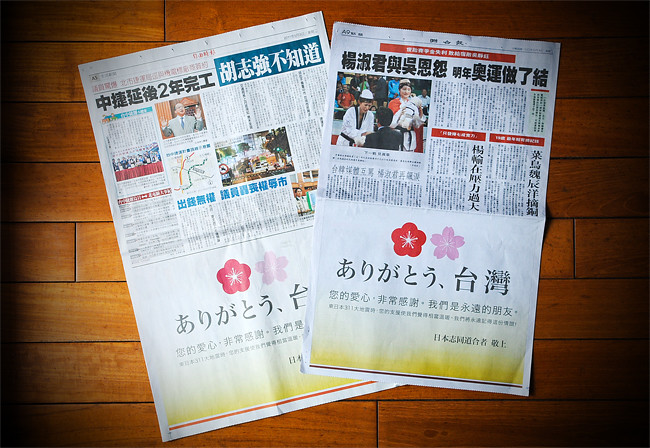
It has been four years since the 2011 earthquake in Japan. It had been a while since March, but whatthe Japanese did in that time was more than impressive. In June 2011, the Japanese thanked Taiwan by putting advertisements in two Taiwan newspapers thanking them for their efforts in the, earthquake. This year some Japanese NGOs expressed their gratitude by doing volunteer work in superman suits and last March a Japanese restaurant owner in Taipei gave out free curry rice for a week so as to thank the enthusiasm shown by the Taiwanese people.


Some people might say Japanese are over-pretentious as they predominantly show their polite side to others but on the other hand shouldn't we see this as a sign of being educated? To thank those who have helped his/her country in plight is a sign of politeness - putting the word "pretentious"aside, Japanese has won in terms of politeness. When a child receives a gift that he doesn't like much and he still thanks that person, would you say that he is pretentious? If he pouted and remained silent, or even made a long face, would you say that he was sincere and tell him "you don't have to thank others if you don't like the gift"? You simply wouldn't because thanking others is a form of politeness and virtue.

In China, during the Eastern China Flood and Wenchuan Earthquake (seven years ago), tears shed for their victims were uncountable in Hong Kong. Very many people donated their own money to help the flood victims and those who disagreed with such donations were condemned as "cold-hearted". But what have we got in return for our genuine distress and wish to help? Has any Chinese tourists thanked us for "giving a helping hand in our plight"? Are there Chinese putting advertisements in newspapers thanking us? No. Instead we hear of some Chinese tourists humiliating Hongkongers: "If it isn't us [coming], your Hong Kong is certainly doomed!" or "China has arisen, you Hongkong-dogs are jealous of us being rich!"

For sure, these people don't represent all Chinese but Hongkongers are being humiliated online and offline. How can people expect Hongkongers to donate when there are many charities raising donations for China? A decision to donate hinges on how the donor feels about the place and its people. I have a few words for those genuine victims: "Your compatriots are tirelessly zealous in humiliating those who have helped you. If they are so rich and powerful, can you really blame others not seeing the need to help you? Not to mention how much money has been pocketed during the donation process, after many Chinese charity scandals have been exposed."

Therefore it is not strange for Hongkongers to show unwillingness to donate to China.

Some "patriots" might say, "Are Japanese worth emulating? They have tonnes of problems, such as..." Certainly Japan has tonnes of problems, but why don't we learn from their positive attributes? If a nation only nit-picks at others and feels comfortable doing so without learning from their good points such nation will inevitably degenerate slowly but surely.

20150504

Maron: Put A Stop To "Construct A Democratic China"

Put A Stop To "Construct A Democratic China"
Translated by Chen-t'ang 鎮棠, edited by Kristee Q, written by Maron
Original: http://www.passiontimes.hk/article/03-27-2015/22006/ 

Richard Tsoi and Lee Cheuk-yan. (aTV)
The tertiary student sector appears to be "bidding farewell to Greater China" - deflecting from the pan-dem's trajectory of "constructing a democratic China".

The Greater China faction has fabricated tales to draw support for "constructing a democratic China", such as the discourse of "de facto governance of Hong Kong by CCP". There are two logical errors in this proposition. First, if Country X governs Hong Kong, then Hongkongers have to fight for democracy and freedom for the people from Country X? No, of course not.  Are Hongkongers "universal democratic fighters"? Second, the relationship between China and Hong Kong is the relationship of the rapist and the victim. When the victim cannot escape from the iron fist and sympathises with the rapist, this is called "Stockholm Syndrome". When rapists have democracy and freedom, will they not rape others? A leopard will not change its spots.

Another discourse to be considered is the "geopolitics of HK and China". As China is close to Hong Kong, then it has to interfere with our affairs. Vietnamese refugees have seriously affected Hong Kong in the past, so we have to "construct a democratic Vietnam"?

Also, "a democratic China benefits Hong Kong" discourse says democracy in China will be conducive to HK's autonomy. Chinese people hate HK's prerogative (border/passport/tax revenue...), and there are no signs  that this discourse is an effective path, or worse, they will use "the majority rules" and metamorphosise Hong Kong into an utterly Chinese entity. Autonomy? Daydreaming. Such discourse is beyond logic.

The Pan Dem's theory and actions are beyond comprehension. What have they accomplished in the many years following their hollow slogan of "constructing a democratic China"? They don't have a plan,but  rather the utilisation of another Ponzi scheme to extract money from pan-dem supporters! They offer all kinds of sops and excuses, such as China banning them from entering the mainland -- is there any country allowing such an opposition party from entering its own territory? Stowing away is a common tactic adopted by revolutionaries, why isn't there anyone adopting the tactic? Don't tell me it's illegal, the Occupy movement is technically illegal too, so isn't it more worthwhile to stow away so as to achieve the goal of "constructing a democratic China"? The basis of such construction should be in China, not Hong Kong. Try to explain in 1989, why Lee Cheuk-yan had to sign his confession letter and return to Hong Kong? Why not instigate rebellion in those  political prisoners in Qincheng Prison and create a Chinese Storming of Bastille? It seems that these "seniors" are afraid of death. They love fame and fortune from the local political arena, and as a natural progression of this fear they have started to dream of "constructing a democratic China". It is absurd to continue the formulaic procedures of chanting slogans at every  Tian'anmen Massacre vigil. Those who appear  on  stage are unabashed, and appear complacent when they do so. To be frank, it is just a joint celebratory  wanking party.

Waiting for the  situation to change in China is spineless and  passive. Those evil Greater Chinese ignoramuses do not want to take the huge risk in China, yet they are willing to wait and take credit once there are some signs of democratic development there. Even the appearance of mass movements does not mean that all Chinese people want democracy. Wukan villagers have said they did not seek the overturn of CCP. Chinese people do not want democratic China nor to overturn the CCP regime - that's it! Why force them? We should respect their choice. Pan-dems want political gains, and to  bind China and Hong Kong together by chanting slogans like "No democratic Hong Kong when there is no democratic China". They often fantasise about the reform in China. They have not realised that most  Chinese people do not want to change, and Hongkongers do. Hong Kong is our land. A leftard, Ben Lam, said Chinese are our war-fellows -- he is ignorant and therefore unimportant to HK. Apple Daily and Ming Pao are both leftard-leaning. Hongkongers have to wake up, and not turn Chinese people into cannon fodder -- it is unrealistic and unethical and the bottom line is that it is ineffectual.

Stop "constructing a democratic China". Stop being a nuisance.

20150428

Christopher Ho: Lies of HKFS - 7 Mins and You'll Know What's Wrong With HKFS

Lies of HKFS
7 Mins and You'll Know What's Wrong With HKFS
Translated and written by Christopher Ho Quen-thai
(This article is an abridged English version of the two series of Debunking the Numerous Lies of HKFS published on VJMedia between February and April 2015.)

Introduction
appointmentThe Hong Kong Federation of Students (HKFS) has recently been under a wave of members’ withdrawal, triggered by its various mistakes committed during the Umbrella Revolution. The author came into notice in mid-February (when the Hong Kong University Students’ Union was having its referendum to decide whether to withdraw from HKFS) various financial irregularities of HKFS and one of its major sources of finance – H.K.F.S. Fund Limited, and has uncovered numerous pieces of fact regarding HKFS’s financial situation which has long been concealed. A few of them have been addressed and clarified by HKFS, but more remain unanswered. 

Background information
H.K.F.S. Fund Limited is a company limited by guarantee registered in Hong Kong. It was called “Hong Kong Student Travel Bureau Limited” before 1994. One of its major objectives is to finance HKFS by making to the latter regular donations. The company holds in total three land properties, two of which on trust for HKFS as the beneficiary (including the office of HKFS), and the remaining one an investment property which generates rental income to finance the donations. The investment property is presently valued at around HK$13 million.

All the dishonest statements and practices of HKFS are hereby listed out.

A) All the irregularities concerning H.K.F.S. Fund Limited are, contrary to HKFS’s allegation, not merely “administrative negligence”

1. Between 2004 and 2014 HKFS had, in rampant violation of its constitution, failed to appoint student directors into H.K.F.S. Fund Limited every year.
2. The power of the said appointment lies in HKFS’s Annual General Meeting and Representative Council, and has nothing to do with its administrative body, namely the secretariat.
3. The 50th Representative Council of HKFS allowed H.K.F.S. Fund Limited to reduce the amount of yearly donation to HKFS, which was abetting the company to breach its own articles governing the amount of donation payable every year.
4. The two “reports by student directors of H.K.F.S. Fund Limited” issued in January and February contains a list of member of the company’s board of directors which was inconsistent with the information shown in the Company Registry at that time. The lists in each of the two reports were also inconsistent with each other.
5. A public statement of HKFS issued in February which attempted to explain the irregularities concerning H.K.F.S. Fund Limited contains numerous factual errors, including the relationship between the company and HKFS, and the year in which the name of the company was changed.

B) Every promise of financial reform is empty and misleading
1. The root of the irregularities is HKFS’s rampant violation of its constitution by not appointing student directors into H.K.F.S. Fund Limited every year, instead of any structural or institutional problems which need reforms.
2. The reform promised in the public statement of HKFS issued in February has turned out to be only a two-page yearly report of the “student directors of H.K.F.S. Fund Limited” submitted in March to the HKFS Annual General Meeting, with plenty of errors and unexplained inconsistencies with previous reports, including
a. Error in the date,
b. Error in the names of the directors,
c. Unexplained change of directors not even reported to the Company Registry,  and 
d. Unexplained change of estimated value of the investment property, from HK$8.7 million in the February report to HK$13.4 million in the yearly report.
3. Ridiculously, the February report, which is inconsistent with the January report, and the yearly report, which is inconsistent with both the January and February reports, have been passed without objection in HKFS Representative Council and Annual General Meeting respectively. The Annual General Meeting consists of the entire membership of the Representative Council; in other words, in only one month the same group of supposed student representatives approved two inconsistent reports in which no explanation on the inconsistencies have ever been given. Notwithstanding any promise to reform, these constituting bodies of HKFS remain total rubber stamp.

C) HKFS has probably concealed the internal conflicts as regards H.K.F.S. Fund Limited

1. The membership of the board of directors as shown from company search is still not totally consistent with that alleged by HKFS, which probably reflects internal conflicts between HKFS and the company on the one hand, and among the directors of the company on the other hand. There may well be a dispute as to the validity of membership of certain people in the board of directors.
2. This inference of internal conflicts is also supported by the fact that H.K.F.S. Fund Limited has (in breach of its articles) stopped making donations to HKFS since 2011.
3. The origin of the problem is, after all, HKFS’s failure across 10 years to appoint student directors into H.K.F.S. Fund Limited to exercise its otherwise granted power of control over the company.

D) HKFS is still trying to conceal the facts concerning H.K.F.S. Fund Limited’s investment property

1. HKFS deliberately avoids mentioning the investment property in all of its public statements and Facebook posts which attempt to answer the concern of its financial irregularities.
2. The investment property was deliberately undervalued for millions of dollar in order to downplay its importance.
3. No tenancy agreements regarding the investment property has been registered with the Land Registry for more than 10 years, rendering most information of the rentals inaccessible by even members of HKFS.
4. Owing to the increase in rental income and the failure of H.K.F.S. Fund Limited to make donations since 2011, the company now has, according to its articles, more than HK$1 million payable to HKFS.

20150427

敘述,所以存在/還是被敘述,所以存在:試以臺灣為例—淺論香港主體意識的重構

敘述,所以存在

還是被敘述,所以存在
試以臺灣為例—淺論香港主體意識的重構
Written by Mak Heung-fai 麥向暉
Original: CityU Monthly 2015 April Edition

(蒙城大編委授權刊載,稍後將提供英文版)
(English version will be available soon. Authorised to be shared by CityU SU Editorial Board.)

當是非對錯,尚且糾纏於本土、偽本土、港獨還是一國兩制,而無日無之,距政改方案徹行的時間點,又迫在眉睫,此誠危急存亡之秋也。問題之紛至沓來,固謂亟待解決,然而,至關重要的解釋論述—「我是誰?」,仍然束之高閣。這個概念,顯然是身份認同問題,雖道是尋常,亦看似與眼下的脅逼無關宏旨。其實,身份與信念關係千絲萬縷,恰恰是辨除偽本土、港獨、一國兩制等偽命題之箭矢。拙文以為,身份問題只有重構屬於香港「主體意識」的前提下,才能理解何謂真本土、以至香港之核心價值,卒之決定去留統獨。泛論之,必難以道明,姑且引情狀相類的臺灣以略談—究竟我們「敘述,所以存在;還是被敘述,所以存在」?
Photo Credit: 劉明堂, 何豪毅, 黃謙賢/Taiwan People News

「主體意識」:存在的自我賦予
「主體意識」四字,於香港人,或許陌生非常;一海之隔的寶島,卻心領神會。跳出主權和從屬的非黑即白,擺脫政治角力的制肘,以一地為中心,重新追本溯源,找尋屬於該地原有之文化源頭,並以之為底基,旁及外來的多元文化,肯定一地之獨特性,進而在歷史、文化、經濟上加以闡揚,此之為「主體意識」。惟務須申明者為,主體意識在政治上,往往被外間解讀為「獨立」,實抹黑異見之舉也。前述之主體意識,乃從中性而言,一種自我本位的肯定,一旦就此作政治論述,政見不同者或重新把這拉入黑白二元的困局。臺灣之大漢族主義者,國民黨為首,認為臺灣為中國領土,不可分割,遂誣蔑持論者和民進黨人為伍,即「臺獨」。當然,「主體意識」跟「獨立」貌合,但神離,前者具較大包容性;後者排他性則較明顯,並據主體意識的意涵,採相對極端之論調。礙篇幅所限,不另多贅。

在上述前提下,臺灣自然不是中華民國,該處之落地者乃不折不扣之「臺灣人」。筆者起初也不明所以,在外人角度,臺灣完全跟中華民國劃上等號,而何以謂臺灣人,非為中華民國人?答案在於各人對臺灣「主體意識」的理解。上文就主體意識,淺嘗輒止,也不妨引套之。即是臺灣本來就有不假外求,迥異於別國的文化源頭,甚至民族源頭。最早居於臺灣者,原住民也,諸如泰雅族、阿美族、以及新近認可之拉阿魯哇族等,他們才是臺灣的主人,亦即是臺灣民俗的源頭,其活跡範圍遍及全臺灣,日後族與族之間的生活記憶,成為臺灣主體意識的主要來源。

「我們是臺灣人,不是中華民國人」
文化與歷史的追溯與認知,一直為國民之根本,關乎人民身份之認同。可惜礙於語言隔閡,文字闕如,而且各族尚停留在部落階段,各自為政,主體意識迄自未能凝聚,旋為西方列強所入侵,胎死腹中。直到日治「內地延長主義時期」,有「臺灣孫中山」之稱的蔣渭水、霧峰林家的林獻堂諸人成立「臺灣文化協會」,復興既有文化。臺灣史學家連璜杜撰、首部以臺灣為主角敘述的《臺灣通史》並時出世,始喚醒臺灣人的本土情懷,臺灣的主體意識由是發端。

成也蔣氏,敗也蔣氏,蔣渭水為首之協會,始終秉持着中國國族主義。在打着三民主義植根在臺之口號、復興原住民文化的同時,選擇性排斥部份臺灣的特殊文化,譬如臺灣之傳統劇種「歌仔戲」,雖發祥地是宜蘭,協會認為不值一哂,沒有戮力推揚,觀點反倒較同時代的林呈祿遜色。林則旗幟鮮明,處身日治政府同化政策當道之時,發動「臺灣議會設置請願運動」。簡言之,高度自治也。1928年謝雪紅之臺灣共產黨,政治取態遠比前兩者激進,矢言臺灣徹底獨立。三者相互激宕,60年代的彭明敏某程度上取萃其中,高唱臺灣的主體意識,再據此走上「臺獨」路線。緣是臺灣的主體意識毫無懸念,一連串野草莓、太陽花等本土運動,便從此概念流出。

歷史的「表徵」—「歷史記憶」與「歷史事實」
文化與歷史,關乎人民身份之認同,外來政府欲得政治的合法性,自然要從這兩方面着手,而歷史又有跟文化互為包容的傳統,如是者,篡改人民的「歷史記憶」,由政府取得話語權,敘述人民的「存在」,刻不容緩。論者才疏而孤陋,姑妄引臺灣中央研究院院士王明珂教授之理論,寥作淺解。「客觀存在的史事和文物,足以佐證一段往事之痕跡者,曰『歷史事實』,同時,人類種群,千差萬異,但無一例外,各自傳頌有關本族或本村源起的神話、傳說、靈獸等文化意象,一種主觀塑造自身存在的敘述方式,曰『歷史記憶』。」據王明珂教授之論,即便一河之上、中、下游各有一村,而客觀的材料可證明彼此有非常密切的關係,「歷史事實」也庶幾一致。然,親訪三村,問其傳說而繫乎其村之發軔,竟然大相逕庭,如上游可謂己乃山神之孕、中游道靈獸所生、下游言破石而出,傳說作為「歷史記憶」,決定了三村之分離獨立、生活習俗等,儼然非我族類,縱使「歷史事實」證明三村同源,他們依舊否定。

正因三者有着堅立千仞的自我主觀「敘述」,所以彼此的客觀「存在」便產生不同的分歧和差別。換言之,「歷史記憶」的敘述,會改變「歷史事實」的存在。若執政者有其用心,刻意竄改一地人民的「歷史記憶」,進而變易政權屬外來入侵的「歷史事實」,遂為自己的政權取得合法存在:人民因為「被敘述」,所以才向掌握話語權的人,以附首稱臣的方式「存在」。如此,極為危險。

存在的「被敘述」
上述情況一度發生於臺灣歷史中,最為明顯者,莫如日本和戒嚴時期的中華民國。臺灣史上,當然外來者,有宋朝、清朝時期的中國以及荷蘭,然而,論規模之盛、影響之大,斷然不及日本和中華民國。日本駐臺灣總督兒玉源太郎之副手民政長官後滕新平,於始政時期(1895-1919)已着眼於「歷史記憶」的修改,後來同化時期(1919-1937)進一步提升,皇民化時期(又作皇民化運動時期,1937-1945)則達致高峰。中日八年戰爭,總督小林躋造對當地人的「歷史記憶」大幅竄改,意圖重新打造成「皇國臣民」,使之盡為日本帝國利用,於是推廣國語(日本語)家庭、改姓名運動,臺民改為日本姓名、發展日本神道教,取締台灣傳統信仰、研習日本史等。長此下去,「歷史記憶」的再造勢必令「歷史事實」的臺灣主體意識被消弭,臺灣人形同「被敘述」為日本人,而以「皇民」的方式「存在」。

戒嚴時期(1949-1987)之中華民國與日本只是伯仲之間。蔣介石斯時剛失去中國江山,
(二·二八事件;圖片來源︰未知)
於是擬以臺灣為反攻基地,得以反攻大陸,可戰敗隨蔣抵臺之外省人以及軍隊,紀律敗壞,經濟處理又不善,而本身臺灣人被殖民統治百年之久,蔣亦畏共產黨潛伏臺灣,乃借戒嚴為名,極力打壓一切日治前後的風俗。益有甚者,原住民俱在禁制之列,如學校範圍內,不得用土著語言說話,違者罰款,製造「白色恐怖」,嗣後釀成「二‧二八事件」,戕害冤殺臺灣居民;與此同時,大力推行華夏文化,如將國語定為單一法定語言、修讀中國二千年的歷史等等,臺灣人無疑迎來第二次「歷史記憶」的改造,「被敘述」為中國人,而以「漢人」的方式「存在」。猶幸以上舉措,伴隨日本帝國倒臺、戒嚴時期撤消作罷,彭明敏、施明德等人又重申臺灣的主體意識,讓既有的「歷史記憶」連帶「歷史記憶」得到相當的恢復。儘管國民黨老調重彈,指臺灣為既有領土,亦無阻臺灣人繼承前人真正之主體意識、自我敘述的「歷史記憶」,因此和「歷史事實」契合,而確立以「臺灣人」的「存在」、一種獨立於日本、中國,並和兩者平起平坐之身份。

從未存在過的「香港本土派」
臺灣人還可如此,香港呢?似乎不容樂觀。其主體意識,只有近年,特別雨傘運動失敗後,始有萌芽之象,然,一直拘泥在真、偽本土之別,樞要之主體意識反倒不曾用心。論者不敏,以為主體意識之討論蒙塵,非獨謂時人冷感,實是英國政府刻意為之。蓋香港1842年開埠以先,與中國關係密切,唐軍屯兵、宋帝逃難,皆施於港,細心者,更留意到遠古時代,香港已有人聚居,縱遠古之人,隱歿久渺,莫之能求,惟此種種,悉為香港主體意識的一部分,又適英國作為宗主國,最為忌殫者,無他,慮香港人的主體意識醒覺,省察自身之獨特性,而發現英國僅借武力侵犯此地也,緣此發難,終結英國的殖民統治。

英國乃剛柔並濟,積極拉攏、打壓、分化這種主體意識。中學教育上刻意省略思辨性的哲學、改歷史為選修課,核心課程又以英國史為主,至於有關中國者,別目「中國歷史科」,顯然是受1953中文科檢討委員會報告書(Report of the Chinese Studies Committee)中,對中史教學「不宜過多政治化」的指示影響,香港史之課程,甚至1998年始獲準納入世界史講授課程之一部份。英方此舉,力圖避免惹起港人過多的本土意識,或者意識形態上向中國靠攏,斯時大學教育,仍未普及,故不詳細交待(按:大抵50年代末的香港大學,斯有英人安德葛在歷史系講授開埠以後的香港史,羅香林在中文系之香港史課,則偏重於香港開埠前的歷史),總之,英國漸次改造香港的「歷史記憶」,淡化港人對香港主體意識的理解,相關之體察、考量,自然不成氣候。後來,70至80年代末,英方苦心孤詣下,香港經濟騰飛,卓然成為亞洲四小龍之首,置身紙醉金迷的氛圍,日日絲管,夜夜笙歌,主體意識,落得個無關痛癢。妄論之,現時中國對港的治術,蕭規曹隨,不過主導者由英方換成中方,課程增逸,全然倒置為國族主義為中心思想的論述而已。可憐香港,由始至終,都是「被敘述」,所以「存在」:以英國治民、中國人民的身份「存在」。徒然97回歸挨近、雨傘運動,港人才偶爾思索之。

本土學術?
順帶一提,香港的主體意識,與本土學術不無關係。香港的主體意識一旦廓清,港人便可避免游談無根之弊,何為「真本土派」、「偽本土派」,不攻自破,所以,何去何從,是「統」、是「獨」,端見於此。惜哉香港主體意識的自我論述,在近數年方驟然冒起,而且觸及者,多流於「本土」真偽之皮相,鮮見坊間討論擊中主體意識此要害,更遑論本地學術界了。正當臺灣學者、中央研究院院士杜正勝提出「臺灣地圖左轉90度」論,從學術(歷史觀)角度敘述自身的主體意識,得到廣泛迴響;香港之主體意識,在本土學術之中,迄今未見辯述,或許,源於本土研究多在迎合國際,即學術國際化大潮中,不為大專院校的支持,而遭受消磨、冷落,民間更是和聲罕聞。香港的主體意識,乃被中國、香港政府取得話語權,橫加敘述。

人言人殊。這篇文章,追求獨立者或可以謂之提示香港底基的彌補,國族主義者可以貶損為鼓吹獨立,無論何者,一則此文影響力並沒有如斯可觀,二則「身份認同」的而且確須要釐清,拙文之要旨,即建基於「香港人」與「中國人」的身份平等而互不排斥的情況,思索我們當如何敘述自己的「存在」。以上之論,殊為鄙見,商榷之處,前輩同業,望加指證。

20150426

Video Interview with Ventus Lau

HKCT Interview: Ventus Lau


*EXCLUSIVE INTERVIEW WITH VENTUS LAU*HKCT starts its first video interview with Ventus Lau from CUHK Local Society. He will talk about the impace of SUs' withdrawal from HKFS.
Posted by Hong Kong Columns - Translated on Saturday, 25 April 2015

Ventus Lau will be talking about the impact of SUs' withdrawal from Hong Kong Federation of Students.

20150425

Surya Deva: Students and Political Reforms: The Journey has Begun!

Students and Political Reforms: The Journey has Begun!
Written by Dr. Surya Deva
Dr. Surya Deva is an Associate Professor at the School of Law of City University of Hong Kong. He specializes in business and human rights and comparative constitutional law.
Original: CityU Monthly April 2015 Edition


Should politics be part of the menu at universities? Should Hong Kong students be concerned about political reforms? 

Views may differ, but in my opinion the answer to both questions should be a definite yes, especially in the context of the current political climate in Hong Kong. Several reasons underpin this opinion. The first reason stems from the paradoxical nature of constitution making: a constitutional instrument (like the Basic Law) binds not only the generation that drafted it, but also future generations who had no say in its content. 

But why should the Basic Law bind the Hong Kong youth who were not even born when the Basic Law was adopted in April 1990? This paradox is resolved by giving future generations a right to amend constitutions – regarded as “living” documents – as and when necessary or even adopt a new constitution in certain situations. Therefore, students would need to assess whether the Basic Law meets their aspirations or not. History tells us that denying such a right to current/future generations often results in internal conflicts, coups and revolutions. The case of Hong Kong, despite being a special administrative region of China, is unlikely to be different.        

Second, although the Basic Law guarantees – until 2047 at least – a “high degree of autonomy”, various freedoms, the rule of law and the “way of life” are practiced by Hongkongers, yet the very institutions designed to safeguard these values are undermining them. The role played by the Hong Kong’s Chief Executive (CE) is a case in point. The CE takes an oath to uphold the Basic Law. In practice, however, Mr. CY Leung is doing little to uphold Hong Kong’s autonomy or to pursue the ultimate goal of electing the CE as well as the Legislative Council members by universal suffrage.

The CE is of course accountable to the central government as well. But such accountability is only in accordance with the Basic Law, not in breach of its provisions. Serving two masters is never easy. Nevertheless, Hong Kong people, including students, would need to monitor the CE’s conduct closely, so that he does not pay lip service to his constitutional obligations.        

Third, students as part of civil society do have a role to play in making the government accountable. Their role has become more critical because the local government has not been active enough in catering to the needs of disadvantaged sections of society. The recent statement of the Financial Secretary John Tsang – that if you can’t afford a home, then don’t buy it – sums up the government attitude. Free markets do not mean that the government acts only for the benefit of powerful business tycoons.    

Fourth, after the umbrella movement, the central authorities are showing greater signs of controlling all types of institutions and bodies by packing them with pro-Beijing people. Such a systematic “institutional capture” will not only pose threats to Hong Kong’s autonomy but also stifle the space for creativity and dissenting views. This scenario again requires that all citizens are vigilant about rights and freedoms rather than relying solely on the local government institutions to act as a bulwark against pressures from Beijing. 

In short, students must engage creatively with the process of political reforms – not merely for their future, but also for the future of Hong Kong. The road to democracy in Hong Kong is likely to be long, but the journey has begun. As Professor Fu Hualing aptly reminded us that the seeds of democracy “have been planted; and there is simply no return”.

20150424

Randy Shek: The Real Challenge - Civil Rights Lawyers

The Real Challenge - Civil Rights Lawyers
Translated by Chen-t'ang 鎮棠, written by Randy Shek 石書銘 (Progressive Lawyers Group 法政匯思), edited by Karen L.
Original: http://www.pentoy.hk/%E4%B8%AD%E5%9C%8B-2/mpforum2013/2015/03/31/%E7%B6%AD%E6%AC%8A%E5%BE%8B%E5%B8%AB/ 

Back in 2012, on the People's Daily Overseas Edition, there is an article named "What Are the Real Challenges of China" which mentioned the potential threats against China in the next five to ten years. It said, the United States will adopt more "non-military tactics to attenuate or tamper the rise of China", precisely "...under the banner of Internet freedom, subverting the traditional model of the top-down Chinese democracy through the immersion of forces, for instance the civil right lawyers, underground religions, dissidents, online opinion leaders and the underprivileged community, infiltrating the men in the street and forcing China to change". What is more, there are Chinese-mouthpiece media referring these people as "The New Five Black Categories".

It is known among the ones interested in modern Chinese history that during the Cultural Revolution, Mao Zedong labelled the landlords, rich farmers, anti-revolutionists, bad-influencers, and rightists as "Five Black Categories". These people and their families were persecuted by the regime — some were forced to admit to various crimes in the struggle sessions, some were killed by lynching, and some were given re-education through labour and ideological re-moulding. And why, do the civil rights lawyers come first in the new “Five Black Categories”?

Pu Zhiqiang
Pu Zhiqiang, a mainland Chinese civil rights lawyer.
Strictly speaking, each and every lawyer is supposed to be a civil rights lawyer. When a criminal defense lawyer is to provide legal support to his/her client in a police station, it is his/her responsibility to inform the suspect of one’s Miranda rights, so that the suspect would not wrongly regard one’s right as a behaviour obstructing the constables in exercising their authorities or would not make any confession which might harm one’s own interests. Before trial, the defense lawyer will require the prosecution to disclose all related documents and evidences, including the ones which might be conducive to the defendant. Added to that, the defendant has the right to know what related evidences the prosecution has. When the defendant is brought before the court, it is the defence lawyer’s duty to ensure a fair trial, so that the defendant's rights are protected. As for civil cases, it is a basic requirement for solicitors hired to protect a client’s legal interest. For property purchasing, the solicitors in charge should ensure the interests of their customers over certain property or properties be protected. For the solicitors providing legal services for public listings, it is their responsibility to protect the interests of both that company and its shareholders. And when the lawyers are hired, they should help their customers at best about their legal rights.

In Hong Kong, when most people think of "civil rights lawyers", they will naturally relate them to the ones handling cases involved the Basic Law or the Hong Kong Bill of Rights Ordinance (HKBRO). This kind of lawyers handles cases involving freedom of speech, assembly, demonstration or protest. Some others might help refugees to seek asylum in order to prevent them being repatriated by the Immigration Department, so that the refugees no longer have to live under inhumane treatment based on one’s political preference, race, religion or other reasons.

Another type of civil rights lawyers known by Hongkongers is the ones handling cases involved transsexual marriage, in which the lawyers quoted “equal marriage rights for all” and “the freedom to marry” justifying the right enshrined in the Basic Law and HKBRO. All of these cases are in common: by challenging the government departments or public organisations, it is to find out whether they exercise legally their public authorities — precisely whether they during the course, violate the public rights written in the Basic Law and HKBRO. To put it another way, civil rights lawyers maintain the boundary between human rights and the government's rights. 

It is believed that the major reason for these civil rights lawyers to be ranked the top of the new Five Black Categories is that they stand on the side defending this boundary which the regime is not allowed to cross. Besides the basic rights, such as freedom of speech, of the press, of assembly, of thought and of religion, The HKBRO and ICCPR affirm that some of the civil rights shall be upheld prior to anything else: the right to life, the refusal of any torture, inhuman treatment or medical or scientific experimentation on oneself, the right to be not slavery or servitude, the right to avoid imprisonment under breach of contract, full equality to a fair and public hearing and so on. The objective of these related provisions is to prevent an autocratic and despotic regime. The existence of civil rights lawyers is a necessity in a rule-of-law society. If the lawyers give in, then rule of law will inevitably lead to collapse.

But still, one may wonder: why would civil rights lawyers pose a threat to China's rise? Doesn't it mean the cost of China's rise is to infringe rights, shattering the right to life, the refusal of any torture, inhuman treatment or medical or scientific experimentation on oneself, the right to be not slavery or servitude, the right to avoid imprisonment under breach of contract, full equality to a fair and public hearing and so on? When a regime neglects such civil rights, doesn't it become less likely to implement democracy and freedom?

Eventually, the very question we should ask is not the one to figure out the potential influence new Five Black Categories will have on the way of the rise of China, but rather what sort of country China is when they resort to ways in suppressing these so-called 'New-Five-Black-Categories' threats?".

Progressive Lawyers Group is a group of Hong Kong lawyers dedicated to promoting core values of rule of law, judicial independence, democracy, human rights, freedom, and justice.

20150423

Atsuna: If China's the loser, HK's the winner

If China's the loser, HK's the winner
Translated by Chen-t'ang 鎮棠, written by Atsuna, edited by Yeung So-san
Original: http://www.passiontimes.hk/article/04-19-2015/22431 

(Bloomberg)
"Kong girls", "Kong kids" or "Kongformists" – are terms that amount to more than self-discrimination when used by Hongkongers. Every dog has its day. In the eyes of Chinese people, the Hong Kong brand has degraded from Chanel to Sasa or Bonjour; cheap but convenient; yet somewhat different from Chinese brands. But once the asking price is too high, Chinese people think Hongkongers are pretentious. After all, "mainland tourists are almsgivers of Hongkongers, and we should respect them" (quote from People's Daily).

"Kongformists" love being tortured, much more than Greater China morons. "Kongformists" are not zealous in slogans like "constructing a democratic China", but rather, over-sophisticated - "Why not pocket it first and stop messing around? When the communist party didn't hand sweeteners to you, you don't grab for them. Hongkongers should be minions. How would such a big nation listen to you? Probably they might send more troops down here!"

Facing such a big nation, Hongkongers naturally feel awestruck and fearsome. Because we grew up, hypontised, with messages like "Hong Kong is a small place without natural resources or much land". China, being populous, breeds excessive competition and, thus, an abundance of talent. Housewives like to compare their kids with high achieving ones from new immigrant families. SMEs bosses blame local graduates with mainland Chinese graduates in Hong Kong (not to mention using resources of HK). HKSARG has continuously nit-picking at Hong Kong's youth for not crossing over the border and developing businesses there. It seems that HKSARG has forgotten that there are over 8 million graduates every year on the mainland,  busy striking backroom deals or building  guanxi just for a job. How can we, spoiled Hongkongers, possibly do the same? We are bound to fail in this sense!

The rise of China makes a stark contrast to the fall of Hong Kong. If this is just about Hongkongers not being the eager beaver, that would be fine. But that's not the case. This is about the "drying up" of Hong Kong by pro-Beijing allies. Can you bear this? That is as ludicrous as the case when HKSARG curried favour from "the Motherland" to  get "mother tongue teaching", but in turn pointed fingers in relation to the poor English standards of young people. The logic is no different to denouncing a woman because she is no longer a virgin after raping her.

HKSARG is not "picking winners" but "picking losers". "Picking winners" means government provision of tax incentives or other assistance to certain sectors, as in South Korea government support of its entertainment industry [1].

HKSARG is learning from the CCP in "picking losers". MTR purchases compartments and parts from China rather than from overseas as it has long done. One can count how many service disruptions it has caused every year. HKTV Network has suffered too, once highly acclaimed, we are now forced to watch CCTVB and aTV. When the tactics of Chinese Gong'an (public security officers) are learnt, Hong Kong Police has to try to “Chunfeng” an allegedly Chinese oil-spilling motorcycle.

A wolf in sheep's clothing, losers crowd out winners. Can Hong Kong stay standing? The Chinese often say, "without Chinese people, Hongkongers are doomed". This is true indeed.

The nature of Hong Kong has been eroded by the Chinese Communists. They try to re-mould Hong Kong into Xianggang, Guangdong Province. With a reddest 689 chief executive, the HKSARG now no longer flinches from siding with the Communist Bloc and its people, from policies to the speech from high-ranking officials. It has been rumoured that the law firms and financial institutions have been infiltrated with second generation of officials or rich people. The grassroot is full with Chinese immigrants as well.

China is a society which picks losers. When one has got guanxi and "father's shelter", one can get rich because he is able pay his way into a famous university. Hongkongers believe in "Lion Rock Spirit" , which encourages meritocracy and fair competition and only punishing the loser (for example, those who receive CSSA might be discriminated against as losers who refuse to work hard). This is not as absurd as "picking losers". The rules will likely be re-written in this generation.

[1] But whether we should use "picking the winner" has become a controversy - some might agree "picking the winner" (as the cost of certain industry is big with a long reaping period, causing some investors stepping back), so the government use this as to balance the market failure; some others might think this is against the principle of free-market, and cause corruption and lining one's pockets.