Showing posts with label HK-China conflict. Show all posts

20160114

Speechless: View CCP's Stance on Lee Bo's Case from Global Times' Op-Ed

View CCP's Stance on Lee Bo's Case from Global Times' Op-Ed
Translated by Karen L., written by Speechless
Original: http://polymerhk.com/articles/2016/01/07/26322/ 
(Screen capture of Global Times)

Despite Global Times' editorials on uncertain whereabouts of Causeway Bay Books' associates went absurd, it is referential as to catching a glimpse of CCP's attitude over the incident.

In Abduction Rumours Scotched by Lee's Fax on 6 Jan, it says,
"Combining Hong Kong media's news reports, Lee Bo is well aware that the investigation he has been assisting in involves a serious matter. Causeway Bay Books, for years, had published and sold a great deal of books that are directed against politics in mainland China. Those books are filled with false content, maliciously attacking the country's political system, and have already brought along bad influences. Although the bookshop is located in Hong Kong, the harm it has done has reached across the border to mainland, for which Lee knows it very well. Personally Lee seems to be willing to handle this in a low profile, whereas Hong Kong media's hype is not doing any good on him and on his business. As to the collateral damage it carries, the oppositions are not going to make it up for anything."

In short, Causeway Bay Books is regarded by CCP as the source of chaos destructing the country's efficient management. Metaphorically speaking, it is a pain in the neck someone intends to get rid of as soon as possible. Disappearance of Lee Bo and his fellow workers, by simple deduction, is expected to be work done by CCP itself, so there's something to be condemned scathingly and a chance to "right the wrong". This so-called "willing" to assist in investigation is merely a lie that sounds nice.

On the next day, 7 Jan, in Speculation over HK Bookstore's Investigation Went Completely Wild, it further clarifies,
"first thing first, even though Causeway Bay Books is based in Hong Kong, the business, in a large extent, targets readers from mainland China – thus stepping one foot in Hong Kong and another in mainland China. It creates interference in the mainland's social order, undermining the foundation of stability. The reasonableness of the investigation therefore is solid, and it is in accordance with the law in China."

In this case, Xi Jinping's emphasis on "rule of law" is being implemented. How? Following the above extreme principle of thinking – bookstore as a means to shaken the stability and social order in China – relevant party being arrested and punished is simply a natural consequence.

People may indicate the fact that according to the Basic Law, CCP's officials have no authority in the jurisdiction of Hong Kong even in the condition that Hongkongers engage in activities which endanger CCP's regime. Or else, if this is not strictly followed, the Basic Law will equate to being null and void. That being so, "One Country, Two Systems" will turn into obliteration, of which it turns out CCP did respond to it.

It says in the Abduction Rumours Scotched by Lee's Fax,
"Hong Kong has practised capitalism, and the people there enjoy freedom of speech. Still, the Two Systems exists in the necessary condition – One Country. Accordingly, Hong Kong cannot be a hostile base where involves activities to overthrow the country's political system. Those extreme oppositions have forced their opinion to transform the Two Systems into an unlimited manner... Based on the wrong knowledge, they attempt aggressively to confront the central government by the radical tool of 'freedom of speech'."
 "One Country overrides Two Systems" is unquestionably CCP's stance that will not concede even an inch. Even though it is explicitly stated in the law that only Hong Kong law-enforcement personnel have the legal authority to enforce laws in Hong Kong, the impregnable position is not up to Basic Law. The absolute power decided that the stability of the party and the country secures the foremost importance. Therefore at the unusual time, Basic Law being treated as a doormat is not a problem at all. Besides, Lee Bo being captured by police from mainland China is so far a speculation; CCP would be like, "haven't been known; therefore, 'Two Systems' is still in effect."

It is further elaborated in Speculation over HK Bookstore's Investigation Went Completely Wild,
"it's certainly a no go if the mainland officials are to truss Lee Bo up and stuff him into some police car to get pass in the checking points. In general, there are some methods for the law-enforcement departments to avoid violation of law and at the same time undergo investigation – a win-win situation."
"One thing is important: there should not be any confrontation between the Basic Law in Hong Kong and Law of the People's Republic of China. The former shall not be exploited to shield someone or some organizations which are in an attempt to sabotage the country’s stability..."
"Those Hongkongers who are obsessed in the opposition of politics should indeed straighten out the essential meaning of 'One Country, Two Systems', quit the fantasy which 'Two Systems' dominates 'One Country', and throw away the assumption which Hong Kong can be safe whatever it does to harm the country's operations..."
Basically, CCP has already admitted that it is the police from mainland China who have taken Lee Bo, simply not with violence. Added with the unproven speculation on the police (or CPHK dare not), "One country, Two Systems" does "sustain". Thus, CCP seems to be confident that this is "a win-win situation". The following two paragraphs quoted from the editorial clarify CCP’s stance that "Two Systems" and "the Basic Law" shall make way for the country’s safety at a certain time.

As to whether Lee Bo can return to Hong Kong someday, Abduction Rumours Scotched by Lee's Fax said, "...Sooner or later, Lee Bo will have to go back to Hong Kong..." and from Speculation over HK Bookstore's Investigation Went Completely Wild, it said, "it seems we will have to wait for Lee Bo’s return and his personal explanation to the media." It is expected that the possibility of release is high, while "his personal explanation to the media" seems to indicate an upcoming press conference, so that the public will be relieved and go back to their lives once again.

If I’m not mistaken, Ng Leung-sing’s speech "those five bookstore guys must have been arrested of slipping across the border and visiting prostitutes" apparently does not meet CCP’s purpose. It is the Achilles’ heel of the loyalists – sycophant who couldn’t able to keep up with their master’s steps; no wonder Ng apologized for what he said the very next day.

20151122

Fong Chi-hang: Subjectivity in HK Football Team

Subjectivity in HK Football Team
Translated by Vivian L., written by Brian FONG Chi-hang
Original: http://hk.apple.nextmedia.com/news/art/20151118/19377462 

  • Hong Kong held China to a 0-0 draw in a World Cup qualifier match on Tuesday night at Mong Kok Stadium

Hong Kong’s World Cup qualifier match against China came to an end on Tuesday night as the city’s team battled its rival to a valiant 0-0 draw. Prospect for team Hong Kong aside, we have witnessed the birth of a new era as the games progressed—a new age of the "Hong Kong subjectivity".

To say football [or soccer as the Americans say] has nothing to do with politics is a lie that cannot fool anyone with half a brain. In fact, football [translator's comment: or any team sports for that matter] more often than not embodies the nexus between sports and politics. Football is the battleground between bitter rivals both on and off court (for example England─Argentina or Japan─South Korea). It also reflects the conflicts between a state's centralised power and its peripheral groups (centre-periphery conflicts).

Political scientist Benedict Anderson defined a nation as an imagined community [translator’s note: In contrast with an actual community where members interact with each other face-to-face, an imagined community is constructed socially, and imagined by the people who perceive themselves as part of that group]. Awareness of such a community is usually through symbols.

Star players pegging away on the pitch, fans cheering for their heroes, team flags and banners filling every corner of the fully seated stadium—the game of football provides the perfect concoction of the construction of subjectivity of the “periphery” community.

Examples of centre-periphery conflicts exemplified in football symbolisms are abundant.
Football clubs Barcelona and Athletic Bilbao are both the mascots and arenas of the Catalans' and the Basques' defiance against the Spanish state. In Verona, Italy, one lives and breathes a sense of the proud Venetian identity. Go to a Cardiff City game and you will see the mutual grudge between the Welsh and the English in action. Over in the French cities of Bastia and Rennes, the regional identities of the people of Corsica and Brittany cannot be more apparent in their home teams.

Today’s Team Hong Kong may not be the best squad in the city’s history, but it is certainly the team that carries the strongest sense of subjectivity of the Hong Kong identity. The match-up between HK and China inadvertently set the stage where Hongkongers defied “the Chinese Celestial Empire” at a time when China’s oppression towards the city is in full throttle while Hongkongers reap an ever-strong sense of Hong Kong subjectivity.

As team HK delivered two electrifying draws against China, every cheer and chant that echoed all around the city marked the birth of the Hong Kong Subjectivity. Our time has come and the political discourse between Hong Kong and China will never be the same.

(Author Dr. Brian FONG Chi-hang is the Associate Director of the Academy of Hong Kong Studies at The Hong Kong Institute of Education)

20151009

[Undergrad/HKUSU] From Race to Citizen: Football of the Hong Kong Nation

From Race to Citizen: Football of the Hong Kong Nation
Translated by Chen-t'ang 鎮棠, written by Chris Lau Kwun-shing 劉觀成 (Aug 2015)
Original: https://drive.google.com/file/d/0B0nrPotOynIFLUdMbFFRbjlaZE0/view


("HK TILL I DIE; THE POWER OF HONG KONG", 11 June 2015, Hong Kong vs Bhutan - Passion Times)

("Hongkongers are Bravo!", 11 June 2015, Hong Kong vs Bhutan - Passion Times)

“Do not underestimate any opponent. In this team, there are black-skinned, yellow-skinned, and white-skinned players. We must be cautious against a team with so many colour layers”.


The passion towards football soared for Hongkongers in June 2015. A provocative poster sparked off the passion for the Hong Kong team. Tickets of three matches with Hong Kong as host were all sold. Hongkongers no longer watch matches of other teams, but our own team. Many people might only know the HK Team from its championship during East Asian Games 2009 or its recent powerful form, but football has rooted deeply in the territory for over 100 years. This articles aims to introduce the history of football in Hong Kong, to delve into the establishment of the Hongkongers subjectivity, and the relationship between football and the Hong Kong nation, as well as how to deepen civil education through football.

The First "Others": the White
The way to establish one's identity is through the demarcation between "us" and "them". Football started from the UK, and took root in Hong Kong, a former British colony. At first, only the White played football. The first football club by the White, Hong Kong Football Club, was founded in 1886; the first Chinese football club in Hong Kong, South China Athletic Association, was founded in 1910. Qing dynasty declined at that time, and Chinese seemed to be suppressed by the White, and thus felt aggrieved.
Thus, in order to defeat "them" -- the White, some local Chinese started their team. With "them", the ethnic identity formed quickly. Around 1918, South China participated in the Hong Kong First Division Football League, and won the champion in 1923-24. After that, the Chinese teams won most of the matches, and thus formed sense of superiority.

Football star and nationalism
Hong Kong football clubs gradually became stronger, yet the team members did not gain the identity of Hong Kong, because the best players were representing the Republic of China (ROC) team, while the weaker ones played for the Hong Kong team. After 1949, ROC went Taiwan and lost the continental China to the Communist Party, hence the People's Republic of China (PRC; its football team usually referred to China PR). During 1954 to 1971, most of the ROC team members were from Hong Kong. This team was so bright that it won two champions in Asian Games, and even entered the quarter-final in 1960 Roma Olympic Games, and we can still see the strength of the team. But what about the players' ethnic identity? Some said the reasons why they represented ROC: some may join the ROC team because of the pro-Taipei background, or could be part of the team which could join the Roma Olympics with better privilege, rather than "emotionally attached to the Chinese nation (zhonghua minzu)". We could not determine the response of the Hongkongers at the time, but if we looked up in the lines of pro-Taipei newspaper, "Hongkongers were supporting the team for bringing honour to ROC - but these might be biased. Usually few in the ROC team were from Taiwan, and the rest were from Hong Kong; or the entire ROC team was from Hong Kong, as well as most who actually played in the field. Hongkongers wholeheartedly supported local football games: last season the average number of audience in a Hong Kong Premier League match was around 1,000, but the battle between South China and KMB in 1951 attracted over 30,000 football fans to a stadium which could contain only 15,000. We could not possibly know people's feeling towards the ROC team, but we can be sure about the passion towards local matches. We could infer that even under the name of ROC, the reason why Hongkongers were so connected to football was brilliant football stars.

Rise of Subjectivity: The Real Hong Kong Team
As United Nations passed General Assembly Resolution 2758 and the rapprochement with PRC went well, no Hongkongers participated in the ROC team after 1971. In 1974, the ROC team was kicked out of AFC, and had declined since then. Before that time Hong Kong Team existed, but with mediocre players, but since then the real Hong Kong team was formed, and attracted a lot of local football fans. The awareness of "Hongkongers supporting Hong Kong team" started to grow.

The first match between Hong Kong and China PR is the 1975 Asian Cup Qualification. Both sides were competing for being qualified in the next round. Hong Kong lost 0:1 to China PR. After the match, pro-Taipei newspapers said Hongkongers cheered for the Hong Kong team, and feel disgruntled about the brutal Chinese team. Pro-Beijing newspaper did not have a particular stance towards Hong Kong or China PR team. In 1959 Asian Cup Qualification, there were opinion of "Hong Kong team should not win ROC team", but there was no similar opinion towards China PR team. The passion towards Hong Kong team can be seen in Hong Kong vs Korea DPR (North Korea). Hong Kong team had an advantage in the early second half, but lost 2:3 to them. From newspaper reports, there were fans holding banners "Make it to Tehran, Hong Kong!" in the cheering team. In 1977 and 1986 World Cup Qualification, Hong Kong team won Singapore and China PR. When the team returned, they were well-received by fans with banners like "Hong Kong team, the best in Asia!" and "Hongkongers are bravo!" (the top picture), which is still commonly used by the fans nowadays. These away games were live on TV, so every Hongkonger could experience the peaks and valleys with the team.

Compared to the '60s, the passion towards Hong Kong team reached its peak from mid-'70s to the '80s. A clear delineation was seen: support was for Hong Kong team, not ROC team. The identity on football shifted from the White-Chinese racial differentiation at first, to the rise of Hong Kong football stars, then to a genuine, strong identity of Hongkonger.

The Fall of HK Football and the Chinese Nation Complex
Since 1990s, the football development in Hong Kong met its ebb, and no longer befit the name of "Football Kingdom". In November 2012, the world ranking of Hong Kong team fell from 90th (in '90s) to 172nd. The ebb is due to several reasons, including the HKFA's policy (which will not be explained here). As the strength of local teams no longer attracts the passion from football fans, and with satellite transmission, Hongkongers chose to watch better foreign matches. Before 1997, "democratic reunification" was a trendy phrase, and the Chinese Nation identity was strengthened, and it could be seen in the sports field. Sports is important in the ethnic identity and emotions. Many Hongkongers will support Team China in the Olympics (and the Chinese media called them the National Team after 1997 - translator's note), and felt thrilled when Team China won hurdle races, diving or table tennis, sometimes even more than Hong Kong team.

According to HKUPOP, the Chinese identity for Hongkongers was the highest in 2008, the year Beijing held Olympic games. Sports and people's emotions are often interconnected - for example, Koreans will be thrilled if they knock Japan down; or the tense atmosphere when the English team is competing with Scotland. The identity of Hongkonger declined as there were very few sports connection in the recent decade; but on the contrary, the identity of Chinese rose as the mainstream media has propagated.

HK football and Revival of the Hongkonger Identity
This June, a poster (the second from the top) from Team China read "Do not underestimate any opponent. In this team, there are black-skinned, yellow-skinned, and white-skinned players. We must be cautious against a team with so many colour layers", mocking there were members with different skin colours. After the public outcry, this poster ignited Hongkongers on supporting Hong Kong Team. This poster has provided an imagination of the Hong Kong Nation -- civic national society. There are players who are black-skinned, white-skinned, from China or from Hong Kong, but they are part of the Hong Kong Team. Putting it to the Hong Kong nation, a Hongkonger is not defined by his race, but rather, his civility. If the naturalised players are willing to wait for 7 years and be trained by the Hong Kong team, they can become part of the Hong Kong team. Football fans were thrilled whenever there were goals, no matter made by local Hongkongers or naturalised players. The linkage between players and fans is not a racial matter, but civility, or else local fans will not cheer when a White scored a goal.

Establish Our Strength through Football
Hong Kong is a small place, and it is hard to build up recognition with hard power, so we can only strengthen our subjectivity with soft power, such as culture and sports. The hard power of South Korea is not comparable with Japan and China, not to mention on the world. So Korea made itself well-known by soft power, such as Korean culture and sports (Taekwondo and football). The strength of Hong Kong football is not comparable to those years, but there were some surprising moments too. In 2009 East Asian Games, Hong Kong Team defeated the Asian football giant Japan in front of over 30,000 spectators, and won the first gold medal in football amid international sports events. The football clubs played well in Asian competitions. In 2009 AFC Cup, South China entered the semi-finals with the cheer from over 37,000 fans, but lost to Kuwait Sporting Club 0:1. Last year (2014), Kitchee also entered the semi-finals of the AFC Cup with the entire Mong Kong Stadium full with fans, but lost to Erbil from Iraq 2:3 in two rounds. This year (2015) is the first time when two Hong Kong teams entered the quarter-finals of the AFC Cup. Hong Kong Premier League (HKPL) was formed last year, and football clubs not only started their promotion for decorating, but also started finding better fields for training. Eastern Sports Club even hopes to be listed in five years, and has set targets of winning the AFC Cup in 4 years and AFC Championship in 7 years (the highest honour in Asia football club). HKFA hopes that the amenities for football in Hong Kong can be improved after the opening of Tseung Kwan O Football Training Centre in 2017. With the passion, it is expected that the football development of Hong Kong will be improved, and Hong Kong can be more influential in the football field.

Stay Local, Support Hong Kong Football
Recently there is a documentary Finding Cheung Chi Doy, focusing on the long-forgotten football star and introducing out once-famous hero. Cheung was the first Chinese player in the top football clubs in Europe. He once played in Blackpool, a League One team (the top league in England at that time). Most Hongkongers do not know this part of history because there is no introduction to the past football history.

In order to enhance national recognition, Hongkongers need to support Hong Kong football, and should not confine our vision only on football matches elsewhere, and to attach importance to training the next batch of potential players. The vital key is the support from Hongkongers - buying tickets and watch the matches, or even providing suggestions for improvement. With pressure, the HKFA will change its tack. In terms of policy, the government should train players and provide a long term planning. There is a severe lack of football training venues. The clubs or Hong Kong Team cannot help but use poor venues, and are given time restriction when using them. The administration shall build a large training venue as soon as possible, as well as set up a well-structured youth system. Belgium is a good example. With good policies, the ranking raised from 71st (2007) to what is now the 2nd, with stars like Eden Hazard and Thibault Courtois.

Regarding Youth System, clubs can work with schools to encourage students playing football, so as to change the situation of "too much emphasis on marks but too few on PE". On the other hand, the government shall improve the quality of football fields. In 2013, the Hong Kong stadium scandal smeared the name of Hong Kong when we host a match, as the supposedly grass pit become a mud ground. There was a mistake in the renovation of Mong Kok Stadium, where the capacity was reduced. We can be sure that the risk of players getting hurt will increase if the venue is poor. Besides improvement over all fields, the authorities concerned shall build a cost-efficient standard football field.

Also, the government and HKFA should unswervingly combat match-rigging. After a match in 2014, 17 players were brought away by ICAC because of suspected match-rigging. In 2011, a young Hong Kong player was abetted by a Communist Party member to buy his fellow teammates off and rig the results. Not only on the football field, we do not tolerate any corruption in any fields in Hong Kong. Integrity is one of the core values of Hong Kong. Hong Kong football can only flourish under fair competition. If Hongkongers support Hong Kong football, our once pride can be reinvigorated, so as to stop the intrusion of Chinese element, and become a genuine city with values and culture.

From 1986 to 2009, Hong Kong team had produced several great moments for us. I hereby quote the book of Dr John Lee Chun-wing, Football Kingdom: "To some people, football might only be a game where 22 people chase after a ball; but for football fans, what happened on the field is certainly not a meaningless chase." To me, football is the game after our dreams. Even clouds might overshadow Hong Kong, we Hongkongers shall go after our dreams and make miracles.

20150522

Maron: HKers Are Not Morally Obliged to Save Depraved Chinamen

Hongkongers Are Not Morally Obliged to Save Depraved Chinamen
Translated by Chen-t'ang 鎮棠, Edited by Karen L., Written by Maron (瑪倫)
Original: http://www.passiontimes.hk/article/03-15-2015/21757/ 


Gary Fan, Claudia Mo, Ray Chan, "Fast Beat", "Long Hair", James Hon, Raphael Wong Ho-ming.....these names were widely acclaimed a few months or few years ago, among all obfuscating pan-democrats. These self-dubbed "progressists" had perplexed some politically naive Hongkongers as if they can truly help.

These days, citizens have witnessed the pan-dems becoming "pan-fried democrooks" and have seen the mounting localist protests against parallel traders. Even though the restoration movement might not be as successful as expected, the localists have gained the public an upper hand of this battle, whereas these self-claimed "progressive" pan-dems took the credit of the favourable results and left the blames to localists.

What is behind localists' success? It is that the localists all know a cruel fact - "politics is showbiz for ugliness". Instead of getting "halo" or claiming credits, localists are pragmatic and emphasise efficiency - even at the expense of adopting extreme means. For the "Restoring Tuen Mun" social movement, the mainstream media have condemned the localists as severe as possible. But we localists are not going down because of it as we do know one thing - nothing is ever done by the pan-dems because they love sitting on the moral high ground and dodge immediately if being criticised. If it is useful in talking the talk, the valorous localists will never have to walk the walk!

Out of fear, the pan-dems have been avoiding conflicts. Take Umbrella Revolution as an example. Admiralty and Mong Kok are utterly two different worlds back then. Pan-dems were calling the shot in the Admiralty "Big Stage". Can weak flowers living in the greenhouse really be compared to the daredevils in Mong Kok? Leung Kwok-hung "Long Hair", a self-claimed revolutionist, has shown his true colours - a coward - since the valorous confrontational tactics derived in Mong Kok.

What Leung uses to do - hurling bananas or sending coffins to officials - is performance art after all, without a slight of influence. The conflicts between the pan-dems and the localists these days are exactly the continuation of the differences between Admiralty and Mong Kok.

I am a localist, and localists can be unscrupulous - I'm not ashamed to admit it. Why not indulging in the "love and peace" crap as the pan-dems do? Let's see what the Occupy Central movement ended up. Nosediving popularity in the end. And then what? There has been seen no coming back. Talking Chinamen into love and peace is merely casting pearls before swine given that it is their nature to bully the weak, fear the strong and nothing else. They will come after you once you show weakness in front of them.

Do remember what Lu Xun says, "We shall not be afraid of speculating Chinese people with the most malicious intent". Chinamen are not entitled to blame Hongkongers for being ruthless since they never deserve otherwise.

Some leftards might believe, "When you oppose devils, you become one of them." For the record, with the mission to protect our civilised city, we choose to treat Chinamen like barbarians - Barbarians will only be taken aback by acts of their kind. 

Localists dare to deal with Chinamen because there's no mind-shackles towards the suggestions by some "Greater China" faction, which are thoughts such as "the institution is the culprit" and "the party and the country are two separable concepts" so as to harbour their own kind. Leopard cannot change its spots. Even with a different regime, Chinamen are Chinamen.

Imagine the "the party and the country are two separable concepts" discourse stands. It would not be a problem if Japan does not apologise for what they have done in WWII. By this very logic, the Imperial Rule Assistance Association would have nothing to do with Japanese. Therefore there would be no need for today's Japanese to bear the responsibility back then. This logic itself proves what the kind of people Chinamen are. I wouldn't mind if Chinamen mutilate themselves with such retarded thought. But letting them to rule over Hong Kong? The answer is "No", a certain "No".

Democracy and China combined is the best example of Stockholm syndrome. If ever there is some so-called democratic China, it will not change the fact that Chinamen are born colonisers.

Let me ask you a question. If your neighbours have some family disputes, will you intervene between them? Lines are clearly drawn, so "No". Similarly, Hongkongers are not morally obliged to save depraved Chinamen. And the localists are going to kick them out of our home - by all means necessary - before it is too late.

20150331

So Sam: Human Wave Attack

Human Wave Attack
Translated by Chen-t'ang 鎮棠, edited by K. Griffin, written by So Sam
Original: http://www.passiontimes.hk/article/03-30-2015/21967/ 

PLA's human wave attack during the Korean war.

Hongkongers are so forgetful. Whenever there is a breakthrough in our movement, there are people who will say “this leaves a bad impression on others”, and that our aim should be “to act justly and to love mercy” [Micah 6:8]. These are the people who changed their tacks as soon as the glass door of the LegCo was broken. The Berlin Wall did not fall by itself, and if Ukrainians dared not to break a glass, their very country would long be gone.

When two armies are involved in a battle, things get cut-throat. But when talk turns to the “human wave attack”, the KMT veterans will remain silent – they dare not remember the past. During the Chinese Civil War, the Communists used “human wave attacks”. They held assemblies where landlords and elders were killed. They forced innocent people to be at the frontline in battles so as to waste the KMT's ammunition – old and weak people, female and children were bound and forced to the front to be attacked by grenades. Trenches were exploded and filled up with bodies, and the Communist soldiers marched on. Some KMT soldiers did not want to shoot civilians, but as orders came, they did so with their eyes shut. The KMT base will all be taken to the Commies, with the slightest hesitation from the KMT soldiers.

Such tactics by the People's Liberation Army were said to be inspired by the Thoughts of Mao Zedong, but they were actually plagiarised from a battle in which the Soviet army crossed the Mannerheim Line and stacked many layers of bodies in front of its base. The Communists know, of course, that a coin has two sides. So in the 1979 Sino-Vietnam War, they ordered “Kill all those who march forward, irrespective of their age or gender”.

Mao Zedong once said, “A revolution is not a dinner party, or writing an essay, or painting a picture, or doing embroidery; it cannot be so refined, so leisurely and gentle, so temperate, kind, courteous, restrained and magnanimous. A revolution is an insurrection, an act of violence by which one class overthrows another.”
In the course of this action, it is either win or lose; if one succeeds, it's a revolution; if one fails, it is a riot. When active forces are suppressed, the entire movement can only die in silence. To fight for democracy and freedom under an authoritarian regime, you don't “morally impress your enemy”, you terminate your enemy.

Hong Kong is now in an invisible war. Being so gentle and temperate doesn’t help at all.

(Originally on the 28th Issue of Passion Times [Printed Edition])

20150308

Hoi Yee Cheung: Dongjiang Water...AGAIN?

Dongjiang Water...AGAIN?
Translated by Chen-t'ang 鎮棠, Written by Hoi Yee Cheung (海意翔)
Original: http://www.passiontimes.hk/article/03-08-2015/21595/ 


Dongjiang water supply...AGAIN. Probably there aren't much left to be discussed between HK and China. I don't understand, really. Does buying Dongjiang water have anything to do with "blood is thicker than water"? It is just a deal, a transaction. Buying water does not have anything to do with "blood is thicker than water". We buy Thai rice, so "blood is thicker than rice"? We buy Japanese and Korean electronic appliances, so "blood is thicker than appliances"?

It is so brazen-faced to relate a transaction with "blood ties". Zhang Xiaoming said "try as much as possible to ensure clean water delivery to HK". For real? No! Dirty water, indeed. Also, isn't the seller responsible for "trying as much as possible to ensure delivery"? Thailand tries as much as possible to ensure rice delivery, too. Shouldered basic responsibilities and felt complacent? And ask us to be grateful? Is Beijing treating Hongkongers aTV staff? We ARE ENTITLED TO get this all. We aren't as silly as aTV staff.

But thank you for mentioning Dongjiang water all the time -- now we know the problem, which makes us all Hongkongers fools. You have reminded us that, we buy water and discharge them to the sea, that we spend 260 times more than Singapore buying water from Malaysia.

Zhang Xiaoming might change his words a bit, "Buying dirty water so expensively from us? Are you nuts? Oh right, we have 'blood ties', that explains it all!"

20150304

Siu Kiu: Modern Chinese History Should Be Called the Era of "Red Peril"

Modern Chinese History Should Be Called the Era of "Red Peril"
Translated by Chen-t'ang 鎮棠, Edited by Kathy Griffin, Written by Siu Kiu (蕭喬)
Original: http://www.passiontimes.hk/article/03-01-2015/21448/ 
(Source: Reuters/VOA)
When the Communist regime is someday overturned, its years of rule may come to be regarded as the "Red Peril" in Chinese history.

This is not simply an opinion about the Communist regime, it is a fact. One of the localist slogans has been "to build a culture nation" in Hong Kong. But why "culture"? You have to look at the country across our border. The idea of building a "nation state" belongs in the last century. Now that the Cold War is over and we have seen the outcomes of countries dictated by the Communists, "building a culture nation" seems a more appropriate goal.

China was culturally dead at the moment when the Communists "founded" the PRC in 1949. From 1949 to 1978, all of China was immersed in an era of "extreme Communism". Extreme politicisation was prevalent, embodied by the push to uphold Marxism-Leninism or Maoism, combat Confucianism, pursue collectivism and economic equality, the Cultural Revolution, all sorts of political struggle. These activities in the name of a single political ideology strongly affected each and every aspect of life in China, including politics, the economy, society and culture. Even Confucianism, which had prevailed for thousands years of Chinese history, permeating social relationships from the family to the state, was completely denied and rejected. "Father is dear, mother is dear, but not as dear as Chairman Mao" was a popular slogan during the Cultural Revolution. China became (and still is) culturally dead.

How did the old China "disappear" from the world? We could make a satirical comparison with its neighbouring countries. In Japan, we can find many things that we would regard as “Japanese” in the qualities, traditions and architectures there. Kinkaku-ji or the Apartment of Tokugawa Ieyasu, for example, has been retained for its significant cultural heritage. Japanese soft power is embodied in the kimono, the traditional clothing of the country, which is seen as a symbol of elegance and decency in the eyes of foreigners. Japanese pop music culture is also still part of the global mainstream. In fact, the genuine strength of the country lies in its cultural influence. The rise of Japanese culture happened during the economic miracle era of the 1950s to 1970s. Similarly, Korean culture thrives in Korea (and beyond). You can "find the culture of the country in that country".

Do not think this is a matter of course. In a Communist country, the culture of the country can be completely eliminated. And this is what happened (and still is happening) in China. The current China is not a Sinitic China, but a foreign Communism regime, drawing its breath from Russian or foreign culture. In this China, all forms of traditional culture have been destroyed, including ethics, especially during the Cultural Revolution. The Chinese you see today retain the faces of Chinese, but they do not act as they would have in the past. A culture is defined not only by its tangible parts, such as the Lunar New Year (which is now called "Spring Festival"), but also its intangibles, such as one's cultivation. We have seen the qualities that are deep down Japanese - bushido, and the considerate character - especially in the Fukushima nuclear disaster. This is the collective character underpinning the culture of the nation. But what about Chinese? They are no longer cultivated and civilised as they were in the past. They only carry the selfish gene, and Confucian values no longer exist in their minds.

You can barely argue with Chinese people, as you are not on the same channel. A Chinese citizen might say, "I have my own reasons", "Political power grows out of the barrel of a gun", "Money talks", or "We have our own culture". In Hong Kong, we have a different culture – we do not eat dogs, they do.  They have re-interpretation for each and every word. Socialism, "with Chinese characteristics"; Rule of Law (法治), in China would be "governing the country according to law" (依法治国) and so on. Chinese culture has long vanished to thin air, leaving "Chinese-style" culture. It is not difficult to see who is more dependent on whom for safe food when it comes to grey goods smugglers. But they will say, "Without us buying things from you, you, Hong Kong, are dead." So when we talk about the issue of Hong Kong Independence as a nation, we have reason to support this idea of "build a culture nation".

The Chinese today are pathetic. Who is to blame? Probably the "Red Peril" of Communism, but really, the Chinese people themselves. Hong Kong is fortunate enough to have been taken by the British, so we could be slightly removed from the historical tragedy. The current China has nothing to do with Chinese culture anymore. Genuine Chinese culture, however, has been restored in our neighbouring countries. We can see influences of the Tang dynasty in Japan, the Ming dynasty in South Korea, the Qing dynasty in Taiwan, and the Song dynasty in Vietnam. When an ethnic Chinese (huaren) region wants to build its own nation and aim for real strength, it does not have to think this comes solely from rely solely  economic strength or military prowess – it can also come from a cultural foundation. Hong Kong has such a foundation and it should cherish it, or we will fall to the Red Peril.

20150210

Atsuna: Why Is Military Training A Must for Kids in Hong Kong Mums' Minds?

Why Is Military Training A Must for Kids in Hong Kong Mums' Minds?
Translated by Chen-t'ang 鎮棠, Edited by Karen L., Written by Atsuna
Original: http://www.passiontimes.hk/article/01-26-2015/20786 


Hongkongers radically do not have a clue how to hit the country's spot: bootlicking seems to be the best tune, but in fact it goes to the wrong way.

When the people from mainland China are "in cahoots with foreign powers", Hongkongers rather give in the world and accommodate China as the new one; When the people from mainland China are learning English with eagerness, Hong Kong on the contrary ruins the generation's English by the "Mother Tongue Education", and even promots "Putonghua as the medium of instruction for Chinese subject" (PMIC); when the mainlanders cast doubts on the military training on students, Hong Kong rather fervently advocates "military summer camp", and now goes so far as to "Hong Kong Army Cadets"!

In China, it is compulsory for high school students (Grade 10) and university freshmen to participate in military training (MT). Military Service Law in 1955 provids the grounds for MT, but before the Tian'anmen Massacre in 1989, students were not forced to do so.

A Chinese writer therefore marked  1989 as the first year of MT, and since then nearly all freshmen have to receive MT for at least a month. Peking University being the staunch supporter of 1989's student movement was even given a year of MT for every student. Even though this one-year MT rule didn't maintain for a long time, it is crystal clear of its motive taming the revolutionary students.

No wonder Chen Danqing, a painter, said on his Weibo, "MT on students acts in no good purposes. This is a form of education turning men into slaves, and should it only exist in authoritarian states like North Korea. Do we opt to training a healthy, independent and free-thinking future generation, or simply obedient machines one after another?"

News covering severe corporal punishment in the training has made Chinese starting to cast doubts on the purpose of MT. Alone in 2014, there is quite some scandals happened. In Hunan, 42 injuries in total, and one of them is a teacher, who is in critical condition. All beaten by the instructors; In Liaoning, a female high schooler committed suicide after criticised of a disqualified posture; In Xi'an, a male student fell on the ground during training, and was certified dead during the way to hospital.

Well, just as I expected, flunkies popped up in time and categoried these as "exceptional cases". They criticised the youngsters are unable to face adversity, and said things such as "Many Chinese parents condone and spoil their only children, and MT can help build up their kids' team spirit and discipline". It does sound familiar, isn't it? These are precisely the reasons Hong Kong mums sending their children to MT camps!

The "Hong Kong Youth Military Summer Camp" and "Hong Kong University Student Military Life Experience Camp" are free in charge. I believe those mums will not value Chen Zuo'er's words ("Brainwashed by the Western theories and have to be refill their brain with the correct thoughts") much, but still pushing their young adult daughters and sons to participate in these camps. Why? Discipline training and advantages taking. In some weirdo university students' minds, "Work life is surely going to be much harder than studying. Through the camp, I can prepare myself to be more tenacious!”

Apart from parents, there are some school headmasters who force their students to join "discipline training camp. The harshness is indeed not comparable to MT, but running around the field, standing still under the sun and doing conditioning are matters of course. Be it MT or discipline training camps, through torturing your body, the endgame is about tearing down one's self-worth and turn people into more "disciplined" selves.

The main course includes severe conditioning punishment due to some slightest issues. Everyone gets to running around the field and doing press-ups. The "team spirit" the camp has attempted to build is based on collectivism. If one cannot be found obedience, it will make them all "villains". Those cocky or go-one's-own-way students are therefore the targets. Added with looped scolding and peer pressure, the students are "re-moulded" as "good" students who will succumb to authority.

Mere punishment is known to be insufficient. This is where the existence of "self-repentance" lies to complete the program. Under some sentimental music, exhausted students are forced to think through what they did wrong to their parents, their teachers and even the universe. Some may even kneel before the teachers and cry, swearing that they will start with a clean slate. If an outsider is to watch the scene, he or she might have thought the students have commited some sort of serious crime.

Not a few parents strongly believe such training camps can turn their kids into tougher ones, as it is known that students are supposed to suffer there. Yet, when they get out from the bars....I mean camps, they might be good boys and girls for a few days, however, it is but a on-the-spur-of-the-moment thing. Expecting a weekly camp to get rid of bad habits that has been accumulated for years, isn't it too greedy?

Knowing that the environment can change a person, Hong Kong mums get used to compare their kids with the same age from mainland China. These mums blame their kids for being less industrious than the ones there. Satirically, for years, these mums have instructed the domestic helpers to take care of all the "irrelevant" matters for their kids so that they can focus on practical skills such as English, Mandarin, piano, painting, dancing, etc – What so surprise if such kids cannot endure hardships?

20150119

Julian Yip: That's How Our Next Generation Grows

That's How Our Next Generation Grows
Translated by Chen-t'ang 鎮棠, Written by Julian Yip
Original: http://www.passiontimes.hk/article/01-17-2015/20621 


In a district consultation forum back in 2013, 689 (Translator's note: nickname of CY Leung, as he only gained 689 votes) said, "If a four-or-five-year-old kid asks CY, where should he live after marrying...." The kid popped up.

In the Policy Address 2014, the kid popped up again. 689 again said, "A kindergarten kid asked, 'CE, where should I live when I am grown?'" In Polict Address 2015, there goes the kid again, "A five-year-old kid once asked me 'CE, where should I live when I am grown? Are there sufficient land in HK?'"

When kids in Hong Kong have grown to five, besides thinking about the land and housing problem, they need to learn how to "love China", according to the Our Lady's Kindergarten in Wong Tai Sin.


When the kids do not even know how to love their parents, you need to learn the concept of "nationalities are based on countries". When the kids might not know how to write their own names properly, they have to write "I am Chinese". You are what the teachers said - Concept of "Hongkongers"? Excluded.

CY Leung has supported the establishment of "HK Army Cadets Association" as an honorary sponsor. His wife, Regina Tong, will be the chief commander of the army cadets. A secondary school has issued a notice, urging Form 1 students to attend this activity. In Hong Kong, after you have understood the concept of "nationalities are based on countries" and thought about land and housing problems in Hong Kong, you now have to participate in activities of New Red Guards. Selfish adults earn piles of Renminbi by messing Hong Kong around, but they are not satisfied yet. They turn kids into victims, and ruin their childhood by sending them on the way to flatter the Communist Party.

It is already bad when these adults do not prepare a better growing environment for the kids, why are they so brazen-faced to take advantage of the kids and curry flavour to China? They are utterly not ashamed. How will our next generation grow in a world where adults can be so unprincipled, selfish and immoral?

Adults who are counting Renminbi notes will say, "The most important thing is that I can earn money."


20150115

Gnimmm: Condescending "Beasteachers" and Laurel-resting Students

Condescending "Beasteachers" and Laurel-resting Students
Translated by Ciel K. and Karen L., Edited by Karen L., Written by Gnimmm
Original: http://gnimmm.com/2014/12/01/%E4%B8%80%E9%96%8B%E5%A7%8B%E8%AA%95%E4%B8%8B%E5%B7%B2%E7%B6%93%E8%92%BC%E8%80%81/ 

(Clipped from ATV)
Relating "teachers" with "beasts" is something I never wish to do, and yet most of the them in Hong Kong, even not the worst, are no more than "workers who teach", and certainly far from reaching the standard being teachers. They are ignorant enough to assume that they have already fulfilled the ultimate requirements of being a teacher: building positive values for the students and training the students to think critically. But ironically neither do they have a clear set of principle for themselves, nor do they realise the fact that schools are in fact some social organisms.

Most of the teaching staff are typically shallow-minded. Getting into the administrative sector years later does not help them get rid of the paternalistic ruling: No freedom at all times. This is the prime reason why the students in Hong Kong are becoming this well-tamed. These teaching staff restrict the students in every possible way to ensure nothing goes wrong with themselves. Added with the regular quashing on students in the name of authority, their students suffer due to the lack of life experience.

To solve the problem caused, we have to go deep into their mindset and their way handling matters. It is rather their habitual practice persuading the bad students aside and isolating them from the peer. Isn't this trick perfectly the same to those armed with power and wealth in the society? This trick serves as a defence avoiding public discussions that would place them in disadvantage.

In the school context, positions between students and teachers have never been equal. Teacher is a side of vested interests in the establishment, responsible for setting rules. Yet interestingly, people seem to forget that the legitimacy of teachers is originated from the trust of both parents and students, and that they owe a say of being a victim or not. It is the same as the police force abuse the power, people have the right to claim it back, given that it is authorised by the citizens themselves for the sake of protecting the place.

That is why it is justifiable for students to point out teachers' mistakes and to stop them from abusing the power ever again. This is not a case reconstructing "red guards" in the Cultural Revolution, but merely empowering the students themselves.

Students in secondary schools, therefore, shall be entitled to enjoy freedom of speech and freedom of religious belief. They are born with such freedom discussing political issues which is not some sort of grace spared by some "honourable" principals, whereas some beasteachers constantly please their superiors and "thoughtfully" advise the students to cherish the principal's leniency. What a new definition of ridiculousness! And its tone closely resembles Zhang Xiaoming's words "The fact that you [pan-dems] are allowed to stay alive, already shows the country's inclusiveness".

Believing themselves to be infallible,  the administrative personnel, the Directors of General Affairs and the social workers choose to solve the problems within their own "system". Observing and adopting perpetually this distorted set of methods, students therefore lose their innately ability to process some formulae in dealing with problems along the way.

This also explains the reason that a number of students from the non-prestige schools only realise that they had never faced the genuine challenges when they get into the universities and that they have a hard time outperforming their peers who have been used to go against the bureaucratic management in school of serious matters. Due to the pedanticism in secondary schools, the students are isolated from the real world.

Numerous indisputable examples are there. Factually, independence on secondary school students is relatively lower than that on universities students, however, most of the schools are willing to share with the students some clear-cut rules about rights they should have. This paternalistic ruling is what makes the students' unions and house captains figureheads-only.

It has been vague towards the line of power between secondary schools and their students' unions, not to mention that students' union does not exist in each and every school. These students' unions, if not all, have not been once released statement to the outside world. All these are linked to some students' confusion between executive committees and student residents' associations, which then followed by harsh criticisms from their peers.

Students' unions in secondary schools are merely puppets without genuine influence on the school policies. It can tell by their usual duties: simply pursuing welfare and reflect opinions. Even if such unions are bold enough to raise a petition or whatsoever, all they can get is at most an expression of certain stance but not some true efforts that make changes.

On the face of it, through the permission of students' unions, the schools attempted to seem avant-garde. In these cages, student-based authorities are there generated one by one acting as a consultant organisation reflecting students' opinions to school. Yet obviously enough, being as some consultant means to have no share of the power.

A students' union with power is at bottom castles in the air, whereas the make-believe power successfully deceives the students as if the fake universal suffrage deceives quite a number of citizens. For the secondary schools, every single year, there will be some annual meetings launched by the students' union which all the students can question the members of their performance throughout the year. During the process, the students frequently overlook that the school itself is the one holding the upmost authority within a school.

As a result, the power of the school expends, to an extent that the staff do not need to think of how to convince the students of the school's decisions as they know the students have to and are to comply anyway. The teachers who blindly stick to these rules are all accomplices to students' individual growth.

Failure of recognising this serious problem in the system is due to ignorance, while the refusal of change knowing the problem is an unenlightened behaviour. And it is self-abandoned for the students thinking that they will eventually graduate six to seven years later and that it will not affect their lives afterwards whether the school has made befitting response to students' views.

How does the school rules embody? This is the question worth thinking through. When one have suited in the "whatever" way of living, one will lose the vividness of life and there is no turning back.

You should know that teenagers are the only ones who will stand through the wind. The schools and teachers in this society wish you all students abandon your fearlessness, focus solely on studies and studies and pay no attention to them, given that there is forever more a natural conflict of interest between them and you.

If those who are young in age fear troubles and punishments and turn away from the question of life and death, the world will be at a standstill till Doomsday. And I, in line with lamentation, am swollen with anger!

20141227

Atsuna: Sheep in HK, don't boast about your plumpness in front of lion

Sheep in Hong Kong, don't boast about your plumpness in front of lion
Translated by Chen-t'ang 鎮棠, Written by Atsuna
Original: http://www.passiontimes.hk/article/12-01-2014/19860 
[When the article was published, the Umbrella Revolution was not ended yet.]
(Source: PassionTimes)
Lu Xun said, "It does not matter if a lion brags about its big size. But it does matter if the subject becomes a pig or a sheep." Hongkongers, you better boast less about how "rational and peaceful" you are. It is the Communist Party you are facing. You may regard the HKSAR Government as no more than a puppet. Nonetheless it carries the violent genes of its "Northern Overlord".

How long has CY Leung taken over Hong Kong? Two years only has the Hong Kong Police transformed back into "jerks with badges" at the old times, or become Chinese-style "Gong'an" (police) or "Chengguan" (city management squad) who beats up dissidents and protesters. If you still, under such circumstance, decide to brag how peaceful and rational you are used to be, you are just confessing to the Communist that we are simply docile objects without bargaining powers.

Even if all 7 million people in Hong Kong took to the street, the HKSAR Government will not slightly budge. It is not Gau Wu (Translator's note: another form of occupy movement) generating the public pressure that would have led to their submission? To them, it is no more than wandering around the streets and resuming work the next day after that?

Many people think that China was among the victors in WWII, but not Japanese. They rather attribute their defeat to USA instead due to the admiration of the strong. To the same reason, they have always looked down upon China. In Chinese view, Japanese only respect stronger countries and belittle weaker ones. And the Communists herself in China "goes the extra mile". Not only do the Commies want to admired the stronger ones, they want to fear the weaker ones — that's the core value of the Chinese communist regime. Upholding peace and rationality, like us, will be treated as weaker ones in the eyes of such authoritarians.

In the entire Umbrella Revolution, only a single piece of glass was broken. Somehow the shattered glass triggered many criticisms. The Yellow Ribbons condemned such "violence" for that behaviour ruined the moral high ground of the Umbrella Revolution. And they felt shameful to have broken foreign media's high expectation.

Hong Kong calls itself as an international city, whereas there is a lot of room for improving its "internationalisation". A slip in the "English proficiency ranking" by some Western private education institution is enough to set Hongkongers moaning and groaning.

Hongkongers long for aura of morality as children without independence long for praises — more shining it be if the giver belongs to foreign media. It would be fairly nice if we can achieve democracy and freedom in a peaceful manner. But any reasonable person knows that won't be the case, but purely sheer fantasy. Inevitably, there is bound to be "violence" against an authoritarian regime. Look at the Ukrainians as an example. You would not find any Western media to condemn them as being not peaceful enough given their extreme situation there.

Whenever brave warriors charge the police, people at the back will discourage them and ask them to "be calm, and refrain from provoking police officers". I won't say all of them are turncoats. I believe that they want democracy as we do, but they are just cursed to implement "Peaceful, rational, non-violence, non-swearing" spirit regardless of the situations.

To be honest, everyone might once be a leftard. People as such condemn the government, be part of a peaceful and rational demonstration, and check in on Facebook. Altogether, they regard themselves as being on the moral high ground. But as you spend more time to understand politics, people as such will eventually reduce to "radical localists". The clock of Hong Kong is tickling. Unchanged for 50 years, a joke indeed. CY Leung getting the post, comes with faster speed of "merge and acquisition".

From leftard to "radical localist", it takes time. We have no time. Hongkongers need to have "genetic mutation" if we want to live. From sitting there and waiting to be arrested (Occupy Central), to bearing with tear gas and truncheons at the beginning of the revolution, and now producing self-made shields, charging the police, throwing eggs and stuff to the police - two weeks ago, you dare not think about it. But it is just "the fittest of survival". It's okay not to charge in the front line, but at least stop saying "Don't charge!". Because you are facing an authoritarian regime. Your peace and rationality might not anger them; you are just "exempted" from being beaten immediately, but your rights may be deprived politically anyway for such evil regime. Not charging, that's fine; but you should be ready to scramble protesters with the police. Protect everyone who dares to charge, because attacking is the best defence. Without them, we are just plump sheep in the eyes of lion.

Peace and rationality is equally important to genuine universal suffrage - these are important universal values we hold dear. But as sheep do not flaunt their plumpness in front of lion, you have to be sober in prioritising things when the authoritarian is greedily showing its own desire over Hong Kong. In such critical moment, upholding "peace and rationality" is just a slow suicide which makes you feel good about.

20141209

Atsuna: Hongkongers, are you ready for the first death?

Hongkongers, are you ready for the first death?
Translated by Chen-t'ang 鎮棠, Written by Atsuna
Original: http://www.passiontimes.hk/article/12-09-2014/19969 


Umbrella revolution is a Pandora's box - you can see who is bastard, who is not. When we are witnessing HK Police turning into ruffians, and CCP nullifying the Sino-British Joint Declaration, and you are still talking about "unchanged for fifty years"? You must be kidding. Right, we are about to enter 2015, the eighteenth year since the change of sovereignty. China is no longer China after PRC, Hong Kong is no longer Hong Kong after this revolution. Bastards are getting more important, ruffianly police are "maintaining the law and order", the authorities are continuously weakened - Hong Kong has reached a point of no return. Yet, some people are persuading for withdrawal, but their eyes are blindfolded - if we lose this time, the dark ages will fall upon us, and the evil forces will ring the death knell for our original Hong Kong.

Police abusing violence has become the sign of collapse of the civilised Hong Kong. It does not only represent the authorities have become a tool for political suppression, it also declares "2+2-5", as in George Orwell's 1984. If you are on the "right" side, you have the right to rape "rule of law". Ruffianly policemen beat protesters' heads with their batons, and surround you with their fists if you dare to "walk slowly", and even dare to say "say one more word and I will rape you in the police station" to female protesters. Although there are a lot condemnation on Facebook, these ruffians are not punished even they violated the Police General Orders (PGO) - not a legally binding document, and in other words, it is not illegal if they violated it, at most violation will be subjected to disciplinary actions. Wait, security chief Lai Tung-kwok still comes out from time to time on TV to support the police force ... Disciplinary action? Stop dreaming.

Police and Criminal Evidence Act 1984 is an act in UK in restricting the authorities of the police, and is completely shown to the public. In Hong Kong, PGO is not a legally binding document, and is not completely shown to the public, especially the part related to violence and use of arms - the police has continuously denied the public's access. It will be harder to lodge a complaint if the public does not know the line on using violence.

After all, police are part of the public. Even they are enforcing the law, they are still under the constraints of law. Even PGO is a paper tiger, beating and charging are criminal offences, but why these ruffians are still safe? Because criminal offences need to be investigated by police, after collecting the evidence(s), the Department of Justice will then decide whether to prosecute or not. In normal circumstance, if policemen did not get their job done (searching for evidence(s) and find out the perp(s)), their seniors will condemn them. But we have now entered the "era of new Hong Kong". Ruffians beating people - no prosecution; female CPPCC deputies beating policeman - not attacking police. We have no more rules, but "undermined rules" - see if you are on the "right" side.

We might be astonished when we see so many bastards in the police force, not because police had good characters before this, but because the revolution has opened a "broken window". Broken windows theory suggests that if some bad behaviours are not dealt with, then there will be more people following, or even aggravate the situation - example: not fixing a broken window will cause more people to break the window, or even an arson case. Although "Seven ruffianly policemen" beat Ken Tsang (the protester from Civic Party) are immediately suspended from their duties, the formal arrest procrastinated for a month. Pro-China brown-noses like Ann Chiang swiftly helped "raising funds" for them. We are not fixing the broken windows, and encouraged people to break more windows, so ruffian acts can often be seen on YouTube.

Ruffianly policemen themselves are also a broken window. Although it is no longer news when they enforce act selectively, they now become free security for pro-China groups and its hirelings. They escorted Blue Ribbons thugs to go away despite they are red-handed, now they helped Chiu Luen (Chiuchow Associated Minibus Company, the pro-China minibus company which applied for an injunction in the court) to "look after" their terminus. Will it be possible if they bully Hongkongers for Chinese? Hard to tell! "New Hongkongers" and those across the border know where to exploit loopholes. There are more barbaric tourists since Tourism Board forced travel agencies to "kneel down". Police is legal to exercise violence. If they are sided, they encourage people to violate the law. In "New Hong Kong", dare you think about stability and prosperity.

Thomas Jefferson once said, "The two enemies of the people are criminals and government, so let us tie the second down with the chains of constitution so the second one will not become the legalized version of the first." Ruffianly policemen are criminals under the protection of law. They mercilessly attack protesters' heads with batons. It is their luck we haven't had a person dead yet. But luck might be used up. Xu Zhiyuan, a Beijing writer, wrote a book called The Totalitarian Temptation, which, in the preface, reads: "In struggles with totalitarianism, one has to be intellectually and psychologically ready. Slight confrontation will not be effective." Because a totalitarian government cannot allow common sense. Actions like protest, hunger strike or peaceful occupation cannot force it to make concessions. If you are not daring enough, you will be counter-attacked severely. Although you might not be the one, the situation might not be controllable in the future. Hongkongers, are you ready for the first death?

20141117

Atsuna: Why aren't there disciplinary teachers in universities?

Why aren't there disciplinary teachers in universities?
Translated by Chen-t'ang 鎮棠, Written by Atsuna
Original: http://www.passiontimes.hk/article/11-13-2014/19655 


At the recent Commencement Ceremony of Baptist University of Hong Kong (HKBU),  the Vice-chancellor (VC), Albert CHAN Sun-chi, refused to hand out graduation certificates to students who held up yellow umbrellas on stage. He told them they should "respect themselves".

As a CPPCC deputy, Chan believes there should be "big principles" by which a school develops itself. But should this "principle" be one of "illustrating illustrious virtue", or following instructions from the Communist Party like a flunkey? No wonder Confucius said, “Men of antiquity studied to improve themselves, men today study to impress others.” Now when it comes to getting education, acquiring knowledge plays second fiddle to learning how to make concessionary steps and to mentally "castrate oneself as if he is a eunuch".

After the ceremony, HKBU issued a statement saying participants should respect the views of others who were in attendance.. Tang Fei, the chairman of the HKFEW (a pro-China educationalist federation), said students should not deliberately embarrass other parties, as this was not behavior expected of people who had received higher education.

I do not know how can holding an umbrella be "not respecting those at the scene" nor understand how this embarrassed Albert Chan. Is he physically disabled? Moreover, exactly because students have received higher education, they should not tighten their lips and "consider the faces of the seniors". This might be a "solemn" response, but it is just hypocrites who go with the flow. Albert Tam, a fiction writer, says: "It is a VC's responsibility, not right, to hand the certificate to students. Students can refuse to receive it, but if the VC refuses to hand the certificate to them - then he's not doing his job."

Yet, many Hongkongers are "villagers" who are a long way to being mature, and who are afraid of the "crime” of being disobedient. They believe those "adults" who have the say are always right, and blame those "bad kids" who dare to challenge the authorities. In a society like this, a university might then need disciplinary teachers to nit-pick students on Facebook when they use foul language, or to withdraw the right of graduates to receive their certificate if they make a silent statement on stage.

And if that is still not enough? Better learn from the vast piece of land across the border! Liaoning Daily, a CCP mouthpiece, issued an open letter to all university teachers in China, entitled Teachers, Please Do Not Say China in This Way after a "decoy operation" in the classrooms of 20 universities in Shenyang, Beijing, Wuhan, Guangzhou, Shanghai etc that lasted over two weeks. They reported that they found out most teachers acclaimed the separation of powers in the west, and treated "not entering the party" as a stylish thing. The editor wrote: "Being pessimistic should never be the 'main rhythm' of a mature society." But the reality says otherwise. The more mature a democratic society is, the more pessimistic criticism it will hear. In exuberant authoritarian states, on the other hand, you are bombarded by one-sided praise.

The end of the article asked teachers to "treat China well", because students were "sunflowers" who faced and listened to their teachers as the sun. HKBU and PolyU are just treating undergrads as secondary school students, while the place above Hong Kong is even blatantly treating them as primary school students who just happen to inhabit adult bodies. Because in their eyes, university is just a place to get a certificate. Their view is that students who are eager to learn just care about marks and grades because these will determine whether they can go on to a PhD or a successful career. They care little wether you are brave or charismatic.

Merely emphasising that "undergrads are just students", but not treating them as individuals in a fair manner, is the consequence of a place with the wrong ‘metabolism. Students should not listen to these Colonel Blimps.

20141106

Wing Wing: Will Well-known Italian Brands Act on Disinvestment?

Will Well-known Italian Brands Act on Disinvestment?
Translated by Karen L., Written by 翼雙飛 (Wing Wing)
Original: http://www.passiontimes.hk/article/11-03-2014/19504 


I read a piece of article, named "Famous Italian Brands’ Disinvestment Panic" from Oriental Daily's headlines which is spreading everywhere on the Internet in this morning. In the paper's interview, Fabio De Rosa, the Italian Chamber of Commerce in Hong Kong & Macao, pointed out that since the start of the umbrella revolution, the sales of its members have taken a tumble.

He also warned that if the occupy movement sustains by the peak season of consumption in Christmas; some of its members will consider disinvestment in Hong Kong. At the end of the piece, Oriental Daily listed some celebrated brand members of the Italian Chamber, such as a.testoni, Fendi, Giorgio Armani, Prada and Salvatore Ferragamo.

What struck me at the very first moment was confusion, given that social upheavals including overthrow of regime, social instability, demonstration, strike and occupy movement rather happen globally. It should stand as no surprise since Hong Kong is certainly not the origin, not to mention the most violent and severe one.

If you hesitate in resting your conclusion this way, a visit to Mong Kok will clear your mind. Jewellery shops in the occupied Nathan Road remain normal operations, only when the influx arrival of blue ribbons and police will force the shops into closing state.

How many jewellery shops are there in the world like the ones in Hong Kong could carry on business as usual even located in the occupied area? If this should be labeled as "turmoil" and can cause such a slump enough to bring withdrawal decision on the table, where should these brands settle themselves instead? Knowing that the level of instability in the rest of the world is far more astonishing, where should they go other than Hong Kong?

Internet is the key anyways. Put aside the deduction and go straight to the branches of the shops Oriental Daily mentioned.

The first one, a.testoni, remarkably set up a branch in Kiev, the capital of Ukraine in February 2012. It is known that the political situation there has grown tense with the Maidan Nezalezhnosti being the centre of protest activities and the city hall being occupied. Yet to the present day, a.testoni still has not backed out the business from Kiev.

Hong Kong's scale of demonstration pales in comparison with that of Kiev. It is predictable that there should not be many citizens and tourists able to purchase shoes during that coup period in Kiev, however, they have not made an uproar grumbling about the tough environment for business or the consideration withdrawing from Kiev.

The rest of the brands Oriental Daily mentioned are Fendi, Giorgio Armani, Prada and Salvatore Ferragamo. All of them have set up their branches in Bangkok, Thailand. Alternately, Salvatore Ferragamo even has six branches there.

No reasonable man would ever assume stability in Thailand. The government of Hong Kong has severally issued red and black Outbound Travel Alert System on the country due to Bangkok's regime overthrow activities.

In October 2013, Salvatore Ferragamo opened a new branch in Siam Paragon Shopping Center. And on 21 January 2014, Hong Kong's Outbound Travel Alert System on Thailand has leapt from the red one to the black one. The number of tourists there in February and March sank 8-9% comparing with last year's data while up to today, this branch still stays.

Even the Thailand's extent of putsch is not sufficient to make brands leave, in what persuasive grounds would Hong Kong's umbrella revolution be powerful enough to lead to brands' disinvestment? It adds more incredulity as the number of mainland tourists recorded during the Golden Week has shown a 1.55 % increase comparing with last year's data.

Tourists from mainland China still go shopping in Hong Kong. The difference there is that they shift to non-occupied areas. These Italian brands could make adjustments in places like Sha Tin or Tung Chung tying in the consumers.

The flood of counterfeits in mainland China has advanced numerous hearts towards pursuits of genuine brand products. Hong Kong, a city nearby, to international brands is a goose with golden eggs. Even the sales suffers a small setback, it is still more than profitable. If these brands leave for real, I doubt there will be another place much business-favourable and much safer.

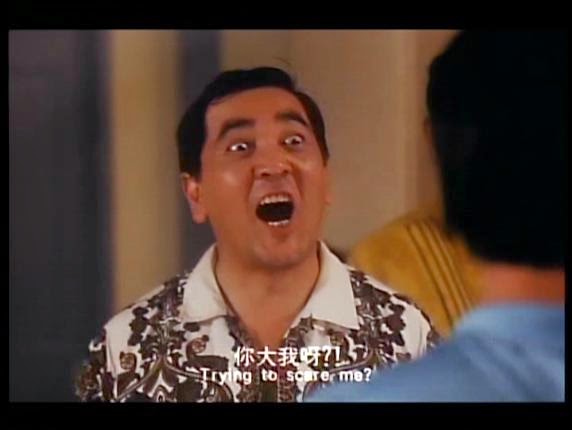
For this reason, I would like to offer Paul Chun's movie quote to this Mr. Fabio De Rosa, "TRYING TO SCARE ME?"