Showing posts with label Sino-Japan relationship. Show all posts

20150522

Maron: HKers Are Not Morally Obliged to Save Depraved Chinamen

Hongkongers Are Not Morally Obliged to Save Depraved Chinamen
Translated by Chen-t'ang 鎮棠, Edited by Karen L., Written by Maron (瑪倫)
Original: http://www.passiontimes.hk/article/03-15-2015/21757/ 


Gary Fan, Claudia Mo, Ray Chan, "Fast Beat", "Long Hair", James Hon, Raphael Wong Ho-ming.....these names were widely acclaimed a few months or few years ago, among all obfuscating pan-democrats. These self-dubbed "progressists" had perplexed some politically naive Hongkongers as if they can truly help.

These days, citizens have witnessed the pan-dems becoming "pan-fried democrooks" and have seen the mounting localist protests against parallel traders. Even though the restoration movement might not be as successful as expected, the localists have gained the public an upper hand of this battle, whereas these self-claimed "progressive" pan-dems took the credit of the favourable results and left the blames to localists.

What is behind localists' success? It is that the localists all know a cruel fact - "politics is showbiz for ugliness". Instead of getting "halo" or claiming credits, localists are pragmatic and emphasise efficiency - even at the expense of adopting extreme means. For the "Restoring Tuen Mun" social movement, the mainstream media have condemned the localists as severe as possible. But we localists are not going down because of it as we do know one thing - nothing is ever done by the pan-dems because they love sitting on the moral high ground and dodge immediately if being criticised. If it is useful in talking the talk, the valorous localists will never have to walk the walk!

Out of fear, the pan-dems have been avoiding conflicts. Take Umbrella Revolution as an example. Admiralty and Mong Kok are utterly two different worlds back then. Pan-dems were calling the shot in the Admiralty "Big Stage". Can weak flowers living in the greenhouse really be compared to the daredevils in Mong Kok? Leung Kwok-hung "Long Hair", a self-claimed revolutionist, has shown his true colours - a coward - since the valorous confrontational tactics derived in Mong Kok.

What Leung uses to do - hurling bananas or sending coffins to officials - is performance art after all, without a slight of influence. The conflicts between the pan-dems and the localists these days are exactly the continuation of the differences between Admiralty and Mong Kok.

I am a localist, and localists can be unscrupulous - I'm not ashamed to admit it. Why not indulging in the "love and peace" crap as the pan-dems do? Let's see what the Occupy Central movement ended up. Nosediving popularity in the end. And then what? There has been seen no coming back. Talking Chinamen into love and peace is merely casting pearls before swine given that it is their nature to bully the weak, fear the strong and nothing else. They will come after you once you show weakness in front of them.

Do remember what Lu Xun says, "We shall not be afraid of speculating Chinese people with the most malicious intent". Chinamen are not entitled to blame Hongkongers for being ruthless since they never deserve otherwise.

Some leftards might believe, "When you oppose devils, you become one of them." For the record, with the mission to protect our civilised city, we choose to treat Chinamen like barbarians - Barbarians will only be taken aback by acts of their kind. 

Localists dare to deal with Chinamen because there's no mind-shackles towards the suggestions by some "Greater China" faction, which are thoughts such as "the institution is the culprit" and "the party and the country are two separable concepts" so as to harbour their own kind. Leopard cannot change its spots. Even with a different regime, Chinamen are Chinamen.

Imagine the "the party and the country are two separable concepts" discourse stands. It would not be a problem if Japan does not apologise for what they have done in WWII. By this very logic, the Imperial Rule Assistance Association would have nothing to do with Japanese. Therefore there would be no need for today's Japanese to bear the responsibility back then. This logic itself proves what the kind of people Chinamen are. I wouldn't mind if Chinamen mutilate themselves with such retarded thought. But letting them to rule over Hong Kong? The answer is "No", a certain "No".

Democracy and China combined is the best example of Stockholm syndrome. If ever there is some so-called democratic China, it will not change the fact that Chinamen are born colonisers.

Let me ask you a question. If your neighbours have some family disputes, will you intervene between them? Lines are clearly drawn, so "No". Similarly, Hongkongers are not morally obliged to save depraved Chinamen. And the localists are going to kick them out of our home - by all means necessary - before it is too late.

20150513

Wing Wing: On Donation to China vs Japan

On Donation to China vs Japan
Translated by Chen-t'ang 鎮棠, edited by Kristee Q, written by Wing Wing (翼雙飛)
Original: http://www.passiontimes.hk/article/05-12-2015/22920 
(GBTimes; in Hong Kong, a citizen donates money to World Vision for Sichuan Earthquake in China)

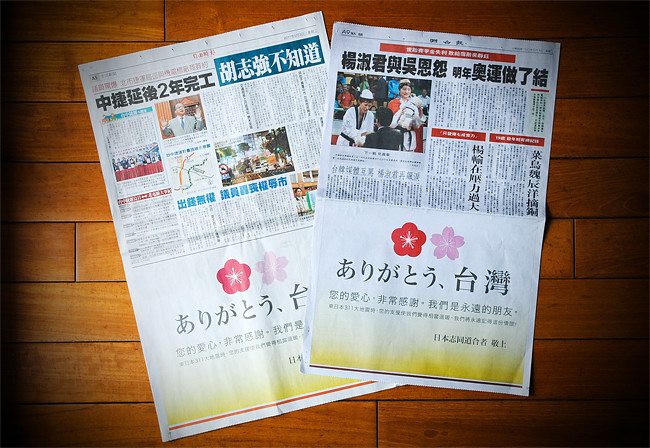
It has been four years since the 2011 earthquake in Japan. It had been a while since March, but whatthe Japanese did in that time was more than impressive. In June 2011, the Japanese thanked Taiwan by putting advertisements in two Taiwan newspapers thanking them for their efforts in the, earthquake. This year some Japanese NGOs expressed their gratitude by doing volunteer work in superman suits and last March a Japanese restaurant owner in Taipei gave out free curry rice for a week so as to thank the enthusiasm shown by the Taiwanese people.


Some people might say Japanese are over-pretentious as they predominantly show their polite side to others but on the other hand shouldn't we see this as a sign of being educated? To thank those who have helped his/her country in plight is a sign of politeness - putting the word "pretentious"aside, Japanese has won in terms of politeness. When a child receives a gift that he doesn't like much and he still thanks that person, would you say that he is pretentious? If he pouted and remained silent, or even made a long face, would you say that he was sincere and tell him "you don't have to thank others if you don't like the gift"? You simply wouldn't because thanking others is a form of politeness and virtue.

In China, during the Eastern China Flood and Wenchuan Earthquake (seven years ago), tears shed for their victims were uncountable in Hong Kong. Very many people donated their own money to help the flood victims and those who disagreed with such donations were condemned as "cold-hearted". But what have we got in return for our genuine distress and wish to help? Has any Chinese tourists thanked us for "giving a helping hand in our plight"? Are there Chinese putting advertisements in newspapers thanking us? No. Instead we hear of some Chinese tourists humiliating Hongkongers: "If it isn't us [coming], your Hong Kong is certainly doomed!" or "China has arisen, you Hongkong-dogs are jealous of us being rich!"

For sure, these people don't represent all Chinese but Hongkongers are being humiliated online and offline. How can people expect Hongkongers to donate when there are many charities raising donations for China? A decision to donate hinges on how the donor feels about the place and its people. I have a few words for those genuine victims: "Your compatriots are tirelessly zealous in humiliating those who have helped you. If they are so rich and powerful, can you really blame others not seeing the need to help you? Not to mention how much money has been pocketed during the donation process, after many Chinese charity scandals have been exposed."

Therefore it is not strange for Hongkongers to show unwillingness to donate to China.

Some "patriots" might say, "Are Japanese worth emulating? They have tonnes of problems, such as..." Certainly Japan has tonnes of problems, but why don't we learn from their positive attributes? If a nation only nit-picks at others and feels comfortable doing so without learning from their good points such nation will inevitably degenerate slowly but surely.

20141119

Yoyo Ko: Japanese and Chinese

Japanese and Chinese
Translated by Karen L., Written by 高慧然 (Yoyo Ko)
Original:http://hk.apple.nextmedia.com/supplement/columnist/%E9%AB%98%E6%85%A7%E7%84%B6/art/20141118/18938294 

I have received several letters from my readers since the publication of my article Japanese Is Indeed Different. Polarised as they are – Little do some question its side towards Japanese respect on lives, while others sailed into my opinion of the ignorance of Japanese cruelty on Chinese back in the day.

It is commonly known that most of the Chinese are killed by Chinese themselves, so does the brutality they are subjected to. 

As for the how, it can be traced far back to the Song state during the Spring and Autumn Period. By the time, commoners exchange their children for that of the others as a source of food, whereas in our modern history, nearly 100 years ago, there were blood-soaked steamed buns recorded by Lu Xun. [Translator's note: Lu Xun, a leading figure of modern Chinese literature, described in his work Medicine that people at the time believed steamed buns which were soaked with human blood could save lives. That is why some traded them for money.] If we look closer, examples one after another are there in front of us since the establishment of the Red China in 1949. 

Affirmatively speaking, to me, Chinese is never ever a nationality which knows how to respect.

There is a significant difference on the nature between Japanese and Chinese. It is not that Japanese will necessarily be nice to the others, but they will, to themselves. Chinese, in the opposite, they make 100% sure to treat their people badly.

"Even a vicious tiger will not eat its cubs" was an old Chinese saying. Yet ironically enough, Chinese had evolved to feel at ease digesting others' children and to comfort themselves, "at least we’re not having our own kid."  

You should not rest on the conclusion that Chinese has abandoned such beastly behaviour. Instead, they have transformed it – some sell contaminated milk formula, some sell poisoned vegetables, some sell gutter oil. 

For the sake of economic development, today's Chinese demonstrate devastation on the land, water and air leaving no chance of survival for next generations. Isn't it another form of utilization to satisfy their appetite by consuming the future?

This is not a normal Japanese would ever do.

20140728

Wing Wing: The Japanese Toilet and the Chinese Crap

The Japanese Toilet and the Chinese Crap
Translated by Vivian L., Edited by Karen L., Written by 翼雙飛 (Wing Wing)
Original: http://www.passiontimes.hk/article/07-26-2014/18058 


I am told that an article by the name "Beijing University Student Embarrasses Japanese Reporter" has been a hit on the web since it came out a few years ago. [Translator note: The article, originally written in simplified Chinese, began to spread as early as 2010 among blogs and social media in mainland China. It is presumably an interview between a Japanese reporter and a female Peking University student. The article comes with a subtitle that reads, "Without the use of a single swear word, the heroine snubs the Japs, winning applause of all".] But I only saw it today on Facebook. Though it could very well be a fabricated story, still, there's something in it that's worth talking about. Amount of truth aside, the fact that the article has been so popular in the Chinese blogosphere may actually shred some light on the Chinese frame of mind.

What catches my attention the most is this particular dialogue: On the question of boycotting Japanese goods, the reporter asks the 'heroine' whether she has ever used a product made in Japan. She replies, "Yes, a toilet." On the sound of "toilet", her fellow students burst into laughter.

I can't help but wonder what is so funny about Japanese toilets. It is just hard to fathom why fully grown and well educated persons would find the mention of bodily functions of pee and poo funny. I would suppose, "Ooh, you pooped! HAHAHAHA!!!" is something I expect to hear from an innocent preschooler or a babbling toddler, even. But university students? Seriously?

Funnier still, if, for the sake of argument, the Japanese reporter retorted, "Oh right, of course. Our toilets don't explode." One thing for sure, the "heroine" would have succeeded in making an exhibition of herself.

A Japanese bidet-style toilet
(source: Tzuhsun Hsu via Flickr)

But my friend Joe Gei disagrees, "Nah, sarcasm isn't a Japanese virtue. A real Japanese person would probably say, 'Domo arigato gozaimasu, dear madam, for your kind patronage to our craftsmanship!'" That's right, this might just add to the Chinese's humiliation.

The Beijing student might have assumed that making toilets is a disgraceful business and that using a toilet made in Japan would automatically bring shame and ridicule to the nation of Japan. But is it shame that is on the Japanese people's mind? It's perhaps anything but shame. The Japanese probably consider it a national pride that their exquisite technology has perfected toilet experiences of customers overseas. The business of making and selling toilets is probably something the Japanese are proud of. And they are rightly so. The Japanese toilet has now won over a wide fan base across the globe because of its superior quality.  But the Chinese mistake that being a customer of the Japanese-made toilet would humiliate its maker. They fail to realise that in doing so, the only people humiliated are themselves.

Back to the article. There is an idea carried throughout the piece—"Japanese runts are despicable":

The Japs don't face up to history. The Japs claim they own Diaoyu Islands? To hell with their crap! The islands have been a part of Chinese territory "since ancient times"! 

Watching the Chinese argue indignantly without any grounds is quite a spectacle. So China, go show the Japanese who's boss. Go to war with Japan! Economic sanctions at the very least!

Canon: Capturing every boycott Japan moment

But the Chinese way of intimidation is quite an unfortunate irony in itself. Pictured above is a Chinese anti-Japan protester carrying a Canon—a Japanese brand—camera around his neck. And earlier this year, the Japanese embassy in Shanghai issued a record high number of visas to Chinese nationals wishing to visit Japan. The latest statistics reveals that Japan has emerged as the most desired destination for Chinese tourists. There has even been an incident when a mob of Chinese holidaymakers became so busy stocking up Japanese brand rice cookers at the Kansai International Airport souvenir shops that more flights back to China had to be delayed.

When Lu Xun's Ah Q gets beaten by random strangers, he says to himself, "A son beating his father. What the world is coming to nowadays!" This is Ah Q's way of achieving "spiritual victories".

The Chinese take it to the next level. When the Chinese feel "provoked" by the Japanese, they gnash their teeth in frustration and make up this so-called "interview" to feel good about themselves—as if in a kind of psychological masturbation—and delude themselves into a delirium of superiority. So the Chinese retaliate,  "What is the big deal about these Japs? They are nothing more than toilet makers. Look at me, it is I who poo on your toilet. Take that, you runts!"

More than 80 years have lapsed since Lu Xun's time, but the spirit of Ah Q lives on ever more vivaciously in the great nation of China.

Further reading:

(Note: The issues of toilets are in fact a serious matter. The World Toilet Organization (WTO) holds yearly summit to address the subject of toilet and sanitation. Members of the WTO come from 177 countries. The WTO has organized World Toilet Expo around the world in countries such as India, Singapore and South Korea.)

The World Toilet Organisation:
http://en.wikipedia.org/wiki/World_Toilet_Organization

The World Toilet Summit 2013:
http://worldtoilet.org/media/photo-library/library-details/?paged=World%20Toilet%20Summit%202013