Showing posts with label Discrimination. Show all posts

20150513

Wing Wing: On Donation to China vs Japan

On Donation to China vs Japan
Translated by Chen-t'ang 鎮棠, edited by Kristee Q, written by Wing Wing (翼雙飛)
Original: http://www.passiontimes.hk/article/05-12-2015/22920 
(GBTimes; in Hong Kong, a citizen donates money to World Vision for Sichuan Earthquake in China)

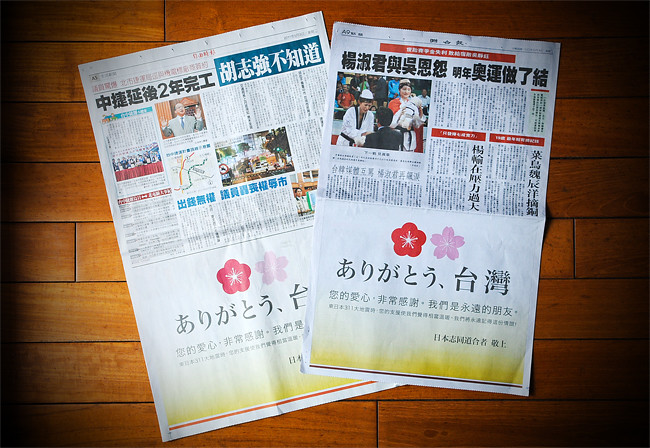
It has been four years since the 2011 earthquake in Japan. It had been a while since March, but whatthe Japanese did in that time was more than impressive. In June 2011, the Japanese thanked Taiwan by putting advertisements in two Taiwan newspapers thanking them for their efforts in the, earthquake. This year some Japanese NGOs expressed their gratitude by doing volunteer work in superman suits and last March a Japanese restaurant owner in Taipei gave out free curry rice for a week so as to thank the enthusiasm shown by the Taiwanese people.


Some people might say Japanese are over-pretentious as they predominantly show their polite side to others but on the other hand shouldn't we see this as a sign of being educated? To thank those who have helped his/her country in plight is a sign of politeness - putting the word "pretentious"aside, Japanese has won in terms of politeness. When a child receives a gift that he doesn't like much and he still thanks that person, would you say that he is pretentious? If he pouted and remained silent, or even made a long face, would you say that he was sincere and tell him "you don't have to thank others if you don't like the gift"? You simply wouldn't because thanking others is a form of politeness and virtue.

In China, during the Eastern China Flood and Wenchuan Earthquake (seven years ago), tears shed for their victims were uncountable in Hong Kong. Very many people donated their own money to help the flood victims and those who disagreed with such donations were condemned as "cold-hearted". But what have we got in return for our genuine distress and wish to help? Has any Chinese tourists thanked us for "giving a helping hand in our plight"? Are there Chinese putting advertisements in newspapers thanking us? No. Instead we hear of some Chinese tourists humiliating Hongkongers: "If it isn't us [coming], your Hong Kong is certainly doomed!" or "China has arisen, you Hongkong-dogs are jealous of us being rich!"

For sure, these people don't represent all Chinese but Hongkongers are being humiliated online and offline. How can people expect Hongkongers to donate when there are many charities raising donations for China? A decision to donate hinges on how the donor feels about the place and its people. I have a few words for those genuine victims: "Your compatriots are tirelessly zealous in humiliating those who have helped you. If they are so rich and powerful, can you really blame others not seeing the need to help you? Not to mention how much money has been pocketed during the donation process, after many Chinese charity scandals have been exposed."

Therefore it is not strange for Hongkongers to show unwillingness to donate to China.

Some "patriots" might say, "Are Japanese worth emulating? They have tonnes of problems, such as..." Certainly Japan has tonnes of problems, but why don't we learn from their positive attributes? If a nation only nit-picks at others and feels comfortable doing so without learning from their good points such nation will inevitably degenerate slowly but surely.

20140918

Wing Wing: "Flunkies of British" and "Noble Chinese Citizens"

"Flunkies of British" and "Noble Chinese Citizens"
Translated by Chen-t'ang 鎮棠, Edited by Vivian L., Written by 翼雙飛 (Wing Wing)
Original: http://www.passiontimes.hk/article/09-18-2014/18844 

(Photo: PassionTimes)

A few days ago, I saw a piece of news on CableTV: There is a shortage of regular ambulances in China, so there are many "illegal ambulances" sending patients to the hospital. These ambulances are owned by private operators, and passengers have to call them and PAY for their service. By saying "sending", I mean, these ambulances are merely metal boxes on four wheels with hardly any life-saving equipment. It also reported a deadly incident where the gas pipe of an "illegal ambulance" was broken, leaking carbon monoxide and killing all four passengers on board.

Many Chinese often say, "We China have stood up!", and criticise HKers: "You don't see yourselves as Chinese, but often mention Britain and so on... Haha! You are all flunkies of British people!" True indeed? We "flunkies" enjoyed one of the best ambulance service in the world under British rule. We do not need to bribe ambulancemen before using an ambulance. Patients would not have their oxygen pipes removed and be kicked out of the hospital if they could not afford the fees. We do not need to pay "red packets" to doctors and nurses before having doctors' and nurses' care.

True, before 1997, the British were somewhat privileged, but they also satisfied the basic needs of grassroots. Hawker centre, Dai-pai-dongs (cooked-food stalls), and shopping centres in housing estates used to sell food and daily necessities at affordable prices. Those public facilities were also places where grassroots gathered. Public housing estates built in the colonial era had sufficient spaces, adequate ventilation and good daylight-capturing, making homes comfy. Since the 1970s, six years of free education had started in HK, and was expanded to nine years in 1980s. No matter how poor you are, as long as you excel in school, there are all sorts of public funds, subsides and scholarships to help you along. Eventually you can be successful.

Even the rights of poorest people among the "flunkies of British people" were respected. With the living environment and basic needs were well cared for, people could move upward and be socially mobile. But what about these "Noble Chinese Citizens"? They have to bribe their way to an ambulance when their lives are in jeopardy; rich people cannot get hold of safe infant formula in China for their young; those who protect their homes will be ran over by bulldozers because they are "obstacles to development".

Whatever names they have for us, be it "flunkies", "dogs", or "bastards" -- a fact is still a fact: who would rather be a "Noble Chinese Citizen" if they can choose on their own?

20140913

Wing Wing: Not Emulating Virtues nor Introspecting Oneself

Not Emulating Virtues nor Introspecting Oneself
Translated by Chen-t'ang 鎮棠, Edited by Karen L., Written by 翼雙飛 (Wing Wing)
Original: http://www.passiontimes.hk/article/09-12-2014/18788 


(Photo Source: Steve Harris via flickr)

Steven, a Shanghainese, went to Sydney, Australia to start his café this year earlier, and recently posted a hiring ad for barista on newspaper. Nilson, a Australian citizen who has lived in Sydney for 9 years, went to apply. Steven said he would not hire Nilson given the fact that Nilson is black.

Followed by media's spread, Australians started to boycott this café. There were some other friendly bosses who invited Nilson to work for them. It is learnt that the Fair Work Ombudsman's investigation is underway right now. And Steven's business was suspended a week later that incident.

I once wrote about this incident (translator's note: attached is the translated version for English readers). This article received a comment below that catches my attention:

"Weird enough. It seems like there's no Chinese be discriminated ever. Why is it a problem when Steven doesn't want to hire someone black? He is a boss. Surely he has to think for his business. As long as he doesn't disclose his opinion, it's fine. Overseas Chinese are often being discriminated, yet who pays attention?" (Translator's note: The source text is in Simplified Chinese)

Confucius once said this: "seeing a man of virtue, I try hard to become his equal; seeing a man without virtue, I examine myself to have not the same evil in me." In other words, we should improve ourselves and learn from good role models, rather being tainted in terms of bad habits and attitudes.

However this reader applied Confucius's words upside down as "seeing a man without virtue, I try to become his equal; seeing a man with virtue, I examine not".

For the first half of the altered version, proof is as such: the phenomenon that "overseas Chinese are often being discriminated" is certainly not a delighted issue, whereas he stands, in the point that "People do bad things. It's reasonable enough for me to act the same". Exactly the opposite of Confucius's moral philosophy as I mentioned earlier.

He then added, "what's wrong of Steven for not willing to hire black people? It's a must for a boss to value one's own business." As I mentioned there were café owners inviting Nilson to work there, I can't help but wonder if there's one and only one café in Australia and solely Steven alone as a boss in the whole nation to that reader's world view. Seeing no discrimination from others to Nilson, this reader rather made up an alibi for that Steven to justify what he have done, but not reflect upon his own attitude towards the issue. Above, it fills also the blank of proof of the second half.

Where does this reader come from? I mean, if one learns from the culture of his/her own country.

Imagine if the logic in argument exists as a normality in his nation, that land must have been hell. Elaboration will be that the more the nationals get exposed to other nation's unhealthy behaviours and attitudes, the higher the chance they will imitate them, while the good ones to them, fairly or even exceptionally, won't inspire a slight introspection, let alone to be treated as moral study object. Eventually, followed the plot, it's inevitable for the story to lead a complete dark page filled with despicable means. By that time, kindness and righteousness, what we regard as good qualities one should possess, can never be found from a single person.

20140828

Lai: How Did I Get on The Nerves of Postgraduates from Mainland China

How Did I Get on The Nerves of Postgraduates from Mainland China
Translated by Carmen Li, Edited by Karen L., Written by 黎德怡 (Lai Tak-yee)
Original: http://www.passiontimes.hk/article/08-20-2014/18424/


(Source: China.com)

Recently, I have consecutively published three articles about some ridiculous behaviours of postgraduate students from mainland China 7 years ago when I was teaching Master of Arts in English in the Chinese University of Hong Kong ("CUHK") as a visiting professor. Some readers asked me what explicitly I had said to trigger mainland students' anger in the lesson. To respond to this, helplessly, all I can say it's that I was too ill-starred to escape from the group of over-sensitive mainland students, of whom are easily offended.

In one of my lessons, rarely, there was one short Chinese article among the English materials. That time, I prepared also traditional Chinese version along with the simplified one as a translation reference for the few Hong Kong students in class. I showed on the PowerPoint first the traditional Chinese version and then the simplified version. It is always a safe bet to be thoughtful of students' needs, even there was a slight confusion in my head that it might be a redundant move as mainland students who have had higher education would have learnt traditional Chinese.

When I look back, the dissatisfaction on me then might had been generated by my displaying orders. I still remember to the day after the lesson, some students came to me. The Hong Kong students spoke in Cantonese, so I did that same. And with those from mainland China, we spoke in English, which I assume as a normal case as that was an English course. Supposedly speaking in English wouldn't be counted as an offence to mainland students, however, on an ordinary school day soon after that, I overheard one student from mainland China who grumbled about me, "She doesn't even speak Putonghua!" It appears to me that even if I spoke in Putonghua, it’s possibly of me being charge of "no awareness of precise pronunciation”. Doesn't it make sense?

The second bomb was The Good Women In China, a famous book written by a British-Chinese author Xue Xinran, narrating several extraordinary life stories of common modern women facing disasters such as Cultural Revolution and Tangshan Earthquake. Rumour has it the book is still on the blacklist of China's book censorship, whereas I believe not all mainland Chinese are blocked outside the wall.

The whole piece, filled with soul-touching incidents, is a glorification of Chinese women, driving me to add it to my teaching materials. Even so, I have my consent on the potential existence of credibility gap towards it, therefore I would prefer students to treat it as literature focusing on the analysis of its narrative methodology and the image the author has built in her work. Still, I wouldn't survive myself from the hatred.

For that, I did regret of channelling this into my teaching materials. In the meantime, invaluable as this type of work is, especially for mainland students given that it's short in China, I have fews question on my mind: Isn't it a precious opportunity to acquire out-of-the-way insights? What's the point choosing some mainstream works whoever could get access to? How would it be if CUHK was to open a course directing to 4 June imitating Harvard University? Could these mainland students with such narrow-minded stand it?

As for the third issue, it was about Hong Kong Culture. The first to be discussed, was, and is the 1997's changeover of sovereignty. It doesn't necessarily relate solely to Hongkongers, but also mainlanders. Yet, clearly it was there the dissent over my thought seeing their poker faces in that lesson. But then through some certain channels, I was able to know what their poker faces interpreted. It turned out to be a matter of translation: They thought "hui-gui" or "return" should be adapted instead of "changeover" or "handover".

And they did not agree my usage of "nostalgia" when it came to the connection between Hongkongers' identity and their "nostalgia" discussing Hong Kong's political culture. Their stand were as such: What’s worth nostalgia? Hong Kong has already been a part of China, which is supposed to be for the whole time. Isn't it a great honour returning to motherland's embrace?

I can say it's a practical lesson I'd had experiencing what precisely erasement of freethought is, rubbing out even the right to owe one's favourite. I mentioned in class once towards my yearning of England, where I had been receiving education and had lived for some time. Back then this sort of affection stood for no political implications. Instead, it is more than normal for someone who had stayed in somewhere a long time to establishing belongingness and favourable sentiment, however, it brought on contempt unexpectedly. I was told that in their minds, I was living in the the good old days, refusing the reality that Hong Kong belongs to China. Worse still, cherishing England somehow be distorted as indirect and symbolic belittle upon them.

Fast forward to today, the HK-China relationship has worsened. And my fond feelings towards England has grown stronger. To the politicalisation trend, let me catering it a bit with a realistic metaphor which might be seen vulgar to some educated: England back then was like bad lover conquering the love of a inexperienced village girl Hong Kong. His richness in manner and knowledge turned the girl's unwillingness into motivation to upgrade herself as a lady. Enjoying the bad lover's company, the lady doesn't care if the man truly loves her or not even he has generally faded his charm. As for mainland China, it's like a redneck who has brought solely insults followed by invasion.

No matter what the future of this lady leads, thanks to the Qing government's contribution which blossomed her beauty, I am, and will be keeping on my blessing over the sea.

20140819

Wing Wing: A New Immigrant Boss Who Discriminates Against Locals

A New Immigrant Boss Who Discriminates Against Locals
Translated by Chen-t'ang 鎮棠, Edited by Karen L., Written by 翼雙飛 (Wing Wing)
Original: http://www.passiontimes.hk/article/08-19-2014/18411 

According to a news report from Daily Mail UK 2 days ago, a newly immigrated Shanghainese, who referred himself as Steven, started his café business "Forbes and Burton" in Sydney, Australia, earlier this year. A while ago, he posted a hiring ad for a barista.

Nilson, a Brazilian-born Australian citizen who has lived in Sydney for nine years, came to apply for the job. Yet, in the job interview Steven told Nilson clearly that for the fact that Nilson is black, Steven would not use his talent here.

The owner also expressed his bias thought that white customers would not like coffee made by black people. Straight away, Nilson told everyone in the café what he just experienced. Feeling disappointed and disgraceful of that hypocrite owner, the customers came beside Nilson and comforted him. After that, they left the café right away with outrage, saying they would not patronise the shop anymore. One of the staffs even resigned immediately.

The issue haven't end yet. These people went on the café's Facebook page and called for a boycott. There are also replies from other cafés which invite Nilson to work for them.

What surprise me the most of this whole issue is this Chinese owner Steven. Becoming one of the citizens in this land of which hails civil rights, he hasn't suited himself in.
Steven the New Immigrant Boss (Photo source: Daily Mail UK)

Steven might have thought owning a café in Australia represents his diligence and perseverance. But above all, he has not been contemplating the opportunity given by the acceptance of many Australians before. What if the Australians discriminated against Steven as being yellow, and chose not to go to his shop? Unless they express clear offense, it's their own freedom to go elsewhere, however it had not been the case for Steven.

But look at what Steven do. Flagrantly, he discriminates. Rejecting an applicant because of one's race, he did not bother to come up with an excuse that sounds less unreasonable. 

No matter Steven is a white, a yellow or a black person, he shall not be discriminated based on his colour. And he himself shall not discriminate against others as the same ground. Australian law protects Steven from being discriminated of his race, but then he hasn't practised it putting aside his obligation and empathy.

It's known that to successfully secure an Australia visa, foreign businessmen need to run the business for two years just as Steven's case. Though it's fair enough if the Australian government deprives his application because of this issue since no society is willing to accept ungrateful new immigrants who trample on others' rights relentlessly rather than citizens whose conducts are in line with the country's standards.

20140818

Jacky Lim: Why Are There Indian-like Faces Among The Group of "Huizhouese" and "Fujianese" Countrymen?

Why Are There Indian-like Faces Among The Group of "Huizhouese" and "Fujianese" Countrymen?
Translated by Chen-t'ang 鎮棠, Edited by Karen L., Written by Jacky Lim (林鴻達)
Original: http://jackyhtlim.blogspot.hk/2014/08/southasianhuizhouhokkian.html 

The so-called "10,000 people Run" in yesterday morning was merely a start. The joke hadn't entered the climax stage until the rally ― which I prefer to be named as The Distribution Session of "Wei Wen" Fund (translator's note: "Wei Wen" is a chinese political term meaning stability maintenance.)― started. Proofs are the following two virus-like photos spreading on the Internet.


"HKers belong to Chinese" isn’t the only byword of
commies' standpoints, but combined with "HKers are born yellow race with black hair naturally like Chinese" condition. So I wonder how this sudden, they would regard Indian-like persons as Huizhanese or Fujianese ― one of their kind?

Here I'm not going deep discussing the neglect of interests leftists and commies have posted on the South Asian ethnic groups in Hong Kong under the incandescence of HK-China conflict, but rather, why would some of the members from the racial minorities fall for this trap.

As I assume, money can be one of the factors. Yet for long enough, even these South Asians, like Indians, Pakistanis, Nepalis and Bengalis have developed living in Hong Kong for generations, majority of Hongkongers with yellow skin and black still look at them through coloured spectacles. Instead, they have built a self-reliant ability in them trying hand to integrate into the local community and hoping that one day they will be accepted by the ethnic Chinese group from the heart.

Comparing with them, new immigrants from mainland China, those bloodsuckers on the contrary, knows only to grab the local social welfare and resources. What is more, they demand assimilation of ideologies and values from Hongkongers by saying aloud "What’s the matter? We are interrelated! We are both Chinese after all!"

It is reasonable to deduce that due to the neglect, not all of them receive the whole picture of Hong Kong's society, which directly affects their blind decisions yesterday without questioning, bearing in mind purely the desire to live in acceptance. Judging from the report of Oriental Daily News, we know that some of them don't even know what those words on placards mean. That's why we can make such a conclusion that rather than calculating, they seem to be falling into commies trap this time.

If we look it up in our history, we may find South Asians' vast contribution to Hong Kong in various fields since 1841 ― the earliest days of Hong Kong. Nabela Qoser (reporter in TVB), Raees Baig (scholar), Gill Mohindepaul Singh (comedian worked for TVB) and the owners of Holiday Inn Golden Mile ― Harilela families, are rather well-known throughout Hong Kong, but these are not the only examples.

Policemen in the early 20th century, soldiers seconded for protecting Hong Kong in WWII, and Gurkhas (who were responsible in guarding the frontier), or even guards standing in front of the Hang Seng Banks and delicious curry cooks served in Chungking Mansions… For all of them who patiently and devotedly make good of Hong Kong's bright future, it's time for us to reflect upon the possible origin of the issue that these good persons might have been used for political aims ― our coldness towards them.