Showing posts with label China. Show all posts

20190225

Lewis Loud: Love for China Complex

Love for China Complex
Translated by Karen L, edited by Chen-t'ang 鎮棠, written by Lewis Loud
Original: https://thestandnews.com/politics/%E4%B8%AD%E5%9C%8B%E6%83%85%E7%B5%90%E7%B3%BE%E7%B5%90%E7%9A%84-%E9%96%8B%E6%98%8E%E6%B4%BE-%E5%8F%AA%E6%9C%83%E5%8A%A9%E9%95%B7%E4%B8%AD%E5%9C%8B%E6%AE%96%E6%B0%91/ 

During the winter peak flu season, Hong Kong doctors called for the abolition of the one-way permit scheme, as the family reunification (which allows 150 mainlanders to settle here daily) has overloaded the city’s health care system. It was not to incite hatred against mainlanders, but to voice discontent with manpower shortage.

It is expected to see organizations specifically serving new arrivals from China against the advocation of the medical staff, as well as to see some of the leftists take the opportunity to suggest importing more manpower from China.

Those fence-sitters could get along so long as the policy does not screw them over in a rather direct way. Most of these people choose to accept what the reality offers (the overcrowding problem in Hong Kong) however unpleasant it is, for it is a hot potato for anyone while turning a blind eye to it requires no effort.
("To reduce immigrants at the source." Gary Fan,
Claudia Mo, Roy Tam and Chapmen Tsang in front.)

The overpopulation caused by mainland migrant influx has been left unresolved for years. Early in 2013 when New Territories was first overrun by parallel traders, acrimonious debate over ‘cutting people from the source of immigration’ had divided the pan-democracy camp. Gary Fan, Claudia Mo and Roy Tam proved themselves non-rubber-stamped as they saw through the ‘family reunification’ presents the ideology placing mainland Chinese before anyone else. In other words, it is Chinese nationalism/patriotism.

From the 1989 Tian'anmen Square protests to the status quo, the development of Hong Kong politics has attached to ‘the love for China’. Though it is high time politicians on people’s mandate should break silence over the deadlock Hongkongers are facing, they could not preserve our Hong Kong if it means to upset mainlanders. Hongkongers’ well-being is long forgotten; all we hear nowadays are concerns about “this is just what the CCP hopes for” or “that would provoke the CCP”.

To pro-Beijing camp, the inflow of one-way permits holders serves the crucial purpose of national security to assimilating Hong Kong into China. Sharing the “general consensus”, pro-democracy camp tends to stand on the moral high ground, emphasizing how inhumane to compromise Chinese people’s benefits. If it occurs to you that actual allocation of resources is not included in the equation, it is because the camp has never been given real power to rule. The shady past of the “democracy campaigns” presupposes a conflict with local people and their interest. Though at the very inception it was the prospect of a democratic China that motivated them, there from the process derives the community rooted for Hong Kong itself which now comes to stand in the way of these Chinese nationalists. The beginning should predict the ending.

In this context of history, a Chinese idiom precisely describes pan-democracy camp’s political standing. Translated into “be spat on the face and let the spittle dry”, it suggests their fate-resigning mindset under Hong Kong’s political reality mingled with the “Chinese” self-identification that hails CCP in trusting it to be orthodox for the conception of China. Thus it explains why many of them are not convinced that Hong Kong is being invaded at the time of speaking, and is going to be handled as another Xinjiang, Tibet and Mongolia. It can also be found in them the chauvinism that generalizes neighbouring countries that can be traced back to the same ancestry to a part of one great China, the prerequisite of disapproving Hong Kong Independence by all means, and so forth.

Career politicians in Hong Kong are acquainted with the fact that crying out for “democracy” and “human rights” keep their seats; at the least such statement would not get them disqualified from the elections. Despite the former has no foreseeable future, the latter, namely Chinese migrants’ human rights, can be satisfied almost effortlessly with the solicitous help from pro-Beijing camp. Cases in point abound in public housing, social welfare, and this time medical services. Their love of China was respected during the colonial period, but with resources taken into account today, it has turned them into accomplices to exploiting Hongkongers’ welfare to the full. 

Under British rule, we used to honour democracy, freedom and human rights. Common virtues as such, sadly, have been rendered to some classic textbook examples in Critical Thinking 101. Sooner or later, the magic of verbal fallacies will fade and inevitably those “democracy-oriented” politicians’ influences will be overridden by their hardcore loyal pro-Beijing counterparts. A tragedy it is, but a sure price to pay with neither genuine Hong Kong identity nor support from China.

20170305

Cheng Lap: Why Do We Need Our Country?

Why Do We Need Our Country?
Translated by Peggy, edited by Chen-t'ang, written by Cheng Lap
Original: https://sosreader.com/why-you-need-your-own-country/ 


There is something we always cherish. Unfortunately, we cannot protect them alone. Yet, we want to protect them as best as we can. That is the reason we need our own country. If the country cannot protect what you value, that is not your country. 

There is something one always value. They can be our life, our family, our home, our property, our privacy, our freedom of action and speech, our interest in land and our language, our culture, our religion, as well as our collective memory and our lifestyle. 

We always want to live in a stable environment. We want to speak in our own mother tongue. We also want our friends and relatives speaking in mother language. We want our life are adequately protected. We can live in a safe and comfortable home. We can eat what we like to eat. We can earn a living and enjoy leisure. We want our belief and religion are respected and passed on. 

We want to preserve the films, the books, the places and shops that we encountered at our young age. And we hope they are still there when we are old. We want to provide support for our elderly. Although our memories are fading, we still hope they can become legacies. Although life is short, we still hope all the good memories can last much longer than our life. They can last forever. They can tell the times we live and the culture we share. And they will not be all gone and forgotten.  

From wealth to feeling, emotion and memory, these build our “own self”. They are integral to our life. If they are lost, we will be really upset. That is why we do not want to lose them because they are so important to us. 

If we are alone, we are weak. We do not have enough power to protect things we value. Our life will be endangered by violence. Our property will be usurped. Our freedom will be lost under fear and threat. Our native tongue will be losing slowly if we lose control of education and media. 

These are the things we want to protect. Unfortunately, we cannot protect them alone. Yet, we want to protect them as best as we can. That is the reason we need our own country.

 “Our country” is the institution that is established to protect these things we value. Law exists to protect our life and property. Education passes on our mother language and custom to the next generation. Constitution protects our freedom and rights. Country gathers the power little by little from every one of us. It can be in term of tax or duty. In return, the country protects things we cherish, and enable our lifestyle to continue, develop and last forever. 

You may think that “your nationality reflects your country”. But that is just wrong. If the country does not protect things you cherish, it is not your country. You are just ruled by a country that you don’t belong to and you are only subject to its authority. 

Another country might have very good governance, but after all it is not your country. You may emigrate to a developed Western country. However, if your mother tongue is not the official language there, it is hard to ask them to protect and promote your mother tongue. 

If there is a country that despises your mother tongue, and it even deprives you of your property, threatens your life, destroys your family, eliminates your culture and belief, smears your collective memory, makes you feel unsafe and deprives you of the freedom, that country is not your country even you hold the citizenship of that country by birth. Unfortunately, you are just a slave without dignity. You are like consumable resources that can be sacrificed anytime. 

You are weak and you need to be protected. That is the reason you need your own country. If you do not have your country, you have no dignity. The things you value will not be protected. Even you are obedient, you are doomed to have miserable life and live sadly at old age. 

You need a country. Country exists because it is responsible to you.

20151012

Sing Tao Exclusive: Fake Nun's Secular Lives - Fake Marriages, Private Cars, iPhone 6

Fake Nun's Secular Lives - Fake Marriages, Private Cars, iPhone 6
Translated by Chen-t'ang 鎮棠, written by Sing Tao Daily
Original: A & B

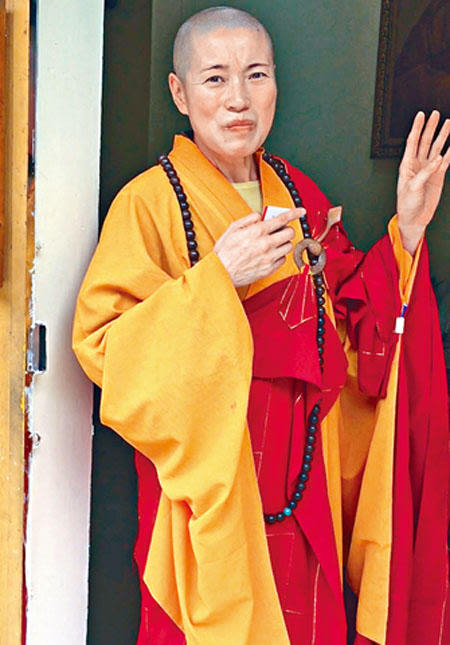
With over a month's investigation, Sing Tao has found out the female chief of Ting Wai Monastery (in Ma Wo Village, Tai Po), Shi Zhiding, had two marriages with mainland monk, in order to help them to gain Hong Kong identity cards. One of them, Ruzhi, has obtained a monk name, Shi Zhiguang, given by Po Lin Monastery in Ngong Ping, after such marriage with Shi Zhiding (or Lung Yan-loi, in secular name) in 2012. Shi Zhiguang has since become the Karma-Dana (General secretary in commoner's word). Marriage between nuns and monks is not only severly against Buddhist rules, but also another way to provide a way for China monks to stay in Hong Kong. She has also been found out that her lifestyle is extravagant, and the accounts of such monastery is but a mess.

Shi Zhiding was born in 27 October 1967 in Jilin Province, China, with her secular name as Shi Aiwen, and became Lung Yan-loi in 1993. She obtained Permanent Residency in Hong Kong since then. She told the media that she became a nun in 1997, but according to the documents in Po Lin Monastery, she became a nun in 2002, and has since become the chief, monitoring over the institution.

According to the Marriage Registry, Shi Zhiding was married in 17 August 2006, with Liu Jianqiang, a 23-year-old merchant. Liu was given a monk name as Shi Zhiqiang after their fake marriage. On such marriage certificate, they said they live in a public housing estate apartment in Tai Yuen Estate, Tai Po, with 2 wedding witnesses who believed are locals.

Shi Zhiding had some telephone conversations with Mary Jean Reimer, a director in Ting Wai Monastery. In which Shi Zhiding admitted twice the fake marriages with Shi Zhiqiang and Ruzhi, and said "I am in fake marriages, do not call the police", "They have obtained HKID cards, you can call the police. It's convenient to others and myself. It is good to be convenient to others, as they work in Po Lin too, and they can provide more comfort to my master (Shi Chuhui, who then lived in Po Lin Monastery). I am not asking Po Lin to give me more money nor asking you more."

Shi disclosed details, too: "Elderly people smells badly because of their urine, and they stink after not bathing for a few days. He was sitting on a chair, and I helped him bathing. He suffers from diabetes, and I dare not to use shower gel, and I use a glove to give him a shower. I took care of the master before, then the one who got HKID card by fake marriage did so. $3,000 a month and to bath for master. Zhiqiang couldn't stay in Hong Kong before, but when he got those ID documents, he helped the master taking bath every day. Master was happy, as if he was a kid."

Sing Tao reporters went to Ting Wai Monastery in 28 August this year, where Shi Zhiding denied of having any sorts of marriage in Hong Kong or China, and retorted by asking why the reporters have to delve into this. That day was having an Obon ceremony, and many Mandarin-speaking monks were chanting. Shi Zhiqiang, the "General Secretary", refused that he is Shi Zhiqiang, and refused to answer all questions from Sing Tao.

After seven years of such marriage, Shi Zhiding and Zhiqiang immediately divorced soon after Zhiqiang obtained HK Permanent Identity Card. Zhiding, who was then 45, married a 38-year-old male teacher, Ruzhi as a "divorced person" in 29 October 2012. They said they live in Classical Gardens, Tai Po. Ruzhi is in turn a monk too, with a secular name Gao Wuguo. He was later given a monk name as Shi Zhiguang by Po Lin as Karma-Dana as well, and "has a high status in the monastery".

During such investigation, Ruzhi (or Shi Zhiguang) has packed his luggage and left Po Lin, and seemed wanting to cut ties with Po Lin. Shi Zhiqiang, the first "husband" of Shi Zhiding, travelled back and forth China and Hong Kong. Most of the time he lives in China except having ceremonies in Hong Kong.
Karma-Dana needs to maintain the law and order within the monastery, and needs "leading morning and evening prays, leading other monks, giving lectures, and chanting charms".
===
Shi Zhiding became a different person after evening. Nearly every night, she returns to the resort in Beverly Hills, Tai Po, on a 7-person-car driven by a male driver, and returns to the monastery in the morning. Shi claims she became a nun in 1997, but actually was in 2002, according to formal documents. She did not perform daily Buddhist duties, but rather, dine out, and even went to a 5-star-hotel and enjoy delicious food, only putting meat aside and eat them all.

According to the Land Registry, the House in Boulevard du Lac, Beverly Hills, Tai Po, was bought by her "disciple", Wang Hui with HK$39.5 million in December 2012. Shi Miaohui, or in secular name Wang Hui, came from China too. She was married and had a pair of daughter, aged 5 and 9. She needs to seek help and get medicines from a psychiatrist. Shi Zhiding said in the phone conversation, "I gave the money to her, she didn't even know how to be a person. She didn't even have the money to have ceremonies for her parents, not even HK$100."

The daughters of Shi Miaohui would sometimes visit Shi Zhiding with the 7-person-car in Ting Wai Monastery. She often talked about selling the house in Beverly Hills with Shi Miaohui.

Ting Wai Monastery was an institution with over 100 years of history. With dilapidated appearance with infected by termites, the monastery has a mouldy wall and broken tiles on the floor. But those who have visited the room of Zhiding said they have seen Shi Zhiding has a nice room with 9 wardrobes of different sizes and a shelf with different skincare products. She also has a private bathroom and all her furnitures are mahogany, an expensive kind of wood. There is a 4-feet king-size bed with a quality mattress, worth of over HK$90,000.

According to their photos and videos, there is a notice of "There is Big and Small Treasure inside, please be aware and close the door". Big and Small Treasure are two female dogs owned by her. The air conditioner will be on 24-hour for them to enjoy. There are wigs and secular clothes and dresses, French skincare products and over a dozen Clarks shoes. What's more, a hairdryer.

Sing Tao reporters have tailed her for her lifestyle. She hopped on a 7-person-car on 20th and 21st September and the male driver drove her to Beverly Hills. They went together in the house, and she returned to the Ting Wai Monastery at 8 am next morning.

Shi Zhiding seldom has dinner in the past three weeks. Most of the time she ate with Shi Miaohui to nearby restaurants. 3pm, 23 September, Zhiding and Miaohui went to Sha Tin to buy a new mobile phone and had afternoon tea together, and returned to the monastery at 6:30pm. A car, EH 7××, registered by Chan Kai-yuen (and his wife), carried Shi Zhiding to the five-star hotel in Harbour Grand Kowloon in Whampoa, with another monk.

Shi Zhiding has a wonderful life if there is no ceremonies. After returning from Beverly Hills to the monastery, she will continue sleeping. When she's up in noon, she would go shopping and afternoon tea with Miaohui and even buy iPhone 6. She even demanded to install Mac computers in the monastery. Her lifestyle didn't fit the Buddhist rule.

According to the observation from Sing Tao, she was often carried by a Mercedes-Benz (RN75××) or BMW car. Often she was carried by a male driver without any company. 

20150513

Wing Wing: On Donation to China vs Japan

On Donation to China vs Japan
Translated by Chen-t'ang 鎮棠, edited by Kristee Q, written by Wing Wing (翼雙飛)
Original: http://www.passiontimes.hk/article/05-12-2015/22920 
(GBTimes; in Hong Kong, a citizen donates money to World Vision for Sichuan Earthquake in China)

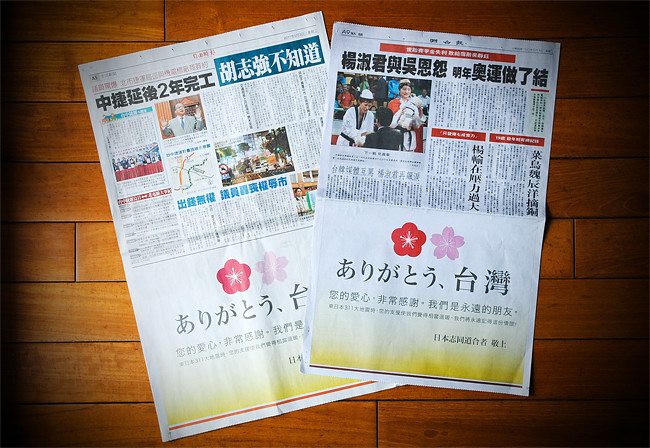
It has been four years since the 2011 earthquake in Japan. It had been a while since March, but whatthe Japanese did in that time was more than impressive. In June 2011, the Japanese thanked Taiwan by putting advertisements in two Taiwan newspapers thanking them for their efforts in the, earthquake. This year some Japanese NGOs expressed their gratitude by doing volunteer work in superman suits and last March a Japanese restaurant owner in Taipei gave out free curry rice for a week so as to thank the enthusiasm shown by the Taiwanese people.


Some people might say Japanese are over-pretentious as they predominantly show their polite side to others but on the other hand shouldn't we see this as a sign of being educated? To thank those who have helped his/her country in plight is a sign of politeness - putting the word "pretentious"aside, Japanese has won in terms of politeness. When a child receives a gift that he doesn't like much and he still thanks that person, would you say that he is pretentious? If he pouted and remained silent, or even made a long face, would you say that he was sincere and tell him "you don't have to thank others if you don't like the gift"? You simply wouldn't because thanking others is a form of politeness and virtue.

In China, during the Eastern China Flood and Wenchuan Earthquake (seven years ago), tears shed for their victims were uncountable in Hong Kong. Very many people donated their own money to help the flood victims and those who disagreed with such donations were condemned as "cold-hearted". But what have we got in return for our genuine distress and wish to help? Has any Chinese tourists thanked us for "giving a helping hand in our plight"? Are there Chinese putting advertisements in newspapers thanking us? No. Instead we hear of some Chinese tourists humiliating Hongkongers: "If it isn't us [coming], your Hong Kong is certainly doomed!" or "China has arisen, you Hongkong-dogs are jealous of us being rich!"

For sure, these people don't represent all Chinese but Hongkongers are being humiliated online and offline. How can people expect Hongkongers to donate when there are many charities raising donations for China? A decision to donate hinges on how the donor feels about the place and its people. I have a few words for those genuine victims: "Your compatriots are tirelessly zealous in humiliating those who have helped you. If they are so rich and powerful, can you really blame others not seeing the need to help you? Not to mention how much money has been pocketed during the donation process, after many Chinese charity scandals have been exposed."

Therefore it is not strange for Hongkongers to show unwillingness to donate to China.

Some "patriots" might say, "Are Japanese worth emulating? They have tonnes of problems, such as..." Certainly Japan has tonnes of problems, but why don't we learn from their positive attributes? If a nation only nit-picks at others and feels comfortable doing so without learning from their good points such nation will inevitably degenerate slowly but surely.