Showing posts with label lewis loud. Show all posts

20190225

Lewis Loud: Love for China Complex

Love for China Complex
Translated by Karen L, edited by Chen-t'ang 鎮棠, written by Lewis Loud
Original: https://thestandnews.com/politics/%E4%B8%AD%E5%9C%8B%E6%83%85%E7%B5%90%E7%B3%BE%E7%B5%90%E7%9A%84-%E9%96%8B%E6%98%8E%E6%B4%BE-%E5%8F%AA%E6%9C%83%E5%8A%A9%E9%95%B7%E4%B8%AD%E5%9C%8B%E6%AE%96%E6%B0%91/ 

During the winter peak flu season, Hong Kong doctors called for the abolition of the one-way permit scheme, as the family reunification (which allows 150 mainlanders to settle here daily) has overloaded the city’s health care system. It was not to incite hatred against mainlanders, but to voice discontent with manpower shortage.

It is expected to see organizations specifically serving new arrivals from China against the advocation of the medical staff, as well as to see some of the leftists take the opportunity to suggest importing more manpower from China.

Those fence-sitters could get along so long as the policy does not screw them over in a rather direct way. Most of these people choose to accept what the reality offers (the overcrowding problem in Hong Kong) however unpleasant it is, for it is a hot potato for anyone while turning a blind eye to it requires no effort.
("To reduce immigrants at the source." Gary Fan,
Claudia Mo, Roy Tam and Chapmen Tsang in front.)

The overpopulation caused by mainland migrant influx has been left unresolved for years. Early in 2013 when New Territories was first overrun by parallel traders, acrimonious debate over ‘cutting people from the source of immigration’ had divided the pan-democracy camp. Gary Fan, Claudia Mo and Roy Tam proved themselves non-rubber-stamped as they saw through the ‘family reunification’ presents the ideology placing mainland Chinese before anyone else. In other words, it is Chinese nationalism/patriotism.

From the 1989 Tian'anmen Square protests to the status quo, the development of Hong Kong politics has attached to ‘the love for China’. Though it is high time politicians on people’s mandate should break silence over the deadlock Hongkongers are facing, they could not preserve our Hong Kong if it means to upset mainlanders. Hongkongers’ well-being is long forgotten; all we hear nowadays are concerns about “this is just what the CCP hopes for” or “that would provoke the CCP”.

To pro-Beijing camp, the inflow of one-way permits holders serves the crucial purpose of national security to assimilating Hong Kong into China. Sharing the “general consensus”, pro-democracy camp tends to stand on the moral high ground, emphasizing how inhumane to compromise Chinese people’s benefits. If it occurs to you that actual allocation of resources is not included in the equation, it is because the camp has never been given real power to rule. The shady past of the “democracy campaigns” presupposes a conflict with local people and their interest. Though at the very inception it was the prospect of a democratic China that motivated them, there from the process derives the community rooted for Hong Kong itself which now comes to stand in the way of these Chinese nationalists. The beginning should predict the ending.

In this context of history, a Chinese idiom precisely describes pan-democracy camp’s political standing. Translated into “be spat on the face and let the spittle dry”, it suggests their fate-resigning mindset under Hong Kong’s political reality mingled with the “Chinese” self-identification that hails CCP in trusting it to be orthodox for the conception of China. Thus it explains why many of them are not convinced that Hong Kong is being invaded at the time of speaking, and is going to be handled as another Xinjiang, Tibet and Mongolia. It can also be found in them the chauvinism that generalizes neighbouring countries that can be traced back to the same ancestry to a part of one great China, the prerequisite of disapproving Hong Kong Independence by all means, and so forth.

Career politicians in Hong Kong are acquainted with the fact that crying out for “democracy” and “human rights” keep their seats; at the least such statement would not get them disqualified from the elections. Despite the former has no foreseeable future, the latter, namely Chinese migrants’ human rights, can be satisfied almost effortlessly with the solicitous help from pro-Beijing camp. Cases in point abound in public housing, social welfare, and this time medical services. Their love of China was respected during the colonial period, but with resources taken into account today, it has turned them into accomplices to exploiting Hongkongers’ welfare to the full. 

Under British rule, we used to honour democracy, freedom and human rights. Common virtues as such, sadly, have been rendered to some classic textbook examples in Critical Thinking 101. Sooner or later, the magic of verbal fallacies will fade and inevitably those “democracy-oriented” politicians’ influences will be overridden by their hardcore loyal pro-Beijing counterparts. A tragedy it is, but a sure price to pay with neither genuine Hong Kong identity nor support from China.

20190207

Lewis Loud: “HK's Father of Democracy” Not So Democratic After All

“HK's Father of Democracy” Not So Democratic After All
Translated by Karen L, written by Lewis Loud
Original: https://www.upmedia.mg/news_info.php?SerialNo=57126&fbclid=IwAR3XxwdJyEAopOcVAJpkUF0NrKCo3vBGoyHrqnwQpoTlcyHPD5xhW6Bki-o 
[Summary, not full translation]
(Photo courtesy: Citizen News/Ho Kwan-kin)
The deep-seated scholar-official tradition sanctifying “impress the emperor for practising the scholar's ideals” (dejun xingdao) is in another dimension where the populace of a country is given trust to contribute oneself to examining the political reality. To this day, the pro-democracy camp is more of incompetent yet loyal courtiers in imperial China; they give advice but know their place enough not to get “over the line”. The “democracy” they have been pursuing is a bestowment from the holy CCP rather than a common effort people would assume. Denying self-determination and separation, they are insulting the spirit of democracy, making themselves peers to the Pro-Beijing camp.

Martin Lee Chu-ming, the “Father of Democracy”, too, expressed his presumption on many occasions that the Hong Kong Independence bandwagon would calm so long as Xi Jinping returned to Deng Xiaoping’s leadership style and restored the democracy under “One Country, Two Systems”, though it never seems to occur to Lee that CCP would be more welcomed to flash its winning card to Hong Kong people than handing over real power and acting as a titular head. Considering that missile tests were launched by CCP at the time when Taiwan had its first direct presidential election in the history, it goes without saying that they are aware that democracy in real terms IS independence. 

Imagining that there is a directly elected HKSAR government which is genuinely responsible to Hong Kong people, certain policies (e.g. dealing with the population overload) will be regulated so as to protect the benefits of the citizens. Fair decisions as such will compromise China’s interest for its part; granting Hong Kong democracy, therefore, remains to be a far-fetched hope.

It is the self-proclaimed democrats’ superficial knowledge over Chinese culture that leads them to believe Deng Xiaoping’s “relatively moderate” leadership is the way out. Not knowing that China’s political philosophy has long been an infinite loop—the means of winning is not necessarily about being just and honourable, but ironically enough, those are employed as counter-argument when one loses—democrats conveniently take the old practice of Deng Xiaoping for the solution. However undogmatic he might seem to be, Deng Xiaoping did what he had to sustain CCP’s power. The illusional freedom and open social environment that followed were by-products after all for he had decided to settle them by violence. Even though being high up in the rank, the leaders in China are merely pawns under the development of the country. Someone assertive has to follow up what Deng Xiaoping has left behind, and the person can be others if not Xi Jinping.

“One Country, Two Systems”, by the same token, does not exist to preserve Hong Kong’s special status, but as a buffer to gradual assimilation (Basic Law provides that the current system will remain unchanged for 50 years and the details stay ambiguous). The democrats could let out a spate of nonsense and mislead us the policy is entitled to autonomy, but it still does not change the fact that the failure of the policy in our eyes is what it is meant to be.

Embracing the unification of the country, these “democrats” centre on moral judgment, but no practical problems like resource allocation. Martin Lee is no difference, and he would advise Hong Kong people in earnest not to exclude people from mainland China in discussions. But then again, isn’t it the people from mainland China who are the ones occupying our limited living space? Really, do we ever have a say in this?

Even the “liberal” politicians would call for Deng Xiaoping’s leadership, from which you can tell what is referred to as “liberal” is not liberal, and what is called “democracy” is a fake one. Sinocentrism had prevailed during the development of ancient China, and now, modern China is going backward to hail despotism as the ultimate solution. Nothing changes.

20160420

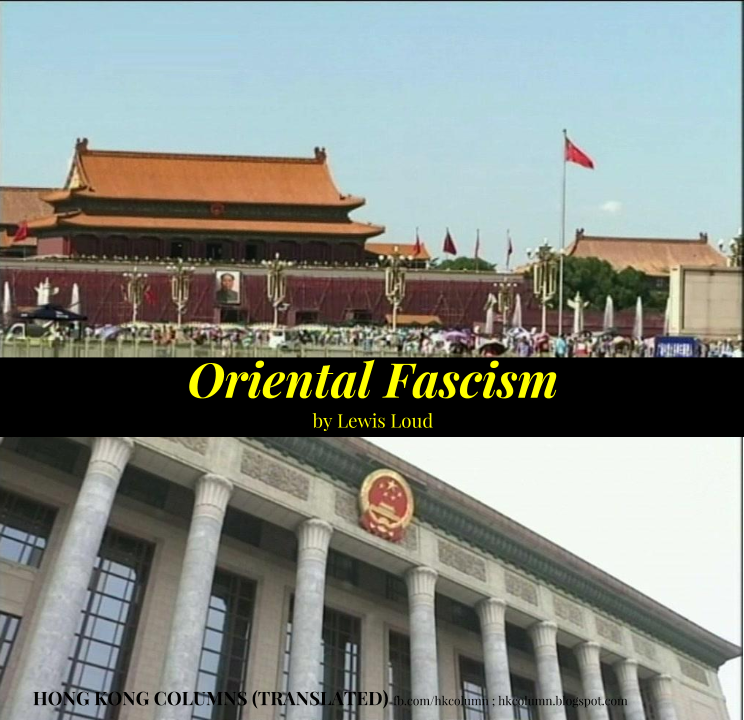
Lewis Loud: Oriental Fascism

Oriental Fascism
Translated by Ryan L, edited by Chen-t'ang, written by Lewis Loud
Original: Passion Times Vol. 41

China is a fascist country. Modern China abides by the belief in “Ein Volk, ein Reich, ein  Führer”. Modern China is an empire masquerading as a nation state.

For an ethnicity to have more than one country, like Austria and Germany, is a universal standard. Yet Chinese do not abide by this. They believe Hongkongers are Chinese, thus bound by the belief “blood is thicker than water”, therefore Hong Kong must accept Chinese rule. To mention independence is certainly treacherous, but even autonomy and localism are identified with separatist and treasonous intent. 

These beliefs are full of the elements of fascism. Westerners turn pale at the mere mention of fascism but America, ignorant and tolerant of the Communist East, supported China in opposing the Soviet Union. Hence, the largest fascist country is thriving today. Churchill once said that communism and fascism are twins that share the DNA of totalitarianism. 

90% of Hong Kong’s population are descendants of Chinese immigrants experiencing the rule from proper China since the Qin dynasty. They belong to the same ethnicity. But many entities may grow out of one ethnicity. Germanic peoples founded more than one country. The British founded America later. Once separated there was never any talk of reuniting with mother Britain.

China’s opposition to any secession through evocation of nationalist sentiments is merely hyperbole. In reality, the Chinese Communist Party cares not a wit about territorial integrity. Russia has swallowed vast chunks of Chinese territories since the Qing dynasty but Jiang Zemin signed a treaty demarcating present borders, forsaking the recovery of those lost territories. So why are the Chinese who live on these forsaken territories not traitors?

Ethnic Perceptions with Chinese Characteristics 
If China really cared about ethnicity, each province would be autonomous and establish their nationhood, then confederate to discuss matters that affected the entire region like Australia or Germany. Each province would be able to choose its own method of governance or development in accordance with the national condition yet the ethnicity would still belong to one entity. Yet China describes itself as a multiethnic yet united country. It is united so as to protect the party’s ability to monopolise all the power and profit; it is multiethnic to rationalise China’s invasive expansionism, its plundering of others’ lands. 

An ethnicity can only have one country. A country can only have one leader. Such beliefs if used in the West would be identified as hegemony, fascism and racism. Yet to the pompous westerner, eastern fascism is culturally specific to cultural complexities thus should be tolerated. This is tantamount to Westerners demanding gender equality and feminism yet tolerating the deprivation of female rights in Islam due to different values. 

Pretentiously cosmopolitan Hongkongers have very vague understanding of ethnicity. The Chinese nation (zhonghua minzu) is an artifice created by intellectuals at the end of the Qing and the beginning of the Republic era with only a century of history yet a majority of Hongkongers embrace it wholeheartedly as an earth-shattering revelation. Community eminences like Joseph Sung, Vice-Chancellor of the Chinese University of Hong Kong is an example. Yet Hong Kong with its modern meaning is already 176 years old, meaning the Hong Kong ethnicity is older than the Chinese nation by sixty or seventy years yet described as a fantasy. 

If the Hongkonger as a nation is a joke, where are the unshakeable foundations for the Chinese nation? Undoubtedly it is the mischief of power; the powers that be may have the power to define. The relationship between the signifier and the signified are unstable, artificial or arbitrary, yet, humans are the author of everything. All is silent, only power may speak. 

Hong Kong is not a nation because she says she is not. Once she decides she is, she is.