Showing posts with label Hong Kong Independence. Show all posts

20190228

Straight Talk with Kurt Tong (26.2.2019) - Full Transcript

Straight Talk with Kurt Tong (26.2.2019) - Full Transcript
http://news.tvb.com/programmes/straighttalk/5c75430de6038315322124ee

MC: Hello I’m Michael Chugani and this is Straight Talk. With me today is the US Consul General, Mr Kurt Tong. Thank you very much. Now, Mr Consul General, you were here about a year ago. 

KT: About a year ago, yes. Thanks, Michael.

MC: In that year, a lot has happened. Since you last came, we’ve had the trade war, we’ve got legislative councillors who were disqualified, we’ve got a national anthem law and we have a congressional report that said we should reassess the Hong Kong Policy Act. I’m going to start off with the trade war because just yesterday President Donald Trump said okay, negotiations have gone well and he’s going to delay the tariffs for a while. Now, Mr Consul General, a lot of people say, critics say that the trade war was not necessary, and it was America’s way to try and suppress the rise of China. Would you say that was true?

KT: Well, thanks Michael and thank you for having me again this year. It’s been...I enjoyed...it’s a really good opportunity to have some dialogue. The situation with the ongoing trade negotiations, I would characterize it as “we’ve entered a second overtime”. We’ve had a brief first overtime for about two days and then the president, as you said, has indicated that he’s going to postpone raising US tariffs for a period of time while we have future negotiations. I think the US continues to have high expectations for these talks. There's a lot of very important structural issues that we’re now substantively engaged on. We have a clear agenda and there is a reason to think that we can actually have a significant breakthrough in improving the nature of the US-China economic relationships, which the US as you know had a lot of points of dissatisfaction with. So, I’m hopeful that these negotiations would go well and that is pretty much the intentions of the talks...the tariffs you know, are an action-forcing event. They focus the mind and they help China understand to the degree of which the US really consider these problems that are buildup in the nature of the US-China economic relationship to be very serious.

MC: Was it necessary? Because people say that it’s hurt both the US and it’s hurt China, it definitely has hurt Hong Kong, and that it could’ve been settled without tariffs, and that by imposing these tariffs, President Trump is trying to, I asked, again to suppress the rise of China.

KT: That’s clearly not the case. We’re not trying to suppress the rise of China, we’re trying to interest China and create incentive for China to focus on significant problems that are...

MC: Have they been playing unfair?

KT: Who?

MC: China. In trade.

KT: Yes. Absolutely. It’s been an unfair...
MC: In areas like technology transfer, forced technology transfer.

KT: Unfair and non-reciprocal on trading relationship in the way it’s been structured, and particularly, as with respect to technology and investment. So, we focus the mind through tariffs and have had negotiations. This is not uncommon in global commerce or trade negotiations. 

MC: Sure, now the thing is that I’m going to link that with the Huawei issue, with the arrest of a senior Huawei official. 

KT: Well, that’s the wrong thing to do, because they’re not linked.

MC: OK, they are not linked. But you know, it’s been said that the two are separate. I understand that but people, critics look at it as one whole thing. You’ve got the trade war, you’ve got the arrest of the Huawei official and then you’ve got the US trying to stop Huawei into dominating 5G. All these things combined…

KT: Well, critic... 

MC: ...will give people an impression that they’re trying to suppress the rise of China.

KT: Right, and those people, those critics are incorrect. There's no linkage between the Huawei technology issue, the specific case against Mrs Meng [sic] or the ongoing bilateral trade negotiations. These are separate things and that’s the way the real world works. Now, there’s a talking point that is being issued by the Chinese side that the United States is interested in containing or suppressing China.

MC: Right.

KT: That is a talking point also intended to create leverage and motivate people to…

MC: You’re not trying to do that? You’re not trying to do that? The US is not trying to do that?

KT: That’s right. We’re trying to resolve specific problems in specific ways using specific levers. When someone breaks the law, you have a law enforcement action. When there’s a technological risk, that will be considered debated and as you seen there's been a lot of countries considering the right way to deal with the risk mitigation, with respect to technologies coming out, particularly 5G. And in trade area, trade investment area, you have a negotiation. If you need to create leverage in order to have that negotiation, you create leverage and have a negotiation. This is how the real world works.

MC: Okay, I’m going to bring the issue back to Hong Kong now because we’re in Hong Kong and I think one of the things that concerns a lot of Hong Kong people, especially businesses in Hong Kong. Is that congressional report that came out that said that because they see Hong Kong’s autonomy is diminishing, perhaps it’s time to reassess to giving Hong Kong a special customs status, right? Now, you have said, Mr Consul General, that they’re not going to take...the US is not going to take back the Hong Kong Relations Act for the time being, is that right?

KT: So, the most important point to make is...and you’ve said all the way from trade negotiations to the Hong Kong Policy Act, there’s no relationship between those issues as well. 

MC: Yes, of course. It’s a separate issue.

KT: It’s entirely separate issues and the Hong Kong Policy Act is a piece of US legislation that allows the United States to treat Hong Kong differently than it treats the rest of China for purpose of the US law. That will continue as long as Hong Kong continues to be substantively autonomous in those various areas of US laws. So, I think...again it’s a much more legalistic, methodical, scientific conversation that is often portrayed. So...I think that we will issue another report again soon, coming out of the State Department, the consulate assisted in the creation of that. It will report the reality of Hong Kong…

MC: What is the reality, Mr Consul General?

KT: ...situation and autonomy. The reality is that Hong Kong continues in many ways, in many areas to enjoy a high degree of autonomy but there are issues on areas for concern, in particular this last year 2018 was not a particular good year for Hong Kong’s autonomy. There were signs for increasing pressure put on Hong Kong’s political space and some unfortunate events have happened in 2018 which created a sense that Hong Kong may be losing some of that grip on autonomy. So, I think the report is likely to reflect that fact but also will be fair in assessing the overall balance of the pros and cons with respect to autonomy. 

MC: I’m going to try and pin you down on that. Now, the last time you were here, you said that the emphasis seems to be less on autonomy and more on “One Country”. That’s what you said last time. Now, you’re saying a new report is coming out…

KT: It’s required by Congress…

MC: Sure, right. And things have happened, unfortunate things. I think what you meant was that you’ve had candidates being disqualified to run in elections, you’ve had a foreign journalist expelled for hosting a talk at the Foreign Correspondents’ Club by a pro-independence party. Then you’ve got people in Hong Kong saying free speech has limits, you cannot even talk about independence. You, when you were last here, you said, free speech is free speech, right? And as long as it’s peaceful, it should be allowed, right? Now, you are now saying that the new report, as required by law, will come out soon, and it will reflect these things. How strongly will it reflect these things that the autonomy is now under threat?

KT: Well, the report is yet to be issued. You know, I don’t want to lessen your enthusiasm for actually reading it when it comes out. But the point that matters is that I think there’s been a trend in the last few years and in 2018 in particular of emphasis on “One Country” in ways that impinged on the realization on the full benefits of “Two Systems”, and the autonomy, the high degree of autonomy that Hong Kong is supposed to enjoy under the Basic Law.
So the thing that concerns me is that concern from the mainland side about politics in Hong Kong. Hong Kong politics is different than mainland politics and that’s… I understand that it’s uncomfortable for the mainland. But that kind of pressure that’s being applied can impact the political sphere in Hong Kong in a narrowing political space, that a deeper concern for US interests is that it could actually, over time, start to influence the economic spheres as well. And really this year, we’re experiencing… we’ve enjoyed the 175th anniversary of our consulate, we’ve spent a lot of time reflecting on what our consulate is about, what the US presence is about in Hong Kong? When you really dig into it, a lot of it is about economic ties, trade, investments and business. And if that political atmosphere changes to a sufficient extent, it ends up hurting the business environment that would be very problematic I think for everyone involved, for the United States, for China, for Hong Kong people certainly and even for the region.

MC: Okay. Quick break. See you soon.

/////

MC: Thanks for staying with us. This is Straight Talk. With me is Mr Kurt Tong, he is the Consul General of the US. Now, Mr Tong, before the break, we talked about the US Policy Act, I think that’s one thing that concerns a lot of people in Hong Kong. And you did say that what concerns the US is that, as people see autonomy eroding, and more focus being put on “One Country”, rather than “Two Systems”, it could then spill to affecting business ties, the business atmosphere, and that concerns the US because you have got a lot of companies in Hong Kong that do business here, right?

KT: Yes. A huge presence.

MC: Exactly. Now, you know last year when you are here, you did say and I will say it again that you felt that emphasis is now more on “One Country” than “Two Systems”, and autonomy is eroding. A new report is coming out again, and I’m sure, even though you won’t tell me what it is, it is still being done, I don’t think that it will say “everything is fine”. I am sure it will say that “things are not fine”, right? Now, how much worse does it need to get before the US congress says “okay, now we must take a serious look at whether we should give Hong Kong special status”.

KT: So, there is no autonomy meter, right? And it’s not…

MC: That I do know, but Mr Consul General, you have said that…

KT: Let me…

MC: Okay.

KT: It’s not… so my point being that it is not a black or white question. And the report and what not will be very careful to be fact-based, to be careful and assessments, and make sure that we get our stories straight. The Hong Kong Policy Act provides a legal framework for a variety of activities and cooperation, application of US law, to the relationship between the United States and Hong Kong. The likely way that things will happen going forward is that there will be, some scrutiny of the various aspects of implementation of that law. And if there is autonomy in those areas of application, then it will continue just fine. And I expect that mostly the case in most areas going forward. In a specific area, bilateral activity, like say law enforcement cooperation, things are going great, Hong Kong is showing a high degree of autonomy, Hong Kong is acting like a “Two Systems” special place, then the US will continue to treat it as such.

MC: But what areas do you feel that autonomy is eroding? 

KT: Well, in the biggest implication, I think it’s in the political sphere again, that political activities have been constrained, you talked about some of the negative events with respect to the freedom of expression, over the past year…

MC: Will those things be…

KT: And that’s the concern. So that is the general background, and then when you consider the Hong Kong Policy Act and US-Hong Kong cooperation, in some ways it's more specific to various activities.

MC: Do you expect, I know this is like you don't know yet, but do you expect that when the report comes out, it will be more critical than the one before?

KT: Well, I think, given what I have told you about our assessment of the previous year, I think that could be the case, yes.

MC: It would be more critical than the one… because the one before drew a very angry response from Carrie Lam, the Chief Executive, right? So, you said the new one coming out will be even worse? 

KT: It’s an uncomfortable thing for one government to make a report about the activities of another government.

MC: Sure.

KT: Or either the Hong Kong government or the mainland government. That’s an uncomfortable thing, people sometimes react to that. I get it, we are required by law because of these special circumstances of “One Country, Two Systems”. And being allowed under US law to apply these special positive aspects of a unique relationship.

MC: Well, I’ll ask you…

KT: We are required to report on it, and we will report on it, and people might not like what we say, but we…

MC: But it’s the US law, so you report on it, right? Now, I am going to ask you one more question, and then I will move on. Now, you think the report will be worse than the one, well, more critical than the one last year, right? Okay, fine. Now, can I assume that it will be more critical because in that year, you have had candidates being disqualified, you have had a journalist being expelled, you have had a political party being banned, and then the insistence that you cannot even talk peacefully about independence, if you do you will no longer be able to run for elected office again. Are these the things that will make the report more critical? 

KT: You have cited some important examples of what we would consider negative trends in autonomy in Hong Kong’s political space.

MC: So those were the issues that will make the report more critical? 

KT: Again, I hope you look forward to reading it.

MC: But then the point will not be reached. In your opinion, as Consul General, the point will not be reached for the Congress to say “we are going to take away the Policy Act”?

KT: Well, the act will require another act of Congress to change, and I haven’t seen anyone suggest that.

MC: Alright, okay. Now, I am going to move on. We have got another thing here now that a lot of controversies, an extradition proposal from the government, stemming from an alleged murder case in Taiwan, involving a Hong Kong person.

KT: Right.

MC: Now, you know, the funny thing is a lot of people in Hong Kong, politicians saying “fine, let’s have one with Taiwan”, but they’re worried about having one with mainland China, right? And the reason being that if you allow that, then Beijing can demand to have this or that person to be extradited for political reasons, right? Now, the US and China, you do have a treaty, right, the US and China, you have a…

KT: No.

MC: You do have one.

KT: With Hong Kong.

MC: With Hong Kong? Not with… I am sorry, yes. You have one with Hong Kong, but not with mainland.

KT: Because of the Hong Kong Policy Act…

MC: Exactly, right.

KT: and “One Country, Two Systems”.

MC: And that came about 20 something years ago with Hong Kong, right? 

KT: We had one predating the handover, but that agreement is remained enforced, again because of the Hong Kong Policy Act allowing us to do that.

MC: So, are you worried that you have one with Hong Kong, and then if Hong Kong said “could you please extradite this person to Hong Kong?”, is the US worried that if Hong Kong has one now with mainland China, then that person upon arriving in Hong Kong, the Chinese government can say “we want that person over there”. Does that worry you?

KT: Well, here is the thing, I am going to give you a careful answer on this, I think the details in this kind of thing really matter, and so I am not prejudging the likely outcome of Hong Kong’s deliberation about what to do with respect to fugitive transfer, vis-a-vis mainland, vis-a-vis Taiwan, and also I don’t want to prejudge what the US reaction would be, because it really depends upon the details and how these things are implemented, in terms of the carve-outs protection for individuals, and with respect to possible fugitive transfer or extradition. So, we will just have to wait and see. There is a possibility that if it is structured in certain ways, then that could have some impact on the implementation of our bilateral arrangement between the United States and Hong Kong. But I don’t want to prejudge that.

MC: Sure.

KT: We are just going to wait and see what happens.

MC: Okay. We have just got a couple more minutes. The Greater Bay Area, some details have been announced. Yet again people say that this is going to even further worsen Hong Kong’s autonomy. Does that worry you?

KT: I don’t know. I honestly don’t know.

MC: Do you think it will?

KT: I honestly don’t know. I have carefully read the framework that was announced. Let me put a more positive spin on it. I think the Greater Bay Area initiative does create some significant opportunities to reestablish momentum around the reform and opening process for the Chinese economy, using once again, as was the case 40 years ago, and during that 40-year Reform and Opening period, we have heard so much about lately, that to use south China as a place that shows the way to the rest of China, in terms of economic reform and opening. So, a Greater Bay Area initiative that would most excite foreign businesses as well as foreign governments would be one that, in a sense, pushes reform and opening process and the kind of global best practices and rules-based systems that are prevalent in Hong Kong and Macao into Guangdong. That would be great.

MC: Not the other way around?

KT: That would create enormous opportunities for foreign business as well as Hong Kong businesses, as well as mainland businesses, everyone would be happy. So, I really think that, again, the devil is in the details on this, and there weren’t that many details so far. They haven’t announced.

MC: Yeah, they are working on the details.

KT: And if at the end of the day, it’s just some slogans and some bridges, then that’s kind of a neutral outcome, it doesn’t really help open up China, but it also doesn’t really pose a big problem for Hong Kong.

MC: Okay. I have got one minute left. The last time you were here, I asked you free speech is free speech, and you said you can use it even if you promote independence as long as it’s peacefully done. Do you still stand by that?

KT: Well, that’s our approach in the United States. There has been a lot of discussion around flags and anthems of late, and in the United States, you can burn flags or misbehave during the national anthem, people don’t like it when you do it, it’s considered impolite, and not good. 

MC: So free speech is free speech, even for independence?

KT: Certainly, it’s legally protected, free speech.

MC: But for Hong Kong, you think it should be allowed, you can speak about independence peacefully?

KT: Well, our interpretation of freedom of expression is that it’s a boundless thing, and people should be allowed to express themselves as long as they are not specifically hurting another person.

MC: Okay, I have got to end it right there. Thanks. See you next week. Good evening.

20181010

Hong Kong Didn’t Even Show up in Pence’s Speech: Whose Fault Is This?

Hong Kong Didn't Even Show up in Pence's Speech: Whose Fault Is This?
Translated by Gordon, written by Lewis Loud
Original: Hong Kong Didn’t Even Show up in Pence’s Speech: Whose Fault Is This? 


Mike Pence, Vice President of the US, Source of photo: Internet
Mike Pence, the Vice-President of the United States, delivered a stinging speech about China at the prestigious Hudson Institute, with every paragraph pinpointing at every flaw of China. Starting off by retelling the story where the US has supported China for the last century, the speech depicts China’s betrayal amidst and despite the US’ benevolence; as the speech unfolds, it sounds as if the US is giving an ultimatum to China before launching a full-out attack. This U-turn of policy bears a striking resemblance to what was laid down in Michael Pillsbury’s book: The Hundred-Year Marathon.

What's more unsettling is that, whereas Pence's speech did mention many countries, Hong Kong (HK) was completely left out of it. While it is true that US-HK Policy Act still remains in effect, such is no guarantee of peace during turbulent times like these. Today, the Foreign Correspondents’ Club (FCC) is facing political oppression from the HKSAR government, as Financial Times journalist and FCC Vice President Victor Mallet’s working visa has been rejected, as a payback for hosting a talk by Andy Chan, Chairman of the Hong Kong National Party (HKNP). The act of terminating of Mallet’s visa amounts to sending him in exile. The HKSAR Government, by its conduct, revealed the fact that Hong Kong is no longer a free port nor an international metropolis, but instead “another Chinese city”. China has been in breach of the Sino-British Joint Declaration and Basic Law for a long time, and such conduct has been understood by the US. Sooner or later, if not already the case, HK will be seen as an accomplice of China, and there would be no way we can stay out of it once the US decides it’s payback time.

Just a month ago, HKNP wrote to President Trump, claiming that HK had suffered a total loss of its autonomy, thus asking the US to review US-HK Policy Act, as well as to revoke HK and China’s respective WTO memberships. Back then, quite a lot of criticisms came from the political and business sectors, saying that this would send HK to its demise. On the other hand, Alan Leong, a senior member of the pan-democrats, issued a high-profile rebuttal through Apple Daily, stating his disagreement over the claim that HK has suffered a total loss of autonomy, and claimed that HKers should “persuade” the Chinese Communist Party to act according to Sino-British Joint Declaration and Basic Law…

As we can never tell whether Leong's seeming naïveté was genuine, there is little need to comment such an act. Given, however, that the pan-democrats have occupied so many seats in the LegCo, Victor Mallet’s incident is in turn a reflection for what they have achieved so far amidst such political reality: ZERO.

Let us look deeper into it. The US’ grievance over China stems from China’s intellectual property theft and breach of trade regulations. While taking advantage of international trade, China maintains its shady connections with enemies of the international community, such as Iran and North Korea, and HK has played an pivotal role as an intermediary. The reason why HK can intermediate between the West and these shady links is not that HK is particularly brilliant, but because of the differential treatment it receives from the international community and, in other words, their belief in the One-Country-Two-Systems doctrine.

The international community has now realized that their tolerance is the root cause for HK’s infiltration of the international trade order, and so it’s not hard to imagine how HK will be treated by the international community in the near future. For example, as China has instilled a credit system to spy on and control their citizens, they would need to import spy cameras, for which HK is the transport hub. When the West has imposed an embargo on sensitive materials to China due to the outbreak of human rights crisis in regions like Xinjiang, there is no way Hong Kong can stay out of the embargo list. In another example, having breached trade regulations by doing business with Iran, ZTE had to accept direct management by the US to avoid going bust altogether. We will see HK receiving similar punishment very soon.

Moreover, the trade of raw materials to and from North Korea, as well as money laundering, were all done through more than 160 HK’s shell companies with North Korean background; selling oil to North Korea also involved HK shipping companies.

Void as it might seem, human rights remain a powerful pretext for certain actions. In 2017, German firearm manufacturer Heckler & Koch suddenly refused to sell MP5 submachine guns to the HK Police Force, as the German government had made a requirement in 2015 that all firearm manufacturers must assess the buyer’s level of corruption and democracy before selling, due to the worries that these firearms would be used by dictatorships to oppress their people.
Another less obvious reason for this is that the West is worried about leakage of sensitive and strategic materials, such as weapons, as well as steppers that are used to manufacture CPUs, into countries like Iran or China, through the help of intermediaries. An experienced intermediary, it is no wonder that HK is becoming less and less popular amongst the international community.
How did the HKers respond to this, then? Elites like Alan Leong would never stop preaching the same old drivel, claiming that the One-Country-Two-Systems doctrine remains intact, and that HKers stand the same common ground of democracy, freedom and human rights with the free world, and therefore the differential treatment ought to continue. Nice as they might seem, foreign politicians, of course, have their own agendas. Whereas democracy and freedom are but an empty promise, conflict of interest is the real deal. As HK moves from a free city to an accomplice to China’s dirty work, the One-Country-Two-Systems doctrine stops being the glory of the world, but a backdoor to the political and economic order of the world.
As a backdoor is a gateway through which a system is invaded, how would any knowing computer engineer not try to block it?
All these years, the politicians who tried to lobby in the US put all their emphasis on the One-Country-Two-Systems doctrine. From a Western perspective, isn’t this some sort of circus act all these years? On one hand, the West knows HK has become China’s handyman and is doing damage to the world order; whereas on the other, they keep hearing these blokes from HK emphasizing on how high-degree autonomy they enjoy and how the One-Country-Two-Systems promise remains intact. “Is this a joke?”
Technically and factually speaking, HK IS China’s handyman. If HKers want the free world to help maintain the One-Country-Two-System promise on one hand, AND want to keep the differential treatment such as low tariffs and qualification recognition on the other, how would that be different from asking the free world to grab a knife and stab themselves? In fact, the more HKers emphasize on the existence of the One-Country-Two-Systems doctrine, and the less HKers are willing to admit the fact that it has been defeated and that it has surrendered, the more would HK register as a sleeper cell on the radar of the international community.
To maintain the willful belief that the One-Country-Two-Systems doctrine as the common ground between HKers and the international community, mainstream HKers have refused to look at the reality and, essentially, have been living a lie for all these years. The only concern for the West is this: Aren’t you guys all involved in hacking the order of international trade? You took all the privileges given to you by the international community, hacked into the system as a handyman, THEN came back to us, demanding we tolerate you despite all the damages you’ve done, AND continue giving you the differential treatment as well?
It is self-centred for the HKers to only want their business and professional services (also businesses) to continue to foster. From a foreign perspective, as China and HK have successfully merged as a whole, the denying of the merge and demanding of differential treatment means HKers only want to enjoy all the rights without fulfilling any obligations. Just like China.
What do we have to do in the face of such a hostile environment outside? For starters we need “civil diplomats”. Opinion leaders need to stop living in denial, and need to plead the truth to the international community, that HK has completely fallen and its autonomy has suffered a total loss; that HKers, however, like the international community, are victims of the One-Country-Two-Systems lie as well as the Chinese tyranny; and that all the damages done to the international community had been done by China, hijacking the name of HK. We HKers need to free ourselves and cast off the yoke of bondage known as the game of elections, and stop telling foreigners all we wanted was the status quo. Embracing the status quo means HK WILL be punished alongside China.
HKers need to sever the ties with China as soon as possible, whereby we at least need another way of civil diplomacy, to tell the international community and our allies our true opinion: HKers do NOT wish to be an accomplice for China’s attempt to dominate the world, which is why HKers ardently seek true autonomy through independence. This is not only to benefit HKers themselves. It is only when HKers obtain true autonomy and set boundaries can HK stop being the threat to the international order.
HKer’s primary perception of the world is that freedom and democracy have to be mentioned hand-in-hand with the One-Country-Two-Systems doctrine. At the end of the day, HKers didn’t want to offend China and would like to remain as China’s handyman on one hand, meanwhile also wanting to remain as an ally of the West on the other. The fact that China took an action against a foreign journalist means that it has used HK as a pawn. The colonial master known as China has decided to sacrifice HK, and HK, as a subordinate, never had a chance to make a difference even if it chooses to side with its master. As we refused to choose whether to jump off the sinking ship or to remain on board, we’d still have to face the fact that the ship IS going to sink anyway.
The problem for HK is not that it doesn’t want to side with the West; it’s that it doesn’t get the opportunity to do so. As Pence made his speech, Taiwan’s President Tsai Ing-wen immediately thanked the US for having the “moral courage” to speak up for Taiwan. Ties between US and Taiwan has been increasingly close these years, and an “Abandon-HK-Keep-Taiwan” policy has almost reached a consensus.
It is virtually impossible for HK to safeguard its own interest and values with its own existing system, and with the One-Country-Two-Systems doctrine, it renders it virtually impossible to seek help from foreign allies as well. To respect the One-Country-Two-Systems doctrine is to let China do whatever they like, and HK is doomed to be the backdoor China uses to hack the rest of the world.
5 months before, Alan Leong discussed HK politics at Asia Society, and all of a sudden he started to defend China (footage starting at 13:54), claiming that if the US had believed China to be in breach of the trade protocols, they should seek to resolve their differences within the framework of WTO, and they shouldn’t expect China to play by the rules if US had started a trade war, because by doing so would make China steer further away from democratic values. To Americans, this act is but defending this rogue regime. Didn’t you want democracy and autonomy for starters?
Fast forward to 5 months later. Pence made a stinging speech about all the crimes China had committed against the US and the world as a whole, including, on a domestic level, suppressing human rights and freedom of speech, and on an international level, influencing American elections, stealing confidential information from American companies, forced technology transfer, using “debt-trap diplomacy” against Belt-and-Road countries, and militarizing the South China Sea, to name a few. NONE of these conflicts can be resolved within the WTO framework, and as the US has made clear that they do not intend to do so, as they are seeking to establish multi-lateral trade relations anew.
Pence’s speech has rendered Leong’s defense a joke, as it has shown the extent how HK politics has lost touch with reality.
In his speech, Pence did mention Tibet, Xinjiang, Taiwan, North and South Korea, South China Sea, as well as countries in the Belt and Road Initiative, leaving HK behind. Obviously, it is because HK has been so pro-China for such a long time that it stops showing up on the radar of the international community. Starting from Martin Lee fighting for the US to treat China as a most favoured nation after the Tiananmen massacre, to Alan Leong’s defense for China at Asia Society, HK politics has remained as pedantic as ever.
Whereas we never expected anything radical to come out of these politicians in fancy suits whose main concern is getting elected; had they stayed distant from China and treated them like an adversary (even if it was just a pretense), it would have made a huge difference in perception. Few people could tell the difference between defending HK and defending China. When they beg the US for their mercy to spare HK in the trade war, while ALSO saying good things about China at the same time, isn’t this revealing of their true desire to remain as a two-faced handyman, but with different wordings?
Then, if the international community forgets about HK, how would this be China’s responsibility at all? It is this entire generation of HKers who couldn’t make sense of their own identity and position or, worse yet, deliberate two-faced free-riders that exemplify the old saying “those who insult themselves shall be insulted likewise”. As we enter a time of a black-and-white, all-or-nothing showdown between China and the US, being two-faced means getting slapped in both.

20171207

Nicole Wong: The False Song of Chinese Nationalism

The False Song of Chinese Nationalism
Written by Nicole Wong; originally on Comitium Volume 3 (publication of Hong Kong National Party)
Originally from issuu

Tanni / EJInsight
When Hongkongers first realised that their fate currently lies in the hands of the foreigner, when the first call for Hong Kong Independence was voiced, and when the Hong Kong National Party was first convened, the resounding rebuttal was that of a familiar question: “Are you not a Chinese as well?”  All too familiar indeed is the question, for not only is its contents a cliché, but its accompanying features: the moralising and patronising tone, the aged and wrinkled face, and the underlying sincere belief from the accuser that all parties engaging in the heated debate are, beyond any doubt, Chinese.  The PRC members are Chinese, the Hongkongers are Chinese; the pro-Establishments are Chinese, the pro-Independents are Chinese; you are Chinese, I am Chinese, we are all Chinese.  It is as if the fabled Golden Headband of Journey to the West's Monkey King has come to life, and with the familiar words, the inescapable Chinese identity binds us all to our predestined obedience to our Chinese colonial masters, who are, as we are reminded by this very instant, our beloved brothers in the Sinic brotherhood.

Thus smugly does the self-assured Sinic accuser disarm, without any self-awareness of Stockholm Syndrome, any threats to the imposed Chinese identity.  Those politically engaged amongst you might have noticed that this “call to linked arms” is no novel rhetoric.  Indeed, long since before the sovereignty of Hong Kong was handed from the Brits to the Chinese in 1997, whenever the separate identity of Hongkongers was ever raised, there came inevitably the self-assured, “patriotic” rebuttal: “Are you not Chinese?” And how effective it was in shutting down all discussions!  In an age where both the pro-Beijing and the pan-democrats believe they are merely squabbling brothers born of the same beanstalk [Though it must be said the illusion runs far deeper for the latter.], it is easy to see why the curse is so effective --- to claim you are somehow a different national identity from those with which you share the same nationality is a patently absurd idea.  It is not until very recently when Hongkongers realised that it is the premise of this curse that is the absurd detail: the age-old lie that Hongkongers are “Chinese”, for the specific definition of “Chinese” that this curse implies.  The opposition stops here, though, and most “localists” are content with substituting it with a murky self-identification of “Hongkonger”, after which we observe a mess of competing bikeshedding: whether “Hongkonger” is an ethnic-national identity, civic-national one, or both; when the “historical immigration cut-off” line should be drawn for “Hongkongers” to be considered natives; and so on.  None has recognised and attempted to lob off the chief supporting leg of the argument on the other side: the curse of “Are you not a Chinese?” is allowed to flourish even to this day, because the Hong Kong public still implicitly believes in, in one way or another, the false song of Chinese nationalism.

The “Chinese”: a national identity built on self-defeating ideas

There are many ways to dismantle the lie of Chinese nationalism.  One could observe how it is no more than a continuation of an imperial subject identity, given a modernist and fashionable name when the ROC and then the PRC adopted the idea from Europe.  This particular thrust has been explored by past publications on Comitium by analysing the intentionally woolly definition of the word “Chinese” written in the Chinese script.

The very same word could mean,
1, the pseudo-biological ethnicity of Han Chinese;
2, the legal nationality of a PRC national;
3, the cultural identity of a Chinese transcending legal nationality; and
4, the romantic idea of a single cultural tradition, presumably unbroken for millennia, found in the East Asian territories that are within today's PRC borders. 
The absurdly wide range of definitions contained within this single word has given rise to such claims from a certain Member of the National People's Congress, Michael Tien Puk-sun's mouth, “Just look at our skin [colour], if we weren't Chinese I don't know what we are” (definition by biology) to be followed by “the Chinese nation has its history spanning millennia.  Now I don't know if you've read any history,” (definition by romantic tradition) “but this whole thing is as simple as stating 'my mother is a woman'!” (definition by popular consensus) “When you go travelling, you fill in the nationality field with 'China' and not 'Hong Kong'” (definition by legal nationality).  At no point does the nebula of definitions attempt to be consistent with itself, with different facets thereof carted out when the situation calls for it --- its principal aim is to remind the audience that they are Chinese.  The Chinese nationalist-reminder thus selects its victims with utmost abandon, for anyone with the most tenuous claim to “Chinese”-ness, perhaps by some distant grand-grand-grand uncle who lived in a conquered province under the (Mongolian-ruled) Qing Dynasty, could still be lassoed in to become just as “Chinese” as the bloodline heir to Old Confucius by the interwoven mess that is “Chinese national identity”.  And once that association is mentioned, the Chinese nationalist-reminder grows full-blown into the Chinese nationalist-curse, for it is within that narrative that any such identified “Chinese” are duty-bound to follow the leadership of the current “Chinese” regime, i.e. the PRC.  That these wildly varying and at times self-conflicting definitions could be played out at will to form an unassailable and messy whole is precisely how the call to Chinese nationalism is no more than a utilitarian chain whose purpose isn't to define a nation, or a nation's people, but to subjugate whatever audience it may lay claim to.  Were this mess of what constitutes a Chinese to be taken seriously, the identity of a “Chinese” would be most schizophrenic indeed.

One could likewise observe how the idea of a Han Chinese identity would fall apart pretty quickly on both ethnic and civic/cultural grounds once you factor in the observable effects of geography on the centuries of interbreeding (and lack thereof), both in blood and language, so much so that the language of the Cantonese is mutually unintelligible with the tongue of the Fujianese, that the funeral customs of Sichuan would look alien to the most accepting Shanghainese, and that the adage of “All Chinese look alike” is indeed a racist generalisation, for no inhabitant of this East Asian land would be unable to differentiate the telling physical differences between a Beijingese and a Hongkonger.  All these, of course, could be wily dismissed by those who (mis-)follow the school of thought where nations are imagined, and thus as long as the ruling Beijing and the majority of her followers imagine Hongkongers to be part of this “Chinese” whole, it is democratically just to accept that, yes, Hongkongers are “Chinese”, too.  All the more lamentable is the reality, in fact, when it is not only the Beijingese, but also a substantial amount of Hongkongers, who buy into this line of thought.

“Chinese nationalism” fails to be nationalism at all

What, then, could the Hong Kong Nationalists offer as a rebuttal?  The answer is simple: Chinese nationalism fails as nationalism.  That is to say, Chinese nationalism is not nationalism.  To support this argument one might need to devote several lifetimes' work into defining “what is nationalism” academically, which is commendable as an intellectual pursuit on its own, but infinitely unhelpful to the situation that Hongkongers are facing with our limited time, quickly running out.  Thus sweeping away all academic considerations on the clinical definitions of nationalism and focusing on the most important thing at hand --- the people of the nation --- one arrives at a common thread that permeates through all definitions: that nationalism is a supreme uniting force for the people, by the people, of the people.  It is a noble call to arms, a sense of camaraderie with those with whom you know you share a common ground.  It is a promise that someone you might not know personally has your back covered on matters important.  And most importantly, it is an exclusive force, for it defines clearly its criteria for inclusion, and from it do the nationals derive their shared pride --- whether in culture, in blood, or in myth.

Let us ask, then, what are the effects of the question, “Are you not Chinese?” upon the accused Hongkongers.  It is not a noble call, but a condescending subjugation of the Hongkonger identity.  It is not a celebration of camaraderie, but a shaming order for compliance and obedience.  It is not a recognition for common ground, but an admission of a lack thereof.  It is not a promise of support, but a threat of public guilt.  And most damningly, it does not evoke pride in Hongkongers, but instead demands submission and self-deletion.  The question is not so much as a reminder of Sinic brotherhood but a memo on Sinic domination.  To tell a Hongkonger he or she is Chinese is anything but a nationalistic call --- Chinese imperialism is alive and well, and no matter of rebranding can the leopard change its spots, oppressive blemishes and all.

20160420

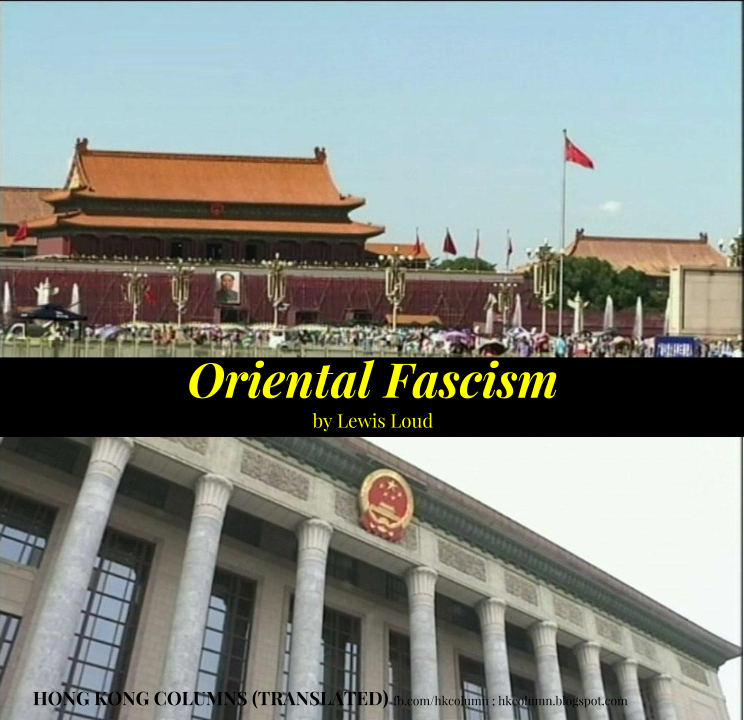
Lewis Loud: Oriental Fascism

Oriental Fascism
Translated by Ryan L, edited by Chen-t'ang, written by Lewis Loud
Original: Passion Times Vol. 41

China is a fascist country. Modern China abides by the belief in “Ein Volk, ein Reich, ein  Führer”. Modern China is an empire masquerading as a nation state.

For an ethnicity to have more than one country, like Austria and Germany, is a universal standard. Yet Chinese do not abide by this. They believe Hongkongers are Chinese, thus bound by the belief “blood is thicker than water”, therefore Hong Kong must accept Chinese rule. To mention independence is certainly treacherous, but even autonomy and localism are identified with separatist and treasonous intent. 

These beliefs are full of the elements of fascism. Westerners turn pale at the mere mention of fascism but America, ignorant and tolerant of the Communist East, supported China in opposing the Soviet Union. Hence, the largest fascist country is thriving today. Churchill once said that communism and fascism are twins that share the DNA of totalitarianism. 

90% of Hong Kong’s population are descendants of Chinese immigrants experiencing the rule from proper China since the Qin dynasty. They belong to the same ethnicity. But many entities may grow out of one ethnicity. Germanic peoples founded more than one country. The British founded America later. Once separated there was never any talk of reuniting with mother Britain.

China’s opposition to any secession through evocation of nationalist sentiments is merely hyperbole. In reality, the Chinese Communist Party cares not a wit about territorial integrity. Russia has swallowed vast chunks of Chinese territories since the Qing dynasty but Jiang Zemin signed a treaty demarcating present borders, forsaking the recovery of those lost territories. So why are the Chinese who live on these forsaken territories not traitors?

Ethnic Perceptions with Chinese Characteristics 
If China really cared about ethnicity, each province would be autonomous and establish their nationhood, then confederate to discuss matters that affected the entire region like Australia or Germany. Each province would be able to choose its own method of governance or development in accordance with the national condition yet the ethnicity would still belong to one entity. Yet China describes itself as a multiethnic yet united country. It is united so as to protect the party’s ability to monopolise all the power and profit; it is multiethnic to rationalise China’s invasive expansionism, its plundering of others’ lands. 

An ethnicity can only have one country. A country can only have one leader. Such beliefs if used in the West would be identified as hegemony, fascism and racism. Yet to the pompous westerner, eastern fascism is culturally specific to cultural complexities thus should be tolerated. This is tantamount to Westerners demanding gender equality and feminism yet tolerating the deprivation of female rights in Islam due to different values. 

Pretentiously cosmopolitan Hongkongers have very vague understanding of ethnicity. The Chinese nation (zhonghua minzu) is an artifice created by intellectuals at the end of the Qing and the beginning of the Republic era with only a century of history yet a majority of Hongkongers embrace it wholeheartedly as an earth-shattering revelation. Community eminences like Joseph Sung, Vice-Chancellor of the Chinese University of Hong Kong is an example. Yet Hong Kong with its modern meaning is already 176 years old, meaning the Hong Kong ethnicity is older than the Chinese nation by sixty or seventy years yet described as a fantasy. 

If the Hongkonger as a nation is a joke, where are the unshakeable foundations for the Chinese nation? Undoubtedly it is the mischief of power; the powers that be may have the power to define. The relationship between the signifier and the signified are unstable, artificial or arbitrary, yet, humans are the author of everything. All is silent, only power may speak. 

Hong Kong is not a nation because she says she is not. Once she decides she is, she is. 

20160321

Statement of the Generation: 11 Our 2047

Statement of the Generation: Our 2047
Translated by Chen-t'ang 鎮棠, written by The Undergrad session 2015, HKUSU

[DIRECTORY: AT THE END]

In his election platform, Edward Leung (from Hong Kong Indigenous) proposed to commence the 2nd round of negotiations and use of referenda to determine Hong Kong’s post-2047 future. On the other hand, in a New York Times interview, Joshua Wong said he will form a new party and join the LegCo election in September 2016. He will use the next 10 years to foster support for a referendum on Hong Kong’s future and self-determination.

The responsibility for bringing the issues of the second negotiation for Hong Kong’s future to the attention of all Hongkongers will belong to this generation. 

In retrospect, we were not born during the 1st negotiation for Hong Kong’s future, so we can only look at the silhouette of history to identify the roots of Hong Kong’s plight. In 1971, PRC replaced ROC to represent China, and in 1972, Hong Kong was removed from the UN's list of colonial territories. Since then Hongkongers, as colonial subjects, have lost the right to exercise self-determination granted by the UN.

In his memoir, Chung Sze-yuen, the LegCo and ExCo member, wrote that in 1984, Lydia Dunn, Lee Quo-wei and him met Deng Xiaoping. Deng immediately said the negotiation for the future of Hong Kong will only be settled by China and the UK. As for the so-called “three-legged stool”, it did not have three legs only two. Since then, Hongkongers were deprived the right to determine their own fate. 

In 1984, Zhao Ziyang and Margaret Thatcher signed the Sino-British Joint Declaration, which instituted the transfer of sovereignty of Hong Kong to China after 30 June 1997. Hong Kong commenced 14 years of waiting.

We once chose to believe China yet she has never kept good faith. Meeting Point, which later became Democratic Party, promoted Democratic Reunification widely. Meeting Point put the wager on China, anticipating she would reform, and Hong Kong would then have democracy. The Tiananmen Massacre did not falter the patriotic hearts of Meeting Point, nor the hope for Democratic Reunification.

History did not follow their wishes.  The current PRC regime is much more centralised and conservative than that of the 1980s. Hongkongers have waited since 2007/08 to 2012 to 2017 for everyone to wake up from the dream of democracy. Meeting Point became the pan-democrats now, occupying the council with slow reforms. 

For example, Emily Lau remains a Legislative Councillor since 1991. The pan-democrats control the resources and voice of the opposition and want to lead the next negotiations for the future, so as to ensure their parties political survival and perpetuate influence. Yet this will severely retard our progress. The pan-democrats do not understand the current China, and still harbour liberal fantasies for the eventual democratisation of authoritarian China. The belief in China’s inevitable march towards democracy is their blind spot. This is the cause of their failure to respond to the surge in localist thought and suffer a dearth of imagination about the resistance through social movements. They uphold the banner of absolute pacifism. When someone tries to break the box with physical resistance, they condemn these protesters and sever ties with them, leaving us, the “eggs” (the eggs/wall simile by Haruki Murakami), out there. Before the election, they will ask us to consider the bigger picture. We cannot repress the sense of helplessness at the shortsightedness of these people who have led the democratic movement for the past thirty years. They have eyes only for ballots but have no mind for the fresh thinking for Hong Kong’s future. The pan-democrats do not belong to this era which has no hope for democratic reunification. 

In 2014, we no longer needed to read literature or watch documentaries because we WERE there. We occupied the road. We were beaten by batons so hard that we bled and sore. The Umbrella Revolution is the greatest roar from this generation. We were naive, because we thought our tear and sweat might bear some fruits in Admiralty or Mong Kok, but this turned out to be futile. The failure of the umbrella revolution lies not only in the revolution itself, but also the Democratic Reunification theory We know that the era of democratic movements has passed, for it will be a tumultuous time of anti-authoritarianism. In early 2016, a policeman violated the Police General Order and shot towards the sky. The protesters hurled bricks as a way to resist. It might be a shock to witness, but it might be the prelude of a new model for resistance. 

All this is for we refuse to be slaves. 

The promise of 50-years of no change to Hong Kong’s way of life as enshrined in the Sino-British Joint Declaration will expire  in 2047. The future of Hong Kong again becomes unknown yet society barely talks about it -  whether it be independence, maintain the status quo or become just another city in China. 2047 seems to belong to the distant future but people were already discussing 1997 in the late 1970s. Looking at the pace of “mainlandisation”, we need to prepare for the preparation of the 2nd negotiation for Hong Kong’s future. We have the following demands:
  1. Hong Kong becomes an independent sovereign state recognised by the UN;
  2. Establishment of a democratic government;
  3. Design of the Constitution of Hong Kong by the entire community.
The HKSARG has become the puppet of the Communist Party. The governance of HKSARG sides with the CCP, undercuts the autonomy, and can be seen in cases like Northeast New Territories development, overspending limitlessly on the Guangzhou-Shenzhen-Hong Kong Express Rail Link (XRL), flattering CCP by developing Qianhai, or turning Hong Kong’s Policy Address into China’s Belt-and-Road Report. Even Hong Kong might not be strong enough in terms of “hardwares”, or China’s economy will still be strong, but our focus is not on CAN Hong Kong be independent, but rather, SHOULD Hong Kong be independent. We want to protect Cantonese, traditional characters, colonial period post boxes, the solemn institution of an independent judiciary, the unique culture and society in Hong Kong, and a democratic government for which the interests of Hong Kong is the first and foremost priority. These aspirations are not borne out of hatred, but comes from every heart and mind desirous of freedom. The struggle for independence will certainly not happen in the span of a day; we are only its beginning. There are plenty of “Greater China” supporters  who insist “it is hard for Hong Kong to have democracy if China does not have it”. But is democratising China easier than an independent Hong Kong? Absolutely not.

Though the Basic Law is the cornerstone of the “one country, two systems”, it never enjoyed the popular mandate of the Hongkonger people. Furthermore, the power of its interpretation lies in the hands of the Chinese Communists meaning that the Communists were free to make such interpretations based on their political whims. Even if we wished to amend the Basic Law we must first obtain the consent of two-thirds of the Hong Kong Legislative Council and the Hong Kong NPC Delegates, then submit a bill to the Politburo and the final say lies in the National People's Congress.

Even though constitutionally speaking it is not impossible for such thresholds to be crossed, unless the proposed amendments have the approval of the Communist Party, there is no hope of them going through. As the recent illegitimate, cross-border abduction of Lee Po demonstrates, when the Basic Law is breached, we Hongkongers have no means of enforcing the Law. The so-called One Country, Two Systems supposedly protected by the Basic Law is in reality very fragile. Before the aggressive red tide, our supposed defences are practically non-existent. Where something can be shattered, something can be established. The next step after invalidating the Basic Law is to draft a constitutional of Hong Kong. Due to the present political constraints, popular demand for a popularly enacted constitution cannot be enacted. However, it will be the result of the participation of the entire population of Hong Kong, enjoying concrete support as it represents our hopes and determination for independence, firmly establishing the foundation for Hong Kong’s future constitutional framework. 

We know that the path to independence is a distant one and will not be a result of just one generation’s effort. We must establish footholds in every arena of society: the streets, the Legco, the commercial sector, the unions, the media, the cultural sector; not one can be missed. Everything from the LegCo seats to local literature is the capital for achieving independence. Last year in September, Catalonia was able to obtain in parliament commencement of secession procedures after three hundred years of struggle. Within 18 months they realised independence. We as spectators are green with envy but must bear in mind the sacrifices of the Catalonians. From the late 1930s to mid-1970s, Catalonia endured severe repression under the dictator Franco. Local culture was forbidden, spread only through the underground which only added to the darkness that overhangs Catalonia. Yet, this only added to the swiftness of the independence efforts afterwards through the strong promotion of the Catalan language and establishing the ethnic pride of the Catalonian people. Hong Kong’s Cantonese culture swept across Asia in the 1980s proving that Hong Kong may be small but has the ability for a febrile cultural infrastructure. Such capital not only is a resource to console the spirit but also mandatory material to enlighten indifferent souls. 

The land resources of Hong Kong will once again encounter issues of ownership and a post-2047 credit crisis thus justifying the urgent need to commence the second round of negotiations. Before these negotiations begin, we must acquire popular support. Communist attempts to win over the youth have failed. Independent thinking once lost remains lost. Localism has grown steadily under the irrational oppression of the Chinese Communist Party. Coupled with the fact that our connection to China is far from that of our parents, we quote from Taiwan academic (who is of Hong Kong origin) John Lim Chuan-tiong: “the next generation of Hongkongers will be the natural independents, bearing by birth rich identification with the Hongkonger identity. This generation will oppose local communists’ collusion with the Chinese Communists and support Hong Kong’s right to independence. Unlike us, they will not have to fumble to find their identification nor will they be confused by the same conflict we felt about dual identities. They will inject energy into the independence movement and become our staunch ally.” 

Cringing is never an option for us.

If your civilization wants us to cringe, I'll show you the pride of savages till the end.
(Warriors of the Rainbow: Seediq Bale trailer)


Statement of the Generation

20160316

Statement of the Generation: 00 - Preamble

Statement of the Generation: 00 - Preamble
Translated by Chen-t'ang 鎮棠, written by The Undergrad session 2015, HKUSU

[DIRECTORY: AT THE END]

This is the change of an era, and we are in this whirlpool. The disputes between generation have not stopped, but the struggle of this era has begun. No one can arrogantly neglect the aspiration from the society. No one can be trampled cowardly by the authority. We might not win the cruel reality, but we have the responsibility to respond to this era. From “Greater China” to localism, from democracy in China to autonomy in Hong Kong, from resistance to awared, comprehensive revolution – we are trying to prove that these are values that all Hongkongers deserve, and also our Zeitgeist. As Immanuel Kant said, “Out of timber so crooked as that from which man is made nothing entirely straight can be carved”.

So we drafted this statement – it began with the difficulties encountered by Hong Kong youth in this era. We described our characters and what do we want our Hong Kong to be. We know the inter-generational conflicts, and dare to point out the problems of them. We are like expecting the birth of a Hong Kong constitution, so we have prepared well to talk about the spirit, the character, the values, the facets and the vision of this code. We are like providing policies, laying the foundation for the council politics in a new generation. We are more like giving us a firm promise, that the blueprint we are having now and the sparkling aspiration will follow us for the whole life that we dare not forget.

Out of a crooked man, we must carve a straight path from it. Hong Kong needs to be under the test of the era. We Hongkongers must create a unique identity too. We Hong Kong youth need to show our strengths and determination. A generation of youth might eventually be old, but the proposals and spirits in this statement will be continuously under critique, debates, as well as developed and practiced – eventually, gaining roots across this territory.

The “Character” of This Generation
We are the best of generations, we are the worst of generations.

We are not born in chaotic times, but rather a moment when the sovereignty of Hong Kong was not transferred to China. The little us were not as perturbed as our older generation. The far and happy childhood was our imagination to Hong Kong: after school, kids ran along with their friends in parks; assignments, tests or exams were never a burden to us; we loved the estate shopping mall where we could buy our daily necessities in grocery stores or markets, or get capsule toys in stationery shops; on holidays, we could go to the Space Museum, Science Museum or Ocean Park, which were not yet cramped. As we grow, we see Hong Kong degenerating. These good old images are becoming the “Old Hong Kong”. Under this political darkness, catastrophes keep on pushing Hong Kong to the brink of death: the bogus One Country, Two Systems; a dysfunctional council; an ineffective horde of law enforcement agencies; a deceitful bunch of media; “white elephant” projects draining on and on... We have entered the worst times of Hong Kong when ridiculous things become normal. We are the generation hung between desperation and hope.

We did not choose Hong Kong, we choose Hong Kong.

Being born in Hong Kong was never our choice – we were born in British Hong Kong but raised in the Hong Kong Special Administrative Region, and are now living in the Hong Kong which is seemingly ruled completely by the PRC. Some may say if we do not like this identity, we can leave. We have no absolute responsibilities to be loyal to a place, but we have innumerable feelings to protect a place that raised us, and to protect Hongkongers as we share the common language and memories. This is the verity of “being born and raised in Hong Kong”. Even some may see Hong Kong as a temporary place to live; even some may be nonchalant on current affairs and live in the tiny existing freedom; even some may not be willing to resist the authoritarian regime for their homeland, we – amid political, economic, cultural fall – are willing to shout. We are mavericks who are unwilling to succumb to the authority nor interests.

We are the molded generation under competitions.

Our paths have been set since we were small, and pretty much the same one: interest classes, studying, taking exams, getting into colleges, finding good jobs. “We” might begin from different starting points on the running track, be it rich, middle-income or grassroots, but we are heading to the same destination. We compete for educational resources. We have to run faster, better, or even nastier to get others out of the track if we have to win. The last generation said “poor results means failure” and “not getting into colleges means meaningless prospects”, so we study and study for a good job with high salary. We spare no efforts in getting into schools they want us to get in, because education is the tool for social power and wealth allocation. Therefore, if they can afford, we have to go to different interest classes, learning different languages, musical instruments, sports or other art activities, so as to get into the “top-notch schools”. We are exhausted – brains and brawns: tutorial classes after classes make us sharp in exams so as to cut weaker ones away. We are in this competition. Those who win will say this is fair, because the winners are superior and the losers are lazy; the losers think this is fair too, because they have fought hard. Then we are thrown into the attritive society. To survive, one must compete; to compete, one must step on others' failures.

We refuse to live in such monotonous and gruelling society, nor follow the values shaped by the last generation. Even though it sounds hard, we have the courage to break the box. Every possibility exists in our Hong Kong, where artists and athletes can be a good occupation. Everyone should have the chance and possibility to paint and realize their dreams, and choose their own ways. In the Cantonese film “She Remembers, He Forgets”, there is this line: “Dream is things you think you must do before your last breath”. Our dream is to change Hong Kong. We are good at calculation, but failed at too much calculation. From taking means of transportation to life partner, we are too adept at turning things which can or cannot be quantified into numbers, treating success or failure with this so-called rationality. “Either you step on others' bodies, or you'll be stepped”, and one will fall into this endless cycle. In a narrow living space, people are afraid of being stepped on and have become self-protecting. This has in turn become a bigger nightmare.

We resist uncertainties, including resistance. It tampers our “calculators”. The “monochromatic screen” cannot tackle complicated geopolitical questions, so when we saw people taking it on streets, we stood with folded hands. We are not afraid of no fruits. No fruits might even be good, but if those self-deceiving fruits – hope – were gone, who would comfort such wound? Even if I decided to throw away the “calculator” and take on the road against the authority, I might the only one on the road. Who would comfort this solitude? We are domesticated as “rational animals”, but must it be so? “The calculator” shows the arrogance to include the world in a machine. The evolution of men and the advances in the society do not rely on the “calculated” success, but the unknown – which cannot be “calculated” at all. 

Since we were small, we were taught that obedience, instead of arrogance and obstinacy, will help one merge in the mainstream. We follow the mass because we know what comes with that is the pride from the society. The recognition, acknowledgement and status of ourselves can hardly be outside the box of criteria set by the society. When they say “you are elites”, we are elites; when they say “you are wasted youth”, we are wasted youth. The criteria on personal values brutally remove the right to define ourselves. “I” am no longer elaborated by “me”.

The last generation told us we can feel safe when we react in a way everyone likes when appropriate, if our emotions can follow the social ethics. But are we real if our behaviour is not based on real feelings but “set as default”? Are we real if we cannot face our true emotions and suppress how we really feel? There are only two kinds of things in the world, your business and none of your business. The former one needs us to tackle, and we have no stance on the latter one. On one hand we dislike the bland side of ourselves, on one hand we are glad that we are those who are recognized by the society. Every day, we are struggling between self-abhorrence and arrogance, and the only status we have is youngsters in Hong Kong. We have nothing left besides this. Albert Camus, in his book The Stranger, wrote “In our society any man who does not weep at his mother's funeral runs the risk of being sentenced to death.” We do not want to live in the society of Meursault, we want to live our lives.

This generation lives in the “blissed tree shades” of the last generation. We have more resources and are enjoying their economic fruits. They make Hong Kong famous and part of the “Newlonkong”. A beautiful city with bright lights indeed, Hong Kong has become a place chasing after figures. There is no big change in the game rules – survival of the fittest. But the last generation has not yet found out that those on the top who hold most resources are the “survivors”. The last generation has not yet realized that the fairy tales of “Lion Rock spirit” (which says hardship will be repaid well) no longer exists. The social mobility of this generation is low. Hardship can barely get economic fruits in exchange. Justice means following the original game rule. Lessons and preaches such as “What have you done for Hong Kong except messing around?” have become part of our lives. In their eyes, we are but ungrateful wasted youth sitting there; we are useless trash. After the Umbrella Revolution, the values differences between two generations become more and more obvious. Parents or teachers no longer stand with us. Following the “work - eat bread - save money for down payment” chain after graduation, giving seats in MTR compartment, obeying rules set by the last generation are the path for removing the “wasted youth” label.

We do not want to see our society tearing apart. We are sick of bickering with the seniors. We once tried to talk rationally to the last generation but no one seems to comprehend the real world. Some of us came out and strived for changing problems that the last generation failed to against all odds. We carried the sin of “wasted youth/rioters” and neglected the backfire from the last generation. We stood until dawn on Nathan Road or Connaught Road Central. We threw bricks with anger and despair, because we do not want Hong Kong to die.

This generation does not only crave for richness materially, but also the say which is controlled by the last generation, and the freedom we have not had before. We hope Hongkongers can live happily afterwards and continue to be under the “blessed tree shades” brought by the last generation. Maybe we might not be acknowledged by the last generation, but we can only “wilfully” chase after the light at the end of the tunnel amid this storm. If this is what a “wasted youth” do, we are absolutely “wasted”, because what we are after is freedom.

The society sugarcoats the truth, rottens in the hands of officials and gags us all. The society domesticates us, and we can no longer give anything else other than the model answer. We started to refuse and reject because some changes are irrevocable. Our Hong Kong is no longer what it was. It can no longer be tormented. We are restricted by doubts and fears, but we see our weakness and constraints, and try to overcome them. We are talking about things others dare not to. We are pointing fingers to the injustice. More people might enjoy in their comfort circles, but we would rather live painfully because our eyes are no longer blind.

In the face of a ridiculous society and so-called masochistic peers, we have to see hopes in desperation. Wong Pik-wan, a local novelist, wrote: “Hope is like air and light to God. When you say there is hope, and there it is.” We are standing on the cliff and have no alternatives. Let us say “there is hope, and there it is”. We have to see hope, we have to grasp hope.

THE UNDERGRAD 2016 FINALE Editorial Board
Editor-in-chief: Marcus Lau Yee-ching
Deputy editor-in-chief: Chan Hoi-ying; Chiang Min-yen

Statement of the Generation