Showing posts with label Hong Kong Nation. Show all posts

20160601

End of "Overseas Chinese Patriotism" Marks Beginning of HK's Nation Awareness

End of "Overseas Chinese Patriotism" Marks Beginning of Hong Kong's Nation Awareness
The Epochal Significance of "Putting a Stop On Commemorating Tian'anmen Massacre"
Translated by Chen-t'ang 鎮棠, written by Tony Chui
Original: http://polymerhk.com/articles/2016/05/31/31754/ 
A newspaper headline on Hongkongers supporting students in Beijing, not to mention CY Leung's support at that time.
Since 2013, people might oppose the vigil in Victoria Park held by the Hong Kong Alliance in Support of Patriotic Democratic Movements in China (the Alliance), but people do not reject commemorating the Tian'anmen Massacre itself. Many other commemoration activities of the Massacre turned out. However, this year, there are people (who are not pro-Beijing) to propose not to commemorate the Massacre in the future. Recently, Althea Suen, the president of the HKUSU, said "I think that within one or two years, commemorating the Massacre should no longer be on the agenda of the tertiary education sector, and a period should be put there." She added that "Commemoration of the Massacre based on the 'compatriot' identity should be ended. " At the same time, Samuel Lai, Acting Chairperson at Current Affairs Committee, HKUSU Council, said, "We should put an end to the commemoration of the Massacre based on patriotism".

The "wind" that blows off the Massacre commemoration candles might not be Beijing, be it vindication or further suppression, but Hong Kong's nation awareness, or more commonly known as "localism" . In fact, in 2013, regarding whether to attend the vigil in Victoria Park, columnist Joseph Lian already said, "The year Hong Kong does not condemn the Massacre in Victoria Park, the year Hong Kong independence is full-fledged to made its existence among us [ref John 1:14]".

Where Does the Tradition of Massacre Commemoration Come From?
Before asking whether Hongkongers should continue to commemorate the Massacre, we should first ask: why are there so many people commemorating the Massacre every year? Why the number of attendants is far less in commemoration vigils in Taiwan or Macau?

Some commentators said the commemoration of the Massacre in Hong Kong is not only out of patriotism, but also out of the pursuit after democracy, freedom and human rights, as well as the persistence to justice. This is untenable: there are so many tragedies in the world, and no society will commemorate all. Choosing which tragedy to commemorate depends on whether such tragedies are significant to that society. Therefore, human rights or justice cannot be the only force for the community to commemorate an incident for such a long time so regularly, instead, specific identity and community ties can.


Why would Hongkongers supported the Beijing students' protest in 1989? Why were Hongkongers having strong reactions to the Massacre? Why were there so many large scale of commemoration vigil every year? I would like to cite an analysis written by Leung Man-tao back in 2005:

"During April to June 1989, the unprecedented passion of the Hong Kong society is related to the identity as Chinese. Songs prevalent at that time include "Be a Brave Chinese", "I am Chinese", "Descendants of Dragon" and so on [...] After two decades of growth and separation to the Mainland's political and social environment, Hong Kong and its people have a chance to know more about its motherland and to "re-identify" themselves as Chinese. Many Hongkongers might not know exactly what the Beijing students demand, but they will spend lots of time to listen to the radio and watch the TV, to discuss the trend of the movement — the way to connect China and themselves, who were in a British colony. Therefore, compared to the 1 July protest, the 1989 protest is actually an unprecedented patriotic movement.
Leung also pointed out the support of Beijing students from Hongkongers were not only because of "the patriotic mentality of overseas Chinese", but also because Hongkongers hoped that the success of China's democratic movement can ensure the freedom and autonomy of Hong Kong, and preventing Hong Kong from the "death of Hong Kong" by 1997.

"Lots of commentators have pointed out that the [then] passion of Hongkongers was built on the envisage of the future. Many Hongkongers believed that if China has started a political reform towards democracy before 1997, then the handover in 1997 would not be that fearful [...] Democracy and patriotism have since entwined with each other, thus becoming the largest momentum of the Alliance, and the political capital and background of pan-democrats, including the Democratic Party."
The ending was universally known - the Tian'anmen Massacre. Rich Hongkongers applied for emigration; poor ones demanded to accelerate the progress of Hong Kong's democracy, and hoped for an unchanged situation after 1997 with a democratic system. But at that point, many Hongkongers still see themselves as Chinese. After the 1991 Eastern China flood, Hongkongers donated HK$700 million;  in 1992 Barcelona Olympics, many Hongkongers supported Team China; in 1996, the Senkaku/Diaoyu Islands conflicts have caused many people to join protests organised by the Action Committee for Defending the Diaoyu Islands (ACDDI, and the movement is known as "Baodiao" movement), and make donations for them to go to the Islands. After David Chan Yuk-cheung, a prominent Baodiao activist who drowned around the seas of Diaoyu Islands, Democratic Party and DAB had an unprecedented joint candlelight vigil in the Victoria Park to commemorate this "Baodiao hero". Supporting the Beijing students' movements and commemorating the Massacre are ordinary examples of the "patriotic overseas Chinese mentality" by Hongkongers at that time — to be safe patriots outside China.

The Massacre Enlightens Hongkongers Politically, But Has Become Balls and Chains?
It is well known that the Massacre is the incident that enlightens many Hongkongers politically. Many Hongkongers participating in democratic movements started to care about the politics of Hong Kong and China, and started various confrontations. League of Social Democrats and ACDDI member Bull Tsang Kin-shing is one example.

When compared to recent "localist" movements, these democratic movements do not deny "Hong Kong is part of China" and "Hongkongers are Chinese", and based on these two principles, the activists supported democracy, human rights and autonomy for Hong Kong. The protest against brainwashing National Education in 2012 did not deny such principles (even they were led by new generation), and largely supported "loving China, but not loving the Party" — or "Hong Kong style patriotism". For the deliberation of the "Occupy Central with Love and Peace" and "I want universal suffrage" movement during 2013 to 27 September 2014, the main principle is not to challenge "Hong Kong is part of China". This explains why there were many youngsters who were not yet born during the Massacre went to Victoria Park Vigil during 2011-2014, and sung patriotic songs. This is because it was a stance against HKSARG and CCP. However, these democratic movements declined after the tearing gas shot on 28 September 2014.

Rumours of "cops have fired" or "PLA has came out of the barracks"" spreaded on the Internet on 28 September. Many people remembered the Massacre. In order to avoid the same tragedy in Hong Kong, they asked protesters to leave as soon as possible. On 1 October, students have formed a chain from letting other protesters barging the PRC national day flag-raising ceremony in Golden Bauhinia Square. It was said that the reason is not to give excuses for Beijing to launch a carnage. Such thoughts and moves are definitely related to the Massacre. Thus, we can say the memory of the Massacre has deterred some protesters from escalating their actions.

Whether the memory of the Massacre is a force or a hindrance to the post-Umbrella confrontation is a food for thought for you.

HK Alliance + Pan-dems = Kuomintang?; "Construct a Democratic China"="Three Principles of the People Unites China"?

The trend of Hong Kong independence has arised. Some pro-Beijing politicians said pan-democratic parties can be the "loyal opposition camp" that supports One Country, Two Systems. Then it is unavoidable to compare the development of Taiwan independence movement and Hong Kong in recent years.

If one looks at the political propaganda of KMT in the early 1980s, one can easily find out KMT often condemned Taiwan independence groups having close connections with CCP. After KMT has moved to Taiwan, they knew it was impossible to "counter-attack mainland China". After Chiang Kai-shek passed away, Chiang Ching-kuo even used "Three Principles of the People Unites China" to replace the slogan of "counter-attack mainland China". Li Teng-hui became the president in 1990s, and thus some old Kuomingtang members withdrew from KMT and formed New Party, in pursuit of ultimate unification. This move was welcomed by Beijing. In 2000, when Democratic Progressive Party started ruling Taiwan for the first time, KMT and CCP have become closer as they are against Taiwan independence. If Beijing sees the archenemy in Hong Kong as the "Hong Kong separatists", then it is important to look at whether CCP treats pan-dems in the way that CCP treats KMT as the allies of anti-secession, or Tongzhan subjects.

Chip Tsao and Ivan Choy have pointed out that what Beijing fears most is not lots of participants in the Victoria Park vigil, but rather, no participants at all. If so, commemorating the Massacre in Hong Kong may cause Beijing to be "unhappy" on the surface, but deep inside, CCP welcomes such commemoration because this is what Christopher Chung said, "being local without separation". In 1958, CCP attacked Quemoy and Matsu, the two islands held by KMT which are close to mainland China. On the surface, CCP attacked with strong weapons, and the US even asked Chiang to give up these two islands, but Chiang did not do so. CCP did not want KMT to leave, because if they did, the ties between Taiwan and mainland China will be completely severed, and the situation of Two Chinas will be formed. This is what Mao and Chiang opposed, but the US supported (Taylor, 2009). Commemoration of the Massacre might be the main emotional tie between mainland China and Hong Kong, and be treated as a tool to suppress separatism. Few years ago KMT veterans went to mainland China, and said "KMT army or PLA are all Chinese army!" By the same token, Hong Kong Alliance in Support of Patriotic Democratic Movements of China and Communist Party of China also contain the word China.

Conclusion: Re-consider About the HK-China Relationship, and One Would Doubt the Necessity to Commemorate the Massacre
After the handover in 1997, Hongkongers are no longer "overseas Chinese" under the British rule, but Chinese nationals under the (though indirect) rule of PRC. In face of Beijing's rule with HK-China integration, the difference between Hong Kong and China gradually diminishes. Hong Kong is no longer a British overseas territory with political stability with nice livelihood. Members of public having confrontation with the police force on the street is no longer something afar like the Tian'anmen Massacre, but rather places that one can easily access to. It is not only normal but also mature and responsible for Hongkongers, especially younger ones, to re-consider the Hong Kong-China relationship. Other Hongkongers are irrational and irresponsible to backfire them without rhyme or reason — especially those Hongkongers who can emigrate whenever they want and be a "patriotic Chinese"in the West.


Reference:
Jay Taylor (2009): The Generalissimo: Chiang Kai-shek and the Struggle for Modern China / End of IV 2 - Managing the Protector

20160420

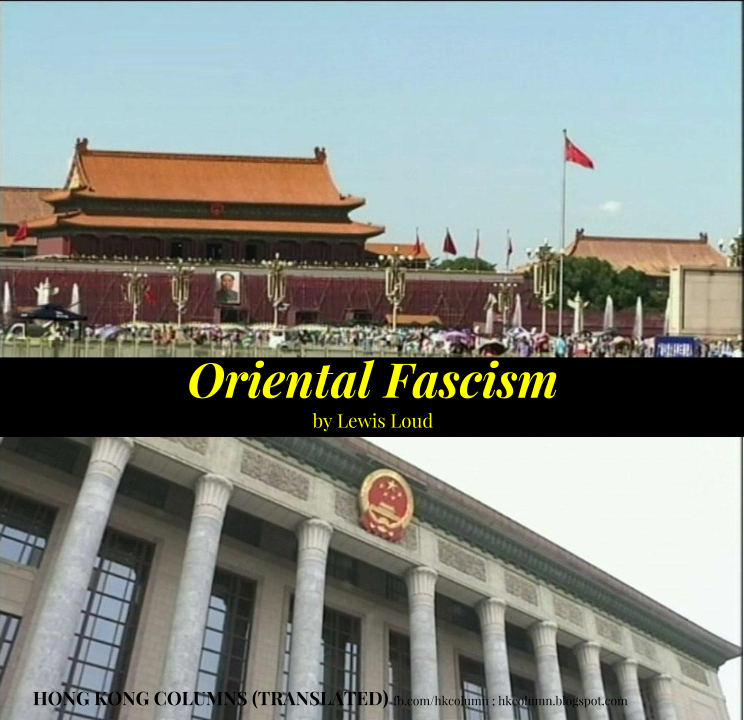
Lewis Loud: Oriental Fascism

Oriental Fascism
Translated by Ryan L, edited by Chen-t'ang, written by Lewis Loud
Original: Passion Times Vol. 41

China is a fascist country. Modern China abides by the belief in “Ein Volk, ein Reich, ein  Führer”. Modern China is an empire masquerading as a nation state.

For an ethnicity to have more than one country, like Austria and Germany, is a universal standard. Yet Chinese do not abide by this. They believe Hongkongers are Chinese, thus bound by the belief “blood is thicker than water”, therefore Hong Kong must accept Chinese rule. To mention independence is certainly treacherous, but even autonomy and localism are identified with separatist and treasonous intent. 

These beliefs are full of the elements of fascism. Westerners turn pale at the mere mention of fascism but America, ignorant and tolerant of the Communist East, supported China in opposing the Soviet Union. Hence, the largest fascist country is thriving today. Churchill once said that communism and fascism are twins that share the DNA of totalitarianism. 

90% of Hong Kong’s population are descendants of Chinese immigrants experiencing the rule from proper China since the Qin dynasty. They belong to the same ethnicity. But many entities may grow out of one ethnicity. Germanic peoples founded more than one country. The British founded America later. Once separated there was never any talk of reuniting with mother Britain.

China’s opposition to any secession through evocation of nationalist sentiments is merely hyperbole. In reality, the Chinese Communist Party cares not a wit about territorial integrity. Russia has swallowed vast chunks of Chinese territories since the Qing dynasty but Jiang Zemin signed a treaty demarcating present borders, forsaking the recovery of those lost territories. So why are the Chinese who live on these forsaken territories not traitors?

Ethnic Perceptions with Chinese Characteristics 
If China really cared about ethnicity, each province would be autonomous and establish their nationhood, then confederate to discuss matters that affected the entire region like Australia or Germany. Each province would be able to choose its own method of governance or development in accordance with the national condition yet the ethnicity would still belong to one entity. Yet China describes itself as a multiethnic yet united country. It is united so as to protect the party’s ability to monopolise all the power and profit; it is multiethnic to rationalise China’s invasive expansionism, its plundering of others’ lands. 

An ethnicity can only have one country. A country can only have one leader. Such beliefs if used in the West would be identified as hegemony, fascism and racism. Yet to the pompous westerner, eastern fascism is culturally specific to cultural complexities thus should be tolerated. This is tantamount to Westerners demanding gender equality and feminism yet tolerating the deprivation of female rights in Islam due to different values. 

Pretentiously cosmopolitan Hongkongers have very vague understanding of ethnicity. The Chinese nation (zhonghua minzu) is an artifice created by intellectuals at the end of the Qing and the beginning of the Republic era with only a century of history yet a majority of Hongkongers embrace it wholeheartedly as an earth-shattering revelation. Community eminences like Joseph Sung, Vice-Chancellor of the Chinese University of Hong Kong is an example. Yet Hong Kong with its modern meaning is already 176 years old, meaning the Hong Kong ethnicity is older than the Chinese nation by sixty or seventy years yet described as a fantasy. 

If the Hongkonger as a nation is a joke, where are the unshakeable foundations for the Chinese nation? Undoubtedly it is the mischief of power; the powers that be may have the power to define. The relationship between the signifier and the signified are unstable, artificial or arbitrary, yet, humans are the author of everything. All is silent, only power may speak. 

Hong Kong is not a nation because she says she is not. Once she decides she is, she is. 

20160316

Statement of the Generation: 00 - Preamble

Statement of the Generation: 00 - Preamble
Translated by Chen-t'ang 鎮棠, written by The Undergrad session 2015, HKUSU

[DIRECTORY: AT THE END]

This is the change of an era, and we are in this whirlpool. The disputes between generation have not stopped, but the struggle of this era has begun. No one can arrogantly neglect the aspiration from the society. No one can be trampled cowardly by the authority. We might not win the cruel reality, but we have the responsibility to respond to this era. From “Greater China” to localism, from democracy in China to autonomy in Hong Kong, from resistance to awared, comprehensive revolution – we are trying to prove that these are values that all Hongkongers deserve, and also our Zeitgeist. As Immanuel Kant said, “Out of timber so crooked as that from which man is made nothing entirely straight can be carved”.

So we drafted this statement – it began with the difficulties encountered by Hong Kong youth in this era. We described our characters and what do we want our Hong Kong to be. We know the inter-generational conflicts, and dare to point out the problems of them. We are like expecting the birth of a Hong Kong constitution, so we have prepared well to talk about the spirit, the character, the values, the facets and the vision of this code. We are like providing policies, laying the foundation for the council politics in a new generation. We are more like giving us a firm promise, that the blueprint we are having now and the sparkling aspiration will follow us for the whole life that we dare not forget.

Out of a crooked man, we must carve a straight path from it. Hong Kong needs to be under the test of the era. We Hongkongers must create a unique identity too. We Hong Kong youth need to show our strengths and determination. A generation of youth might eventually be old, but the proposals and spirits in this statement will be continuously under critique, debates, as well as developed and practiced – eventually, gaining roots across this territory.

The “Character” of This Generation
We are the best of generations, we are the worst of generations.

We are not born in chaotic times, but rather a moment when the sovereignty of Hong Kong was not transferred to China. The little us were not as perturbed as our older generation. The far and happy childhood was our imagination to Hong Kong: after school, kids ran along with their friends in parks; assignments, tests or exams were never a burden to us; we loved the estate shopping mall where we could buy our daily necessities in grocery stores or markets, or get capsule toys in stationery shops; on holidays, we could go to the Space Museum, Science Museum or Ocean Park, which were not yet cramped. As we grow, we see Hong Kong degenerating. These good old images are becoming the “Old Hong Kong”. Under this political darkness, catastrophes keep on pushing Hong Kong to the brink of death: the bogus One Country, Two Systems; a dysfunctional council; an ineffective horde of law enforcement agencies; a deceitful bunch of media; “white elephant” projects draining on and on... We have entered the worst times of Hong Kong when ridiculous things become normal. We are the generation hung between desperation and hope.

We did not choose Hong Kong, we choose Hong Kong.

Being born in Hong Kong was never our choice – we were born in British Hong Kong but raised in the Hong Kong Special Administrative Region, and are now living in the Hong Kong which is seemingly ruled completely by the PRC. Some may say if we do not like this identity, we can leave. We have no absolute responsibilities to be loyal to a place, but we have innumerable feelings to protect a place that raised us, and to protect Hongkongers as we share the common language and memories. This is the verity of “being born and raised in Hong Kong”. Even some may see Hong Kong as a temporary place to live; even some may be nonchalant on current affairs and live in the tiny existing freedom; even some may not be willing to resist the authoritarian regime for their homeland, we – amid political, economic, cultural fall – are willing to shout. We are mavericks who are unwilling to succumb to the authority nor interests.

We are the molded generation under competitions.

Our paths have been set since we were small, and pretty much the same one: interest classes, studying, taking exams, getting into colleges, finding good jobs. “We” might begin from different starting points on the running track, be it rich, middle-income or grassroots, but we are heading to the same destination. We compete for educational resources. We have to run faster, better, or even nastier to get others out of the track if we have to win. The last generation said “poor results means failure” and “not getting into colleges means meaningless prospects”, so we study and study for a good job with high salary. We spare no efforts in getting into schools they want us to get in, because education is the tool for social power and wealth allocation. Therefore, if they can afford, we have to go to different interest classes, learning different languages, musical instruments, sports or other art activities, so as to get into the “top-notch schools”. We are exhausted – brains and brawns: tutorial classes after classes make us sharp in exams so as to cut weaker ones away. We are in this competition. Those who win will say this is fair, because the winners are superior and the losers are lazy; the losers think this is fair too, because they have fought hard. Then we are thrown into the attritive society. To survive, one must compete; to compete, one must step on others' failures.

We refuse to live in such monotonous and gruelling society, nor follow the values shaped by the last generation. Even though it sounds hard, we have the courage to break the box. Every possibility exists in our Hong Kong, where artists and athletes can be a good occupation. Everyone should have the chance and possibility to paint and realize their dreams, and choose their own ways. In the Cantonese film “She Remembers, He Forgets”, there is this line: “Dream is things you think you must do before your last breath”. Our dream is to change Hong Kong. We are good at calculation, but failed at too much calculation. From taking means of transportation to life partner, we are too adept at turning things which can or cannot be quantified into numbers, treating success or failure with this so-called rationality. “Either you step on others' bodies, or you'll be stepped”, and one will fall into this endless cycle. In a narrow living space, people are afraid of being stepped on and have become self-protecting. This has in turn become a bigger nightmare.

We resist uncertainties, including resistance. It tampers our “calculators”. The “monochromatic screen” cannot tackle complicated geopolitical questions, so when we saw people taking it on streets, we stood with folded hands. We are not afraid of no fruits. No fruits might even be good, but if those self-deceiving fruits – hope – were gone, who would comfort such wound? Even if I decided to throw away the “calculator” and take on the road against the authority, I might the only one on the road. Who would comfort this solitude? We are domesticated as “rational animals”, but must it be so? “The calculator” shows the arrogance to include the world in a machine. The evolution of men and the advances in the society do not rely on the “calculated” success, but the unknown – which cannot be “calculated” at all. 

Since we were small, we were taught that obedience, instead of arrogance and obstinacy, will help one merge in the mainstream. We follow the mass because we know what comes with that is the pride from the society. The recognition, acknowledgement and status of ourselves can hardly be outside the box of criteria set by the society. When they say “you are elites”, we are elites; when they say “you are wasted youth”, we are wasted youth. The criteria on personal values brutally remove the right to define ourselves. “I” am no longer elaborated by “me”.

The last generation told us we can feel safe when we react in a way everyone likes when appropriate, if our emotions can follow the social ethics. But are we real if our behaviour is not based on real feelings but “set as default”? Are we real if we cannot face our true emotions and suppress how we really feel? There are only two kinds of things in the world, your business and none of your business. The former one needs us to tackle, and we have no stance on the latter one. On one hand we dislike the bland side of ourselves, on one hand we are glad that we are those who are recognized by the society. Every day, we are struggling between self-abhorrence and arrogance, and the only status we have is youngsters in Hong Kong. We have nothing left besides this. Albert Camus, in his book The Stranger, wrote “In our society any man who does not weep at his mother's funeral runs the risk of being sentenced to death.” We do not want to live in the society of Meursault, we want to live our lives.

This generation lives in the “blissed tree shades” of the last generation. We have more resources and are enjoying their economic fruits. They make Hong Kong famous and part of the “Newlonkong”. A beautiful city with bright lights indeed, Hong Kong has become a place chasing after figures. There is no big change in the game rules – survival of the fittest. But the last generation has not yet found out that those on the top who hold most resources are the “survivors”. The last generation has not yet realized that the fairy tales of “Lion Rock spirit” (which says hardship will be repaid well) no longer exists. The social mobility of this generation is low. Hardship can barely get economic fruits in exchange. Justice means following the original game rule. Lessons and preaches such as “What have you done for Hong Kong except messing around?” have become part of our lives. In their eyes, we are but ungrateful wasted youth sitting there; we are useless trash. After the Umbrella Revolution, the values differences between two generations become more and more obvious. Parents or teachers no longer stand with us. Following the “work - eat bread - save money for down payment” chain after graduation, giving seats in MTR compartment, obeying rules set by the last generation are the path for removing the “wasted youth” label.

We do not want to see our society tearing apart. We are sick of bickering with the seniors. We once tried to talk rationally to the last generation but no one seems to comprehend the real world. Some of us came out and strived for changing problems that the last generation failed to against all odds. We carried the sin of “wasted youth/rioters” and neglected the backfire from the last generation. We stood until dawn on Nathan Road or Connaught Road Central. We threw bricks with anger and despair, because we do not want Hong Kong to die.

This generation does not only crave for richness materially, but also the say which is controlled by the last generation, and the freedom we have not had before. We hope Hongkongers can live happily afterwards and continue to be under the “blessed tree shades” brought by the last generation. Maybe we might not be acknowledged by the last generation, but we can only “wilfully” chase after the light at the end of the tunnel amid this storm. If this is what a “wasted youth” do, we are absolutely “wasted”, because what we are after is freedom.

The society sugarcoats the truth, rottens in the hands of officials and gags us all. The society domesticates us, and we can no longer give anything else other than the model answer. We started to refuse and reject because some changes are irrevocable. Our Hong Kong is no longer what it was. It can no longer be tormented. We are restricted by doubts and fears, but we see our weakness and constraints, and try to overcome them. We are talking about things others dare not to. We are pointing fingers to the injustice. More people might enjoy in their comfort circles, but we would rather live painfully because our eyes are no longer blind.

In the face of a ridiculous society and so-called masochistic peers, we have to see hopes in desperation. Wong Pik-wan, a local novelist, wrote: “Hope is like air and light to God. When you say there is hope, and there it is.” We are standing on the cliff and have no alternatives. Let us say “there is hope, and there it is”. We have to see hope, we have to grasp hope.

THE UNDERGRAD 2016 FINALE Editorial Board
Editor-in-chief: Marcus Lau Yee-ching
Deputy editor-in-chief: Chan Hoi-ying; Chiang Min-yen

Statement of the Generation

20151122

Fong Chi-hang: Subjectivity in HK Football Team

Subjectivity in HK Football Team
Translated by Vivian L., written by Brian FONG Chi-hang
Original: http://hk.apple.nextmedia.com/news/art/20151118/19377462 

  • Hong Kong held China to a 0-0 draw in a World Cup qualifier match on Tuesday night at Mong Kok Stadium

Hong Kong’s World Cup qualifier match against China came to an end on Tuesday night as the city’s team battled its rival to a valiant 0-0 draw. Prospect for team Hong Kong aside, we have witnessed the birth of a new era as the games progressed—a new age of the "Hong Kong subjectivity".

To say football [or soccer as the Americans say] has nothing to do with politics is a lie that cannot fool anyone with half a brain. In fact, football [translator's comment: or any team sports for that matter] more often than not embodies the nexus between sports and politics. Football is the battleground between bitter rivals both on and off court (for example England─Argentina or Japan─South Korea). It also reflects the conflicts between a state's centralised power and its peripheral groups (centre-periphery conflicts).

Political scientist Benedict Anderson defined a nation as an imagined community [translator’s note: In contrast with an actual community where members interact with each other face-to-face, an imagined community is constructed socially, and imagined by the people who perceive themselves as part of that group]. Awareness of such a community is usually through symbols.

Star players pegging away on the pitch, fans cheering for their heroes, team flags and banners filling every corner of the fully seated stadium—the game of football provides the perfect concoction of the construction of subjectivity of the “periphery” community.

Examples of centre-periphery conflicts exemplified in football symbolisms are abundant.
Football clubs Barcelona and Athletic Bilbao are both the mascots and arenas of the Catalans' and the Basques' defiance against the Spanish state. In Verona, Italy, one lives and breathes a sense of the proud Venetian identity. Go to a Cardiff City game and you will see the mutual grudge between the Welsh and the English in action. Over in the French cities of Bastia and Rennes, the regional identities of the people of Corsica and Brittany cannot be more apparent in their home teams.

Today’s Team Hong Kong may not be the best squad in the city’s history, but it is certainly the team that carries the strongest sense of subjectivity of the Hong Kong identity. The match-up between HK and China inadvertently set the stage where Hongkongers defied “the Chinese Celestial Empire” at a time when China’s oppression towards the city is in full throttle while Hongkongers reap an ever-strong sense of Hong Kong subjectivity.

As team HK delivered two electrifying draws against China, every cheer and chant that echoed all around the city marked the birth of the Hong Kong Subjectivity. Our time has come and the political discourse between Hong Kong and China will never be the same.

(Author Dr. Brian FONG Chi-hang is the Associate Director of the Academy of Hong Kong Studies at The Hong Kong Institute of Education)

20151009

[Undergrad/HKUSU] From Race to Citizen: Football of the Hong Kong Nation

From Race to Citizen: Football of the Hong Kong Nation
Translated by Chen-t'ang 鎮棠, written by Chris Lau Kwun-shing 劉觀成 (Aug 2015)
Original: https://drive.google.com/file/d/0B0nrPotOynIFLUdMbFFRbjlaZE0/view


("HK TILL I DIE; THE POWER OF HONG KONG", 11 June 2015, Hong Kong vs Bhutan - Passion Times)

("Hongkongers are Bravo!", 11 June 2015, Hong Kong vs Bhutan - Passion Times)

“Do not underestimate any opponent. In this team, there are black-skinned, yellow-skinned, and white-skinned players. We must be cautious against a team with so many colour layers”.


The passion towards football soared for Hongkongers in June 2015. A provocative poster sparked off the passion for the Hong Kong team. Tickets of three matches with Hong Kong as host were all sold. Hongkongers no longer watch matches of other teams, but our own team. Many people might only know the HK Team from its championship during East Asian Games 2009 or its recent powerful form, but football has rooted deeply in the territory for over 100 years. This articles aims to introduce the history of football in Hong Kong, to delve into the establishment of the Hongkongers subjectivity, and the relationship between football and the Hong Kong nation, as well as how to deepen civil education through football.

The First "Others": the White
The way to establish one's identity is through the demarcation between "us" and "them". Football started from the UK, and took root in Hong Kong, a former British colony. At first, only the White played football. The first football club by the White, Hong Kong Football Club, was founded in 1886; the first Chinese football club in Hong Kong, South China Athletic Association, was founded in 1910. Qing dynasty declined at that time, and Chinese seemed to be suppressed by the White, and thus felt aggrieved.
Thus, in order to defeat "them" -- the White, some local Chinese started their team. With "them", the ethnic identity formed quickly. Around 1918, South China participated in the Hong Kong First Division Football League, and won the champion in 1923-24. After that, the Chinese teams won most of the matches, and thus formed sense of superiority.

Football star and nationalism
Hong Kong football clubs gradually became stronger, yet the team members did not gain the identity of Hong Kong, because the best players were representing the Republic of China (ROC) team, while the weaker ones played for the Hong Kong team. After 1949, ROC went Taiwan and lost the continental China to the Communist Party, hence the People's Republic of China (PRC; its football team usually referred to China PR). During 1954 to 1971, most of the ROC team members were from Hong Kong. This team was so bright that it won two champions in Asian Games, and even entered the quarter-final in 1960 Roma Olympic Games, and we can still see the strength of the team. But what about the players' ethnic identity? Some said the reasons why they represented ROC: some may join the ROC team because of the pro-Taipei background, or could be part of the team which could join the Roma Olympics with better privilege, rather than "emotionally attached to the Chinese nation (zhonghua minzu)". We could not determine the response of the Hongkongers at the time, but if we looked up in the lines of pro-Taipei newspaper, "Hongkongers were supporting the team for bringing honour to ROC - but these might be biased. Usually few in the ROC team were from Taiwan, and the rest were from Hong Kong; or the entire ROC team was from Hong Kong, as well as most who actually played in the field. Hongkongers wholeheartedly supported local football games: last season the average number of audience in a Hong Kong Premier League match was around 1,000, but the battle between South China and KMB in 1951 attracted over 30,000 football fans to a stadium which could contain only 15,000. We could not possibly know people's feeling towards the ROC team, but we can be sure about the passion towards local matches. We could infer that even under the name of ROC, the reason why Hongkongers were so connected to football was brilliant football stars.

Rise of Subjectivity: The Real Hong Kong Team
As United Nations passed General Assembly Resolution 2758 and the rapprochement with PRC went well, no Hongkongers participated in the ROC team after 1971. In 1974, the ROC team was kicked out of AFC, and had declined since then. Before that time Hong Kong Team existed, but with mediocre players, but since then the real Hong Kong team was formed, and attracted a lot of local football fans. The awareness of "Hongkongers supporting Hong Kong team" started to grow.

The first match between Hong Kong and China PR is the 1975 Asian Cup Qualification. Both sides were competing for being qualified in the next round. Hong Kong lost 0:1 to China PR. After the match, pro-Taipei newspapers said Hongkongers cheered for the Hong Kong team, and feel disgruntled about the brutal Chinese team. Pro-Beijing newspaper did not have a particular stance towards Hong Kong or China PR team. In 1959 Asian Cup Qualification, there were opinion of "Hong Kong team should not win ROC team", but there was no similar opinion towards China PR team. The passion towards Hong Kong team can be seen in Hong Kong vs Korea DPR (North Korea). Hong Kong team had an advantage in the early second half, but lost 2:3 to them. From newspaper reports, there were fans holding banners "Make it to Tehran, Hong Kong!" in the cheering team. In 1977 and 1986 World Cup Qualification, Hong Kong team won Singapore and China PR. When the team returned, they were well-received by fans with banners like "Hong Kong team, the best in Asia!" and "Hongkongers are bravo!" (the top picture), which is still commonly used by the fans nowadays. These away games were live on TV, so every Hongkonger could experience the peaks and valleys with the team.

Compared to the '60s, the passion towards Hong Kong team reached its peak from mid-'70s to the '80s. A clear delineation was seen: support was for Hong Kong team, not ROC team. The identity on football shifted from the White-Chinese racial differentiation at first, to the rise of Hong Kong football stars, then to a genuine, strong identity of Hongkonger.

The Fall of HK Football and the Chinese Nation Complex
Since 1990s, the football development in Hong Kong met its ebb, and no longer befit the name of "Football Kingdom". In November 2012, the world ranking of Hong Kong team fell from 90th (in '90s) to 172nd. The ebb is due to several reasons, including the HKFA's policy (which will not be explained here). As the strength of local teams no longer attracts the passion from football fans, and with satellite transmission, Hongkongers chose to watch better foreign matches. Before 1997, "democratic reunification" was a trendy phrase, and the Chinese Nation identity was strengthened, and it could be seen in the sports field. Sports is important in the ethnic identity and emotions. Many Hongkongers will support Team China in the Olympics (and the Chinese media called them the National Team after 1997 - translator's note), and felt thrilled when Team China won hurdle races, diving or table tennis, sometimes even more than Hong Kong team.

According to HKUPOP, the Chinese identity for Hongkongers was the highest in 2008, the year Beijing held Olympic games. Sports and people's emotions are often interconnected - for example, Koreans will be thrilled if they knock Japan down; or the tense atmosphere when the English team is competing with Scotland. The identity of Hongkonger declined as there were very few sports connection in the recent decade; but on the contrary, the identity of Chinese rose as the mainstream media has propagated.

HK football and Revival of the Hongkonger Identity
This June, a poster (the second from the top) from Team China read "Do not underestimate any opponent. In this team, there are black-skinned, yellow-skinned, and white-skinned players. We must be cautious against a team with so many colour layers", mocking there were members with different skin colours. After the public outcry, this poster ignited Hongkongers on supporting Hong Kong Team. This poster has provided an imagination of the Hong Kong Nation -- civic national society. There are players who are black-skinned, white-skinned, from China or from Hong Kong, but they are part of the Hong Kong Team. Putting it to the Hong Kong nation, a Hongkonger is not defined by his race, but rather, his civility. If the naturalised players are willing to wait for 7 years and be trained by the Hong Kong team, they can become part of the Hong Kong team. Football fans were thrilled whenever there were goals, no matter made by local Hongkongers or naturalised players. The linkage between players and fans is not a racial matter, but civility, or else local fans will not cheer when a White scored a goal.

Establish Our Strength through Football
Hong Kong is a small place, and it is hard to build up recognition with hard power, so we can only strengthen our subjectivity with soft power, such as culture and sports. The hard power of South Korea is not comparable with Japan and China, not to mention on the world. So Korea made itself well-known by soft power, such as Korean culture and sports (Taekwondo and football). The strength of Hong Kong football is not comparable to those years, but there were some surprising moments too. In 2009 East Asian Games, Hong Kong Team defeated the Asian football giant Japan in front of over 30,000 spectators, and won the first gold medal in football amid international sports events. The football clubs played well in Asian competitions. In 2009 AFC Cup, South China entered the semi-finals with the cheer from over 37,000 fans, but lost to Kuwait Sporting Club 0:1. Last year (2014), Kitchee also entered the semi-finals of the AFC Cup with the entire Mong Kong Stadium full with fans, but lost to Erbil from Iraq 2:3 in two rounds. This year (2015) is the first time when two Hong Kong teams entered the quarter-finals of the AFC Cup. Hong Kong Premier League (HKPL) was formed last year, and football clubs not only started their promotion for decorating, but also started finding better fields for training. Eastern Sports Club even hopes to be listed in five years, and has set targets of winning the AFC Cup in 4 years and AFC Championship in 7 years (the highest honour in Asia football club). HKFA hopes that the amenities for football in Hong Kong can be improved after the opening of Tseung Kwan O Football Training Centre in 2017. With the passion, it is expected that the football development of Hong Kong will be improved, and Hong Kong can be more influential in the football field.

Stay Local, Support Hong Kong Football
Recently there is a documentary Finding Cheung Chi Doy, focusing on the long-forgotten football star and introducing out once-famous hero. Cheung was the first Chinese player in the top football clubs in Europe. He once played in Blackpool, a League One team (the top league in England at that time). Most Hongkongers do not know this part of history because there is no introduction to the past football history.

In order to enhance national recognition, Hongkongers need to support Hong Kong football, and should not confine our vision only on football matches elsewhere, and to attach importance to training the next batch of potential players. The vital key is the support from Hongkongers - buying tickets and watch the matches, or even providing suggestions for improvement. With pressure, the HKFA will change its tack. In terms of policy, the government should train players and provide a long term planning. There is a severe lack of football training venues. The clubs or Hong Kong Team cannot help but use poor venues, and are given time restriction when using them. The administration shall build a large training venue as soon as possible, as well as set up a well-structured youth system. Belgium is a good example. With good policies, the ranking raised from 71st (2007) to what is now the 2nd, with stars like Eden Hazard and Thibault Courtois.

Regarding Youth System, clubs can work with schools to encourage students playing football, so as to change the situation of "too much emphasis on marks but too few on PE". On the other hand, the government shall improve the quality of football fields. In 2013, the Hong Kong stadium scandal smeared the name of Hong Kong when we host a match, as the supposedly grass pit become a mud ground. There was a mistake in the renovation of Mong Kok Stadium, where the capacity was reduced. We can be sure that the risk of players getting hurt will increase if the venue is poor. Besides improvement over all fields, the authorities concerned shall build a cost-efficient standard football field.

Also, the government and HKFA should unswervingly combat match-rigging. After a match in 2014, 17 players were brought away by ICAC because of suspected match-rigging. In 2011, a young Hong Kong player was abetted by a Communist Party member to buy his fellow teammates off and rig the results. Not only on the football field, we do not tolerate any corruption in any fields in Hong Kong. Integrity is one of the core values of Hong Kong. Hong Kong football can only flourish under fair competition. If Hongkongers support Hong Kong football, our once pride can be reinvigorated, so as to stop the intrusion of Chinese element, and become a genuine city with values and culture.

From 1986 to 2009, Hong Kong team had produced several great moments for us. I hereby quote the book of Dr John Lee Chun-wing, Football Kingdom: "To some people, football might only be a game where 22 people chase after a ball; but for football fans, what happened on the field is certainly not a meaningless chase." To me, football is the game after our dreams. Even clouds might overshadow Hong Kong, we Hongkongers shall go after our dreams and make miracles.