Showing posts with label Education. Show all posts

20201229

HKCT Review 2020: Education

HKCT Review 2020: Education
(Citizen News)

The education sector has long been seen by pro-Beijing forces as a major source of dissent in Hong Kong. Hong Kong officials and state media repeatedly said it was necessary to impose national education on local schools. Tensions came to a head in May, when the Examinations and Assessment Authority set a question in a history DSE paper asking whether Japan effected more good than harm to China from 1940 to 1945. Few defended the question, but when the Education Bureau (EDB) seemed to force the Authority to cancel the question, many feared for the Authority’s autonomy, and said the cancellation was unfair to students. An application for judicial review was dismissed by the High Court in July. Hans Yeung, head of the history unit in HKEAA, had to leave the organisation he served for 15 years.

In December, Liberal Studies, a particular bugbear of those opposed to the anti-ELAB protests, was gutted. It is now allocated half the time, will be assessed on a pass/fail basis, and will be taught only using strictly vetted textbooks. Meanwhile, the EDB banned two teachers from teaching, and has punished several others; more punishments are threatened. The government defended the changes, denying that they would undermine critical thinking. A pro-Beijing legislator, Priscilla Leung, however, opposed teaching secondary school critical thinking skills, and therefore supported the changes.

At the University of Hong Kong, Benny Tai, the architect of Occupy Central, was fired by the University Council in July, and 2 Tsinghua University colleagues of the current Vice-Chancellor, Zhang Xiang, were appointed Pro-Vice-Chancellors in October. CUHK university authorities called the police on its own students on graduation day in November, 8 of whom were arrested on suspicion of violating the National Security Law. University Services Centre for China Studies (USC) at CUHK would be restructuring in 2021; its Director Professor Pierre F. Landry tendered his resignation after the University proposed to restructure the Centre.

Internationally, universities including Oxford and Harvard acted to protect students studying China by ensuring that any controversial remarks they made in classroom discussions would not be disclosed anywhere else. In Australia, disciplinary proceedings went against Drew Pavlou, a student activist who organised a protest about Hong Kong; the University of Queensland denied that the proceedings had anything to do with the protest, but also refused to disclose why they had been initiated.

Last but not least, with COVID-19, universities, as well as primary and secondary schools, started to move all teaching and learning activities online, such as Zoom (though Zoom was earlier reported to be linking users' computers to PRC servers if they are using a certain version). We might have some students who have never been to a university campus to attend lessons to be university, primary or secondary school graduates.

De facto national education?

Officials both in Hong Kong and the Mainland, as well as the pro-establishment camp, have called for radical changes to the education system. In August, Kevin Yeung, the Education Secretary called on kindergarten teachers to ‘develop’ the ‘national identity’ of toddlers with ‘interactive activities’. He suggested story-telling and singing of nursery rhymes to build Chinese identity and encourage filial piety (https://www.facebook.com/hkcolumn/posts/2736703616547020). The EDB also suggested some activities to promote the PRC constitution on 4 December, such as flag-hoisting and the singing of the National Anthem. It also encouraged students to pay close attention to developments on the Mainland such as the inauguration of the Guangzhou-Shenzhen-Hong Kong Express Rail Link. The EDB did not mention certain parts of the PRC Constitution. For example, Articles 33 to 37 guarantee equality before the law, respect of human rights, and freedom of speech, the press, assembly, association, procession, demonstration, religious belief, and the person, and Article 39 prohibits unlawful searches of and intrusion into citizens’ residents. Article 40, meanwhile, protects the privacy of correspondence, and Article 41 the right to criticise state organs and suggest improvements. No activities about these provisions were suggested (https://www.facebook.com/hkcolumn/posts/2798430843707630).

Around the time of changes to Liberal Studies (see below), Reuters reported that two mainland officials had warned of ‘comprehensive education reform’ by the end of Carrie Lam’s term in 2022. Although they offered few specifics, they mooted greater monitoring of teachers. The Education Bureau did not directly respond to the report when asked for comment, but laid emphasis on the development of national identity and national security education, comparing the situation to other countries (https://www.facebook.com/hkcolumn/posts/2816505491900165). State media has also condemned the education system. The People’s Daily worried that Liberal Studies, for example, could lead to brainwashing and acceptance of ‘laam chaau’. ‘Laam chaau’ refers to mutual destruction, and is one strand of thought amongst anti-ELAB protesters, according to which, even if the achievement of protesters’ aims is impossible, some attempt should still be made to damage the local and central authorities (https://www.facebook.com/hkcolumn/posts/2818615411689173). Similar worries were expressed by the Hong Kong and Macau Affairs Office (HKMAO). A spokesperson said that advocacy of Hong Kong independence and violence was taking place in schools, and needed to be eliminated. The HKMAO also insisted on patriotism and adherence to the rule of law in schools. (https://facebook.com/hkcolumn/posts/2672849026265813). In practice, even in the one case the Education Bureau considered sufficiently egregious to disqualify a teacher from teaching, it transpired that Hong Kong independence had been discussed, but not advocated (see below). In a November blog post, Matthew Cheung, the Chief Secretary for Administration (second only to the Chief Executive) said that national security education was ‘imperative’, without providing specifics. In the new vocabulary of Hong Kong officialdom, he spoke of ‘positive values’, and praised Carrie Lam’s 2020 Policy Address as ‘comprehensive, rich, pragmatic and progressive’. According to Cheung, national security education not only helps to secure the country, but will also ensure prosperity and stability (https://www.facebook.com/hkcolumn/posts/2818377641712950).

CY Leung, a former Chief Executive, has demanded that the EDB should go further. This year he has publicly denounced several teachers and revealed their identities. Citing the arrest of over 1,000 minors in anti-ELAB protests, he said that some teachers must be ‘black sheep’ to blame, and referred to similar practices in the UK. (The Prevent scheme to prevent radicalisation in the UK has been criticised by human rights lawyers, and a Whitehall investigation found it did not work, as reported in the Financial Times. A government review is ongoing, although the appointment of a chair has been delayed by the Covid-19 pandemic.) (https://www.facebook.com/hkcolumn/photos/a.1446445815572813/2780360488847999/). Outgoing education sector lawmaker Ip Kin-yuen compared Leung’s approach to the Cultural Revolution. The Privacy Commissioner for Personal Data has received 17 complaints about Leung, and said it would handle complaints in line with existing procedures. Meanwhile, the largest teachers’ union in Hong Kong—the Professional Teachers Union (PTU)—said that it would consider filing an injunction (https://www.facebook.com/hkcolumn/posts/2777366499147398). Although the EDB has refrained from identifying teachers whom it has punished in order to comply with data protection legislation, CY Leung dismissed such concerns and applied for a judicial review of the decision. In response to a letter, the EDB said that it was following up on cases closely, but this did not satisfy Leung (https://www.facebook.com/hkcolumn/posts/2765201433697238). Leung also said that parents should be able to access this information and accused the EDB of succumbing to political pressure from teachers’ unions; in his view, good teachers would be tarred unless bad teachers were identified (https://www.facebook.com/hkcolumn/posts/2768166940067354).

Meanwhile, a Roman Catholic primary school was revealed in September to have included a patriotic prayer, which read ‘God, thank you for letting me become Chinese. I have to love the Country and the Nation just like Jesus to express my gratitude to you.’ (https://www.facebook.com/hkcolumn/posts/2749583805259001).

That same month, after references to the separation of powers under the Basic Law were removed from textbooks, the Secretary for Education denied that there was any censorship of secondary school textbooks in Hong Kong (https://www.facebook.com/hkcolumn/posts/2744332209117494).

Earlier, in May, a kindergarten teacher was accused of insulting the police after using promotional material about the Police Dog Unit on its 60th anniversary (https://www.facebook.com/hkcolumn/posts/2642574632626586).

Universities

In July, Benny Tai was fired from the Faculty of Law by HKU (https://www.facebook.com/hkcolumn/posts/2710168759200506). Tai was the architect of Occupy Central with Peace and Love, the 2014 protests demanding universal suffrage as promised in the Basic Law that led to the 2019 anti-ELAB protests. Fu Hualing, the head of the Faculty of Law, said in a circular that he strongly regretted Tai’s dismissal, but expressed hope that the faculty would still be able to maintain academic freedom. Fu is a constitutional and human rights expert, and earlier wrote an article (https://www.facebook.com/hkcolumn/posts/2697831477100901/) expressing concern about the National Security Law in that respect (https://www.facebook.com/hkcolumn/posts/2785330111684370).

In September, the HKU Lennon Wall was vandalised but rebuilt. Students demanded a full investigation from the university, especially into the possibility that security guards had neglected to prevent vandalism on campus. They held a march to the President’s office (https://www.facebook.com/hkcolumn/posts/2764162770467771). September also saw a statement from six journalism departments asking the police not to restrict their definition of journalists for operational purposes to locally government-registered and internationally prominent outlets (https://facebook.com/hkcolumn/photos/a.1446445815572813/2758806841003364).

In November, 8 graduating CUHK students were arrested after a small protest was held. Last year, the university was praised for attempting to negotiate with police on behalf of student protesters. This time, it was condemned for calling the police by its students (https://www.facebook.com/hkcolumn/posts/2825134384370609). In a joint statement by university student unions, the university was accused of destroying trust between students and management, and betraying the ideals of its founders, who had fled from the CCP’s persecution (https://www.facebook.com/hkcolumn/posts/2824919784392069). Amnesty International condemned the arrests (https://www.facebook.com/hkcolumn/posts/2825167747700606). The National Security Department claimed graduating CUHK students advocated Hong Kong independence and caused criminal damage with spray paint; it also said that CUHK had reported the students to them (https://www.facebook.com/hkcolumn/posts/2810560219161359) Later that month, four students were arrested for unlawful assembly after setting up a street booth to raise awareness about the case of 12 Hongkongers earlier arrested by the Chinese coast guard and detained in Shenzhen. The 12 were attempting to flee to Taiwan (https://www.facebook.com/hkcolumn/posts/2819484091602305).

In December, the President of the Baptist University’s Student Union was arrested on suspicion of obstructing the course of justice, possession of an offensive weapon, and resisting arrest. He had earlier been acquitted in a similar case (https://www.facebook.com/hkcolumn/posts/2821326944751353). The Student Union condemned the arrest and called it arbitrary (https://www.facebook.com/hkcolumn/posts/2820645111486203). A magistrate later granted him bail, but prohibited him from leaving Hong Kong and required him to report to the police every Thursday (https://www.facebook.com/hkcolumn/posts/2825282424355805).

Also, in December, University Services Centre for China Studies (USC) at The Chinese University of Hong Kong would be restructuring in 2021. Founded in 1963, the USC is renowned in academia worldwide and hailed as the “Mecca for China Studies”, and the imminent restructuring in the coming year amidst turbulent times in Hong Kong’s political scene has drawn suspicion of oppression. A source at CUHK told RFA that the former Centre Director Professor Pierre F. Landry tendered his resignation after the University proposed to restructure the Centre (facebook.com/hkcolumn/posts/2837965313087516).

Widespread opposition amongst students was sparked when Max Shen, later appointed Pro-Vice-Chancellor, was found to be a Party Committee member at Tsinghua University. A separate proposal will allow the Pro-Vice-Chancellor to appoint selection panels for college deans. 4,000 students signed a petition against the appointments (https://www.facebook.com/hkcolumn/photos/a.1446445815572813/2789016604649054). But Shen denied that he was a member of the Communist Party, saying that the website administrator at Tsinghua had made a mistake (https://www.facebook.com/hkcolumn/posts/2789266977957350).

Liberal Studies

Signs that changes to Liberal Studies were likely appeared in August, when it was reported that several changes had been made to textbooks. After a review by the EDB, material on the separation of powers and civil disobedience was removed. Also absent was content on localism, photos of pro-democracy marches and the 4 June candle-lit vigil. The Vice President of the PTU, Tin Fong-chak, said that the changes were an attempt to impose pro-Beijing views and went too far. Tin also remarked on the removal of references to Hong Kong’s former status as a British colony, and said that it was common knowledge anyway (https://facebook.com/hkcolumn/posts/2733826036834778). Hong Kong’s status as a colony was a vexed question in the run-up to the handover. The United Nations in 1960 passed a Declaration on the Granting of Independence to Colonial Countries and Peoples, which also made reference to self-determination. Hong Kong was classified as a colony to which the declaration applied by a report published in 1963. The view of the Chinese government, however, is that Hong Kong is not a territory entitled to self-determination, since it was always an integral part of China merely (illegitimately) occupied by Britain. Hong Kong was removed from the list after China joined the United Nations.
 
Portents continued to appear over the next few months. In September, a government task force suggested that current affairs should not be discussed at all within secondary schools, since they were beyond students’ comprehension (https://facebook.com/hkcolumn/posts/2758731234344258). The analytical components of other subjects, such as history and geography, were also under threat. New EDB guidelines placed much more emphasis on the factual elements of curricula, and cautioned against analysis of current affairs on the basis that conclusions might be subjective (https://facebook.com/hkcolumn/posts/2769156439968404).
 
Without consulting the task force concerned, the EDB decided to radically alter the Liberal Studies curriculum in November. Under the plans, the 1 to 5** grading system will be changed to pass/fail, the EDB will provide a list of approved books, and the number of topics will be halved (https://www.facebook.com/hkcolumn/posts/2815049268712454).

Ip Kin-yuen, the outgoing education sector lawmaker, said the move was a politically motivated attempt to stop students from developing critical thinking skills and discussing current affairs. Priscilla Leung, however, said doing so was a good idea, and that secondary school students were too young and vulnerable to ‘twisted information[sic]’ (https://www.facebook.com/hkcolumn/posts/2816252231925491). Over 90% of Liberal Studies teachers opposed the changes. The EDB instead said that the PTU was needlessly politicising curriculum reform and attempting to create dissension between the EDB and teachers (https://www.facebook.com/hkcolumn/posts/2826634727553908).

Civil servants and staff at the Curriculum Development Institute working on Liberal Studies said they were unaware of the changes. This discrepancy led some to suggest that the changes were politically motivated and had not actually originated from professionals in the sector (https://www.facebook.com/hkcolumn/posts/2818344878382893). The charge was repeated by the PTU. The Liberal Studies Teachers Association also said that the changes had been imposed without consultation. However, the Federation of Education Workers (HKFEW) said that changing the curriculum would reduce stress levels and allow more time to be spent on other subjects. He also worried that Liberal Studies was potentially misleading and biased, echoing other pro-establishment voices’ criticisms. The FEW is the smaller pro-establishment counterpart of the PTU (https://www.facebook.com/hkcolumn/posts/2816490408568340). Kevin Yeung, Secretary for Education, insisted that the changes were exactly as proposed. He denied any need to determine students’ precise level of knowledge in Liberal Studies, saying that the pass/fail system was sufficient (https://www.facebook.com/hkcolumn/photos/a.1446445815572813/2816631398554241/).

Yeung also attempted to reassure the public by noting that the changed curriculum would not exactly be called ‘National Education’ (https://www.facebook.com/hkcolumn/posts/2822966644587383). In 2012, student protesters forced the government to abandon moral and national education; the content of the proposals is not dissimilar from the changes to Liberal Studies. Scholarism (one of whose members is Joshua Wong) was thrown into the public limelight after the protests.

Meanwhile, at one school, the Principal ordered pupils to write letters of praise to the Chief Executive. All letters were to be submitted to her for approval, and were required to praise the Policy Address of the Chief Executive. The Principal, when questioned, defended the letters as a way to present multiple views (https://www.facebook.com/hkcolumn/posts/2818305505053497). Yeung later denied that changes to Liberal Studies would undermine critical thinking (https://www.facebook.com/hkcolumn/posts/2822966644587383).

Disqualification/investigations of teachers

One teacher revealed at the start of the year that the EDB was investigating him for criticising the police. Although his school confirmed that he had not discussed politics with pupils, the EDB demanded explanations for each individual Facebook post he had made (https://www.facebook.com/hkcolumn/posts/2553433441540706). In October, a primary school teacher was de-registered by the EDB and will therefore not be able to teach in future after discussing materials advocating Hong Kong independence in class, to the regret of some parents (https://www.facebook.com/hkcolumn/posts/2770118469872201) and pupils (https://www.facebook.com/hkcolumn/posts/2804813393069375). Amnesty International condemned the move (https://www.facebook.com/hkcolumn/posts/2770660046484710).

The People’s Daily declared that the ‘poison of colonial education’ was still present in the education sector, citing the dismissal of a primary school teacher accused of using material about Hong Kong independence (https://www.facebook.com/hkcolumn/posts/2773500822867299). The dismissal led to self-censorship amongst other teachers; for some, it was their first time. One teacher particularly feared complaints from parents or a probe from the EDB (https://www.facebook.com/hkcolumn/posts/2784194428464605).

Others have also been disciplined: 21 have been reprimanded, and 12 given written warnings; the EDB has also threatened to de-register those who break regulations. It also ‘reminded’ about 40 teachers not to behave in a manner detrimental to the professional image of teachers, and behave socially acceptably (https://www.facebook.com/hkcolumn/posts/2769623713255010). International schools have also told teachers to be careful, and reminded teachers that some pupils’ views were likely illegal (https://www.facebook.com/hkcolumn/posts/2736691943214854). In December, the Secretary for Education said that the EDB was also considering proposals to introduce new forms of punishment, such as pay cuts and temporary suspensions (https://www.facebook.com/hkcolumn/posts/2823700681180646).

Another teacher was de-registered in November after making some mistakes in teaching, such as inaccurately saying that the Opium War was started by the British to rid China of opium (https://www.facebook.com/hkcolumn/posts/2803982089819172).


In late February, Ho Pak-yan, a teacher in Confucius Hall Secondary School, published an apology in the newspaper for his suspect of issuing hate speech against the police earlier. The verse can be read vertically by the first Chinese character on each sentence, together to be read as "death to dirty cops and their families, not one less" (https://www.facebook.com/hkcolumn/posts/2585776551639728). Ho remained a teacher at the school after investigation though.

Exam controversy
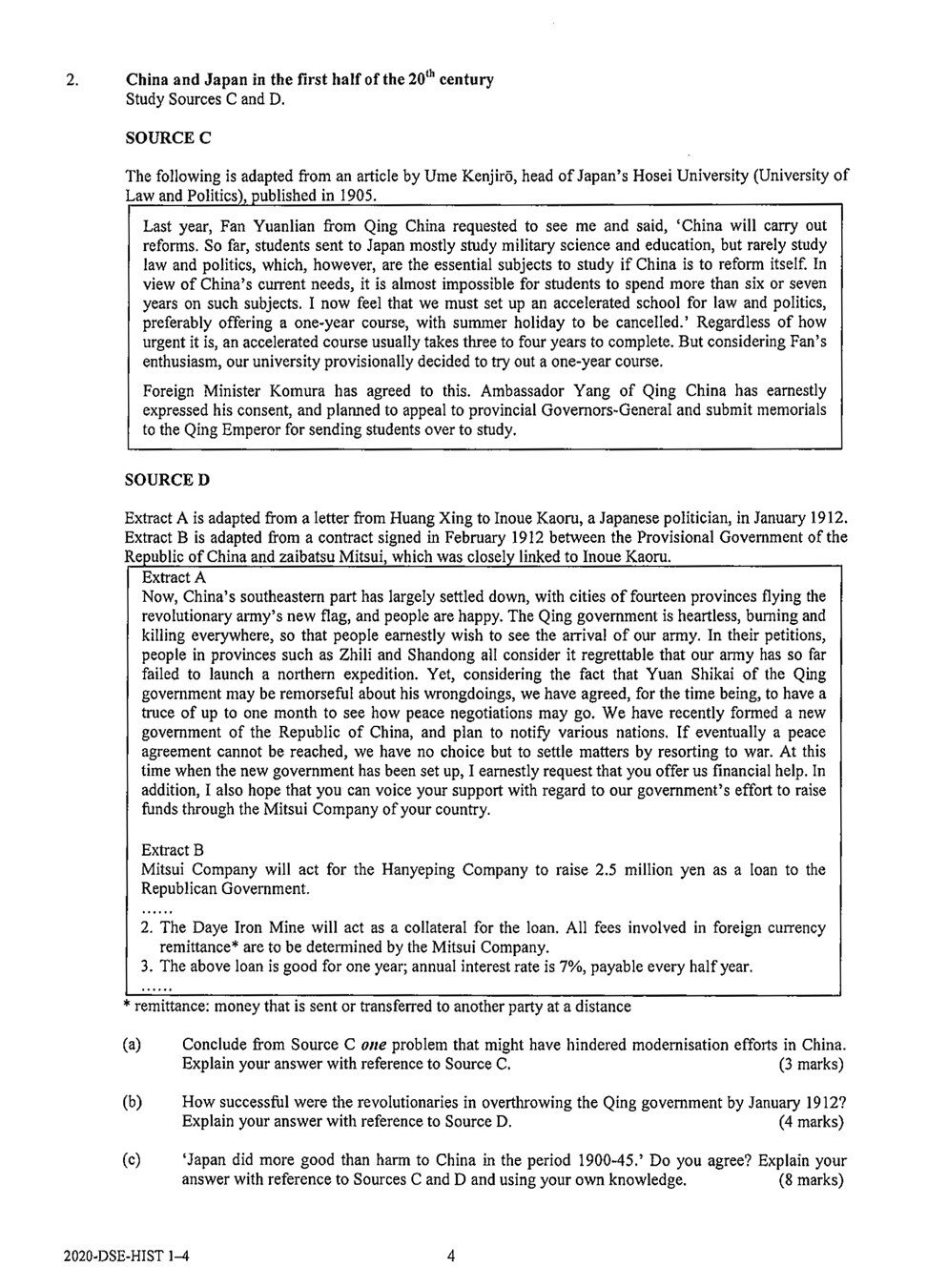

In this year’s DSE history exam, one question asked about the effect of Japan on China in the early twentieth century, sparking much controversy. The EDB demanded the cancellation of the question, and simultaneously denied exerting pressure on the Examinations and Assessment Authority (https://www.facebook.com/hkcolumn/posts/2650222985195084). It then announced an investigation into the Authority, prompting worries about its autonomy from some principals (https://www.facebook.com/hkcolumn/posts/2652544361629613).

Commentaries in the People’s Daily declared the education sector ‘deeply poisoned’ and called for stricter supervision by the EDB (https://www.facebook.com/hkcolumn/posts/2651789445038438). These complaints were echoed throughout Chinese state media (https://www.facebook.com/hkcolumn/posts/2650109455206437). Eventually, at a special meeting, the Authority decided to cancel the question and adjust marks accordingly (https://www.facebook.com/hkcolumn/posts/2655729401311109).

Several senior officials in the Authority later left. Those opposed to the move were generally worried by potential unfairness or the possibility of undermining the Authority’s autonomy, as opposed to the question in particular. One, Hans Yeung Wing-yu, a senior manager at the Authority, said that it was placed under immense political pressure. He added that to ignore candidates’ work by cancelling the question was disgraceful (https://www.facebook.com/hkcolumn/posts/2819809154903132). 2 others, who privately made controversial remarks on social media, also left (https://www.facebook.com/hkcolumn/posts/2651037021780347). Hans Yeung left HKEAA in November and received several media interviews to reveal details; it is known that the name of the setter was Kelvin Ip Kai-yiu (previously a history teacher in a leftist school and now a Curriculum Development Officer at EDB). (https://facebook.com/hkcolumn/posts/2839649649585749)

A secondary school student applied for judicial review (https://www.facebook.com/hkcolumn/posts/2652732904944092) on the basis that it was unfair, but the application was dismissed in July (https://www.facebook.com/hkcolumn/posts/2690151671202215).

Later that year, Wei Xiangdong, an education economist specialist at Lingnan University, replaced the previous Secretary-General after he decided to retire (https://www.facebook.com/hkcolumn/posts/2817475851803129).

International

The National Security Law has had international implications for teaching about China.  The University of Oxford has anonymised essays to protect students from National Security Law. Students who endanger others by making recordings will commit a disciplinary offence. (https://www.facebook.com/hkcolumn/posts/2763400660543982). Princeton, Harvard, Amherst and others and others have followed (https://www.facebook.com/hkcolumn/posts/2728787564005292).

Meanwhile, Australian universities have attempted to avoid any backlash from the Mainland after several controversial incidents involving Hong Kong. Drew Pavlou, University of Queensland student activist who organised a pro-democracy rally, was suspended. The university denies that the matter had anything to do with the rally, but also has not specified what Pavlou was accused of. It also ordered Pavlou not to disclose what the proceedings were about, threatening further punishment (https://www.facebook.com/hkcolumn/posts/2662455720638477). At the University of Melbourne, students called for the removal of job advertisements from the Hong Kong police after the passage of the National Security Law (https://www.facebook.com/hkcolumn/posts/2692323164318399).

At the University of New South Wales, management declared it had a ‘long and valued relationship with Greater China’ after complaints about articles about Hong Kong. 3 academics had written an article that was featured by the university website, attracting criticism from China. The university quickly apologised. (https://www.facebook.com/hkcolumn/posts/2713324125551636).

20201228

21:31 27 Dec: Hans Yeung Reveals: Trust in Turncoat Leads to End of Career; Sources: Question Setter Teaches in Leftist Sch before Entering EDB

Hans Yeung Reveals: Trust in Turncoat Leads to End of Career; Sources: Question Setter Teaches in Leftist Sch before Entering EDB
Original: Stand News 
21:31 27 Dec


Speaking to Stand News, Hans Yeung, former History subject manager at HKEAA, cried during an interview as he was agitated - "how can they be so unscrupulous?" The hallmark incident marking the fall of the education sector, is after all, a meticulously schemed contrivance.

Hans Yeung said, "This setter - when I knew him he was still in MPhil. He helped me when it was still in A-Level era. To put it simply, I introduced him to this path of exam-setting." After Yeung finalised to choose this man to be the setter last year, he then joined Education Bureau (EDB). The man told Yeung he was applying for the post in EDB. Based on years of cooperation and trust, Yeung did not think too much about it.

On 13 May this year, his Facebook post about China and Japan years ago was unearthed by leftist papers Ta Kung Pao and Wen Wei Po before the History DSE exam. Both papers called him for response. Yeung said, "They escalated that quickly against that Facebook post and the topic is so similar to the question in the exam, which will be due the next day - the question will surely be heckled."

Yeung then called this setter. "I said 'Hey it seems someone wants to mess with this question, what do you think?' He even said, 'It's a good exam question. If they try to mess with it, it will look very nasty." On the day of the exam, Ta Kung Pao and Wen Wei Po put Yeung as the front page, and EDB issued a statement to condemn the question. Secretary for Education Kevin Yeung demanded HKEAA to cancel the question. Yeung reached the setter again, but the setter only said "I've read it" without further response. This was the last thing he said to him directly and vanished in the life of Hans Yeung, whom the setter has known for more than 10 years.

The next time Yeung knew about this setter's remarks was from the verdict in early July after some students filed a judicial review. As a curriculum development officer, this setter wrote a report on 14 May, the exact day when the exam question was bombarded by the pro-Beijing camp.

Calling the question containing severely biased view and serious faults, The setter wrote, "This question has no room for discussion, since the answer must be only "home", instead of any "good". Given the absence of room for discussion, this question is neither suitable for educational purposes, not suitable for public examinations that aims are differentiating students' abilities objectively."

Vanished Archives learnt that this setter, when devising questions, was still a history teacher in a leftist school. He finished his MPhil in HKU History in 2009, and ironically his thesis title was "Leftist Propaganda in the Hong Kong 1967 Riots". Vanished Archives found that the thesis has disappeared from the Internet, nor can alumni nor staff access the thesis. It would be interesting to see how this former leftist school teacher interprets "anti-British riots" in his thesis.

20160318

When HK Education Becomes Banality of Evil

When HK Education Becomes Banality of Evil
Translated by Chen-t'ang 鎮棠, written by May Lau (劉倩) @ Jumbo 48.4, HKBU
Original: http://issuu.com/_hkbusueb/docs/jumbo48.4/1 
[Translator's note: not being sexist, man/men here refers to human being in general.]

What Makes Man?
The definition of education varies in different schools, and I agree what John Dewey, an American educator, proposed - education is needed to train the people to have independent thinking and sensibility, so as to reform the society and build democracy in people's mind, and this, is individual subjectivity. Education is treated as a basic human right in a civil society. Convention on the Rights of the Child Article 28 said "States Parties recognize the right of the child to education, and with a view to achieving this right progressively and on the basis of equal opportunity".

The Book of Rites said, "Generally speaking, that which makes man man is the meaning of sense of propriety and justice." Though I share Mencius' view of "Men at their birth are naturally good", sense of propriety, justice, honesty and honour need a long time to be motivated (except those emotionally detached). The fundamentals of teaching is to make a man a man, or in Mandarin chengren, which means to be a conscientious man. The teaching must be started when they are young. People now send their children to receive education in schools. Such education means teachers, who have received professional training, will deliver values to children. School and teachers play important roles in the children's development.

The Inferiority of Hong Kong's Education: Banality of Evil
The most ridiculous thing about Hong Kong's education is nothing wakes up the individual subjectivity of the students. Rome is not built in a day, and the failure of Hong Kong's educational system has accumulated for a long time, causing a fundemental institutional problem. The education system is ossified, schools and parents are overemphasizing exams and results without much care about sense of benevolence, justice or propriety. Students have no choice but become the sacrifices of such distorted education system.
The education system in Hong Kong makes me think of banality of evil - that means no thinking, not thinking of people nor the society. Evilness is banal, and everyone might fall into this trap. Some people are willing to give up their own free will to assimilate themselves into the system and follow its arrangement, and would not speak a word for the hidden immorality. Such people would use all sorts of excuses to rationalize their moral faults. These people are but horrible, because they look the same as normal people do, but when they commit crimes, the consequences are unimaginable. The most evil of human being is not to think and to blindly follow.

The concept of "banality of evil" was mentioned by Hannah Arendt, an American philosophist, in 1963 in her book Eichmann in Jerusalem: A Report on the Banality of Evil. She illustrated that these "criminals" are not unpardonably wicked, and sometimes even quite conscientious (like helping old ladies on zebra crossings), but they commit crimes when they do not think and feel responsible. When Adolf Eichmann, the Nazi killer, faced with the charge against humanity, he said he was just a law-abiding person and all he did was to execute his duties. Eichmann said his role in the Final Solution (Endlösung) was just incidental, and any other people under his situation would execute tasks delegated by Hitler.

When Education Becomes Banality of Evil
System is a double-edge sword. Whether it is well used depends on the people inside a system. The biggest problem of Hong Kong's educational system is "quantifying everything" by looking at numbers in exams and assessments. Policy makers, executers and participants do not think. Secretary for Education Eddie Ng, who said he reads 30 books a month, quantifies his reading habit into number of books read; schools, who worry parents choosing other schools, would quantify the school achievement by how many score achievers in HKDSE. The education in Hong Kong has entered an era when nothing else but quantification is important.

First, talk about territory-wide assessment (TSA). TSA initially intends to evaluate the school's education policy, provide data for the school and teachers to improve its teaching, and let the Education Bureau evaluate the schools' qualities. Many schools worry that they will be eliminated or culled, so this burden is transferred to the shoulders of students. I do not know the reason behind - must the results of students reflect the teaching quality of a school or a teacher? Does good results in students reflect good teaching? Does good teaching (or not) depend on the good results? Since primary schools, students are carrying such burden to achieve the goals set by teachers and schools, and completing exercise books one by one as if they were robots. Eventually, students and parents can no longer take it, and call for complete eradication of TSA.

Then, the public exams. In the past there were HKALE and HKCEE, and now there is HKDSE. Studying is for exams. How many things can students remember and use it for their whole lives, instead of returning to their teachers once they are outside the exam halls? With such ideology in mind, schools become "input-output" factories. Students are input with formula - "studying is for scoring marks, or you cannot get in universities". Students live under such distorted system, and some high achievers cannot even take care of themselves, not to mention "lofty ideals".

Blind Obedience - When Education Becomes the Tool for Training Skills
The education in Hong Kong does not need nor allow us to think or to ask but to absorb knowledge and become puppets. Education becomes a tool to train skills and ensure capitalism to run on. Students are raw materials, and eventually become parts which cannot function on themselves, as they need to work with other parts - they can never become an independent individual. Schools are places producing parts in a closed circuit. As Michel Foucault said, "In every society, the body was in the grip of very strict powers, which imposed on it constraints, prohibitions or obligations." (Discipline and Punish, p136, 1977 Vintage Books) In schools, students are domesticated by authority.

Under the education system in Hong Kong, students can barely think, or if they wish, they do not know how to think outside the box. Most of the time they think inside the box of Examination and Assessment Authority (HKEAA). When they recite model answer from famous tutors, speculate markers' thoughts when answering "open-ended questions", they can get high marks. The banality of evil in Hong Kong's education is not because of students' ignorance, but rather, lack of thinking ability or willingness to think, because in schools, when you follow the authority, you get awards. And so, the younger generation becomes willing to assimilate their personal will into the system, and neglect the injustice of the system, thus growing the seeds of banality of evil.

What HK Teachers Teach Is to Compromise - System Is Bigger than Justice

I think what Hong Kong teachers teach is to compromise. Why I would conclude so? I watched an episode of Below The Lion Rock 2015, a RTHK TV programme. The female leading role, Yip Hiu-yuet, stood out for the classmate bullied by the bully, but was avenged by the bully. The teacher, without understanding the complete story, punished and insulted Yip physically. The bully and her father even said they will charge Yip. The teacher worried that Yip, who will be troubled by the lawsuit, will affect the school reputation, so the teacher demanded Yip to apologise to the bully and her father. The teacher did not teach students to stand out for injustice, but rather wanted Yip to play this down and compromise. Such "roll-with-the-punches" attitude would distort justice and treat this as normal -- that is the abnormal point. Students will treat teachers as authoritative yardsticks and social norms are delivered through and confirmed by teachers. The teacher has shown the ordinary education culture in Hong Kong - students should not resist but succumb to the fact.

There are many real life examples. In the 2013 Kei Chun Primary School tragedy (where a 10-year-old girl fell from 5th floor but teachers failed to respond promptly and causing her death), a seemingly good teacher did such hysteric thing (calling St Johns, 6.9 km away instead of dialling 999 and asking for an ambulance from Margaret Hospital, which is 1.5 km away). The school and teachers succumbed to "the protection of school reputation". During the death inquiry, the teachers even said "all were following established procedures". The seemingly good teacher become murderer, because she followed the procedures and the arrangement, and put system above justice.

Reshape the Role of Teachers as Social Intellectuals
To be honest, the system cannot be changed in a day, but the people inside the system can be the key. Teachers, as social intellectuals, are not only responsible for teaching, but changing the society. Teachers have to jump out of the box of "I am just a teacher", and should remain critical to the injustice in the school and the society, and pass this mindset to students, so as to foster social transformation. This is critical pedagogy, which advocates students should have the critical thinking, to think independently and solve problems. Students can have different points of views from real life problems, so they can get away with those rigid models, and think about men and the society.

Conclusion
George Orwell's 1984 warns the world how terrible an authoritarian regime is. If people still face the society with the none-of-my-business attitude, then they would be banality of evil too, as they become puppets manipulated by others. Hong Kong education should not be in this way, and Hongkongers should not be in this way. We should hold our conscience, and probably this is the only thing we can do for Hong Kong.

Reference: Hannah Arendt, Shek Chun-yin, Alex Hui, Tsang Wing-kwong

Statement of the Generation: 02 The Possibilities of Education

Statement of the Generation: 02 The Possibilities of Education
Translated by Chen-t'ang 鎮棠, edited by Stephen Lai and Ryan L., written by The Undergrad session 2015, HKUSU

[DIRECTORY: AT THE END]

So, we are well-trained.

Education and training are two completely different concepts. Training focuses on ‘How’; education focuses on ‘Why’. Training enables us to complete a task; education enables us to determine what we should do. Training is drilling over and over again a set of model answers; education is discovering the answer while you’re learning from the books. Education is less rigid than training and there should give us more possibilities in education.

But when we talk about possibilities in Hong Kong, what are we talking about? We think we only have three possibilities in choosing a university; we choose what we read from limited possibilities: Medicine or Law are the top picks, but Pharmaceutics or Dentistry will make do. Only disciplines that come with a good expected outlook in terms of salary are possibilities. For those who are okay with numbers, a Business degree is also a possibility. These are the so-called possibilities that are presented to us.

The French sociologist Émile Durkheim once said,
Education is the influence exercised by adult generations on those that are not yet ready for social life. Its object is to arouse and to develop in the child a certain number of physical, intellectual and moral states which are demanded of him by both the political society as a whole and the special milieu for which he is specifically destined.
Education is always a way for the State to control Society. Hong Kong’s twelve-year compulsory education system keeps students at school five days a week, ten months a year. We are completely protected and monitored by the schools, carrying out all the so-called “constructive tasks” day by day. The State’s quest for control goes beyond the school-hours and children are demanded to take part in activities sanctioned by Society so no trouble would be caused. When we were small, we were asked to either stay at school or at home. So these are the two main places determining our upbringing. When the education system in Hong Kong makes exams its ultimate objective, schools only encourage an exam-oriented way of learning for the sake of their reputations, rankings and the expectations from the parents. An uniform and rigid curricular creates a singular mainstream value, assimilates non-mainstream values in Society and imposes these values on us. We are asked not to discover things that are not within the syllabus because these do not make us get better grades.

The education in Hong Kong has become a means to tame our children. Education no longer attaches importance to  people’s urbanity, but becomes the medium to instill knowledge.

When the ABC song was ‘A for apple, B for boy, C for cat’, words for things they would encounter in life but the ABC song is now ‘A for astronaut, B for barbarian, C for chimpanzee’. These kids might not dream to become astronauts but they (were made to) believe that if they know complicated words, they would not be unlettered. They might not even see a real chimpanzee in the zoo in their entire childhood.

When the aim of learning a language is no longer to promote mutual cultural exchange but to stand out in exams and interviews, what kind of children do we expect this education system to nurture? Also, for the sake of enrolment in so-called prestigious schools, parents will enrol their children in strangest of extra-curricular activities. Is it not the greatest of ironies that children do not join interest classes out of interest? From the moment they begin to walk, every step HK’s children takes is carefully calculated for the grand design of the future.

Stepping back a little, let’s have a look at the secondary school students in Hong Kong. The number of candidates for the science stream in public exams always exceed that of the humanities’ must take the compulsory subject - Chinese language. The exam paper for this subject is known as the “fatal exam paper” as candidates often perform abysmally in comprehension and writing. What could possibly be the reasons for this?

The kids nowadays are not good at subjects without formulae. Kids can read every words from the passage but they do not know the reasoning behind. They know how to write but we lack the corresponding emotions and wordings. Words are no longer used to pass on the cultural torch or promote exchange but as a means to tackle exams. We no longer crave knowledge but only the techniques for exams. This had lead to the popularity of cram schools. As a social phenomenon, cram schools is something worthy of reflection by the community.

  • Firstly, education becomes commercialized. With the exam-oriented education system, those who attend tutorial school will know the game rules better, and have a higher chance to get into universities. Your certificate affects your job application, and thus further causes inter-generational poverty. Education justifies the unfairness in society.

  • Secondly, the mode of these tutorial classes are questionable. In order to maximize the profit, the number of students for a tutorial class far exceeds the number of students for an actual school’s daytime class. The "tutors" mostly appear in DVDs. With these constraints, students are not encouraged to ask questions. We are afraid of asking silly questions and embarrassing ourselves in front of a group, not to mention questioning the formulae taught in classes. If we have questions, we will sort out ourselves instead of asking these tutors. We are afraid of mistakes and not fitting into the group.
  • Thirdly, the formulaic teaching is to blame too. Tutors will even say there are a set of answering rules to follow for humanities subjects. Even personal emotions can be expressed in formulaic ways. Imagine one day when you turn over an exam paper: instead of asking you to prove a theory, the first question asked how can you apply it in daily lives. The results might be tragic.

Once I saw a quote, "Kids are unique, but where do those banal adults come from?" When asked of books they like, most will answer designated books from the subject curriculum.

In the New Senior Secondary Curriculum, there is Liberal Studies subject. Students might need to study conservation, but how many will go to heritages on their own feet? Students might need to study the political system of Hong Kong, but how many will go to vote once they reach 18? Exams lead us to certain topics, then we will study those topics, and choose to recite those answers which can bring high marks to us. It is just like Pavlov's Dog experiment [translator's note: I guess English readers know this, I'll just skip it].

You might think you are the experimenter, but one day, you realize you are actually a Guinea pig in this huge experiment, and you know how ironic it is. Finally you made it into the college, but the society now tells you your DSE certificate is only an entrance ticket - without it, you certainly cannot get into unis; even with it, the queue is as long as Nathan Road.

Despite our youth receiving higher education, this education has not given them that promised cutting edge in the labour market. Social mobility is constrained. There is a lack of opportunity for us to work as middle-class. We strive a long way, but there is a glass ceiling. Most of the time our degrees might not be related to what we do, but employers insist on aN unnecessary certificate.. Because a certificate does not only mean skill acquisition, but also acquisition of the way of living required by the society, such as going to work on time, completing tasks given, obeying orders without making messes etc. So when undergraduates are using rather radical means to express their demands, the society will say "students are not studying but messing around". But they will not understand, these demands exist because of studying. Because we care about the society, we are able to have independent value judgement, we have so sufficient moral courage that we even dare to take the blame and join those thankless protests and actions. But in Hong Kong, the goal of education means domestication, instead of having one's own idea and opinion, so we became "bad students messing around".

Of course, entering colleges is but an ideal hypothesis. There are limited seats in colleges under UGC. Those who failed to get UGC-funded seats have to apply for associate degrees, self-financing degrees and so on. What comes with their graduation is their college loans, but the chance they can get back into universities is slim. They felt sorry as they have brought heavy financial burden to their families. They have tried their best, but they do not know what (else) can they do. In turn, no matter you want to follow the rules obediently or to fight for a better system in this society, we will not end up in a better destination. What is pathetic or lamentable is, spoon-fed Hong Kong students performed well in PISA, so the society will not reflect on the long term development after our exams.

The education in Hong Kong is distorted: Kindergarten is no different from high school as infants who have only just learned how to hold a pen are already finding it necessary to attend cram school. Conversely university is “kindergartenised” when university holds "parent's day" and provides a reply slip on the notice. We receive education, but we become the educated illiterate who are not used to independent thinking, and eventually do not know how to have independent thinking. From the moment we were born we were doomed to a struggle within this dead alley of “education”.

So, we are well-trained, but we are not well-educated.

How can we, who do not even comprehend the definition of the word “possibilities” imagine a future? Changes in the educational system are not made in a day, but we can begin with the following:

  1. Students should proactively explore knowledge beyond the syllabus and curriculum and read extensively.
  2. Interest classes should be the students’ initiative and not parents’ command;
  3. The Education Bureau (and HKEAA) should avoid making humanities subjects too formulaic. There should not be a model answer nor a marking scheme, but to evaluate the overall standard of the students. That can alleviate the tutorial class frenzy.
  4. Society should not determine the future of students with public exam results. The government should provide more skill-oriented courses, which are widely recognized, to provide more options for the younger generation.
Statement of the Generation

20160309

Wesley: In HK's Deserted Battle, It's All About Volition

In Hong Kong's Deserted Battle, It's All About Volition
Translated by Chen-t'ang 鎮棠, written by Wesley
Original: http://www.passiontimes.hk/article/03-09-2016/29222 


What appears on media recently? Students' suicide cases. Why? Stresses from studies. Since the new academic year, 19 has taken their own lives.

We are not them, we can never know how many agony and stresses they have walked through. What they endured might not be solely on academic stresses, and suicide notes can barely conclude their melancholies. Family, friendship, love or other despairs might cause their suicides. For those who were born after the Handover, they have started suffering the stresses from the society: competition for bed spaces, milk formula, lead-tainted water, and after birth? Land, insufficient housing flats, inflation.... okay, "knowledge changes fate", so things might get better in schools? Putonghua as MOI in Chinese subject, national education, spoon-feeding, all-time comparison between classmates and teachers on different things, and the list runs on and on. How about work? We have distorted company structure, unfair treatment from the supervisor, speech like "no overtime work means not aggressive enough", incommensurate proportion between wage and stress, criticisms from the society... these are suffocating.

Stresses do not only come from the pathetic now, and the desperate future. All nonsense policies, all injustice in the society, all ugly faces in LegCo, people disappearing "voluntarily" as if caught by KGB, the "One Country, Two Systems" which has melted earlier than it supposed to be ... spare kids, adults can barely see light in such a long tunnel.

When I was still studying, I will put on a sad face when I encountered difficulties. My mother would sigh and quote Xin Qiji (a Song dynasty literati), "while young, people do not know about sorrow". That might mean, "dude, you have so much more to bear in the future".

But we don't want to bear any more.

Protests, resistance, or "riot" are not for fun. Government officials are civilized beasts when they say "youngsters' resistance is barely for fame among their friends" without looking at the real problem in Hong Kong. Resistance on streets are perhaps the only hope they have got.

The society forces us to stand out, we need perseverance, action and volition. When it comes to valorous resistance, we need to resist all sorts of pressure from the media, we need volition; in companies, colleagues may have an axe to grind with you, you need to keep calm and carry on, we need volition; under the authoritarian regime, we do not scare or retreat, we need volition; academic pressure, classmates' teasing, peers' betrayal, family issues... we need volition to stand.

To live on, we need volition.

And in Hong Kong's deserted battle, it's all about volition.

My youngster friends, I will not ask you to join valorous resistance before your suicidal, or say something like "better to die in glory than live in dishonour". You own your life, and you have the right to choose your future. But remember, you will not lose when you are alive. Turn the so-called "courage to die" into a volition to revenge. Resist to those who looked down upon you, cast injustice on you, cause dejected feelings on you. It might fail, you might fall, but when you carry on and persist, one day, they will fall before you.

Remember - Carry on, and you will know, we can claim victory in this battle, LIFE.

20150929

Cheng Lap: A Country Exists for "Barbarians"

A Country Exists for "Barbarians"
Translated by Karen L., Written by Cheng Lap
Original: http://opinion.udn.com/opinion/story/6777/739442 

Source: Dennis Jarvis (CC BY-SA 2.0)

Regardless whoever you are or whatever ethnic group you are in, you, like anybody else, are born with a nationality. We have taken it for granted, membership of a country as an inborn package, that we somewhat forget to leave room wondering why it exists.

Outwardly it does not bother us at all without a stance of the existence of countries, while delving into the matter will you find an opposite answer to the initial expectation. It is expressly so since we have been in a democratic government -- though everyone of us is not directly holding the governance of one's country, every statement one voices and each vote one casts are influencing the country little by little.

Putting forward the idea, if we choose to ignore the consideration why countries are countries, it is natural for us to confuse with the roles for governmental positions. From the legislator to the president, how do we determine the right person -- functioning component of a country? Politicians, as well as bureaucracy are gearing and bearing -- with fair quality can they perform better.

We sometimes vote for a politician out of our perception of him/her being good, kind, competent, smart, or his/her healthy image, or the mutual stance with ourselves. Truly these are virtues, however here is the twist: embracing these advantages does not necessarily represent he/she is the proper one. Traditionally, being honest and having good manners are on our list of an able candidate, yet is it authentic? The answer to the presence of country lies on this question.

Western countries, if not all, refer to a country as "she" -- a goddess or a mother. It's not my intention to deny such figure of speech, but in my opinion, "it" would be more appropriate.

You mush have heard, more or less, the condition of international world remains anarchic where law is an empty recommendation. International law helps distinguishing right from wrong at most, whereas we could only pray to God for the effective implementation. Let's untie our mind shackles: What would happen if the entire judiciary, police together with judges, disappeared one day? If somebody was killed then, given that police existed no more, what could you possibly do?

The state of anarchy gives us the very answer. Politeness, reasoning, law, dogma, order of an international society -- EVERY social norm, natural as air, becomes faintly discernible. They are still there somewhere, yet no one is authoritative enough to enforce them. Yes, if someone simply wants your head down or wants to take over your possession, they should be wrong. But sadly the case in anarchy is that this someone could succeed and could get away from any of the punishment that he/she is supposed to receive.

Mere civilisation is unlikely to function in an anarchic world. Barbarity, inevitably as a consequence of such a world, can only be dealt with a new set of survival rule.

In a society of civilisation, you read and learn, in order to be qualified to meet certain criteria for a job. Then you make money in order to exchange for necessities of life, and if conflicts beyond personal level arises, you settle it rationally through lawful methods. One is regarded civilised to fulfill these situations.

In a barbaric world, reading and learning though available to one, there will be no examination to test one's capability. Conflicts are being settled not by reasoning and law, but by minimizing others' threat through conquering or governing. No one, in this case, will be hired for a job. It becomes one's responsibility to fight against each other by all means for resources so as to survive. Even so, dejectedly enough, law, if there is, does not provide you protection over your possession and anything else. Thus it narrows to the one and only way to let people know the price if they ever lay hands on you -- that is, violence, sufficient violence.

Those succeed in a barbaric world does not necessarily act in a barbarian manner, but it's a must for them to understand barbarity -- to use it as a means, to compete against it, to arrive at the level of barbarity as their counterparts. Anyone who could come through life in such environment must possess the ability to live despite the fact that the legal protection ceases to exist. These people are open-minded enough to realise that civilisation only stands when they can maintain their lives from barbarity.

Many of them who play by the rules and master the rules in a civilised society are talent, whereas they still could not get rid of the tag of "men in civilisation". To lead a country or excel in diplomacy, on a contrary, is more like hunting in the wild forest or fishing in the sea.

There is one thing about civilisation - either it stays through proper preservation measures obviously, or it will suffer, particularly so under the circumstance of barbarity. It is vital to understand how this barbaric world works. In other words, countries are there in the interest of the people's lives, their culture and dignity under the anarchic international environment. Or, we can put it this way -- Countries exist for barbarity.

This explains a country's need for violence. As a tiger protecting its cubs, a country has to be ready for others' deceitfulness, rampage or sneak attack from time to time and acts decisively to protect its people from harm. Two opposed measures are adopted, internally and externally -- one soft, one precautious and harsh, or else fatal aftermath will follow. The smaller country, the more resourceful it needs to be.

As a result of it, one will gain an insight into the origin why western culture describes a country with a feminine pronoun. But then if the object isn't within the inner circle, the soft side has to make way for the beastly nature -- it is monstrous creatures that it has to face. That is what we need for the leader of a country, not some perfectly graceful gentlemen.

Extraordinary leaders, if not all, are far from "normality": Napoleon was sort of a "bodgie"in the days of military school if we depict him in today's terminology, and the artilleries he led back in the days did not start off as the best given that cavalry dominated; Adolf Hitler was an unemployed young man living below the poverty threshold and failed to get into his dream school; Emperor Gaozu of Han was a hooligan until his mid-life kicks in; Bill Clinton was a draft dodger and enjoyed Mary Ann.

In the eye of mainstream, the background of these figures are out of orthodoxy, but it happens to be this unique personality formed -- disobedience to the general thought -- that make them stand out from the crowd and be able to deal with the outside world.

We have seen many successful figures who start off impish or mischievous and end up being owners of companies while those behaved turns out to be senior employees. Somehow our society gets overly attentive to the latter one, but for the former one, it has not given weight to foster certain talents. It throws light upon the phenomenon in our society -- everyone wants to get a job, and no one creates enough jobs to balance the demand. One started to lose count of conformity, but it remains short of leaders. The ones who attempted to be leader and failed should reflect on their customary being in the comfort zone of a highly civilised society.

In the core value of mainstream, ironically, it is conveniently found that those challenged the norms are labelled as worthless. The leaders of the future are screened out too early before we realise.

20150519

Cheng Lap: HK is a dangerous time bomb in case China has not yet found out

HK is a dangerous time bomb in case China has not yet found out
Translated by Chen-t'ang 鎮棠, edited by Karen L., Written by Cheng Lap (鄭立)
Original: http://chenglap-blog.logdown.com/posts/258649-causes-of-conflict-in-sino-hong-kong/ 


Recently, in Hong Kong, several anti-smugglers protests broke out. For the Hong Kong-China conflict, one will naturally see its inevitableness due to the tug-of-war-like political structure when one observes at the scene here in Hong Kong.

To start with the incomplete authority of the Government of the HKSAR is far and away the cause. Precisely, HKSARG has no approval authority on whom and how many Chinese can travel in and immigrate to Hong Kong, and neither is the amount of Individual Visit Scheme (IVS) cities controlled by the HKSARG. "The problem of Hong Kong is an external one," some of my friends from the police force who involved in the Umbrella Revolution once said so. It can be seen that to most of the people, they wrongly assume the HKSARG has such authority, but as a matter of fact it hasn't.

In addition, half of the Legislative Council (LegCo) comprises members of the functional constituency group, who walk into the seat with zero votes. That is, the case in Hong Kong is an oligarchy, and above such government, there is the "comprador bourgeoisie" (includes landlords, merchants and civil servants) back in the colonial era. The Chinese Communist Party attempts to take charge of Hong Kong by controlling the "comprador bourgeoisie" as Brits did. And this time, given their worship over the nabobism and unlimited power among the corrupt Chinese bureaucrats, it only takes a slight effort to do so. Why? The existence of functional constituency leads to the forevermore-below-half elected seats of the membership. By a no-brainer deduction, interests will side with the oligarchs.

By controlling the functional constituency group, executive has more or less managed to control the legislature. One of the separation of powers has merely gone. Social problems like over-population and the everlasting unfavourable results afterwards are not likely to be solved given the imbalanced power of the LegCo. Translation: bills avoiding those problems that are supposed to be passed have been opposed since they do not earn benefits for the vested interests. It has been seen enough vested interests strengthening their self-interests this way.

In 1998, HKSARG dismantled its original LegCo. And the then provisional LegCo, which its bigwig members were basically appointed by the CCP, aimed to abolish the vital policies by the colonial government which had maintained the social stability:

- Rent control. The main policy that limits rent increase. It comes as a wonder to many people why there are less dissatisfaction living under the colonial regime than the CCP. Rent control is one of the many answers as the colonial government restricted both the growth of rent and property price. This policy has fallen apart since 1997 when the oligarchy started to take charge. After that, the property price and rent have been skyrocketed, and those landlords and property owners are laughing their way to the bank. To foreigners, Hong Kong is a place about pricey and tiny flats. And to locals, this is daily life suffering endlessly -- everyone is being exploited and is made to paying rent of some HKD$10,000.


- Public Order Ordinance. Police's authority enhanced and the freedom of assembly and demonstration denied as well, they turn protests against the government from a right to some dangerous thing  -- one might get arrested and detained exercising one's right of protesting peacefully, be searched of one's house out of coming-from-nowhere speculations or get a difficult time. A deterioration of police-civilian relationship is what is leading ahead of Hong Kong. The city has long been famous for peaceful demonstrations, whereas the government decide to neglect their views. Worse still, police force are implemented to stop them from protesting and to file prosecutions against them. All these will only lead Hong Kong to form a ideology as "If a peaceful protest does not bear fruit, why bother?". As I mentioned before, the harder the government blackens and suppresses the peaceful protesters, the more hardcore protesters come to the front of protests.


The change before and after 1997 is lifting the restrictions on the vested interests, as well as allowing the police to attack the public, to which CCP is to blame. It is simply too naive for them to belittle the establishment of a colony and to assume a little effort will do. The communist party think they can rule the place with compradors without knowing that a sound separation of powers behind is more than necessary. Although Hong Kong was removed from the colony list in 1972 (Link 1, Link 2), the CCP still treat Hong Kong as one of them. The CCP has taught their students "Colony is a political entity where the invader controls the compradors" and when the students become the leader of the country, they mistakenly expect applying what the colonisers do is going to guarantee a stable regime as UK back in the colonial era.

The Communist Party itself do not have the separation of powers. Thus there is no any sort of rightful checks and balances to monitor over the compradors. Such regime will inevitably lead to an old-style colonialisation -- all about exploitation, suppression, confrontation and independence.

The election is by no means fair in Hong Kong. In the LegCo, a member might be from over 100,000 votes in geographical constituencies , or 0 votes from functional constituencies. The latter ones are the vested interests and most of them have invested shops and have benefited from IVS and smuggling (Imagine the rent of 1,000-feet shop is worth HKD$1,000,000/USD$129,000 per month -- impossible in the rest of the world). And how did the government deal with the side effect? Suppress.

Letitia Lee, one of the leader from the Blue Ribbon thugs.
Yet, the political infighting involved in Hong Kong at the same time. Some thugs sponsored by Chinese funds and the Falun Gong are putting their Communist-style confrontation in Hong Kong. At first Hongkongers felt "it doesn't matter to me anyway", but gradually they found out that when it comes to things related to the CCP, peaceful tactics are futile, or basically laughing stock.

The government neglects every protest of Hongkongers. They even set up a 3-metre barrier to ban citizens from going inside. In other words, they damage channels and spaces for the government-public communication and protests. Applying police force against protesters, they think that if legal protesting becomes harder and inefficient, the public will give up someday.


Yet the government has miscalculated the situation. The Umbrella Revolution first started with a class boycott with few dozens of people, then tens of thousands of protesters for two to three months of street confrontation -- the root is the miscalculation of the public response. Every riot starts with the thought of "once the authority suppresses, protesters disperse", while the new generation of Hongkongers is now possessing the thought of "more suppression, more confrontation" -- the police ended up using more weapons like tear gas and batons which is a further deterioration to the situation. The more participants in the issue, the more unconventional and guerilla-style confrontational tactics appear -- from a peaceful protest to wearing masks; from willing to cooperate to grabbing fellow protesters from the police force; from protesting to the government to starting anti-smugglers movements.


When the suppression escalates, the tactics of participants escalate causing a vicious cycle. The next bottleneck might be on the "boundary". From the viewpoint of historians, this is a repetition of the period during the end of a colonial era, like Boston Tea Party or the Netherlands' Eighty Years War. The confrontation will take place outside of Hong Kong, maybe in China or overseas. Whatever the government attempts to escalate the suppression against the protesters, it can do nothing outside the jurisdiction of Hong Kong.

Since 1997, the education of Hong Kong has been infiltrated with elements from CCP, such as giving salute to the Five-Star Flag, singing March of the Volunteers (PRC's national anthem) and indoctrinating about the CCP. This "Umbrella generation" is grown under such pro-CCP education. But as a teacher, I found that students never for a day like such indoctrination -- the students hate CCP even more after being sent to the military training camp in there. Students found these coercive behaviour strangle which causes a more anti-CCP generation than ever.

Although most of the Hongkongers assert new immigrants are "diluting" the population of Hong Kong, quite a few of the "Umbrella Generation" are the offspring of new immigrants, and some may even receive their primary education in mainland China. Lives have not been easy for them since the moment coming to Hong Kong. Caught between two stools, a strong sense of anti-CCP awareness appears to them -- there is no way can they go back in China and live happily ever after. It is the sole road for them to strengthen their own Hongkonger identity, so as to be more "Hongkonger" than a "Hongkonger".

This reasoning may sound off, but it makes every sense of it. Historically speaking, Napoleon was the French emperor, but he was from Corsica; Adolf Hitler was the Führer of Germany, but he was from Austria; Joseph Stalin was the leader of USSR, but he was from Georgia. These "foreigners" have nothing in the first place. Hong Kong received almost a million new immigrants alike, and this very thought has grown more than prevalent among such generation.

Also, Renminbi (Chinese Yuan) is not a freely convertible currency, whereas HKD has pegged to USD through Linked Exchange Rate system. Hong Kong is the only Common Law jurisdiction in the Greater China region. Our legal system is similar to the UK and the US. Our currency, passport and legal system are internationally acknowledged. Any cities in PRC, including Shanghai, cannot attain that, even their property price skyrockets or they have a record-high GDP.

元, 人民币, 货币, 中国, 背面, 钱, ¥ 元, 法定货币
(Source: Pixabay)
This is one of the blind spots when people look into HK-China relationship -- there is a vital and inseparable interest behind. The biggest wealth of Hong Kong is the system independent from the CCP, and the compradors know this. They know the CCP will not act rashly in Hong Kong, and so they try all means to gain interests in Hong Kong with the support of CCP. The HKSAR passport and those related companies have become springboards for many important CCP figures in leaving CCP. The compradors do not care to aggravate conflicts or the other way round. They can leave Hong Kong whenever they want even if anything bad appears. High-ranked officials in Hong Kong, including CY Leung's family, are basically abroad. Imagine any major unfavourable issue happens in Hong Kong, these officials could land at some overseas countries safely leaving behind a RMB economy bomb with the citizens.

Many people have a thought that empowering elites the full authorities is what makes things work, and makes things work well, however, in the case of Hong Kong, it reveals the absolute power has every ability to turn people corrupt. It is because the one could use the absolute power in hand to serve one's self-interests and to get away with the responsibilities. A friend of mine from the CCP, who is rather open-minded, says that many people undermines the complexity of the Hong Kong society. China has taken a dangerous time bomb. After the 70s, Hong Kong can no longer be seen as a colony, but few people are aware of that.

20150313

Atsuna: HKers Are Educated Illiterates, in Lu Xun's Words

Hongkongers Are Educated Illiterates, in Lu Xun's Words
Translated by Chen-t'ang 鎮棠, Edited by Vivian L., Written by Atsuna
Original: http://www.passiontimes.hk/article/03-02-2015/21495 


[Translator's note: Lu Xun was a famous leftist writer during the first half of the 20th century in China. His works are mostly written in Chinese, and you can find the English translation here.]

Lu Xun's stories are littered with rotten-to-the-core characters--they are either ignorant illiterates, or educated elites who are so fraught with envy one can almost see the green-eyed monster jumping out of the page.

Lu Xun gave up medicine to be a writer because he wanted to rescue the Chinese populace from the age-old depravity by offering stark social criticisms through literaray works. Set in early 20th century China, Lu Xun's stories -- where men wear cheongsams, and struggle over whether to cut or keep their queues (the long pigtails) years after the Qing domination had fallen -- were written to pointedly criticise and mock the society and its people for their crooked ways. It was a time, it seems, that bears little resemblance to our present day Hong Kong--Hongkongers never believe that eating a bread soaked in blood can treat tuberculosis, and we are much stronger than conceited the anti-hero Kung I-chi who is a student of the traditional teaching and a downright loser in all aspects of life--but are we so far from Lu Xun's world?

The aim of education is to enlighten. In Lu Xun's time, education was a privilege. Even if one had a chance to study, it's hard not to be influenced by the traditionalistic backward thinking that was severely outdated in the 20th century society.

Decades of modernised education has virtually eliminated illiterates in Hong Kong, yet a vast number of "educated illiterates" remains in our midst.

In Lu Xun's Medicine, when the jail warden hears the anti-Qing coup leader proudly exclaims, "The great Qing empire belongs to the People!", his only concern is whether he can squeeze some pennies out of the revolutionaries about to be executed. Blue ribbon thugs snarled at mentions of "Hong Kong nation-building" as they find the notion "rebellious", still many sought profit out of the Umbrella Revolution by signing up to the pro-Beijing camp's troop of "amateur thugs" to put on a show in the Mong Kok occupy camp.

Lu Xun taunted the cannabalistic teaching (吃人的禮教) of the old-school feudalistic ideologies in A Madman's Diary. Decades have passed, yet these ridiculous doctrines lived on in reincarnated form here in Hong Kong.

Generations of Hongkongers have been hopelessly bound by the curse of The Great Unity of the "Chinese people" and the pan-democrats' infallible dogma of "Peace, Rationality, Non-Violence and Non-swearing".

The self-deceiving loser protagonist in The True Story of Ah Q professes in "spiritual victories". Despite being synonymous with idiocy, the "Ah Q mentality" continues to be practiced by many in Hong Kong. Even the Umbrella Revolution ended in failure, Hongkongers rejoiced in their spiritual victories when the singer Common mentioned Hong Kong in his Oscar win. As if that was not enough to sate their need to feel good about themselves, they have whipped up an endless string of frivolities to "commemorate" their "hard-fought victory".

Kung I-chi knew how to write the four different forms of the character 回 (hui), for this he is happy as a clam because it makes him the only one who is "knowledgeable".

Leftards (note: faux-LEFTist reTARDs) hail themselves as "knowledgeable" people as well. They like to use jargons to confuse rather than to use valid arguments to win over opponents. When they are losing ground in a debate, they move thegoalposts just as Kung I-chi does, living out his famous saying, "Taking a book can't be considered stealing!". That's why Occupy Central™'s "volunteer lawyers" said they were not obliged to help protesters arrested during the occupy protest.

People of this generation have had much more education than the generations before us. We may not have read as much as it is good for us given our busy lives, yet we should be way more knowledgeable than people in Lu Xun's time! Why are people in this day and age still exactly the same as Lu Xun described?

When there are few choices in life, people become more ignorant. Local author Isaac Sit said,
"If people allow the rulers to decide what is most suitable for them, they become subjects who inevitably grow more and more stupid. If free choice is allowed from the start, people might make wrong choices, but they would learn from their mistakes, and gradually grow smarter."
North Koreans think of themselves as the most blessed nation in the world. Chinese are less delusional, but still think "China has risen because of the Party's right direction" without realising that if it was not for the Great Party, modern China would have advanced to the level of other developed countries decades ago, and not the newly rich with morals of barbarians that it is today.

We have allowed ourselves limited choices since childhood when our parents and teachers always say, "Do as you're told. Don't ask questions." It's only after you are all grown up that you realise you no longer have much choices in how you lead your life, whether it's choices for food and entertainment, or bigger issues like career and government. But you find yourself powerless over the status quo.

Hongkongers might want to read, but everyone has to work their arses off to pay for mortgage. When overtime is the norm, the diligent workers hardly find the time to read or be inspired by the works of Lu Xun, or at the very least suffer the awakening that Lu Xun had already berated characters exactly like themselves 100-odd years ago.
========================
Contemporary Chinese Literature Tidbits: Ah Q Spirit/Mentality