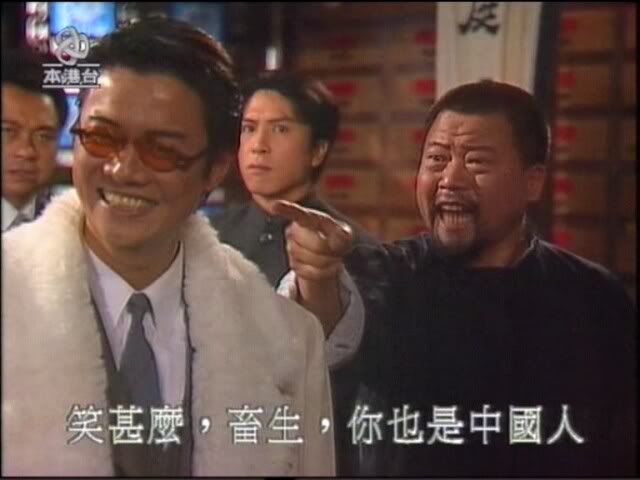
What Are You Laughing At? You Are Chinese Too!
On the Origin of the Chinese Nation and Hong Kong Subjectivity
Translated by Gordon Cheung, edited by Chen-tang, written by Kyle Chung Wai-kin 鍾偉健 (Aug 2015)
Original: https://drive.google.com/file/d/0B0nrPotOynIFLUdMbFFRbjlaZE0/view
 |
| (What are you laughing at? Bastard, you are Chinese too!) |
The very core element in constructing a national identity is the shaping of an ethnic identity. The subjectivity of a people lies in how a group of people primarily identify themselves. To construct a Hong Kong national identity, therefore, is to establish an ethnic identity through historical narratives, public affairs and popular culture. When establishing the subjectivity of a people, multiple identities inevitably clash with each other, and in the case of Hong Kong, the Chinese identity (Zhonghua Minzu) is the first and foremost obstacle in establishing the subjectivity of Hongkonger. This essay aims to manifest the historical track where the concept of Chinese-ness evolves from “diverse/pluralistic” to “unified/singular”, to point out the singularity of the Chinese identity is neither certain nor necessary, and hence to enable reflections on the possible future of a Hong Kong subjectivity.
“What are you laughing at? You are Chinese too!” If we were to encounter such accusations one day, the first thing that comes to my mind would be, “What are you even talking about? What is a Chinese anyway?” “China”… “Since ancient times”… Ironically, China has always been an ambiguous concept since ancient times. Let us start from the definition in a broader sense, where “China” represents a political and cultural community since Zhou Dynasty, and where being a Chinese means the consciousness one is a member of such community. Such consciousness is an inevitable product in human society as humans seek to co-govern and co-exist. A quote from the Commentary of Zuo goes, “A different race entails a different mind,” where “race” means the same ethnicity, but how we define “race” nowadays remains a problem unsolved. Fei Hsiao-tung’s The Pattern of Diversity in Unity of the Zhonghua Minzu reviewed and restated the mainstream opinion of the Chinese academia, where he used “Zhonghua Minzu” to refer to the some billion people living within Chinese national boundary, who have a national identity. He described the community as a “diverse unity”, which means that the Han race absorbed a lot of minor races (or “ethnic minorities”), and minor races also absorbed a lot of Han members during the course of history. However, what is worth noting is, where does this “unity” of a national identity come from? Is it really “unified” national identity?
The Genesis of China: A Cultural and Living Community
As Yu Ying-shih pointed out, ancient Chinese seldom distinguished “a different race” according to their biological ethnicity, which means the difference between Chinese and non-Chinese was not biological but cultural and ethical. As the saying goes, “if the feudal princes obey the barbarians’ conduct, they are barbarians; if they obey the Chinese ones, they are Chinese,” which means the real difference between Chinese and barbarians is li, rituals and ethical conduct, which is prominent of the upper classes. For the lower classes, on the other hand, a “race” is a way of life and a mode of production. For example, those who herded sheep and cattle by the day and live by a fire at night were called Di (狄), the fishermen and hunters who equipped themselves with longbows were called Yi (夷), those who planted rice and practiced slash-and-burn would be called Lieshan Shi (烈山氏), Shennong (神農), or the descendants of Houji (后稷之後). After Yin and Zhou Dynasties, as well as the Spring and Autumn and Warring States period, the concept of a state came to be, it was until then groups of people were no longer distinguished as social communities “by people” but geopolitical communities “by land”. Ever since Confucianism became the orthodox belief system of the central kingdom, “cultural distinction between Chinese and barbarians” came to be widely accepted by the Han Chinese.
In general, Chinese scholars explain the nationalistic concept of ancient Chinese using the theory of
tianxia (“under the heaven”, 天下), which means China is the centre of the World, and other races scatter around China, who can be further classified into Yi (barbarians, 夷) and Fan (tributary states, 藩, barbarians who submit themselves to the superior rule of China); such is called Sino-centrism (
huaxia zhongxin zhuyi), which contains the elements of modern-day cultural nationalism, as it differentiates “our race” and “the other” in terms of cultural customs and ethical conduct. Sino-centrism, in practice, is Han-centrism. For two millennia, different other races migrated to
China proper and became a member of the Han race, as they adopted the Han costume, language, writing system and way of life. However, as Ge Jianxiong (a Chinese historian) pointed out, such kind of Han-supremacist Sino-centrism is unequal in itself, as it develops at the price of other races’ demise, while at the same time it keeps an unrealistic sense of superiority among Chinese people. It was when European intruders came to China and scattered the dream of using Chinese cultural superiority as a symbol of their national identity that Chinese intellectuals came up with ethnic nationalism to fill up the great void they had in national identity.
The Fickle Chinese Nationalism
In fact, as Hung Ho-fung pointed out, the meaning of Chinese nationalism has always been changing and shifting between civic nationalism and ethnic nationalism. In late Ming to early Qing Dynasty, Wang Fu-chi (王夫之) raised the notion of “segregation between Chinese and barbarians (yi xia zhi fang, 夷夏之防)”, which was geared towards the Manchurians, and was the very example of extreme ethnic nationalism. Later, when the Manchurians took over China and underwent Sinification themselves, they were considered a member of the Chinese cultural community.
After the Opium War, the development of the thought on Chinese nationalism took on two different routes, one of them being the Self-strengthening Movement as proposed by high-rank government officials and intellectuals, such as Tseng Kuo-fan, Li Hung-chang, Tso Tsung-t'ang and Chang Chih-tung, who saw Manchurians as a member of China, and suggested a China-versus-West dichotomy, since it was only through which could these Han-Chinese officials, who worked for the Manchurian Qing government, avoid the conflict between their nationalism and their career in the government. The other route was a continuation of Wang’s Han-versus-Manchurian ethnic view, such as when the leaders from Taiping Heavenly Kingdom (太平天囯) announced the Manchurians were misfits and demons to be destroyed.
The term “Chinese nation” (Zhonghua Minzu) was first used by Liang Chi-chao, who borrowed the theory of nation-state from Swiss jurist and politician Johann Kaspar Bluntschli. Believing that “there are only tribal men but no citizens in China”, and that Chinese people had no sense of statehood, Liang deliberately put strong emphasis on the supreme authority of the “reason of state”, a concept where the state is the top priority of its people, due to the fact that China was being coveted by imperialism and was under survival threat. Liang stated that on top of the Han-centric “micro-nationalism”, China should focus more on “macro-nationalism”, which was the macro-nation formed by combining all the races in the state.
At the beginning of the Revolution, Manchurians were seen as foreigners by Dr. Sun Yat-sen, who founded the Revive China Society (Hsing Chung Hui, 興中會), with the oath of “expel Manchu, revive China (Zhonghua)”. However, as Sun assumed the position as Temporary President of the Republic of China on 1st January 1912, he announced that “the territories of peoples of Han, Manchurians, Mongolians, Huis and Tibetans shall be combined to form one single country” and the notion of “expelling the Manchus” had been abolished. But again, in 1920, he stopped advocating China’s role as a republic of five races, as he would like to adopt the melting-pot policy in United States of America, and incorporate all races in China to form a “Chinese nation” (Zhonghua Minzu), while later, he explicated that such a nationalism is “Han nationalism” in practice.
The Chinese Communist Party (CCP) had once adopted the theory of self-determination from the USSR, and supported the five races to freely align and unite with each other to fight against imperialism and oppression. The 1934 draft of Outline Constitution of Chinese Soviet Republic had Verse 14, which stated that “the Chinese Soviet regime recognises the right to self-determination of ethnic minorities in the territories of China, to the extent where ethnic minorities are endowed with the right to secede from China and form their own independent countries.” In 1945, on the 7th National Congress of the CCP, the report submitted by Mao Zedong, On Coalition Government, stated the necessity of forming a federal-based central government: “to improve the treatment of ethnic minorities in the state, and to endow them with the rights to self-determination, as well as the rights to form a united federal state with Han people under the principle of consent.” [Translation discrepancy appeared in its official translation: “Give the minority nationalities in China better and grant them autonomous rights”]
However, immediately after the establishment of the Communist regime, the self-determination issue was downplayed by the government. In the telegraph issued by the Central Committee of CCP on 5 October 1949, “the issue of ‘self-determination’ of ethnic minorities should not be brought up again. During the civil war, the Party used such slogan to gain support from ethnic minorities to fight against the reactionary rule of the Nationalist Party (as they were Han chauvinists to the ethnic minorities), which was totally right in that particular situation. However, the situation has changed nowadays.” From this we can see the CCP advocates different racial theories just to serve their political agenda: when it was to resist the Nationalist government, they advocated self-determination; when it has established its own regime and came to power, they shifted to advocating ethnic assimilation. (Note)
Reflections on the Chinese Nation and the Pursuit of an Identity
In his work Banal Nationalism, Michael Billig pointed out the similarity between nationalism and a flag: rolled up when not in use; but when in need, it would be taken out for display again. The notion of “Chinese nation” has been taken out and given a wag for so many times, ranging from Sun Yat-sen to the Communist regime: sometimes the notion is adopted to advocate racism, sometimes it is used to advocate a melting-pot policy; “Chinese nation” is but a flag used to suit different political regimes and their agendas. The meaning of “Chinese” has undergone 2000 years of Sino-centrism (huaxia zhongxin zhuyi), which is at the same time Han-centrism, all the way until now, where we have the “Chinese nation”, from which doctrines such as “diverse unity” and “the Han in turn enriched other races” derived. With the economic and demographic privilege enjoyed by the Han people of the country, as well as the single-party system dominated by the Han people, there is hardly a unity of Chinese races. The most critical time for the peoples of China was also the time when Chinese nationalism was being manipulated to the fullest. Although there is a growing consciousness of the Communist government concerning the use of terms “children of the Yellow Emperor” or “descendants of the Dragon”, which are replaced by a broader term “the peoples of China”, few Chinese people can get rid of the ethnic-nationalistic framework. The European-Asian dichotomy since late Qing Dynasty reinforces the concept where Chinese-ness merely equals the biological features as having yellow skin and black hair, and as such concept fused with Han chauvinism, minor races with their own languages and customs find it difficult to fit in as a people of China.
Under the current political context in Hong Kong, those who would agree on defining a people by its ethnicity and culture would be labeled as “Greater China morons”. While I agree that the Sinocentric mindset, rooted in Han-centrism, is full of contradiction, I also understand the genesis of such a complex under a Chinese cultural context. A culture links to history, and history links to the communal imagination of a people. Such linkage is especially evident in the 2000-year-old Chinese languages, where idioms are a direct reflection of a common history, unlike Western ones (for example, “pointing a deer and saying it's a horse” [distort rights and wrongs] has a root from Qin dynasty). It is a common saying in the Chinese intelligentsia, “there is no separation of literature from history”, which means literature and history are intertwined. Chinese languages are the very vehicle of Chinese history, which is a history of separation and reunification through dynasties, of the yearning for a unified empire as its ultimate goal, which is why so many Chinese people sense a feeling of diaspora, a feeling where “flowers and fruits scatter” [from the trunk of China], as Tang Chün-i put it.
Lastly, let us go back to a very basic question: “Who am I?” According to the
 |
| (Robert Chung, chief in HKUPOP; aTV News) |
results from the Public Opinion Programme by the University of Hong Kong (HKUPOP) since 1997, when given the options “Hongkonger”, “Chinese”, “Hong Kong Chinese” and “Hongkonger of China”, only 18.1% of the interviewees identified themselves as “Hongkongers” in 2008, whereas 35.9% and 36.5% were recorded in second half of 1997 and first half of 2015 respectively. In other words, there are generally more than 60% Hongkongers who would identify themselves as being Chinese. However, these figures only show Hongkongers’ affiliation with a Chinese identity in its broadest sense, as whether Hongkongers’ identification with China is cultural or political remains unreported in these figures. According to an investigation delegated to HKUPOP (by an academic study task force where a public announcement is yet to be made), citizens still identify very much with “the Chinese nation”, “China as a motherland” and “People’s Republic of China as a motherland”; the data also shows Hongkongers agree there are close historical and ancestral ties between Hongkongers and Mainland Chinese people, but they also emphasise that they hold a different set of values from Mainlanders.
Brian Fong claimed the data show that Hongkongers have, in turn, a “hybrid” national identity, which Chan Chi-kit calls as “Hong Kong-style nationalism”, a nationalism constituted mainly by “civil values”, while including some elements of “ethnic identity”. According to Chan, “Hong Kong-style nationalism” never rejected the common ancestral, cultural and historical lineage to start with; in the past, Hongkongers resented Beijing’s iron-fist policy, which caused damaged Hong Kong’s autonomous status and core values. After the Occupy Movement, Hong Kong undoubtedly sees a slimmer and slimmer chance of regaining autonomy from the hands of Beijing. In order to resolve the inner struggles between embracing and resisting China, as well as to avoid Beijing’s further damage of Hong Kong’s core values, it is necessary to move on from the myth of “same ethnicity, same culture, and same destiny” and reconstruct the citizenship and subjectivity of the Hong Kong people.
I hope there are more thoughts on our self-identification through understanding the historical context of the genesis of “the Chinese people”. First, “the Chinese nation” has never been a consistent concept throughout history; instead it is an official nationalism generated by political needs of different regimes. Second, “the Chinese nation” describes both the ethnicity and the citizenship, considering “the Chinese nation” or “Chinese” as merely having yellow skin and black hair is actually a Han-centric ethnic nationalistic notion, which in turn denies China as a multi-ethnic country and its possibility of achieving racial equality. If “Chinese nation” is to be perceived as the greater nationalism of citizenship, then the right to self-determination should also be respected. If one is to regard ethnicity as the ultimate resort to define a people, under the condition of not causing any harm to the rights and freedom of others because of it, then one is also free to believe in such ethnic nationalism. It is when one overlooks people’s agency and welfare as citizens due to one’s over-emphasis on the ethnic sense of belonging; it becomes unacceptable (to believe in ethnic nationalism). Thirdly, one’s identity comes with multiple layers, including familial, geographical, cultural and national ones. There is no need for Hongkongers to shy away from Chinese culture, or for them to struggle between Chinese culture and their national identity, as Hong Kong is flexible and diverse to start with. Hong Kong’s football, television productions, etc. all support the identity of Hongkongers.
Hong Kong has historically been a migrant society. People land here, but without taking root. Xu Xu, who himself was a migrant from China, described the psyche of rootlessness of Hongkongers, and used it to explain why Hong Kong didn’t emerge with its own literature and culture: “if a place was to have its own culture, there ought to be, at least, ‘nationals’ who live there. People who live in Hong Kong are temporary and fluid, and nobody really treats it as a permanent home. Businessmen would only limit their vision in the 5 years to come at best, and students who’ve got better places to go after graduation would certainly leave. In this situation, it’s hard for a culture to develop.” In fact, the notion is also an apt description about Hong Kong’s lack of subjectivity. As time flows by, and with people born and brought up here, there are certainly the ones who wish to simply leave the city, but there are also the ones who are willing to stay and share responsibility and obligations. I have no intention in advocating “de-Sinification”; instead I advocate, as Lung Ying-tai puts it, “de-Chauvinisation”. There is no doubt about the effect of Chinese culture on our lives. But as we live in a place called “Hong Kong”, instead of asking “what are you laughing at? You’re Chinese too”…Think, I’m a Hongkonger.
Note: Materials regarding the fickleness of racial theories posted by CCP:
“CCP is the Biggest Advocate for Self-Determination”. Hung H.F. Ming Pao 2 Feb 2015, and;
“The Crippled Nation and the Self-Determination of the City-State: the Hong Kong Question under the Plight of Construction of the Chinese Nation State in 20th Century”, On the Hong Kong Nation, 2014.