20160128

Gist of 28 Jan Press Conference, HKU VC & Council Chairman

Gist of 28 Jan Press Conference, HKU VC & Council Chairman (with responses from Pan-dem)
Original article of HKCT


The press conference was taken place in Hong Kong Bankers Club, the Landmark, Central. Press conferences of HKU are rarely held outside the campus, and the spokesperson of HKU said due to various consideration the PC was conducted outside the campus. It is not known whether Arthur Li is the person to book the venue. The time of the conference was at 15:15, but the HKU only notified journalists at 13:39, much shorter time than usual notifications. Both of them wore little white badges which read I LOVE HKU.

Arthur Li "gave the sinceriest [sic] apology to the Hong Kong citizens for a very small minority of students for their misbehaviour". These small number of students are rather like someone who was "poisoned by drugs and manipulated", thus their behaviour become very "unrational". He said it is important to find out condemn "who are the people behind who give the poision to our young people", as  "young people are very idealistic and they can be easily misled". He said Billy Fung was a liar, as he told a blatant lie as on Tuesday, the council agreed to form a review panel, but Fung misled other students by disseminating incorrect messages. When he repeated the message in Chinese, he also asked the public to think about "whether these people are acceptable".

Peter Mathieson said his predominant concern is about safety. He felt there was "invisible danger" and "real risk to life" and it was "physically dangerous" to him, other Council members and staff on Tuesday night (26 Jan), and he felt "absolutely unacceptable" for those who do not care abou safety. He believed there is no way to make progress on that night and engage in reasonable debate without injuries.

Arthur Li said all Council members agreed to set up a review panel but after the release of Newby report, which will be produced in a month or two. He pointed out Audrey Eu was there, and Yvonne Leung Lai-kwok (Arthur: Leung Lai-kwan), one of the strike committee member, is also the intern of Alan Leong, thus pointing fingers to the Civic Party, hence there are political interference. Li said if students want to see him, they can ask the vice-chancellor to arrange, instead of having a riot to force someone to see them immediately, as things have to be done orderly. "Johannes Chan incident is also a kind of interference", he said, as "Johannes Chan cannot sit on where Civic Party wants Chan to sit".

He disagreed with the reporter's view, which said CY Leung appointing him, a very unfavourable man considered by some students, is a kind of political interference, because the University Ordinance allows the chancellor to appoint people into the HKU Council. He said there are 170,000 alumni in total, and around 4,000 (3%) went to vote in which 97% opposed him; but the rest 97% did not say anything [about him], so "there is no problem".

Arthur Li thanked Wen Wei Po, since "his last statement was underhandedly leaked out, and Wen Wei Po has very kindly given him a year of free subscription". On another question from RTHK, he immediately said that the riot that night has "nothing to do with the Council", and he reprimanded the reporter to "reflect upon herself" as she asked whether it is inappropriate to allow policemen to enter the campus, "as this is very unreasonable" and "[we] shall not blame the policemen". The journalist from RTHK wanted to ask follow-up questions but was interrupted.

In answering being appointed as the HKU Council chairman, Arthur Li said "almost each and every relatives and friends ask him not to take this post", as this needs time and effort without pay and needs to be scolded. He said he took the post because "enough is enough", and "we need to stand up for decency", "to say what is fair and just". The journalist from Cable TV wanted to ask follow-up questions but was interrupted.

Arthur Li said they have to protect the reputation and privacy on Johannes Chan's case, so they did not disclose the reason not to put him as an SVP, but he asked the journalist from HK01 to go home and listen to the recording (which was leaked out online) and find out the reason.

He said he refused to make remarks on any individual student, but said "Billy Fung is a liar because he broke the confidentiality rule, and his integrity is in question". [which basically, is making remarks on an individual student]

Mathieson said, "The university will make every effort to cooperate with the police, not only on this issue". The police has requested to provide images of CCTV around a door which was said to be criminally damaged by students, and such images have been provided. A small group will be formed inside the council discussing on confidentiality, and Mathieson will be chairing that committee, and they might be new guidelines to be issued on confidentiality rule. As for disciplinary actions, he said the university has a set of established procedures to deal with.

The live signal of Cable TV, which we rely on this report, ended with English question, and was abruptly covered as the anchor repeated the gist of the PC in Cantonese, and therefore we cannot get through that question.

Response from Civic Party
In response to Arthur Li, Audrey Eu said she left HKU at 5pm that day, and went to the Civic Party HQ in North Point. Alan Leong, chief of the Civic Party, said it is political mudslinging on Civic Party, and predicted that it might be related to the NT East by-election soon. He said Civic Party has become the "No. 1 enemy" and "bete noire" of the central authorities and HKSARG. He demanded a formal apology from Arthur Li as he insulted HKU students. 

20160114

Speechless: View CCP's Stance on Lee Bo's Case from Global Times' Op-Ed

View CCP's Stance on Lee Bo's Case from Global Times' Op-Ed
Translated by Karen L., written by Speechless
Original: http://polymerhk.com/articles/2016/01/07/26322/ 
(Screen capture of Global Times)

Despite Global Times' editorials on uncertain whereabouts of Causeway Bay Books' associates went absurd, it is referential as to catching a glimpse of CCP's attitude over the incident.

In Abduction Rumours Scotched by Lee's Fax on 6 Jan, it says,
"Combining Hong Kong media's news reports, Lee Bo is well aware that the investigation he has been assisting in involves a serious matter. Causeway Bay Books, for years, had published and sold a great deal of books that are directed against politics in mainland China. Those books are filled with false content, maliciously attacking the country's political system, and have already brought along bad influences. Although the bookshop is located in Hong Kong, the harm it has done has reached across the border to mainland, for which Lee knows it very well. Personally Lee seems to be willing to handle this in a low profile, whereas Hong Kong media's hype is not doing any good on him and on his business. As to the collateral damage it carries, the oppositions are not going to make it up for anything."

In short, Causeway Bay Books is regarded by CCP as the source of chaos destructing the country's efficient management. Metaphorically speaking, it is a pain in the neck someone intends to get rid of as soon as possible. Disappearance of Lee Bo and his fellow workers, by simple deduction, is expected to be work done by CCP itself, so there's something to be condemned scathingly and a chance to "right the wrong". This so-called "willing" to assist in investigation is merely a lie that sounds nice.

On the next day, 7 Jan, in Speculation over HK Bookstore's Investigation Went Completely Wild, it further clarifies,
"first thing first, even though Causeway Bay Books is based in Hong Kong, the business, in a large extent, targets readers from mainland China – thus stepping one foot in Hong Kong and another in mainland China. It creates interference in the mainland's social order, undermining the foundation of stability. The reasonableness of the investigation therefore is solid, and it is in accordance with the law in China."

In this case, Xi Jinping's emphasis on "rule of law" is being implemented. How? Following the above extreme principle of thinking – bookstore as a means to shaken the stability and social order in China – relevant party being arrested and punished is simply a natural consequence.

People may indicate the fact that according to the Basic Law, CCP's officials have no authority in the jurisdiction of Hong Kong even in the condition that Hongkongers engage in activities which endanger CCP's regime. Or else, if this is not strictly followed, the Basic Law will equate to being null and void. That being so, "One Country, Two Systems" will turn into obliteration, of which it turns out CCP did respond to it.

It says in the Abduction Rumours Scotched by Lee's Fax,
"Hong Kong has practised capitalism, and the people there enjoy freedom of speech. Still, the Two Systems exists in the necessary condition – One Country. Accordingly, Hong Kong cannot be a hostile base where involves activities to overthrow the country's political system. Those extreme oppositions have forced their opinion to transform the Two Systems into an unlimited manner... Based on the wrong knowledge, they attempt aggressively to confront the central government by the radical tool of 'freedom of speech'."
 "One Country overrides Two Systems" is unquestionably CCP's stance that will not concede even an inch. Even though it is explicitly stated in the law that only Hong Kong law-enforcement personnel have the legal authority to enforce laws in Hong Kong, the impregnable position is not up to Basic Law. The absolute power decided that the stability of the party and the country secures the foremost importance. Therefore at the unusual time, Basic Law being treated as a doormat is not a problem at all. Besides, Lee Bo being captured by police from mainland China is so far a speculation; CCP would be like, "haven't been known; therefore, 'Two Systems' is still in effect."

It is further elaborated in Speculation over HK Bookstore's Investigation Went Completely Wild,
"it's certainly a no go if the mainland officials are to truss Lee Bo up and stuff him into some police car to get pass in the checking points. In general, there are some methods for the law-enforcement departments to avoid violation of law and at the same time undergo investigation – a win-win situation."
"One thing is important: there should not be any confrontation between the Basic Law in Hong Kong and Law of the People's Republic of China. The former shall not be exploited to shield someone or some organizations which are in an attempt to sabotage the country’s stability..."
"Those Hongkongers who are obsessed in the opposition of politics should indeed straighten out the essential meaning of 'One Country, Two Systems', quit the fantasy which 'Two Systems' dominates 'One Country', and throw away the assumption which Hong Kong can be safe whatever it does to harm the country's operations..."
Basically, CCP has already admitted that it is the police from mainland China who have taken Lee Bo, simply not with violence. Added with the unproven speculation on the police (or CPHK dare not), "One country, Two Systems" does "sustain". Thus, CCP seems to be confident that this is "a win-win situation". The following two paragraphs quoted from the editorial clarify CCP’s stance that "Two Systems" and "the Basic Law" shall make way for the country’s safety at a certain time.

As to whether Lee Bo can return to Hong Kong someday, Abduction Rumours Scotched by Lee's Fax said, "...Sooner or later, Lee Bo will have to go back to Hong Kong..." and from Speculation over HK Bookstore's Investigation Went Completely Wild, it said, "it seems we will have to wait for Lee Bo’s return and his personal explanation to the media." It is expected that the possibility of release is high, while "his personal explanation to the media" seems to indicate an upcoming press conference, so that the public will be relieved and go back to their lives once again.

If I’m not mistaken, Ng Leung-sing’s speech "those five bookstore guys must have been arrested of slipping across the border and visiting prostitutes" apparently does not meet CCP’s purpose. It is the Achilles’ heel of the loyalists – sycophant who couldn’t able to keep up with their master’s steps; no wonder Ng apologized for what he said the very next day.

20160112

Have a Look at Lee Bo's Case -- CY Leung's Statement

Have a Look at Lee Bo's Case -- CY Leung's Statement
Translated by Karen L., written by Post-90s Bullshit
Original: http://polymerhk.com/articles/2016/01/07/26327/


(Source: aTV News; CY Leung responding to Lee Bo's incident)


One by one, the employees and shareholders of Causeway Bay Books have gone missing. This includes Lee Bo who disappeared into thin air, for which the international world has shown their concern. The reason being that the books aim at the segment which is interested in dark secrets in China. It is suspected that the whole matter is CCP’s demonstration to violate “One Country, Two Systems” and interference against Hong Kong’s freedom of press.


Four days after Lee Bo went missing, CY Leung said that he will keep a close eye on the events, and indicated that law enforcement in Hong Kong can only be practiced by local officials, but not by officials from mainland China, otherwise it will be the violation of “One Country, Two Systems”.

Yes, CY Leung intended to emphasize that the “One Country, Two Systems” still stands, but nevertheless, from the experiences, such a statement symbolizes an alarm which we should be worried. It always turns out to be the opposite of what he says.

So far, it’s hardly to find examples to disprove this observation. Before the Handover, CY Leung once said that he thinks it’s wrong to send one’s children abroad for studies; but it is known to everyone that all three of his children have studied in England. He said that he himself is not a political material and that he will not run for the CE, but by the same token, he has become the CE now. What is more, in 1989, he expressed his discontent of the violent clearance against students at the Tiananmen Square. And you know the rest of the story.

Following the pattern, the more opposite you view of CY Leung’s “reassuring” statement, the closer it is to the truth. In the case of Lee Bo, CY Leung claimed that officials from mainland China have no authority to execute the law; perhaps, they have already been in Hong Kong lurking somewhere. It’s simply us being kept in the dark. As to whether CCP breaches “One Country, Two Systems”, I believe you've had the answer.

20160110

Atsuna: Grumpy Old Fart's Sophomoric Chunibyo

Grumpy Old Fart's Sophomoric Chunibyo
Translated by Chen-t'ang 鎮棠, written by Atsuna


There are some kinds of "seniors" in the Chinese society:

1 - Some kind of old, grumpy bitches who compare your height, exam results, salary, relationship, marriage, your son, or your relative's son. They tread on others and, therefore, gain happiness.

2 - Some authoritative old farts who have their own opinion. They might not be fans of Chirs Chung, but are usually fans of the Democratic Party, holding "Greater China" thoughts. Some might even say that Raymond Wong Yuk-man still belongs to the People's Power, yet they will say "fighting for universal suffrage without screening" is too naive. Innocence is not the most unbearable thing, but rather, their sophomoric Chunibyo tone when they speak to you. Chunibyo is a Japanese phrase referring silly and arrogant behaviour during one's adolescence. Yet many know-it-all adults in their 50s or 60s are still that silly.

There isn't unprovoked love in the world, nor is there unprovoked faux pas. Behind those authoritative old farts, there are usually ordinary Hong Kong stories: a young grassroots movement benefitted from education reform and had witnessed the years when Hong Kong's economy flourished and China opened up. Hongkongers only needed to do so-called comprador work and laugh all the way to the bank. Some may have even gained their status because of the brain drain of the 1990s. They believe that the only reason for their success is "personal effort", instead of believing that the era helped them. There is a saying: "survival of the fittest". Those who succeeded might not be the best, but rather the fittest who followed the trend of the era.

In Chinese society, "premature youngsters" are sinned. Lin Yu-tang wrote this in his book, My Country and My People (1935):
The Chinese have a certain contempt for young enthusiasm and for new brooms that will sweep this universe clean. By laughing at that enthusiasm and at the belief that everything is possible in this world, Chinese society teaches the young to hold their tongues while their elders are speaking early on.
And even though the society is by no means similar to that era, Hong Kong is still very traditional overall. When students had a class strike for universal suffrage, what we earned was the nonchalant irony from those who had failed to guard Hong Kong, saying things like "If the undergrads want to make sacrifices, they shall quit the universities... Most Hongkongers do not want to be against Beijing, this is not good for Hong Kong." When they are old, they have nothing to be ashamed of. They do not want to be decent men themselves, and neither do they allow "the new brooms" to be decent. No wonder Lu Xun said Chinese people are "on a whim from their old age until their death - they have to occupy roads of youngsters, and breathe all the air of youngsters".

Lee Tien-ming, a philosophist, once said: "Everyone has his adolescence, if he is not dead; everyone loses his teenage years, if everything is well. After all, one should not be proud of his age, unless he has no other things to be proud of; and one should not feel inferior, unless this inferiority can help you forget other heavier inferiorities." This can be applied to those who think that they are young enough, and those who think that they are old enough.

20151230

[Photo Album] On Filipina Domestic Workers

On Fililpina Domestic Workers
Translated by Chen-t'ang 鎮棠, written by Jinky Tam Hoi-yan

文/圖: Tam Hoi Yan,Jinky在玄關裡,我們可以看到一般人看不到的事。身為香港、菲律賓的混血兒,我看到很多香港人和菲律賓人都看不到的事。婆婆和媽媽開辦僱傭公司已有十多年,她們都是菲律賓人,我自小看到很多傭人在香港的生活與感...
Posted by Hoi Yan Tam on Tuesday, 29 December 2015

In the vestibule, we can see a lot of things others don't. As a mixed of Hong Kong and the Philippines, I see a lot of things other Hongkongers and Filipinos don't.

My granny and my mom started a maid employment agency for over a decade. They are all Filipinas, and so I witness many of their stories.

My mum has a good friend Ester, who has been a foreign domestic worker in Hong Kong for 7 years. As her son wishes to be a pilot, she works hard in Hong Kong to earn a living and help her son to fulfill his dreams. Ester said, “Last time I was back. He was playing computer games, and I said, 'If you are not studying hard, I will not earn money in Hong Kong. This is a waste of time.' Then he started to revise.” She could not hold her tears when she spoke of her family members.

Ester could be a lawyer, but her family lacks money. Ester was the best in her school with flying colours, and many teachers appreciated her. Yet, her family could not afford her fees anymore, and her dream subsided. However, she works hard in Hong Kong for her son's dream. “I don't want him to follow me, an example with ability but without a chance.” You can feel that she is different and more independent than other Hongkongers.

Unlike other domestic workers, she would not sit on the ground in the park. “We have dignity too. There are seats in McDonald's and Starbucks, and benches in parks. Why should we sit on the ground?” She understands that Hongkongers do not like going to these streets on Sunday, as there are so many workers, but Hongkongers should understand that they have no other places to go. When they work 6 days a week at home, they naturally want to go somewhere else. Some say they are annoying, loud and dirty. But they are more optimistic and blissful with laughters. They are happy even if they earn a little, and even buy things for their families back home. Hongkongers might wonder why do they often take photos in front of brand name shops? They told me, “We just want them to know we are good in Hong Kong.”

20151228

When A Pretty Election Candidate Becomes an Offence

When A Pretty Election Candidate Becomes an Offence
Translated by Samuel L., edited by Chen-tang, written by Yat Ming Ging Yan (一鳴驚人)
Original: http://polymerhk.com/articles/2015/12/17/25526/


At the age of 24, Yau Wai-ching is young and pretty, grabbing much attention from the general public ever since her electioneering campaign. But, being pretty does not mean she can please everyone. First had Yau Wai-ching been lambasted, as participating in ‘a pageant contest’ but not ‘the district council election’. Faning Yim, a member of the League of Social Democrats, further put her jealousy into words, claiming that ‘let’s turn the LegCo election into a pageant contest’ as soon as she knew that Yau Wai-ching would run for LegCo Election. The criticisms just go on.

Their hidden agenda is obvious. To put it simpler, they claimed that Yau Wai-ching is but a gift-wrapped candidate. While Yau Wai-ching is only a ‘newbie’ to politics who has not shown her political aspiration, how can people draw to such conclusion of ‘being unqualified’ merely based on her appearance?

Even so, is appearance ever related to an election? Shall only an ugly person be qualified to be elected as a councillor? Putting the line of ‘it’s no offence to be ugly’ from the Cantonese movie The God of Cookery into this case, a pretty face shall never be an offence.

Being pretty or handsome is susceptible to be discredited by opponents. Taking the Canadian PM election as an example, the Conservative Party once launched an attack on Justin Trudeau, teasing him as a 43-year-old ‘cutie’ who was not ready for being the Prime Minister. Trudeau, handsome, tall and rich, yet paid no regards to rumours and slanders and excelled in his campaign, eventually defeated Stephen Harper, the 56-year-old Conservative Party incumbent, and has become the new Prime Minister of Canada.

Sometimes, it is not a big deal for an average Joe to be jealous of a prettier, or better person in private, which is no big deal. Yet, such ill-founded and impolite open criticisms shall not only fail to discredit Yau Wai-ching but also show their own jealousy and grudge. ‘The more the jealousy, the poorer their conduct’.

20151202

Adaptation of Laws: When CCP replaces the Crown

Adaptation of Laws: When CCP replaces the Crown
Translated by Gordon C., written by Politic Mood
Original: https://www.facebook.com/politicmood/photos/a.925355774214046.1073741857.349165895166373/927166840699606/


[Chinese only - Vote record]
“We don’t agree with fighting violence with valour. If the government was overthrown, it might give the People’s Liberation Army (PLA) a perfect pretext to take over.” So who’s the one who let the PLA in? Internet Article 23, we still have 8 days to go. 

In the Adaptation of Laws (Military Preference) Bill 2010, the scope of amendment has been far beyond that of adaptation of laws. The Chinese Communist Party (CCP) is able to grant special right to its garrison in Hong Kong, including land purchase, legal exemptions for military vehicles, and the removal of content where the garrison has to be governed by local laws. After the Bill was passed, “armed forces of the Crown” would be replaced by “the Chinese People’s Liberation Army”, the articles concerning “Her Majesty’s Government” would be replaced by “the Central People’s Government”, and “crown immunity” would be replaced by “sovereign immunity”. These adaptations cover a wide scope, including jury system, funeral parlour, rating, registration of persons, transport, telecommunications, libel, dangerous drugs, summary offences, criminal offence, weapons, and pilotage, at a total number of 85 articles. The scope is so wide the adaptations even cover ordinances concerning Star Ferry.

Crown immunity was originally an ancient principle in British Common Law, which signifies the unequal relationship between the ruling class and its subjects. However, throughout the years, laws like Crown Proceedings Act 1947, Human Rights Act 1998 s.4, European Convention on Human Rights, art.6(1) act as a system of checks and balances. Crown Proceedings (Armed Forces) Act 1987 is especially enacted to limit the power of the military forces. The communist government of Hong Kong deliberately kept the exemptions and privileges enjoyed by the British Army and delegated them to the PLA, and crossed out the parts where these powers are limited, enabling the CCP of more power, as CCP places itself at a superior position than the law.

In the Hua Tian Long case in 2010 (The Hua Tian Long (No 3) [2010] 3HKC 557), the plaintiff sued the defendant in the Hong Kong courts for breach of contract and damages, and the crane-barge was supposedly forbidden to leave Hong Kong. The defendant and the owner of the barge, Guangzhou Salvage Bureau was part of the PRC Ministry of Communications, and raised a defense claiming to be entitled to immunity from suit, and therefore could not be sued by virtue of the doctrine of crown immunity. The defense was accepted by The High Court of Hong Kong, none of the parties in this lawsuit queried the legitimacy of such an unfair system, and the Court of Appeal was said to be in no position to carry out any litigation. The judge held that “the immunity which was previously enjoyed by the British Crown in Hong Kong was transferred on Handover to the CPG of the PRC”, and that “crown immunity is absolute and applies not only to functional acts of state but also to commercial acts”. The court in Hong Kong has no right to decide which kind of sovereign immunity is to be practiced in Hong Kong, and has no right to judge in cases concerning sovereign immunity, where the state is the defendant. This entails that state-owned enterprises enjoy special privileges in Hong Kong, and can do harm to the fair competitive environment ad libitum. 

Atsuna: Hong Kong Is Experiencing a Cultural Revolution

Hong Kong Is Experiencing a Cultural Revolution
Translated by Chen-t'ang 鎮棠, edited by Gordon C., written by Atsuna
Original: www.passiontimes.hk/article/11-30-2015/27181 

A 15-vote distance: Teacher Jenny Leung Wing-sze lost to a DAB member in the District Council (DC) Election. Life as a secondary school teacher is already hard, especially when the education sector is so mainlandised. But to be so brave to contest in this election, it is only the love she possesses for her home that enabled her to make such a big sacrifice.

Yet, when the battle ended, in some restaurants, when some neighbours heard that she failed, their response was to exclaim, “Serves her right!” I can even imagine the joyous expressions they might have when they would sing “Congratulations and Celebrations”, filled with schadenfreude.

So you thought this must have been the rantings of some uneducated grumpy old fart? I do have some middle-aged colleagues, who might not have a high qualification, but still decent people. But once I heard them slamming, “That is right! Arrest those who mess around! Occupying the streets and they shall all go to hell!” I am utterly shocked that a decent person like her could turn into such a dragon to a stranger. Those who are willing to sleep on streets and be arrested for Hong Kong are more sinned than criminals in their eyes.

Aleksandras Štromas, a Lithuanian dissident, once said, socialism is “a moral rather than an economic or social concept” (Štromas et al., 2003. Totalitarianism and the Prospects for World Order). The Chinese Communist Party has long given up socialism and become a thorough follower of national capitalism, but is still good at carrying out “thought reforms” and forcing their beliefs onto Hongkongers.

(Apple Daily)
Usually, those who think about politics deeply are the minority – especially in a society like Hong Kong (where people seldom read seriously). The majority of the people do have a conscience, but they are too gullible to propaganda. They might be angry once about the Tian'anmen Massacre, but they would also condemn the Occupy Movement, because their moral values are often skewed, thanks to TVB. When CCP has mainstream media in its grip, they form new “moral values”. They will whitewash the corruption and lies above, and smear those who dare to challenge the authority. Freedom fighters are seen as inexcusable rabble rousers in those elderly's eyes – as the hatred sowed on mice in cats' eyes. No wonder they are so angry about the Occupy Movement.

What they did in the Cultural Revolution was also based on moral concept. They claimed that what they criticised are evils and villains. In such a distorted value system, decent and honest people simply had no room to survive, as they had to either leave the country, or die. Lian Yizheng, a columnist on HKEJ, said there are different “rod-and-carrot” systems in the political and economic environment in China, Hong Kong and Taiwan. Whereas some might not survive if they cannot accommodate this, some might receive carrot when they know how to live well, like how hypocrites are the champion in Mainland Chinese politics. So Hong Kong, Taiwan and China are indeed three different peoples, each with their own cultural heritage.

Xi Jinping shows his preference to Mao, and some even said he is having a small
(nowTV News; Chan Ching-sum)
“Cultural Revolution”. But Hong Kong is under another cultural revolution too! HKSARG spares no efforts to promote “China-Hong Kong integration”. At the end, they want to assimilate the “rod-and-carrot” systems of Hong Kong and China. Gradually, Hong Kong becomes not so talent-oriented; it is those who are shameless enough who are receiving carrots. Lo Chung-mau, who had a thesis credibility crisis, was challenging the “academic standard” of Johannes Chan. Thugs and scoundrels like Chan Ching-sum, Leticia Lee and Man Shek are the ones who rise to fame/notoriety. People seem not to know how bastard those officials are,
(MemeHK)
but fire at those who dare to challenge the authority. This is the “new values” of Hong Kong. But how many people know that our very own “rod-and-carrot” system, the foundation upon which they made a life for themselves, is eroding?

20151122

Fong Chi-hang: Subjectivity in HK Football Team

Subjectivity in HK Football Team
Translated by Vivian L., written by Brian FONG Chi-hang
Original: http://hk.apple.nextmedia.com/news/art/20151118/19377462 

  • Hong Kong held China to a 0-0 draw in a World Cup qualifier match on Tuesday night at Mong Kok Stadium

Hong Kong’s World Cup qualifier match against China came to an end on Tuesday night as the city’s team battled its rival to a valiant 0-0 draw. Prospect for team Hong Kong aside, we have witnessed the birth of a new era as the games progressed—a new age of the "Hong Kong subjectivity".

To say football [or soccer as the Americans say] has nothing to do with politics is a lie that cannot fool anyone with half a brain. In fact, football [translator's comment: or any team sports for that matter] more often than not embodies the nexus between sports and politics. Football is the battleground between bitter rivals both on and off court (for example England─Argentina or Japan─South Korea). It also reflects the conflicts between a state's centralised power and its peripheral groups (centre-periphery conflicts).

Political scientist Benedict Anderson defined a nation as an imagined community [translator’s note: In contrast with an actual community where members interact with each other face-to-face, an imagined community is constructed socially, and imagined by the people who perceive themselves as part of that group]. Awareness of such a community is usually through symbols.

Star players pegging away on the pitch, fans cheering for their heroes, team flags and banners filling every corner of the fully seated stadium—the game of football provides the perfect concoction of the construction of subjectivity of the “periphery” community.

Examples of centre-periphery conflicts exemplified in football symbolisms are abundant.
Football clubs Barcelona and Athletic Bilbao are both the mascots and arenas of the Catalans' and the Basques' defiance against the Spanish state. In Verona, Italy, one lives and breathes a sense of the proud Venetian identity. Go to a Cardiff City game and you will see the mutual grudge between the Welsh and the English in action. Over in the French cities of Bastia and Rennes, the regional identities of the people of Corsica and Brittany cannot be more apparent in their home teams.

Today’s Team Hong Kong may not be the best squad in the city’s history, but it is certainly the team that carries the strongest sense of subjectivity of the Hong Kong identity. The match-up between HK and China inadvertently set the stage where Hongkongers defied “the Chinese Celestial Empire” at a time when China’s oppression towards the city is in full throttle while Hongkongers reap an ever-strong sense of Hong Kong subjectivity.

As team HK delivered two electrifying draws against China, every cheer and chant that echoed all around the city marked the birth of the Hong Kong Subjectivity. Our time has come and the political discourse between Hong Kong and China will never be the same.

(Author Dr. Brian FONG Chi-hang is the Associate Director of the Academy of Hong Kong Studies at The Hong Kong Institute of Education)

20151118

Kim Pan-gon, our Hiddink in Hong Kong

Kim Pan-gon, our Hiddink in Hong Kong
Written, edited and translated by Chen-t'ang 鎮棠

(Singtao Daily)

After the game last (17th) night, with a Korean being the coach and leading our national team and CY Leung refusing to show his support to it, I somehow wonder why would a Korean dedicate his life in Hong Kong, backing the football development?

Born in the May Day of 1969, Kim Pan-gon was initially a left-wing back in 1992 in K League. He met Kwok Ka-ming in a team coach training, who suggested Kim to play on the field in 2000. Kwok was a well-known football technical consultant in HKFA and a lecturer in FIFA and AFC at the time. He gained his fame in Instant-Dict, but a year later, the company withdrew and became Double Flower, and Kim continued. He became the player and coach at the same time in 2002 in Rangers, as he has a strong left leg, he dealt with all free kicks and corner kicks at the time. Later he returned to Korea and obtained the AFC Professional License in 2002.

In 2008, he returned to Hong Kong and led South China to be the champion of the local league, and even brought it to AFC Cup. The match between South China and Kuwait Athletics had taken 37,459 spectators, with the "all sold" flag on in Hong Kong Stadium. He later returned to Korea for medical treatment, and in October 2011, he re-applied for the post of the HK team coach. He was, however, commissioned as the U-18 coach in December. November 2012 marked the start of the coach life, though an acting one, and in May 2013, he became the official coach of our Hong Kong Team.

"When I coach Hong Kong, I really want to die for Hong Kong." That's what he said in this September. Why would he say that? "The war between North and South Korea was beyond their control, and South Koreans were willing to dedicate themselves on the field for the country. Such spirit was incorporated into the education system, and made me growing up with a strong sense of nation. Football match is just like a small war. When you are on the field, you gotta spare no effort for the team, so I said, 'Die for Hong Kong'." he explained.

"Hong Kong is a place with dream. I could no longer be a player, but Hong Kong gave me such chance, and let me become her coach." He did not appreciate the system in Korea, where the coach has to live with the players the whole week except Sunday, not to mention the workload." Kim thinks that Hong Kong is more flexible in terms of time, at least he can take care of his family. The staff of South China once asked Kim how long would his 13-year-old son study in Hong Kong (in 2010, so should be 18 now), Kim answered in a quite serious way: "Thank you, until they go to university."

Mark Sutcliffe, the CEO of HKFA, would soon renew the contract with Kim. Sutcliffe felt optimistic about his role, and once the contract is renewed, not only Kim has to lead the match on 24 March 2016 against Qatar, he also needs to take Hong Kong into one of the 24 teams in the final week of AFC 2019. In order to enhance the development, Sutcliffe said the Japan exchange tour in mid-2015 brought some directions and inspiration to the future development of Hong Kong Football League. The Tseung Kwan O Football Training Centre is about to begin its former works, and will hopefully open in mid-2017.

20151112

2015 District Council Election: Beware of the Pseudo-umbrella-revolution-supporters

2015 District Council Election: Beware of the Pseudo-umbrella-revolution-supporters
Written by Karen Leung

20151010h1
(Photo by Hong Kong In-media)
20151010h2
(Photo by Hong Kong In-media)
20151010h4
(Photo by Hong Kong In-media)


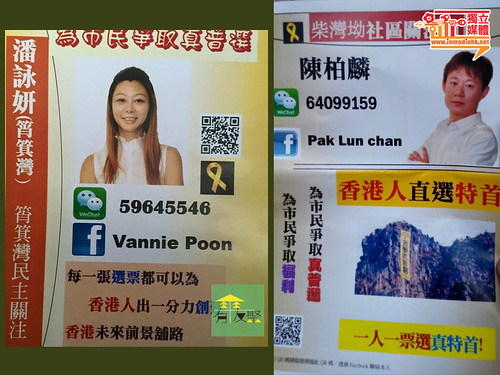
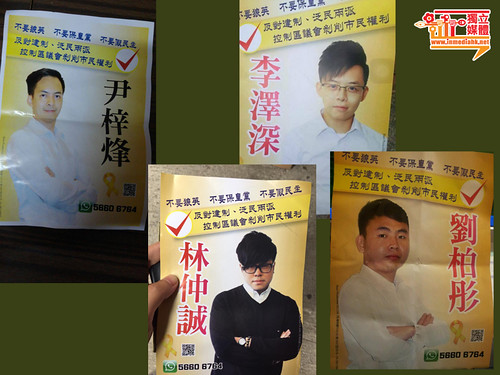
Under convenient cover of “Umbrella supporters”, eight candidates (Li Chak-sum, Lau Pak-tung, Wan Tsz-fung, Winnie Wun Ki-yan, Vannie Poon Wing-yin, Chan Pak-lun, Lun Man-kit and Lam Chung-shing) of the District Council Election seem to be in an attempt to add to Pro-democratic Camp’s unfavorable position in intense electoral district, namely Hong Kong Island. 

Political platforms can hardly be found on their publications; the candidates are from New Youth Group (NYG) share the same slogan, and some of them even share the same mobile phone number; they never in a single occasion explain their definition of "supporting the Umbrella revolution"; so far, candidates have not revealed their occupations, their sources of financial assistance for elections.


When Li Chak-sum was asked in an interview of the knowledge about the system of “small-circle election”, Li replied, “I...I...I...know about this of course. Surely I do. It is...formed by an election committee. Maybe there are some problems from the election committee’s system.” Li’s grandmother said in an interview that Li is paid 1.5K to participate in the election and that Li ranks money and business as the top priority.

It naturally calls in question whether Li or the NYG involves in violation of the Elections (Corrupt and Illegal Conduct) Ordinance. Democratic Party and Civil Party then ask ICAC to look into the matter.

20151017

6 for 1 in Lok Tsui, Tuen Mun: Candidate Background

6 for 1 in Lok Tsui, Tuen Mun: Candidate Background
Original article


Albert HO (aged 64):
[2011 - Lok Tsui: 1879 votes/51.3%]
- incumbent district councillor from Democratic Party HK (DPHK) and Legislative Council member
- former chairman of DPHK
- did not support de facto referendum in 2010
- DPHK had a scandal of entering the Chinese Liaison Office in 2010 on the Constitutional Reform
- lives in Hong Kong island
- did not disclose the identity as a director of a company, which owns a property in Happy Valley
- participated in the Chief Executive election in 2012
- surfed on girlies during the Budget in 2014, LegCo
- assisted in a relocation of power boxes on a narrow passageway in Melody Garden

Julius HO (aged 53):
- chairman of Butterflyers
- solicitor; former chairman of Law Society of HK
- claimed himself as a "social worker" without registration
- recently appointed as Director of Lingnan University in October 2015
- said "did not rule out the possibility of dissolving the LingnanU Student Union" despite he does not have such authority
- indigenous inhabitant in Tuen Mun
- was elected as the representative of Leung Tin Village in 2011
- became Chairman of Tuen Mun Rural Committee as he changed the Memorandum and kicked away Lau Wong-fat, thus become member of Heung Yee Kuk and District Council
- obtained 10,805 votes without "political background" in 2012 LegCo election (NT West)
- opposed the declaration of illegal structures plan by Buildings Department and asked the government to change the current law
- criticised Occupy Central
- suggested the criminalisation of "insulting police officer"
- strong rural network as his dad Ho San-wing, a famous rural "gent" in Tuen Mun, established Yan Oi Tong and has good rapport with Lau Wong-fat and Chan Yat-san

YUEN Wai-chung (aged 61):
[2008 LegCo: 1338 votes/lowest in NT West 2008: 32182 votes]
- founded MESSAGE
His duties and platform in 2008:
- giving sermons in secondary schools and Castle Peak Hospital
- chairman of Melody Garden Owners' Committee
- would promote peaceful unification of China, Hong Kong, Taiwan and Macau
- would better the political system in China and Hong Kong
- had concerns over the impact of online and printed porn on youngsters
- would fight for the extension of library opening time

Leo SHUM Kam-tim (aged unknown, should be over 50):
[2011 - Lok Tsui: 1477 votes/40.40%]
(did not fill in occupation/political affiliation)
- retired Station Sergeant from the police force
- fully supported by NT Association of Societies, a traditional patriotic organisation
- supported by Choi So-yuk and Tam Yiu-chung from DAB
- former teacher in PAOC Ka Chi Secondary School, a secondary school nearby

Dr. CHENG Chung-tai (aged 32):
- Scholar on sociology with academic interests in Hong Kong society and contemporary Chinese society and culture
- Teaching fellow at Hong Kong Polytechnic University
- Member of localist group Civic Passion and host of various political shows on affiliated online channels
- Lead figure in numerous protests and political campaigns mounted against CY Leung’s government and Beijing

CHEUNG Wing-wai:
[no information found up to 17 Oct 2015]

20151012

Sing Tao Exclusive: Fake Nun's Secular Lives - Fake Marriages, Private Cars, iPhone 6

Fake Nun's Secular Lives - Fake Marriages, Private Cars, iPhone 6
Translated by Chen-t'ang 鎮棠, written by Sing Tao Daily
Original: A & B

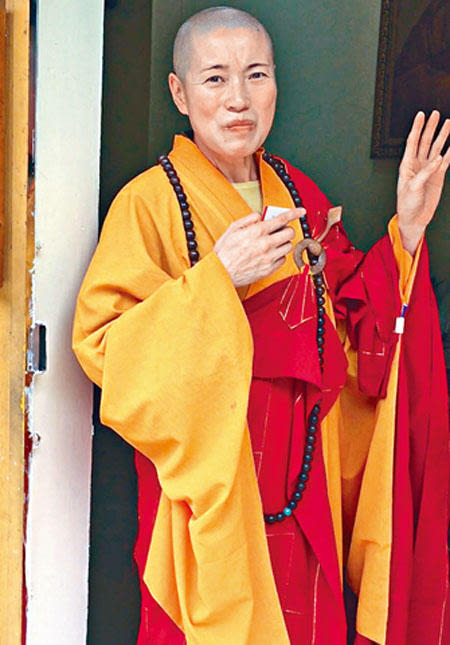
With over a month's investigation, Sing Tao has found out the female chief of Ting Wai Monastery (in Ma Wo Village, Tai Po), Shi Zhiding, had two marriages with mainland monk, in order to help them to gain Hong Kong identity cards. One of them, Ruzhi, has obtained a monk name, Shi Zhiguang, given by Po Lin Monastery in Ngong Ping, after such marriage with Shi Zhiding (or Lung Yan-loi, in secular name) in 2012. Shi Zhiguang has since become the Karma-Dana (General secretary in commoner's word). Marriage between nuns and monks is not only severly against Buddhist rules, but also another way to provide a way for China monks to stay in Hong Kong. She has also been found out that her lifestyle is extravagant, and the accounts of such monastery is but a mess.

Shi Zhiding was born in 27 October 1967 in Jilin Province, China, with her secular name as Shi Aiwen, and became Lung Yan-loi in 1993. She obtained Permanent Residency in Hong Kong since then. She told the media that she became a nun in 1997, but according to the documents in Po Lin Monastery, she became a nun in 2002, and has since become the chief, monitoring over the institution.

According to the Marriage Registry, Shi Zhiding was married in 17 August 2006, with Liu Jianqiang, a 23-year-old merchant. Liu was given a monk name as Shi Zhiqiang after their fake marriage. On such marriage certificate, they said they live in a public housing estate apartment in Tai Yuen Estate, Tai Po, with 2 wedding witnesses who believed are locals.

Shi Zhiding had some telephone conversations with Mary Jean Reimer, a director in Ting Wai Monastery. In which Shi Zhiding admitted twice the fake marriages with Shi Zhiqiang and Ruzhi, and said "I am in fake marriages, do not call the police", "They have obtained HKID cards, you can call the police. It's convenient to others and myself. It is good to be convenient to others, as they work in Po Lin too, and they can provide more comfort to my master (Shi Chuhui, who then lived in Po Lin Monastery). I am not asking Po Lin to give me more money nor asking you more."

Shi disclosed details, too: "Elderly people smells badly because of their urine, and they stink after not bathing for a few days. He was sitting on a chair, and I helped him bathing. He suffers from diabetes, and I dare not to use shower gel, and I use a glove to give him a shower. I took care of the master before, then the one who got HKID card by fake marriage did so. $3,000 a month and to bath for master. Zhiqiang couldn't stay in Hong Kong before, but when he got those ID documents, he helped the master taking bath every day. Master was happy, as if he was a kid."

Sing Tao reporters went to Ting Wai Monastery in 28 August this year, where Shi Zhiding denied of having any sorts of marriage in Hong Kong or China, and retorted by asking why the reporters have to delve into this. That day was having an Obon ceremony, and many Mandarin-speaking monks were chanting. Shi Zhiqiang, the "General Secretary", refused that he is Shi Zhiqiang, and refused to answer all questions from Sing Tao.

After seven years of such marriage, Shi Zhiding and Zhiqiang immediately divorced soon after Zhiqiang obtained HK Permanent Identity Card. Zhiding, who was then 45, married a 38-year-old male teacher, Ruzhi as a "divorced person" in 29 October 2012. They said they live in Classical Gardens, Tai Po. Ruzhi is in turn a monk too, with a secular name Gao Wuguo. He was later given a monk name as Shi Zhiguang by Po Lin as Karma-Dana as well, and "has a high status in the monastery".

During such investigation, Ruzhi (or Shi Zhiguang) has packed his luggage and left Po Lin, and seemed wanting to cut ties with Po Lin. Shi Zhiqiang, the first "husband" of Shi Zhiding, travelled back and forth China and Hong Kong. Most of the time he lives in China except having ceremonies in Hong Kong.
Karma-Dana needs to maintain the law and order within the monastery, and needs "leading morning and evening prays, leading other monks, giving lectures, and chanting charms".
===
Shi Zhiding became a different person after evening. Nearly every night, she returns to the resort in Beverly Hills, Tai Po, on a 7-person-car driven by a male driver, and returns to the monastery in the morning. Shi claims she became a nun in 1997, but actually was in 2002, according to formal documents. She did not perform daily Buddhist duties, but rather, dine out, and even went to a 5-star-hotel and enjoy delicious food, only putting meat aside and eat them all.

According to the Land Registry, the House in Boulevard du Lac, Beverly Hills, Tai Po, was bought by her "disciple", Wang Hui with HK$39.5 million in December 2012. Shi Miaohui, or in secular name Wang Hui, came from China too. She was married and had a pair of daughter, aged 5 and 9. She needs to seek help and get medicines from a psychiatrist. Shi Zhiding said in the phone conversation, "I gave the money to her, she didn't even know how to be a person. She didn't even have the money to have ceremonies for her parents, not even HK$100."

The daughters of Shi Miaohui would sometimes visit Shi Zhiding with the 7-person-car in Ting Wai Monastery. She often talked about selling the house in Beverly Hills with Shi Miaohui.

Ting Wai Monastery was an institution with over 100 years of history. With dilapidated appearance with infected by termites, the monastery has a mouldy wall and broken tiles on the floor. But those who have visited the room of Zhiding said they have seen Shi Zhiding has a nice room with 9 wardrobes of different sizes and a shelf with different skincare products. She also has a private bathroom and all her furnitures are mahogany, an expensive kind of wood. There is a 4-feet king-size bed with a quality mattress, worth of over HK$90,000.

According to their photos and videos, there is a notice of "There is Big and Small Treasure inside, please be aware and close the door". Big and Small Treasure are two female dogs owned by her. The air conditioner will be on 24-hour for them to enjoy. There are wigs and secular clothes and dresses, French skincare products and over a dozen Clarks shoes. What's more, a hairdryer.

Sing Tao reporters have tailed her for her lifestyle. She hopped on a 7-person-car on 20th and 21st September and the male driver drove her to Beverly Hills. They went together in the house, and she returned to the Ting Wai Monastery at 8 am next morning.

Shi Zhiding seldom has dinner in the past three weeks. Most of the time she ate with Shi Miaohui to nearby restaurants. 3pm, 23 September, Zhiding and Miaohui went to Sha Tin to buy a new mobile phone and had afternoon tea together, and returned to the monastery at 6:30pm. A car, EH 7××, registered by Chan Kai-yuen (and his wife), carried Shi Zhiding to the five-star hotel in Harbour Grand Kowloon in Whampoa, with another monk.

Shi Zhiding has a wonderful life if there is no ceremonies. After returning from Beverly Hills to the monastery, she will continue sleeping. When she's up in noon, she would go shopping and afternoon tea with Miaohui and even buy iPhone 6. She even demanded to install Mac computers in the monastery. Her lifestyle didn't fit the Buddhist rule.

According to the observation from Sing Tao, she was often carried by a Mercedes-Benz (RN75××) or BMW car. Often she was carried by a male driver without any company. 

20151009

[Undergrad/HKUSU] From Race to Citizen: Football of the Hong Kong Nation

From Race to Citizen: Football of the Hong Kong Nation
Translated by Chen-t'ang 鎮棠, written by Chris Lau Kwun-shing 劉觀成 (Aug 2015)
Original: https://drive.google.com/file/d/0B0nrPotOynIFLUdMbFFRbjlaZE0/view


("HK TILL I DIE; THE POWER OF HONG KONG", 11 June 2015, Hong Kong vs Bhutan - Passion Times)

("Hongkongers are Bravo!", 11 June 2015, Hong Kong vs Bhutan - Passion Times)

“Do not underestimate any opponent. In this team, there are black-skinned, yellow-skinned, and white-skinned players. We must be cautious against a team with so many colour layers”.


The passion towards football soared for Hongkongers in June 2015. A provocative poster sparked off the passion for the Hong Kong team. Tickets of three matches with Hong Kong as host were all sold. Hongkongers no longer watch matches of other teams, but our own team. Many people might only know the HK Team from its championship during East Asian Games 2009 or its recent powerful form, but football has rooted deeply in the territory for over 100 years. This articles aims to introduce the history of football in Hong Kong, to delve into the establishment of the Hongkongers subjectivity, and the relationship between football and the Hong Kong nation, as well as how to deepen civil education through football.

The First "Others": the White
The way to establish one's identity is through the demarcation between "us" and "them". Football started from the UK, and took root in Hong Kong, a former British colony. At first, only the White played football. The first football club by the White, Hong Kong Football Club, was founded in 1886; the first Chinese football club in Hong Kong, South China Athletic Association, was founded in 1910. Qing dynasty declined at that time, and Chinese seemed to be suppressed by the White, and thus felt aggrieved.
Thus, in order to defeat "them" -- the White, some local Chinese started their team. With "them", the ethnic identity formed quickly. Around 1918, South China participated in the Hong Kong First Division Football League, and won the champion in 1923-24. After that, the Chinese teams won most of the matches, and thus formed sense of superiority.

Football star and nationalism
Hong Kong football clubs gradually became stronger, yet the team members did not gain the identity of Hong Kong, because the best players were representing the Republic of China (ROC) team, while the weaker ones played for the Hong Kong team. After 1949, ROC went Taiwan and lost the continental China to the Communist Party, hence the People's Republic of China (PRC; its football team usually referred to China PR). During 1954 to 1971, most of the ROC team members were from Hong Kong. This team was so bright that it won two champions in Asian Games, and even entered the quarter-final in 1960 Roma Olympic Games, and we can still see the strength of the team. But what about the players' ethnic identity? Some said the reasons why they represented ROC: some may join the ROC team because of the pro-Taipei background, or could be part of the team which could join the Roma Olympics with better privilege, rather than "emotionally attached to the Chinese nation (zhonghua minzu)". We could not determine the response of the Hongkongers at the time, but if we looked up in the lines of pro-Taipei newspaper, "Hongkongers were supporting the team for bringing honour to ROC - but these might be biased. Usually few in the ROC team were from Taiwan, and the rest were from Hong Kong; or the entire ROC team was from Hong Kong, as well as most who actually played in the field. Hongkongers wholeheartedly supported local football games: last season the average number of audience in a Hong Kong Premier League match was around 1,000, but the battle between South China and KMB in 1951 attracted over 30,000 football fans to a stadium which could contain only 15,000. We could not possibly know people's feeling towards the ROC team, but we can be sure about the passion towards local matches. We could infer that even under the name of ROC, the reason why Hongkongers were so connected to football was brilliant football stars.

Rise of Subjectivity: The Real Hong Kong Team
As United Nations passed General Assembly Resolution 2758 and the rapprochement with PRC went well, no Hongkongers participated in the ROC team after 1971. In 1974, the ROC team was kicked out of AFC, and had declined since then. Before that time Hong Kong Team existed, but with mediocre players, but since then the real Hong Kong team was formed, and attracted a lot of local football fans. The awareness of "Hongkongers supporting Hong Kong team" started to grow.

The first match between Hong Kong and China PR is the 1975 Asian Cup Qualification. Both sides were competing for being qualified in the next round. Hong Kong lost 0:1 to China PR. After the match, pro-Taipei newspapers said Hongkongers cheered for the Hong Kong team, and feel disgruntled about the brutal Chinese team. Pro-Beijing newspaper did not have a particular stance towards Hong Kong or China PR team. In 1959 Asian Cup Qualification, there were opinion of "Hong Kong team should not win ROC team", but there was no similar opinion towards China PR team. The passion towards Hong Kong team can be seen in Hong Kong vs Korea DPR (North Korea). Hong Kong team had an advantage in the early second half, but lost 2:3 to them. From newspaper reports, there were fans holding banners "Make it to Tehran, Hong Kong!" in the cheering team. In 1977 and 1986 World Cup Qualification, Hong Kong team won Singapore and China PR. When the team returned, they were well-received by fans with banners like "Hong Kong team, the best in Asia!" and "Hongkongers are bravo!" (the top picture), which is still commonly used by the fans nowadays. These away games were live on TV, so every Hongkonger could experience the peaks and valleys with the team.

Compared to the '60s, the passion towards Hong Kong team reached its peak from mid-'70s to the '80s. A clear delineation was seen: support was for Hong Kong team, not ROC team. The identity on football shifted from the White-Chinese racial differentiation at first, to the rise of Hong Kong football stars, then to a genuine, strong identity of Hongkonger.

The Fall of HK Football and the Chinese Nation Complex
Since 1990s, the football development in Hong Kong met its ebb, and no longer befit the name of "Football Kingdom". In November 2012, the world ranking of Hong Kong team fell from 90th (in '90s) to 172nd. The ebb is due to several reasons, including the HKFA's policy (which will not be explained here). As the strength of local teams no longer attracts the passion from football fans, and with satellite transmission, Hongkongers chose to watch better foreign matches. Before 1997, "democratic reunification" was a trendy phrase, and the Chinese Nation identity was strengthened, and it could be seen in the sports field. Sports is important in the ethnic identity and emotions. Many Hongkongers will support Team China in the Olympics (and the Chinese media called them the National Team after 1997 - translator's note), and felt thrilled when Team China won hurdle races, diving or table tennis, sometimes even more than Hong Kong team.

According to HKUPOP, the Chinese identity for Hongkongers was the highest in 2008, the year Beijing held Olympic games. Sports and people's emotions are often interconnected - for example, Koreans will be thrilled if they knock Japan down; or the tense atmosphere when the English team is competing with Scotland. The identity of Hongkonger declined as there were very few sports connection in the recent decade; but on the contrary, the identity of Chinese rose as the mainstream media has propagated.

HK football and Revival of the Hongkonger Identity
This June, a poster (the second from the top) from Team China read "Do not underestimate any opponent. In this team, there are black-skinned, yellow-skinned, and white-skinned players. We must be cautious against a team with so many colour layers", mocking there were members with different skin colours. After the public outcry, this poster ignited Hongkongers on supporting Hong Kong Team. This poster has provided an imagination of the Hong Kong Nation -- civic national society. There are players who are black-skinned, white-skinned, from China or from Hong Kong, but they are part of the Hong Kong Team. Putting it to the Hong Kong nation, a Hongkonger is not defined by his race, but rather, his civility. If the naturalised players are willing to wait for 7 years and be trained by the Hong Kong team, they can become part of the Hong Kong team. Football fans were thrilled whenever there were goals, no matter made by local Hongkongers or naturalised players. The linkage between players and fans is not a racial matter, but civility, or else local fans will not cheer when a White scored a goal.

Establish Our Strength through Football
Hong Kong is a small place, and it is hard to build up recognition with hard power, so we can only strengthen our subjectivity with soft power, such as culture and sports. The hard power of South Korea is not comparable with Japan and China, not to mention on the world. So Korea made itself well-known by soft power, such as Korean culture and sports (Taekwondo and football). The strength of Hong Kong football is not comparable to those years, but there were some surprising moments too. In 2009 East Asian Games, Hong Kong Team defeated the Asian football giant Japan in front of over 30,000 spectators, and won the first gold medal in football amid international sports events. The football clubs played well in Asian competitions. In 2009 AFC Cup, South China entered the semi-finals with the cheer from over 37,000 fans, but lost to Kuwait Sporting Club 0:1. Last year (2014), Kitchee also entered the semi-finals of the AFC Cup with the entire Mong Kong Stadium full with fans, but lost to Erbil from Iraq 2:3 in two rounds. This year (2015) is the first time when two Hong Kong teams entered the quarter-finals of the AFC Cup. Hong Kong Premier League (HKPL) was formed last year, and football clubs not only started their promotion for decorating, but also started finding better fields for training. Eastern Sports Club even hopes to be listed in five years, and has set targets of winning the AFC Cup in 4 years and AFC Championship in 7 years (the highest honour in Asia football club). HKFA hopes that the amenities for football in Hong Kong can be improved after the opening of Tseung Kwan O Football Training Centre in 2017. With the passion, it is expected that the football development of Hong Kong will be improved, and Hong Kong can be more influential in the football field.

Stay Local, Support Hong Kong Football
Recently there is a documentary Finding Cheung Chi Doy, focusing on the long-forgotten football star and introducing out once-famous hero. Cheung was the first Chinese player in the top football clubs in Europe. He once played in Blackpool, a League One team (the top league in England at that time). Most Hongkongers do not know this part of history because there is no introduction to the past football history.

In order to enhance national recognition, Hongkongers need to support Hong Kong football, and should not confine our vision only on football matches elsewhere, and to attach importance to training the next batch of potential players. The vital key is the support from Hongkongers - buying tickets and watch the matches, or even providing suggestions for improvement. With pressure, the HKFA will change its tack. In terms of policy, the government should train players and provide a long term planning. There is a severe lack of football training venues. The clubs or Hong Kong Team cannot help but use poor venues, and are given time restriction when using them. The administration shall build a large training venue as soon as possible, as well as set up a well-structured youth system. Belgium is a good example. With good policies, the ranking raised from 71st (2007) to what is now the 2nd, with stars like Eden Hazard and Thibault Courtois.

Regarding Youth System, clubs can work with schools to encourage students playing football, so as to change the situation of "too much emphasis on marks but too few on PE". On the other hand, the government shall improve the quality of football fields. In 2013, the Hong Kong stadium scandal smeared the name of Hong Kong when we host a match, as the supposedly grass pit become a mud ground. There was a mistake in the renovation of Mong Kok Stadium, where the capacity was reduced. We can be sure that the risk of players getting hurt will increase if the venue is poor. Besides improvement over all fields, the authorities concerned shall build a cost-efficient standard football field.

Also, the government and HKFA should unswervingly combat match-rigging. After a match in 2014, 17 players were brought away by ICAC because of suspected match-rigging. In 2011, a young Hong Kong player was abetted by a Communist Party member to buy his fellow teammates off and rig the results. Not only on the football field, we do not tolerate any corruption in any fields in Hong Kong. Integrity is one of the core values of Hong Kong. Hong Kong football can only flourish under fair competition. If Hongkongers support Hong Kong football, our once pride can be reinvigorated, so as to stop the intrusion of Chinese element, and become a genuine city with values and culture.

From 1986 to 2009, Hong Kong team had produced several great moments for us. I hereby quote the book of Dr John Lee Chun-wing, Football Kingdom: "To some people, football might only be a game where 22 people chase after a ball; but for football fans, what happened on the field is certainly not a meaningless chase." To me, football is the game after our dreams. Even clouds might overshadow Hong Kong, we Hongkongers shall go after our dreams and make miracles.

20150929

Cheng Lap: A Country Exists for "Barbarians"

A Country Exists for "Barbarians"
Translated by Karen L., Written by Cheng Lap
Original: http://opinion.udn.com/opinion/story/6777/739442 

Source: Dennis Jarvis (CC BY-SA 2.0)

Regardless whoever you are or whatever ethnic group you are in, you, like anybody else, are born with a nationality. We have taken it for granted, membership of a country as an inborn package, that we somewhat forget to leave room wondering why it exists.

Outwardly it does not bother us at all without a stance of the existence of countries, while delving into the matter will you find an opposite answer to the initial expectation. It is expressly so since we have been in a democratic government -- though everyone of us is not directly holding the governance of one's country, every statement one voices and each vote one casts are influencing the country little by little.

Putting forward the idea, if we choose to ignore the consideration why countries are countries, it is natural for us to confuse with the roles for governmental positions. From the legislator to the president, how do we determine the right person -- functioning component of a country? Politicians, as well as bureaucracy are gearing and bearing -- with fair quality can they perform better.

We sometimes vote for a politician out of our perception of him/her being good, kind, competent, smart, or his/her healthy image, or the mutual stance with ourselves. Truly these are virtues, however here is the twist: embracing these advantages does not necessarily represent he/she is the proper one. Traditionally, being honest and having good manners are on our list of an able candidate, yet is it authentic? The answer to the presence of country lies on this question.

Western countries, if not all, refer to a country as "she" -- a goddess or a mother. It's not my intention to deny such figure of speech, but in my opinion, "it" would be more appropriate.

You mush have heard, more or less, the condition of international world remains anarchic where law is an empty recommendation. International law helps distinguishing right from wrong at most, whereas we could only pray to God for the effective implementation. Let's untie our mind shackles: What would happen if the entire judiciary, police together with judges, disappeared one day? If somebody was killed then, given that police existed no more, what could you possibly do?

The state of anarchy gives us the very answer. Politeness, reasoning, law, dogma, order of an international society -- EVERY social norm, natural as air, becomes faintly discernible. They are still there somewhere, yet no one is authoritative enough to enforce them. Yes, if someone simply wants your head down or wants to take over your possession, they should be wrong. But sadly the case in anarchy is that this someone could succeed and could get away from any of the punishment that he/she is supposed to receive.

Mere civilisation is unlikely to function in an anarchic world. Barbarity, inevitably as a consequence of such a world, can only be dealt with a new set of survival rule.

In a society of civilisation, you read and learn, in order to be qualified to meet certain criteria for a job. Then you make money in order to exchange for necessities of life, and if conflicts beyond personal level arises, you settle it rationally through lawful methods. One is regarded civilised to fulfill these situations.

In a barbaric world, reading and learning though available to one, there will be no examination to test one's capability. Conflicts are being settled not by reasoning and law, but by minimizing others' threat through conquering or governing. No one, in this case, will be hired for a job. It becomes one's responsibility to fight against each other by all means for resources so as to survive. Even so, dejectedly enough, law, if there is, does not provide you protection over your possession and anything else. Thus it narrows to the one and only way to let people know the price if they ever lay hands on you -- that is, violence, sufficient violence.

Those succeed in a barbaric world does not necessarily act in a barbarian manner, but it's a must for them to understand barbarity -- to use it as a means, to compete against it, to arrive at the level of barbarity as their counterparts. Anyone who could come through life in such environment must possess the ability to live despite the fact that the legal protection ceases to exist. These people are open-minded enough to realise that civilisation only stands when they can maintain their lives from barbarity.

Many of them who play by the rules and master the rules in a civilised society are talent, whereas they still could not get rid of the tag of "men in civilisation". To lead a country or excel in diplomacy, on a contrary, is more like hunting in the wild forest or fishing in the sea.

There is one thing about civilisation - either it stays through proper preservation measures obviously, or it will suffer, particularly so under the circumstance of barbarity. It is vital to understand how this barbaric world works. In other words, countries are there in the interest of the people's lives, their culture and dignity under the anarchic international environment. Or, we can put it this way -- Countries exist for barbarity.

This explains a country's need for violence. As a tiger protecting its cubs, a country has to be ready for others' deceitfulness, rampage or sneak attack from time to time and acts decisively to protect its people from harm. Two opposed measures are adopted, internally and externally -- one soft, one precautious and harsh, or else fatal aftermath will follow. The smaller country, the more resourceful it needs to be.

As a result of it, one will gain an insight into the origin why western culture describes a country with a feminine pronoun. But then if the object isn't within the inner circle, the soft side has to make way for the beastly nature -- it is monstrous creatures that it has to face. That is what we need for the leader of a country, not some perfectly graceful gentlemen.

Extraordinary leaders, if not all, are far from "normality": Napoleon was sort of a "bodgie"in the days of military school if we depict him in today's terminology, and the artilleries he led back in the days did not start off as the best given that cavalry dominated; Adolf Hitler was an unemployed young man living below the poverty threshold and failed to get into his dream school; Emperor Gaozu of Han was a hooligan until his mid-life kicks in; Bill Clinton was a draft dodger and enjoyed Mary Ann.

In the eye of mainstream, the background of these figures are out of orthodoxy, but it happens to be this unique personality formed -- disobedience to the general thought -- that make them stand out from the crowd and be able to deal with the outside world.

We have seen many successful figures who start off impish or mischievous and end up being owners of companies while those behaved turns out to be senior employees. Somehow our society gets overly attentive to the latter one, but for the former one, it has not given weight to foster certain talents. It throws light upon the phenomenon in our society -- everyone wants to get a job, and no one creates enough jobs to balance the demand. One started to lose count of conformity, but it remains short of leaders. The ones who attempted to be leader and failed should reflect on their customary being in the comfort zone of a highly civilised society.

In the core value of mainstream, ironically, it is conveniently found that those challenged the norms are labelled as worthless. The leaders of the future are screened out too early before we realise.