20160614

Atsuna: You'll Get Comeuppance, CCP Arse Lickers

You'll Get Comeuppance, CCP Arse Lickers
Translated by Chen-t'ang 鎮棠, written by Atsuna
Original: https://atsunablog.wordpress.com/2014/07/21/%E5%89%8D%E6%B8%AF%E5%A7%90%E7%9A%84%E6%82%9F%E6%80%A7/#more-658 

(by Lego Cheung)

Whenever pro-Beijing minions said something provocative, people like Elsie Leung would always defend them with excuses such as “they have freedom of speech too”. However, freedom of speech is not an excuse for wrong things. Even “I will defend to the death your right to say”, it does not mean that I have to “approve of what you say”. Do not cover that with your so-called freedom.

You have a right not to participate in protests, votes or even to join Caring Hong Kong Power, a pro-Beijing goons club, but freedom does not mean that you do not have to be responsible to what you do. You have freedom, and others have freedom to judge you too.

Those who did not study enough like to ask people to “study for a few more years [before making comments]”; those who defend for HKSARG like to say “opponents are stupid”. When you point out that they lack backbones, they will be another Paul Kwong – saying that you are either affected by herd behaviour or “having a brain that does not analyse”.

Before I thought it was just because of their poor education, as the saying goes, “A little knowledge is a dangerous thing”. A colleague of mine asked whether I went to protest on 1 July, and eventually the entire lunch became “City Forum”. My colleague is a smart person, and I think one does not have to be a localist to go to a protest. In turn he said, “I hate people opposing everything. Even my brainless student before said he will go to the protest for the sake of justice, is he a superman?” My colleague can mention some facts after reading. I also believed those who hate protesters are not all angry uncles in Victoria Park. But why so many people with normal IQ still so stubborn after looking at so many facts?

Buddhists use horses to describe the cleverness of people. There are four kinds of horses. For the first two kinds of horses, when they see a whip or felt pats on their tails, they will know the intention of the riders. This means – when people see others' sufferings, they will feel alarmed.

The third type of horses only know the intention of riders after a whip on themselves. This means – only when people experience the sufferings on their friends or families, they will know the pain.

The fourth kind of horses only know the pain after being stabbed. This means – only when they themselves experience sufferings, they will know the pain.

Even the first two types of good horses need to see others' sufferings before they become alarmed. If you told Hongkongers about “civil disobedience”, people will think you are an idiot. The freedom of Hong Kong comes so cheaply. We barely sacrifice and the enlightened “despotic” British administration gave Hong Kong rule of law and human rights, when compared to the hardship in Taiwan and Korea.

Those who are “immuned” in today's Hong Kong will probably be the latter two kinds of horses, especially those “community leaders” who own business in China. When they are stabbed by the CCP, they will then know the pain.

20160605

Declaration of the HKUSU on the Tian’anmen Massacre

Declaration of the Hong Kong University Students’ Union on the Tian’anmen Massacre
Patriotism only ends in hardship and panic, 

We repent to misdeeds to cling on to our lives
Translated and written by Hong Kong University Students' Union
Original: https://www.facebook.com/hkusupage/photos/a.512349045490265.1073741833.509449175780252/1080739061984591/?type=3 

(Content provided by HKUSU)

Twenty-seven years ago, China underwent a change in the midst of spring and summer, looking forward to the emergence of democracy and freedom. In contrary, the striking democratic movement ended only in suppression and bloodshed. Countless citizens and students deceased under the state apparatus. Those who were latterly reprised and put in jail or tortured were also hard to number. Starting the student movement in the name of patriotism, students would have never imagined their country to have been taken over by communist evil who harmed people for their own doing. Lies written in black and white can never disguise the bloody truth. Even though Hongkongers live in a slightly freer place, we, with conscience and justice, have never forgotten this history of 1989. Unfortunately, on the opposite shore of the river, the Chinese seem to have long been blinded by the dictators’ fine words and actions, drowning in the nouveau-riche Chinese dream. There is no one who combats the regime’s atrocity, except very few rights defence protesters. In retrospect twenty-seven years later, the Tian’anmen Massacre marked the last chance for the Chinese Communist to improve itself, which it had missed. After the Massacre, China bid her final goodbye to democracy. Human rights was ruined amid the heyday of the party authoritarian. While the authority expanded infinitely, corruption and collusion were out of limit. As the respectable culture was undermined, society reached a point of no return.

The Tian’anmen Massacre is not only a turning point for China, but also a watershed in Hongkongers building of sense of identity. On one hand, it destroys our fantasy towards China’s Reform and Opening Up, sparking the Hongkonger’s subjective consciousness; on the other, it, paradoxically, muddles up the destiny of Hongkongers and Chinese, knocking the subjective consciousness back down. Over the years, the Victoria Park vigil and patriotism have been chained up to be an inseparable pair of twins. Today, revisiting the historical meaning of the Massacre is to tell everyone that it is more important to recognise the pursuit for freedom and democracy, than the absurdity in patriotism. As we debate over freedom and democracy, they must lead us to a new subjectivity, which is exactly the self-determination that youngsters are now chanting for. As we have realised the truth of China being nothing but a party state, ‘patriotism’ and pursuit of democracy and freedom actually contradict one another fundamentally. ‘Building a democratic China’ shall thus not be included in Hong Kong political agenda. Commemoration based on patriotism shall also be put to an end. Similar to anywhere in the world, Chinese democracy should be fought for by no other but their own people. Hongkongers have no reason to take up such forced duty, let alone ‘building a democratic China’ from afar at such a cost in order to protect ourselves. Denial of the responsibility of ‘Hongkongers building a democratic China’ never means an end to interaction between civil societies of the two nations. Just like the interaction between citizens of Hong Kong and Taiwan, of course Hong Kong can share our experience with Chinese suppressed by the Communist. But the aim of such action must not be based on a non-existent ‘duty’.

The fourth of June should never be only about wailing and whining amid candlelight once every year. While some political parties and politicians keep on proclaiming their ideal to end the one-party dictatorship, they are yet bounded by the ‘Patriotic incantation of Golden Hoop’ day in, day out. They fear and worship the Communist regime. They do whatever it takes to meet officials from Peking, never even challenging a bit of the Communist legitimacy on our sovereignty. Hong Kong is always bothered by only one political problem. It is the cost that we can take. In face of the first Future of Hong Kong discussion, most Hongkongers and even politicians had failed to learn the lesson from the Massacre, lacking the imagination towards Hong Kong subjectivity, let alone the courage to take charge of our homeland. Together with the sugar-coated poison of ‘Hong Kong people ruling Hong Kong, High degree of autonomy’, Hong Kong democratisation was only delayed. Unfortunately, there is never ‘what if’ in history, but only lessons. We may not be able to alter our past, but we still have a say in our future. We shall never make the same mistake twice.

On every 4th June since today, while mourning the deceased in the Massacre from afar, we pay our silent tribute to Hong Kong, a place which has long been betrayed, pledging our strong will for self-determination towards the future after 2047. Some may argue that the Chinese Imperialism shall only make Chinese factors ubiquitous and Hong Kong can never remain uninfluenced at this small piece of land. The new generation upholding Hongkongers’ self-determination is never an attempt to deceive, but to do something that is known to be unlikely to succeed. As a result of the Communist encroachment, revolt in self-determination and independence movement in Hong Kong begin. We are more than well-informed of the realistic considerations and limitation than anyone who only douses us with cold water. Yet, it is more than clear that: for democracy, we must stand and fight, but never kneel and beg. Democracy is always a process of self-empowerment and self-realisation. We therefore must turn our sense of identity into our weapon in protests. We must struggle against the regime and seek for the most political rights for ourselves, and our next generation.

Only a few years may have gone by, but the localist ideology which was once a farce in most people’s mind has already entered the major political agenda. Indeed no one can be sure that such localist ideology can usher Hongkongers into salvation. But at this fork of our age, one way is towards the deep blue sea, and the other is towards the bloody red hell. For this we make a clear decision: we may navigate to the uncharted, but we never mix with the evils. In the meantime, we must shout at the dictators that they must pay the cost if they wish for our compliance. Hong Kong, we must protect it with our lives. 

20160604

2016 Joint Institution Declaration for the Tian’anmen Massacre

2016 Joint Institution Declaration for the Tian’anmen Massacre
Translated by Chen-t'ang 鎮棠, written by CUHK SU, CHI SU, HKSUT SU, BUHK SU, HKSYU SU, OUHK SU, HSMC SU, HKAPA SU, THEi SU, CityU SU Temporary Administrative Committee, CIHE & CBCC SU
Original: http://www.inmediahk.net/node/1042566 

The Beijing student movement in 1989 lasted for 51 days and nights, in pursuit of openness, democracy and freedom. It started from 15 April, the night of commemorating Hu Yaobang, and ended with the bloodshed at Tian’anmen Square. The carnage by PLA has shown the ferocious side of the CCP regime, and has caused a perpetual scar on the course of Chinese history.

27 years have passed. On 4 June, Chinese people around the world will commemorate this tragedy. In Hong Kong, the candlelight in Victoria Park has been ignited year after year. But at this key moment when we face “the 2nd negotiation for Hong Kong's future”, we need more reflection. The tertiary education sector has unanimously decided not to attend the vigil in Victoria Park, as the organizer, HK Alliance, has a rigid form of assembly, promoted the identity as Chinese and the goal of “building a democratic China”. However, not attending the Victoria Park vigil does not mean the tertiary education sector has neglected the Tian’anmen Massacre. 11 tertiary institutions thus organize this forum to make things clear – that is to look at the impact and significance of the Massacre towards Hongkongers from a rational and local perspective.

On 28 September 2014, tear gas was released on Harcourt Road, Admiralty. Black banners with “Disperse with Fire” were upheld by the police. The impact of the Massacre shadowed Hong Kong again. The fear was eventually a false alarm, but lots of people compared two incidents. The rise of localism trend after the Umbrella Revolution has resulted in some voices, saying that Hongkongers should sever ties with the Massacre. For years, the Massacre hovered Hong Kong: on one hand, it has formed the ideology and form of the democratic confrontation in Hong Kong; on the other hand, this is the fear of confrontation deep inside the minds of Hongkongers. Therefore, we cannot neglect the Massacre, but rather, we should know more about it. What is the relations between Hongkongers and “building a democratic China”? What is the shortcoming of traditional social movement in Hong Kong? Why did the tragedy in Tian’anmen not occurring in Hong Kong? We must face squarely to the Massacre from a local perspective.

Firstly, the dream of “building a democratic China” is as hard as a steel. The CCP is a tyrant who have absolute craze for the absolute authority. The CCP will annihilate all opposition powers at all costs, regardless of all sorts of criticisms, not to mention a carnage. Facing this ferocious regime, all Chinese have shown their staunch support to those martyrs and opposition powers, but there are fewer and fewer feedback. Generations of Hongkongers yearn for China, but the country has degraded to what it is now. The CCP regime has not changed its ferocity, yet the Chinese people has degenerated a lot. Look at what China has become now – the dream of “building a democratic China” cannot be achieved even with the aid of Hongkongers.

Secondly, CCP regime is definitely untrustworthy. Before 1989, the CCP said they will reform and open up; before the Massacre, Li Peng has a meeting with the student leaders. The twilight of a democratic China has ended in a dark night with bloodshed and carnage. Since then, we know that, promise is but a way to hide CCP’s ulterior motives on a negotiation table. We must remember that the CCP is not a modern democratic regime, with benefits and themselves in their minds and souls. No matter what kind of future Hong Kong will be after, Hongkongers should never trust a word from the CCP, not to mention any sorts of “collaboration” with the CCP. That is but silly.

The enlightenment of the Massacre is not confined to these two points. Therefore we organize this forum this year to look back on the Massacer’s significance, and look forward to Hong Kong’s future. We hope Hongkongers can really learn a lesson from history, look at our predicament today and prepare for the confrontation in the future. THE TYRANNY WILL DIE, GOD BLESS HONG KONG. 

20160601

End of "Overseas Chinese Patriotism" Marks Beginning of HK's Nation Awareness

End of "Overseas Chinese Patriotism" Marks Beginning of Hong Kong's Nation Awareness
The Epochal Significance of "Putting a Stop On Commemorating Tian'anmen Massacre"
Translated by Chen-t'ang 鎮棠, written by Tony Chui
Original: http://polymerhk.com/articles/2016/05/31/31754/ 
A newspaper headline on Hongkongers supporting students in Beijing, not to mention CY Leung's support at that time.
Since 2013, people might oppose the vigil in Victoria Park held by the Hong Kong Alliance in Support of Patriotic Democratic Movements in China (the Alliance), but people do not reject commemorating the Tian'anmen Massacre itself. Many other commemoration activities of the Massacre turned out. However, this year, there are people (who are not pro-Beijing) to propose not to commemorate the Massacre in the future. Recently, Althea Suen, the president of the HKUSU, said "I think that within one or two years, commemorating the Massacre should no longer be on the agenda of the tertiary education sector, and a period should be put there." She added that "Commemoration of the Massacre based on the 'compatriot' identity should be ended. " At the same time, Samuel Lai, Acting Chairperson at Current Affairs Committee, HKUSU Council, said, "We should put an end to the commemoration of the Massacre based on patriotism".

The "wind" that blows off the Massacre commemoration candles might not be Beijing, be it vindication or further suppression, but Hong Kong's nation awareness, or more commonly known as "localism" . In fact, in 2013, regarding whether to attend the vigil in Victoria Park, columnist Joseph Lian already said, "The year Hong Kong does not condemn the Massacre in Victoria Park, the year Hong Kong independence is full-fledged to made its existence among us [ref John 1:14]".

Where Does the Tradition of Massacre Commemoration Come From?
Before asking whether Hongkongers should continue to commemorate the Massacre, we should first ask: why are there so many people commemorating the Massacre every year? Why the number of attendants is far less in commemoration vigils in Taiwan or Macau?

Some commentators said the commemoration of the Massacre in Hong Kong is not only out of patriotism, but also out of the pursuit after democracy, freedom and human rights, as well as the persistence to justice. This is untenable: there are so many tragedies in the world, and no society will commemorate all. Choosing which tragedy to commemorate depends on whether such tragedies are significant to that society. Therefore, human rights or justice cannot be the only force for the community to commemorate an incident for such a long time so regularly, instead, specific identity and community ties can.


Why would Hongkongers supported the Beijing students' protest in 1989? Why were Hongkongers having strong reactions to the Massacre? Why were there so many large scale of commemoration vigil every year? I would like to cite an analysis written by Leung Man-tao back in 2005:

"During April to June 1989, the unprecedented passion of the Hong Kong society is related to the identity as Chinese. Songs prevalent at that time include "Be a Brave Chinese", "I am Chinese", "Descendants of Dragon" and so on [...] After two decades of growth and separation to the Mainland's political and social environment, Hong Kong and its people have a chance to know more about its motherland and to "re-identify" themselves as Chinese. Many Hongkongers might not know exactly what the Beijing students demand, but they will spend lots of time to listen to the radio and watch the TV, to discuss the trend of the movement — the way to connect China and themselves, who were in a British colony. Therefore, compared to the 1 July protest, the 1989 protest is actually an unprecedented patriotic movement.
Leung also pointed out the support of Beijing students from Hongkongers were not only because of "the patriotic mentality of overseas Chinese", but also because Hongkongers hoped that the success of China's democratic movement can ensure the freedom and autonomy of Hong Kong, and preventing Hong Kong from the "death of Hong Kong" by 1997.

"Lots of commentators have pointed out that the [then] passion of Hongkongers was built on the envisage of the future. Many Hongkongers believed that if China has started a political reform towards democracy before 1997, then the handover in 1997 would not be that fearful [...] Democracy and patriotism have since entwined with each other, thus becoming the largest momentum of the Alliance, and the political capital and background of pan-democrats, including the Democratic Party."
The ending was universally known - the Tian'anmen Massacre. Rich Hongkongers applied for emigration; poor ones demanded to accelerate the progress of Hong Kong's democracy, and hoped for an unchanged situation after 1997 with a democratic system. But at that point, many Hongkongers still see themselves as Chinese. After the 1991 Eastern China flood, Hongkongers donated HK$700 million;  in 1992 Barcelona Olympics, many Hongkongers supported Team China; in 1996, the Senkaku/Diaoyu Islands conflicts have caused many people to join protests organised by the Action Committee for Defending the Diaoyu Islands (ACDDI, and the movement is known as "Baodiao" movement), and make donations for them to go to the Islands. After David Chan Yuk-cheung, a prominent Baodiao activist who drowned around the seas of Diaoyu Islands, Democratic Party and DAB had an unprecedented joint candlelight vigil in the Victoria Park to commemorate this "Baodiao hero". Supporting the Beijing students' movements and commemorating the Massacre are ordinary examples of the "patriotic overseas Chinese mentality" by Hongkongers at that time — to be safe patriots outside China.

The Massacre Enlightens Hongkongers Politically, But Has Become Balls and Chains?
It is well known that the Massacre is the incident that enlightens many Hongkongers politically. Many Hongkongers participating in democratic movements started to care about the politics of Hong Kong and China, and started various confrontations. League of Social Democrats and ACDDI member Bull Tsang Kin-shing is one example.

When compared to recent "localist" movements, these democratic movements do not deny "Hong Kong is part of China" and "Hongkongers are Chinese", and based on these two principles, the activists supported democracy, human rights and autonomy for Hong Kong. The protest against brainwashing National Education in 2012 did not deny such principles (even they were led by new generation), and largely supported "loving China, but not loving the Party" — or "Hong Kong style patriotism". For the deliberation of the "Occupy Central with Love and Peace" and "I want universal suffrage" movement during 2013 to 27 September 2014, the main principle is not to challenge "Hong Kong is part of China". This explains why there were many youngsters who were not yet born during the Massacre went to Victoria Park Vigil during 2011-2014, and sung patriotic songs. This is because it was a stance against HKSARG and CCP. However, these democratic movements declined after the tearing gas shot on 28 September 2014.

Rumours of "cops have fired" or "PLA has came out of the barracks"" spreaded on the Internet on 28 September. Many people remembered the Massacre. In order to avoid the same tragedy in Hong Kong, they asked protesters to leave as soon as possible. On 1 October, students have formed a chain from letting other protesters barging the PRC national day flag-raising ceremony in Golden Bauhinia Square. It was said that the reason is not to give excuses for Beijing to launch a carnage. Such thoughts and moves are definitely related to the Massacre. Thus, we can say the memory of the Massacre has deterred some protesters from escalating their actions.

Whether the memory of the Massacre is a force or a hindrance to the post-Umbrella confrontation is a food for thought for you.

HK Alliance + Pan-dems = Kuomintang?; "Construct a Democratic China"="Three Principles of the People Unites China"?

The trend of Hong Kong independence has arised. Some pro-Beijing politicians said pan-democratic parties can be the "loyal opposition camp" that supports One Country, Two Systems. Then it is unavoidable to compare the development of Taiwan independence movement and Hong Kong in recent years.

If one looks at the political propaganda of KMT in the early 1980s, one can easily find out KMT often condemned Taiwan independence groups having close connections with CCP. After KMT has moved to Taiwan, they knew it was impossible to "counter-attack mainland China". After Chiang Kai-shek passed away, Chiang Ching-kuo even used "Three Principles of the People Unites China" to replace the slogan of "counter-attack mainland China". Li Teng-hui became the president in 1990s, and thus some old Kuomingtang members withdrew from KMT and formed New Party, in pursuit of ultimate unification. This move was welcomed by Beijing. In 2000, when Democratic Progressive Party started ruling Taiwan for the first time, KMT and CCP have become closer as they are against Taiwan independence. If Beijing sees the archenemy in Hong Kong as the "Hong Kong separatists", then it is important to look at whether CCP treats pan-dems in the way that CCP treats KMT as the allies of anti-secession, or Tongzhan subjects.

Chip Tsao and Ivan Choy have pointed out that what Beijing fears most is not lots of participants in the Victoria Park vigil, but rather, no participants at all. If so, commemorating the Massacre in Hong Kong may cause Beijing to be "unhappy" on the surface, but deep inside, CCP welcomes such commemoration because this is what Christopher Chung said, "being local without separation". In 1958, CCP attacked Quemoy and Matsu, the two islands held by KMT which are close to mainland China. On the surface, CCP attacked with strong weapons, and the US even asked Chiang to give up these two islands, but Chiang did not do so. CCP did not want KMT to leave, because if they did, the ties between Taiwan and mainland China will be completely severed, and the situation of Two Chinas will be formed. This is what Mao and Chiang opposed, but the US supported (Taylor, 2009). Commemoration of the Massacre might be the main emotional tie between mainland China and Hong Kong, and be treated as a tool to suppress separatism. Few years ago KMT veterans went to mainland China, and said "KMT army or PLA are all Chinese army!" By the same token, Hong Kong Alliance in Support of Patriotic Democratic Movements of China and Communist Party of China also contain the word China.

Conclusion: Re-consider About the HK-China Relationship, and One Would Doubt the Necessity to Commemorate the Massacre
After the handover in 1997, Hongkongers are no longer "overseas Chinese" under the British rule, but Chinese nationals under the (though indirect) rule of PRC. In face of Beijing's rule with HK-China integration, the difference between Hong Kong and China gradually diminishes. Hong Kong is no longer a British overseas territory with political stability with nice livelihood. Members of public having confrontation with the police force on the street is no longer something afar like the Tian'anmen Massacre, but rather places that one can easily access to. It is not only normal but also mature and responsible for Hongkongers, especially younger ones, to re-consider the Hong Kong-China relationship. Other Hongkongers are irrational and irresponsible to backfire them without rhyme or reason — especially those Hongkongers who can emigrate whenever they want and be a "patriotic Chinese"in the West.


Reference:
Jay Taylor (2009): The Generalissimo: Chiang Kai-shek and the Struggle for Modern China / End of IV 2 - Managing the Protector

20160505

AppleDaily: Forged Academic Research by PRC Prof, No Consequences

Forged Academic Research by PRC Professor, No Consequences
Translated by Chen-t'ang 鎮棠, written by Lam Wai-chung, Apple Daily reporter
Original: http://hk.apple.nextmedia.com/realtime/news/20160505/55066699 

Yang Dan, the accused professor.
[All wordings are back-translated from Chinese; not necessary original English wordings even the original documents are in English]
HKU has made the final ruling on YANG Dan, a Chemistry chair professor who has involved in a fake article scandal. Apple Daily has learnt that the school has confirmed the malpractices in the experiment, but HKU has ruled the complaint invalid as the school has satisfied that the experiments were conducted by her students, and she "knew nothing about it". The two doctor candidates (also from PRC) who were involved in the faked experiments have been ruled not guilty by a Disciplinary Committee which was not formed by scientists. The absurd result is no one has to be responsible for this fake research scandal.

Roger Wong Hoi-fung, a former assistant research professor in Dept of Chemistry HKU, revealed this to the school. Wong accused the article Yang and her team published on Journal of the American Chemical Society (JACS) on HKGreen-4 fluorescent probes for Peroxynitrite. Yang Dan and her two doctor students, Wong Nai-kei and Hu Jun were complained.

HKGreen-4 was meant to detect Peroxynitrite, a harmful substance in cell. In the experiement, Yang compare cells with and without E. Coli, and said the former cells would shine under a confocal microscope, showing that the probes can effectively detect the Peroxynitrite from the cell.

The results were handed to Wong's team to research on its application, but Wong cannot get the result Yang could, so he doubted the experiment of Yang. Wong collected original data from Yang, and saw three suspicious ways of testing, including using stronger laser settings in the microscope to deal with bacterial samples, causing a shiner image; also, compressing seven images into one, while others use five images into one, causing a shiner image. Finally, Wong found out that the pictures used in the essay were not the result from the same experiment, but rather from different dates [in 2011].

Wong started a written complaint in 2014 towards Wong Nai-kei and Hu Jun, and then complained Yang Dan. However, the two complaints were dealt separately, and the former complaint was dealt with Disciplinary Committee, which is used to tackle usual disciplinary problems; and Yang was followed up by an investigation committee on fake research.

The Disciplinary Committee convened a meeting in April 2015, and the members are all formed by members of Senate, who are all not scientists. The committee appointed Lam Yun-wah [CityU Associate Professor of Department of Biology and Chemistry], Dennis Ng [CUHK Associate Vice-President and Professor of Department of Chemistry] and Chow Kam-pui [HKU Associate Professor of Department of Computer Science] as technical consultants. The university representative also sought professional opinion from Wong Wing-tak [PolyU Chair Professor & Head of Department of Applied Biology and Chemical Technology]

Among the professional witnesses, Lam Yun-wah monitors Wong Nai-kei's reenactment of the experiment. Apple Daily gets the report, stating that Lam has discovered that with the same amount of laser, cells with and without bacteria showed the same luminance; and if laser amount increased on both cells, both cells' luminance will increase at the same time. Lam also said the complaint "appear to be valid" as Yang's team can fake the results by controlling the amount of laser. Wong Wing-tak said the samples have to be subjected under same conditions, and data from different settings and experiments are INVALID.

Yang denied the accusations, saying that the initial data of the experiment were changed and selectively handed by Roger Wong to HKU; meanwhile, when Yang replied to Retraction Watch, a website on checking the validity of essays, Yang still accused Roger Wong of changing the initial data, turning Wong from plaintiff to the accused.

In an oral evidence to the Disciplinary Committee, Chow Kam-pui said it is highly unlikely that the initial data have been changed. Chow said unless with professional training on computer and reverse engineering, otherwise the initial data cannot be changed. However, the Disciplinary Committee still rule the complaint to the two students invalid without DISCLOSING THE GROUNDS.

In July 2015, HKU vice-chancellor Peter Mathieson has decided to set up a formal committee to delve into Yang Dan, and hired chemistry professor from King's College in London, Gareth Jones, to be a professional witness. Jones, who has used the same microscope in the experiment, said the initial data cannot be changed without traces, and said comparing samples with different laser settings without stating them is "unacceptable". Therefore, the report draft of this committee satisfied that the data from Roger Wong were genuine, and confirmed the three faked situations were true.

Yang suddenly changed her tack after being found out the "change data" thing was not accepted. She admitted the samples were from different experiments, and the pictures were compressed from more than 5 pictures, but she said she is NOT FAMILIAR with biological experiment. She also passed the buck of using the confocal microscope was carried by Huang Naiqi, and Yang has not looked at the initial data before the article was published, so she did not know the problem. This committee finally said there is no sufficient evidence showing Yang was informed, so the misconduct complaint to her was unsubstantiated.

After two committees and one year probe, HKU has proved that the article was faked but no one has to bear consequences. After reading the essay, a local biological professor said the method was "certainly problematic" in the experiment. The professor added that it is inappropriate to conduct samples with different settings.

He said the investigation [latter] committee satisfied that Yang did not know about the data, but Yang, as a correspondent of the article, is the chief of the whole experiment and should know about the key data in the research. Yang, who was "sentenced no guilty", should withdraw her article as the probe has shown the experiment was forged. HKU should inform the journal after the probe.

Apple Daily journalist went to her office in HKU, but she said "I don't want to say anything to you", and demanded her students to call the police. She even pushed the journalist and yelled "ask the police to kick these three people out", without answering any questions. Peter Mathieson said the probe was internal affairs of HKU, and was completed. Currently the school is waiting for information from JACS, but he did not answer other questions.

20160430

Lewis Loud: Joshua Wong Is Patriotic. Not Surprised. But More Importantly…

Joshua Wong Is Patriotic. Not Surprised. But More Importantly…
Translated by Cesar Guarde-Paz, edited by Chen-t'ang, written by Lewis Loud [Originally written in January 2015]
Original: http://dadazim.com/journal/2015/01/drama/ 


Joshua Wong said that a revolution needs ammunition, and a “revolution” was different from the the sacred umbrella in their hands; afterwards, he joined the TV programme “Face to Face”, where he reiterated that he was patriotic or, otherwise, he would not go to Victoria Park’s candlelight vigil for June 4 Tian'anmen Massacre.

The whole picture can only be grasped when these remarks are taken all together. There were many slogans at Admiralty’s Occupy “Big Stage”. “Do not forget the original intention” is one of them. They prefer “Umbrella Movement” than “Umbrella Revolution”, and they say it’s because there was no ammunition. Again and again, they reiterate the importance of being patriotic. All of these are a hidden confession to the authorities of their true motive and position: We are not engaging in a revolution to overthrow this regime. It is just a crowd moving across the streets. We are patriotic. Beijing or our mother country, please don’t forget the “true intentions” that we Scholarism and the Hong Kong Federation of Students from the Pan-democracy Camp have. We do not actually wish to do anything!
 
What are the “real intentions” that should not be forgotten?
When they stormed into the Civic Square, even Joshua Wong himself could not have predicted that a movement by a small group of citizens would have been handled by tear gas, causing Hongkongers to take the roads for two months without reaching a mutually satisfying state in the end. Now that the movement is over and the low-pressure politics has been emerging, Joshua Wong, related the treatment he received in the police station to his future, naturally would not want the Communist Party to take him as the culprit of the disorderliness of the Occupy Central on September 28, of the in Hong Kong society, of the humiliation the Communist Party has suffered since then or of the turmoil among the factions in the Party.

“Don’t forget the original intentions” The original intentions of Benny Tai and others were to get arrested in October to achieve a greater, faster and better result, while the original intentions of Joshua Wong were to get arrested after a few people stormed into the Civic Square. But Hongkongers will not sit down waiting for their “leaders’” performance. When the tear gas was deployed, the situation became out of control, and the Hongkongers occupied everywhere, leaving Admiralty for Causeway Bay, Canton Road, and Mong Kok. The attitude in the “volunteers” and the “pickets” from Admiralty attempted to permeate these places, however, the mass stayed there against these people’s dismissal suggestion. That is when those from Admiralty started to utter things like “we need to remember the original intentions”. Or in translation, it means “we didn’t expect to go this far!”
 
Joshua Wong is a patriot. No need to be surprised. As for Joshua Wong’s self-declaration of patriotism, Ko Wai-yin, a columnist, also expressed her opposition. It doesn’t surprise me at all. Right at the beginning of the establishment of Scholarism, founders such as Joshua Wong and Agnes Chow stated in an interview by “iSunaffairs” that they have deep feelings towards China and the June 4 Massacre (See note 1).

It can be said that the members of Scholarism and that of the Hong Kong Federation of Students are fundamentally not different from the Greater Chinese democrats (the Labour Party, the Democratic Party, the Civic Party, the League of Social Democrats and so on) in terms of the attitudes towards China. In a party, you always find the shadow of another parties, and vice versa.

In 2011, Fred Lam stated his opposition against attacks to the Democratic Party. Joshua Wong supported him on Facebook. While Agnes Chow appeared in an anniversary dinner of the League of Social Democrats, a pro-Greater China party. This is their nature, and there is nothing to say about it.
Patriotism is the nature of the Scholarism and the Hong Kong Federation of Students, as well as the Pan-democrats. Therefore, it explained their hatred against the word “umbrella revolution” and their fear of the uncontrolled masses (in Mong Kok, Causeway Bay, Canton Road, and those who expect the updated means), which are their true patriotic intentions — Do not work against China. But when you get raped by it, remember to cry a little so as to show your “conscience” and “character”.
 
Do not anger the Communist Party!Everything goes back to the Associate Professor of Sociology at CUHK Chan Kin-man’s words on the reason to initiate the Occupy Central campaign: Ever since the political reform in 2011, the middlemen have stopped contacting them. Therefore, they engaged in the Occupy Central campaign wishing that Beijing would listen to their concerns (EJ Insight).

The “Big Stage”, the international journalists, the artworks, and many other demonstrations exist because the nature of this movement is a show. Precisely, it was a play for Beijing to see, somewhat hoping Beijing to take a step backward -- be it changing the original mindset for real or merely for saving face.

The so-called “original intentions” in them were like a helpless woman begging her father-in-law to take his orders back in ancient Chinese world. It was a mild persuasion, rather than a confrontation. The last thing that woman will do is to anger his father-in-law; similarly, the last thing these parties will do is to anger the Communist Party. It all makes sense then to see them against people’s idea, online or offline, to stop them from launching a protest or upgrading their means on the celebration of the Chinese “National Day” -- all of them work like a human chain preventing citizens from being out of control.

By understanding the patriotic stance of Scholarism and the Hong Kong Federation of Students -- do not anger the Communist Party -- it simply becomes clear to people as to why their actions are consistent. “Do not forget the original intentions” is after  all an empty slogan.

They termed it as “original intentions”. Reason being that they know how unacceptable it would be to many if they are being truthful as “let us all make a show under the premise of not angering the Communist Party”. It doesn’t sound good. So they keep shouting “Do not forget the original intentions”.

This slogan is in their favour. At least innocent citizens may have thought “original intentions” as some pure/truth-seeking measures without demanding for further explanations. Only their counterparts will know what it truly is.

After all the diligent work during these two years as a follow-up of Occupy Central, Chan Kin-man said with relief that after September 28, Hong Kong has come to understand “our city does not have the capital for a revolution.”

Correct me if I’m wrong. It sounds to me that he’s saying the whole point of Occupy Central was to inform Hongkongers how useless confrontation is.

Alex Chow, the former secretary general of Hong Kong Federation of Students, as well joined the escalation to prove how useless escalation can be. Same logic, same choice of word, they are both "moderate” pan-democrats, who have a tendency to surrender. The comments of Alex Chow, Chan Kin-man or Joshua Wong towards revolution are intertwined with each other -- unless you are one of them, whatever you do are wrong and useless.
 
You are just another Szeto Wah
After one Szeto Wah has finally passed away, a new Szeto Wah has been reincarnated in the figure of Joshua Wong. Voldemort are so powerful that, after death, it can divide the human soul into different parts. This is called human soul fragmentation, and thus his soul was separated into three political bodies: the Hong Kong Alliance in Support of Patriotic Democratic Movements of China, the Hong Kong Professional Teachers Union, and the Democratic Party. Similarly, the also patriotic Long Hair Leung Kwok-hung is just another one. And the young Joshua Wong is also one of those patriotic folks defending the Chinese democracy front for the Chinese democratic movement. Everything they ever did, therefore, is to avoid making the Communist Party mad. Under this framework, all their actions are reasonable indeed.

Back in the day, Szeto Wah will repress the “three strikes”, namely the workers’, students’, and the shopkeepers’ strikes, after the June 4 Tian'anmen Massacre memorial, stopping Hong Kong from “losing control” and distancing himself from the “motherland”. Today’s Joshua Wong handled the abortions of the National Education protests and the Umbrella Revolution -- comparable to his predecessors.

Szeto Wah was secretly in deals with you-know-that regime and was maintaining the democratic movement and self-awareness in Hong Kong to a controllable extent. What Joshua Wong is doing now, added with his words and deeds, is not so different from Szeto Wah.

People like Szeto Wah and Joshua Wong are popular to the mainstream “audience”. With a great political energy, a strong fund raising ability, a great deal of blind yellow-ribbon fans, and also the endorsement of Jimmy Lai – they basically have what they want. In the following chapters of Hong Kong, if the situation remains this way, surely ”democracy” will take us another 30 years… without a guarantee of success for certain, if you know what I mean.

Sacrificing Hong Kong in the name of China had happened. Although in the new high school system, history is not a compulsory subject, if we are unfortunate enough, we might see Joshua Wong making history again… just like Szeto Wah  did in the past.
 
 
Note 1: Original text from the interview by “iSunaffairs”:
Joshua Wong said, “Why do I want a Tian'anmen Massacre vindication? It is because I long for democracy in China.” He believes that June 4 is just a checkpoint, and if the government refuses to admit it, China would not have achieved democracy. “There is still a bit of freedom of speech and freedom of association in Hong Kong. so when Hong Kong can still commemorate June 4, we should stand firm and from there fight for Hong Kong’s democracy and for China’s democracy.”

Some may feel that it has nothing to do with Hongkongers whether China has democracy or not, but Joshua Wong said, “First, you have to admit that you are Chinese, and since your life happens to be in this piece of China, anything that happens in China will eventually have an effect in Hong Kong. Thus, whether or not China has democracy will have an effect on Hong Kong’s possibilities for democracy. The June 4 vindication is an opportunity for Chinese democracy, so a peaceful June 4 is also important for every Hongkonger.”
 

20160426

The Land without Law: the House of Lawmakers?

The Land without Law: the House of Lawmakers?
A Brief Discussion on Judicial Intervention in the Irregularities of the Legislature
Written by Cheong Tsz-lok, BSS (Govt & Law) & LLB II, HKU, edited by Chen-t'ang
Original: The Undergrad, April 2016 (Law Association Column)

The Financial Committee of the Legislative Council has recently passed the extra funding for the Guangzhou-Shenzhen-Hong Kong Express Railway Link (XRL) project with their votes unrecorded through the hand-raising mechanism, despite complaints by pan-democrats and protesters inside and outside the Legislative building. Some members voted both yes and no simultaneously. The motion carried.

The view that standard of our honorary representatives in the Legislature has long been disappointing is shared by supporters on both sides of the political spectrum, though the figures that came to their mind may be different. When “Voting them out” is hardly a practical solution, the Judiciary may be the last resort.

The courts of Hong Kong are justified to correct the procedural irregularities by the Legislature and the Court has currently adopted an excessive conservative approach.

The general reluctance for the Judiciary to interfere with the internal management of the Executive decisions is based on the doctrine of separation of powers. The Court explicitly stated this in a judicial review case concerning construction of railways: “[t]he Court can only apply the law. It does not run railways.” (Re Chan Kai Wah, per Reyes J)

The Court is also reluctant to step into the shoes of the Legislature. In Cheng Kar Shun, the Court ruled that the legislature had the power to determine the extent of statutory power, privileges and the degree of immunity enjoyed by the Court. As long as the procedural improprieties was not inconsistent with the Basic Law, the Court will not intervene. In the later case of Leung Kwok Hung concerning the decision to stop the filibuster, the Court has adopted a noninterventionist approach. It was held, to ensure the order, efficient and fair disposition of LegCo
business, it was both desirable and necessary to refrain from intervention. This reasoning is weak as ultimately the Court merely resorted to passive deference without further justification. 

In these decisions, the Court, as usual, relied on mainly English authorities to rationalize its deference attitude. The over-reliance on English authority has made the ruling alien to Hong Kong. Under the doctrine of parliamentary supremacy, the judiciary has no mandates to decide how the other branches should make decisions. Without a written constitution, the Parliament is the source of its own powers and all other sources of statutes and case law. The Parliament will correct itself as a fully elected Legislature. It is against such background that the UK courts are at least theoretically not permissible to intrude into the realm of the other branches.

On the other side of the globe, the wholesale adoption of British authorities does not suit Hong Kong, as a city without a fully elected legislature nor a truly functioning accountability system. The same degree of deference is unsatisfactory that the balance between the branches is not firmly entrenched and respect of separation of powers by the Executive, wielding immense administrative power buttressed by a loose pro-establishment governance alliance, is doubtful.

Professor Yash Ghai says: “Sometimes it is only by court intervention that a modicum of legality can be preserved… In Hong Kong, the point is particular pertinent since neither the Hong Kong executive and legislature is fully elected.” The Basic Law provides the basis of judicial review rather than the abstract Sovereign concept. A purposive reading of the Basic Law, taking how the Court can secure rule of law from the two branches into consideration, suggests that the Court should have inherent jurisdiction to examine the procedural irregularities of the Legislature as well. The Court must not adopt a hands-off approach for preservation of legality hinges on how willing the Court is to scrutinize executive and legislative activities.

It is true that the above proposal may open the floodgates and politicize the courts, usurping the dedicate balance between the three branches. The operation of Legislature may be severely hindered. Nevertheless, the self-imposed blanket exclusion of jurisdiction over the legislative activities does nothing to ensure true separation of powers, where the Court, as an impartial arbitrator, must bear the burdens to decide the legality of legislative activities.

The preposition that the Court can rule whether there is a power to conduct particular affairs but have no power to inquire the operation and irregularity, however reckless and excessive, is hardly a satisfactory approach.

It is time for the Court to fulfill its constitutional roles as a guardian of the rule of law and separation of powers. After all, the line between internal legislative procedures and substantive legislative power is blurred. It is hoped that the precise circumstances that the non-compliance with the rules will lead to an invalidity of the law will be outlined, and the judgment will provide, if not deterrence, to the Legislators, in the days we still have some expectations in our institutions.

20160425

Lee Yee: Opportunities and Advice for Joshua Wong

Opportunities and Advice for Joshua Wong
Translated by Chen-t'ang 鎮棠, written by Lee Yee
Original: http://hk.apple.nextmedia.com/news/art/20160425/19585321 

(Joshua Wong on Demosisto's opening ceremony, from Delight Media Hong Kong)

Demosisto, established under the brand-name effect of Joshua Wong, has been bombarded by the media, pro-Beijing camp, mild pan-dems and radical localists, and we should have some reflections on such opinion. But what comes in to my mind was the speech by Andy Chui Chi-kin, the 48-year-old winner who defeated Christopher Chung in the 2015 District Council election. Chui said in the Umbrella Movement, he felt upset when he saw students protesting on the frontline for democracy, as well as the violence from the police forece. He felt that his political apathy before has caused the dire consequences now, and the buck should be on the shoulders of middle-aged people, as he felt "a strong sense of atonement". From atonement to reflection, his friends said many candidates walk over as no one contested in that constituency, so he started to challenge Chris Chung.

If Chui felt guilty for his political apathy before, then those democrats who supported "the reunification" shall feel more guilty. From the beginning of Sino-British negotiation, I opposed the handover, but from time to time, I felt uneasy when recalling that I cannot awake the public. Now, when we see youngsters stand out against the fall of Hong Kong, middle-aged and elderly people might not be able to take the bullet for the youngster, but at least do not fuel the fire. Youngsters will err, and will be naive and immature, but chances should be given to them. Shouldn't the adults feel guilty when Joshua Wong stood out against national education when he was only 14 or 15?

I can hardly criticize people who participate in political confrontation - be it mild or radical, or regardless of their errors. Because I am only writing, but not sacrificing as those participants who have stood out. Those who comment on politics should always doubt the authority, and be lenient to opposers.

Though I am lenient, I shall remind all participants - only modesty brings progress. Even if they are young, the mistakes made by Demosisto have aroused lots of critics, including promotion, setting up bank account, web domains, not to mention the "self-determination a decade later" in response to the future of Hong Kong. Joshua Wong thinks this is a PR disaster, and said the reason behind is "the requirement and standard from the public to a political party and its figures are so different from a student organisation" - meaning Scholarism was a student organization, so public's requirement and standard were lower; now Demosisto is a party, so the requirement and standard are higher now.

This is merely shifting the responsibility. In fact, Joshua Wong was impressive when he led the Anti-national-education campaign. The standard of the public was not higher, but only with the same expectation, or even lower standard would be acceptable. In fact, the performance was way worse than before. The fundamental problem is there is no foresight nor vision in the party, but rather circumventing the target as politicians do. As a "party of young people", it fails to tell the society how they want Hong Kong to be. When compared to the clarity of Edward Leung (Hong Kong Indigenous), the ambition of Andy Chan Ho-tin (Hong Kong National Party), Demosisto has showed that they are "old".

With years of social movement experience, Joshua Wong is no longer rookie. Experience and aura can be a person's capital and his liability, and the way to get rid of his liability is genuine, instead of oral, modesty. I left in the middle of the launch of Demosisto with Denise Ho and But Ming, because this is what I want them to know.

20160420

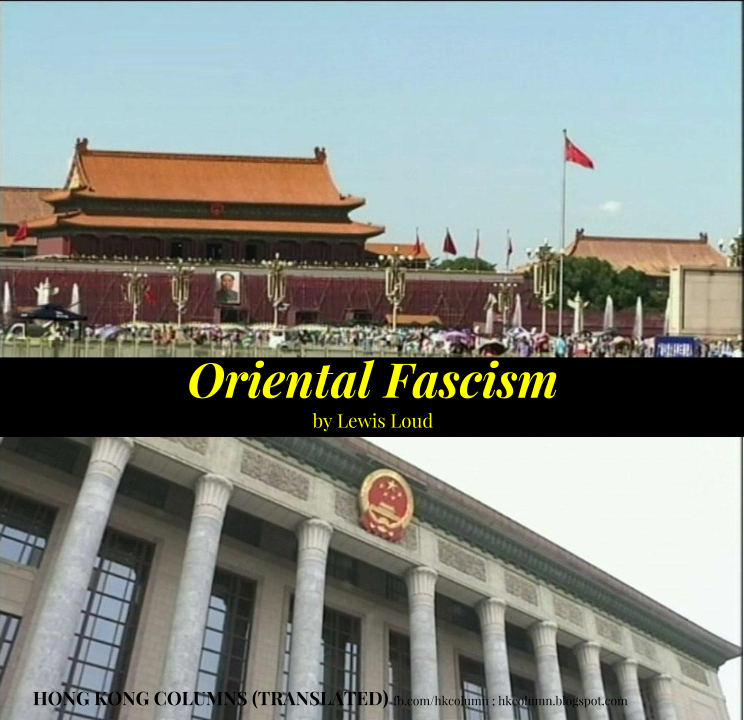
Lewis Loud: Oriental Fascism

Oriental Fascism
Translated by Ryan L, edited by Chen-t'ang, written by Lewis Loud
Original: Passion Times Vol. 41

China is a fascist country. Modern China abides by the belief in “Ein Volk, ein Reich, ein  Führer”. Modern China is an empire masquerading as a nation state.

For an ethnicity to have more than one country, like Austria and Germany, is a universal standard. Yet Chinese do not abide by this. They believe Hongkongers are Chinese, thus bound by the belief “blood is thicker than water”, therefore Hong Kong must accept Chinese rule. To mention independence is certainly treacherous, but even autonomy and localism are identified with separatist and treasonous intent. 

These beliefs are full of the elements of fascism. Westerners turn pale at the mere mention of fascism but America, ignorant and tolerant of the Communist East, supported China in opposing the Soviet Union. Hence, the largest fascist country is thriving today. Churchill once said that communism and fascism are twins that share the DNA of totalitarianism. 

90% of Hong Kong’s population are descendants of Chinese immigrants experiencing the rule from proper China since the Qin dynasty. They belong to the same ethnicity. But many entities may grow out of one ethnicity. Germanic peoples founded more than one country. The British founded America later. Once separated there was never any talk of reuniting with mother Britain.

China’s opposition to any secession through evocation of nationalist sentiments is merely hyperbole. In reality, the Chinese Communist Party cares not a wit about territorial integrity. Russia has swallowed vast chunks of Chinese territories since the Qing dynasty but Jiang Zemin signed a treaty demarcating present borders, forsaking the recovery of those lost territories. So why are the Chinese who live on these forsaken territories not traitors?

Ethnic Perceptions with Chinese Characteristics 
If China really cared about ethnicity, each province would be autonomous and establish their nationhood, then confederate to discuss matters that affected the entire region like Australia or Germany. Each province would be able to choose its own method of governance or development in accordance with the national condition yet the ethnicity would still belong to one entity. Yet China describes itself as a multiethnic yet united country. It is united so as to protect the party’s ability to monopolise all the power and profit; it is multiethnic to rationalise China’s invasive expansionism, its plundering of others’ lands. 

An ethnicity can only have one country. A country can only have one leader. Such beliefs if used in the West would be identified as hegemony, fascism and racism. Yet to the pompous westerner, eastern fascism is culturally specific to cultural complexities thus should be tolerated. This is tantamount to Westerners demanding gender equality and feminism yet tolerating the deprivation of female rights in Islam due to different values. 

Pretentiously cosmopolitan Hongkongers have very vague understanding of ethnicity. The Chinese nation (zhonghua minzu) is an artifice created by intellectuals at the end of the Qing and the beginning of the Republic era with only a century of history yet a majority of Hongkongers embrace it wholeheartedly as an earth-shattering revelation. Community eminences like Joseph Sung, Vice-Chancellor of the Chinese University of Hong Kong is an example. Yet Hong Kong with its modern meaning is already 176 years old, meaning the Hong Kong ethnicity is older than the Chinese nation by sixty or seventy years yet described as a fantasy. 

If the Hongkonger as a nation is a joke, where are the unshakeable foundations for the Chinese nation? Undoubtedly it is the mischief of power; the powers that be may have the power to define. The relationship between the signifier and the signified are unstable, artificial or arbitrary, yet, humans are the author of everything. All is silent, only power may speak. 

Hong Kong is not a nation because she says she is not. Once she decides she is, she is. 

20160321

Statement of the Generation: 11 Our 2047

Statement of the Generation: Our 2047
Translated by Chen-t'ang 鎮棠, written by The Undergrad session 2015, HKUSU

[DIRECTORY: AT THE END]

In his election platform, Edward Leung (from Hong Kong Indigenous) proposed to commence the 2nd round of negotiations and use of referenda to determine Hong Kong’s post-2047 future. On the other hand, in a New York Times interview, Joshua Wong said he will form a new party and join the LegCo election in September 2016. He will use the next 10 years to foster support for a referendum on Hong Kong’s future and self-determination.

The responsibility for bringing the issues of the second negotiation for Hong Kong’s future to the attention of all Hongkongers will belong to this generation. 

In retrospect, we were not born during the 1st negotiation for Hong Kong’s future, so we can only look at the silhouette of history to identify the roots of Hong Kong’s plight. In 1971, PRC replaced ROC to represent China, and in 1972, Hong Kong was removed from the UN's list of colonial territories. Since then Hongkongers, as colonial subjects, have lost the right to exercise self-determination granted by the UN.

In his memoir, Chung Sze-yuen, the LegCo and ExCo member, wrote that in 1984, Lydia Dunn, Lee Quo-wei and him met Deng Xiaoping. Deng immediately said the negotiation for the future of Hong Kong will only be settled by China and the UK. As for the so-called “three-legged stool”, it did not have three legs only two. Since then, Hongkongers were deprived the right to determine their own fate. 

In 1984, Zhao Ziyang and Margaret Thatcher signed the Sino-British Joint Declaration, which instituted the transfer of sovereignty of Hong Kong to China after 30 June 1997. Hong Kong commenced 14 years of waiting.

We once chose to believe China yet she has never kept good faith. Meeting Point, which later became Democratic Party, promoted Democratic Reunification widely. Meeting Point put the wager on China, anticipating she would reform, and Hong Kong would then have democracy. The Tiananmen Massacre did not falter the patriotic hearts of Meeting Point, nor the hope for Democratic Reunification.

History did not follow their wishes.  The current PRC regime is much more centralised and conservative than that of the 1980s. Hongkongers have waited since 2007/08 to 2012 to 2017 for everyone to wake up from the dream of democracy. Meeting Point became the pan-democrats now, occupying the council with slow reforms. 

For example, Emily Lau remains a Legislative Councillor since 1991. The pan-democrats control the resources and voice of the opposition and want to lead the next negotiations for the future, so as to ensure their parties political survival and perpetuate influence. Yet this will severely retard our progress. The pan-democrats do not understand the current China, and still harbour liberal fantasies for the eventual democratisation of authoritarian China. The belief in China’s inevitable march towards democracy is their blind spot. This is the cause of their failure to respond to the surge in localist thought and suffer a dearth of imagination about the resistance through social movements. They uphold the banner of absolute pacifism. When someone tries to break the box with physical resistance, they condemn these protesters and sever ties with them, leaving us, the “eggs” (the eggs/wall simile by Haruki Murakami), out there. Before the election, they will ask us to consider the bigger picture. We cannot repress the sense of helplessness at the shortsightedness of these people who have led the democratic movement for the past thirty years. They have eyes only for ballots but have no mind for the fresh thinking for Hong Kong’s future. The pan-democrats do not belong to this era which has no hope for democratic reunification. 

In 2014, we no longer needed to read literature or watch documentaries because we WERE there. We occupied the road. We were beaten by batons so hard that we bled and sore. The Umbrella Revolution is the greatest roar from this generation. We were naive, because we thought our tear and sweat might bear some fruits in Admiralty or Mong Kok, but this turned out to be futile. The failure of the umbrella revolution lies not only in the revolution itself, but also the Democratic Reunification theory We know that the era of democratic movements has passed, for it will be a tumultuous time of anti-authoritarianism. In early 2016, a policeman violated the Police General Order and shot towards the sky. The protesters hurled bricks as a way to resist. It might be a shock to witness, but it might be the prelude of a new model for resistance. 

All this is for we refuse to be slaves. 

The promise of 50-years of no change to Hong Kong’s way of life as enshrined in the Sino-British Joint Declaration will expire  in 2047. The future of Hong Kong again becomes unknown yet society barely talks about it -  whether it be independence, maintain the status quo or become just another city in China. 2047 seems to belong to the distant future but people were already discussing 1997 in the late 1970s. Looking at the pace of “mainlandisation”, we need to prepare for the preparation of the 2nd negotiation for Hong Kong’s future. We have the following demands:
  1. Hong Kong becomes an independent sovereign state recognised by the UN;
  2. Establishment of a democratic government;
  3. Design of the Constitution of Hong Kong by the entire community.
The HKSARG has become the puppet of the Communist Party. The governance of HKSARG sides with the CCP, undercuts the autonomy, and can be seen in cases like Northeast New Territories development, overspending limitlessly on the Guangzhou-Shenzhen-Hong Kong Express Rail Link (XRL), flattering CCP by developing Qianhai, or turning Hong Kong’s Policy Address into China’s Belt-and-Road Report. Even Hong Kong might not be strong enough in terms of “hardwares”, or China’s economy will still be strong, but our focus is not on CAN Hong Kong be independent, but rather, SHOULD Hong Kong be independent. We want to protect Cantonese, traditional characters, colonial period post boxes, the solemn institution of an independent judiciary, the unique culture and society in Hong Kong, and a democratic government for which the interests of Hong Kong is the first and foremost priority. These aspirations are not borne out of hatred, but comes from every heart and mind desirous of freedom. The struggle for independence will certainly not happen in the span of a day; we are only its beginning. There are plenty of “Greater China” supporters  who insist “it is hard for Hong Kong to have democracy if China does not have it”. But is democratising China easier than an independent Hong Kong? Absolutely not.

Though the Basic Law is the cornerstone of the “one country, two systems”, it never enjoyed the popular mandate of the Hongkonger people. Furthermore, the power of its interpretation lies in the hands of the Chinese Communists meaning that the Communists were free to make such interpretations based on their political whims. Even if we wished to amend the Basic Law we must first obtain the consent of two-thirds of the Hong Kong Legislative Council and the Hong Kong NPC Delegates, then submit a bill to the Politburo and the final say lies in the National People's Congress.

Even though constitutionally speaking it is not impossible for such thresholds to be crossed, unless the proposed amendments have the approval of the Communist Party, there is no hope of them going through. As the recent illegitimate, cross-border abduction of Lee Po demonstrates, when the Basic Law is breached, we Hongkongers have no means of enforcing the Law. The so-called One Country, Two Systems supposedly protected by the Basic Law is in reality very fragile. Before the aggressive red tide, our supposed defences are practically non-existent. Where something can be shattered, something can be established. The next step after invalidating the Basic Law is to draft a constitutional of Hong Kong. Due to the present political constraints, popular demand for a popularly enacted constitution cannot be enacted. However, it will be the result of the participation of the entire population of Hong Kong, enjoying concrete support as it represents our hopes and determination for independence, firmly establishing the foundation for Hong Kong’s future constitutional framework. 

We know that the path to independence is a distant one and will not be a result of just one generation’s effort. We must establish footholds in every arena of society: the streets, the Legco, the commercial sector, the unions, the media, the cultural sector; not one can be missed. Everything from the LegCo seats to local literature is the capital for achieving independence. Last year in September, Catalonia was able to obtain in parliament commencement of secession procedures after three hundred years of struggle. Within 18 months they realised independence. We as spectators are green with envy but must bear in mind the sacrifices of the Catalonians. From the late 1930s to mid-1970s, Catalonia endured severe repression under the dictator Franco. Local culture was forbidden, spread only through the underground which only added to the darkness that overhangs Catalonia. Yet, this only added to the swiftness of the independence efforts afterwards through the strong promotion of the Catalan language and establishing the ethnic pride of the Catalonian people. Hong Kong’s Cantonese culture swept across Asia in the 1980s proving that Hong Kong may be small but has the ability for a febrile cultural infrastructure. Such capital not only is a resource to console the spirit but also mandatory material to enlighten indifferent souls. 

The land resources of Hong Kong will once again encounter issues of ownership and a post-2047 credit crisis thus justifying the urgent need to commence the second round of negotiations. Before these negotiations begin, we must acquire popular support. Communist attempts to win over the youth have failed. Independent thinking once lost remains lost. Localism has grown steadily under the irrational oppression of the Chinese Communist Party. Coupled with the fact that our connection to China is far from that of our parents, we quote from Taiwan academic (who is of Hong Kong origin) John Lim Chuan-tiong: “the next generation of Hongkongers will be the natural independents, bearing by birth rich identification with the Hongkonger identity. This generation will oppose local communists’ collusion with the Chinese Communists and support Hong Kong’s right to independence. Unlike us, they will not have to fumble to find their identification nor will they be confused by the same conflict we felt about dual identities. They will inject energy into the independence movement and become our staunch ally.” 

Cringing is never an option for us.

If your civilization wants us to cringe, I'll show you the pride of savages till the end.
(Warriors of the Rainbow: Seediq Bale trailer)


Statement of the Generation

20160318

When HK Education Becomes Banality of Evil

When HK Education Becomes Banality of Evil
Translated by Chen-t'ang 鎮棠, written by May Lau (劉倩) @ Jumbo 48.4, HKBU
Original: http://issuu.com/_hkbusueb/docs/jumbo48.4/1 
[Translator's note: not being sexist, man/men here refers to human being in general.]

What Makes Man?
The definition of education varies in different schools, and I agree what John Dewey, an American educator, proposed - education is needed to train the people to have independent thinking and sensibility, so as to reform the society and build democracy in people's mind, and this, is individual subjectivity. Education is treated as a basic human right in a civil society. Convention on the Rights of the Child Article 28 said "States Parties recognize the right of the child to education, and with a view to achieving this right progressively and on the basis of equal opportunity".

The Book of Rites said, "Generally speaking, that which makes man man is the meaning of sense of propriety and justice." Though I share Mencius' view of "Men at their birth are naturally good", sense of propriety, justice, honesty and honour need a long time to be motivated (except those emotionally detached). The fundamentals of teaching is to make a man a man, or in Mandarin chengren, which means to be a conscientious man. The teaching must be started when they are young. People now send their children to receive education in schools. Such education means teachers, who have received professional training, will deliver values to children. School and teachers play important roles in the children's development.

The Inferiority of Hong Kong's Education: Banality of Evil
The most ridiculous thing about Hong Kong's education is nothing wakes up the individual subjectivity of the students. Rome is not built in a day, and the failure of Hong Kong's educational system has accumulated for a long time, causing a fundemental institutional problem. The education system is ossified, schools and parents are overemphasizing exams and results without much care about sense of benevolence, justice or propriety. Students have no choice but become the sacrifices of such distorted education system.
The education system in Hong Kong makes me think of banality of evil - that means no thinking, not thinking of people nor the society. Evilness is banal, and everyone might fall into this trap. Some people are willing to give up their own free will to assimilate themselves into the system and follow its arrangement, and would not speak a word for the hidden immorality. Such people would use all sorts of excuses to rationalize their moral faults. These people are but horrible, because they look the same as normal people do, but when they commit crimes, the consequences are unimaginable. The most evil of human being is not to think and to blindly follow.

The concept of "banality of evil" was mentioned by Hannah Arendt, an American philosophist, in 1963 in her book Eichmann in Jerusalem: A Report on the Banality of Evil. She illustrated that these "criminals" are not unpardonably wicked, and sometimes even quite conscientious (like helping old ladies on zebra crossings), but they commit crimes when they do not think and feel responsible. When Adolf Eichmann, the Nazi killer, faced with the charge against humanity, he said he was just a law-abiding person and all he did was to execute his duties. Eichmann said his role in the Final Solution (Endlösung) was just incidental, and any other people under his situation would execute tasks delegated by Hitler.

When Education Becomes Banality of Evil
System is a double-edge sword. Whether it is well used depends on the people inside a system. The biggest problem of Hong Kong's educational system is "quantifying everything" by looking at numbers in exams and assessments. Policy makers, executers and participants do not think. Secretary for Education Eddie Ng, who said he reads 30 books a month, quantifies his reading habit into number of books read; schools, who worry parents choosing other schools, would quantify the school achievement by how many score achievers in HKDSE. The education in Hong Kong has entered an era when nothing else but quantification is important.

First, talk about territory-wide assessment (TSA). TSA initially intends to evaluate the school's education policy, provide data for the school and teachers to improve its teaching, and let the Education Bureau evaluate the schools' qualities. Many schools worry that they will be eliminated or culled, so this burden is transferred to the shoulders of students. I do not know the reason behind - must the results of students reflect the teaching quality of a school or a teacher? Does good results in students reflect good teaching? Does good teaching (or not) depend on the good results? Since primary schools, students are carrying such burden to achieve the goals set by teachers and schools, and completing exercise books one by one as if they were robots. Eventually, students and parents can no longer take it, and call for complete eradication of TSA.

Then, the public exams. In the past there were HKALE and HKCEE, and now there is HKDSE. Studying is for exams. How many things can students remember and use it for their whole lives, instead of returning to their teachers once they are outside the exam halls? With such ideology in mind, schools become "input-output" factories. Students are input with formula - "studying is for scoring marks, or you cannot get in universities". Students live under such distorted system, and some high achievers cannot even take care of themselves, not to mention "lofty ideals".

Blind Obedience - When Education Becomes the Tool for Training Skills
The education in Hong Kong does not need nor allow us to think or to ask but to absorb knowledge and become puppets. Education becomes a tool to train skills and ensure capitalism to run on. Students are raw materials, and eventually become parts which cannot function on themselves, as they need to work with other parts - they can never become an independent individual. Schools are places producing parts in a closed circuit. As Michel Foucault said, "In every society, the body was in the grip of very strict powers, which imposed on it constraints, prohibitions or obligations." (Discipline and Punish, p136, 1977 Vintage Books) In schools, students are domesticated by authority.

Under the education system in Hong Kong, students can barely think, or if they wish, they do not know how to think outside the box. Most of the time they think inside the box of Examination and Assessment Authority (HKEAA). When they recite model answer from famous tutors, speculate markers' thoughts when answering "open-ended questions", they can get high marks. The banality of evil in Hong Kong's education is not because of students' ignorance, but rather, lack of thinking ability or willingness to think, because in schools, when you follow the authority, you get awards. And so, the younger generation becomes willing to assimilate their personal will into the system, and neglect the injustice of the system, thus growing the seeds of banality of evil.

What HK Teachers Teach Is to Compromise - System Is Bigger than Justice

I think what Hong Kong teachers teach is to compromise. Why I would conclude so? I watched an episode of Below The Lion Rock 2015, a RTHK TV programme. The female leading role, Yip Hiu-yuet, stood out for the classmate bullied by the bully, but was avenged by the bully. The teacher, without understanding the complete story, punished and insulted Yip physically. The bully and her father even said they will charge Yip. The teacher worried that Yip, who will be troubled by the lawsuit, will affect the school reputation, so the teacher demanded Yip to apologise to the bully and her father. The teacher did not teach students to stand out for injustice, but rather wanted Yip to play this down and compromise. Such "roll-with-the-punches" attitude would distort justice and treat this as normal -- that is the abnormal point. Students will treat teachers as authoritative yardsticks and social norms are delivered through and confirmed by teachers. The teacher has shown the ordinary education culture in Hong Kong - students should not resist but succumb to the fact.

There are many real life examples. In the 2013 Kei Chun Primary School tragedy (where a 10-year-old girl fell from 5th floor but teachers failed to respond promptly and causing her death), a seemingly good teacher did such hysteric thing (calling St Johns, 6.9 km away instead of dialling 999 and asking for an ambulance from Margaret Hospital, which is 1.5 km away). The school and teachers succumbed to "the protection of school reputation". During the death inquiry, the teachers even said "all were following established procedures". The seemingly good teacher become murderer, because she followed the procedures and the arrangement, and put system above justice.

Reshape the Role of Teachers as Social Intellectuals
To be honest, the system cannot be changed in a day, but the people inside the system can be the key. Teachers, as social intellectuals, are not only responsible for teaching, but changing the society. Teachers have to jump out of the box of "I am just a teacher", and should remain critical to the injustice in the school and the society, and pass this mindset to students, so as to foster social transformation. This is critical pedagogy, which advocates students should have the critical thinking, to think independently and solve problems. Students can have different points of views from real life problems, so they can get away with those rigid models, and think about men and the society.

Conclusion
George Orwell's 1984 warns the world how terrible an authoritarian regime is. If people still face the society with the none-of-my-business attitude, then they would be banality of evil too, as they become puppets manipulated by others. Hong Kong education should not be in this way, and Hongkongers should not be in this way. We should hold our conscience, and probably this is the only thing we can do for Hong Kong.

Reference: Hannah Arendt, Shek Chun-yin, Alex Hui, Tsang Wing-kwong