20210404

[HKUSU The Undergrad] An Oral Account of Hongkongers’ Common Experience

An Oral Account of Hongkongers’ Common Experience
Written by Wah Cheng @ HKUSU The Undergrad, translated by HKCT
Original: https://www.undergrad.hk/19528 


In today's chaotic times, it is increasingly difficult to record and pass on what is happening at a granular level. Due to the erosion of Hong Kong’s freedom of the press and the self-censorship of media, less attention is paid to  social issues as a result. On the other hand, Hong Kong government attempts to deploy the influence of public opinion in all domains to whitewash the situation, to justify itself, and to cover up the truth. 

Over the course of protests in the past few years, the government is so used to stigmatise the side of the “egg” (c.f. the quote from writer Haruki Murakami - “Between a high, solid wall and an egg that breaks against it, I will always stand on the side of the egg.”). Even if we are to fix in mind what we have witnessed, who can assure that the generations after us will be informed of our story instead of the “truth” appeared on some deliberately “sanitised” textbooks? Besides, can such unimaginably horrific and uncomfortable experiences of this age be conveyed in words alone? 

Under such tense, unsettling circumstances, it should take much longer time to heal, and be ready to reorganise and recount the events — hopefully able to explore more untold experiences during the process. In the days to come, every one of us Hongkongers who participated in the protests will have the opportunity to tell this mutual yet personal story in their own voice. 

- Expression Restricted -

Oral history serves as a valuable means in Hong Kong, reason being that the ability to record of written form in Hong Kong is vastly different from what it used to be, making it impossible to accurately set things down. Oftentimes, information has been tampered with which leads to gross distortions in history. Oral history, however, redefines the causes of certain issues through individuals’ experiences, adding more perspectives and credibility to the interpretation of historical events. 

Hong Kong’s press freedom has come under attack since the anti-ELAB movement. From the government's implementation of the National Security Law, to Hong Kong police's revision of Police General Orders to redefine the media's eligibility to cover news, they have generated an uneasy culture of self-censorship among the media. On that account, the media have no choice but to evade the issue, or to exclude any sensitive matters from news coverage, so that they would NOT incriminate themselves. With the police’s new accreditation rules on media, numerous journalists who are not from those media organisations registered with the government information system are no longer allowed to attend press conferences. Journalists of the sort also suffer from differential treatment at protest sites because of the revision of Police General Orders.

In August 2020, over a hundred police officers and Office for Safeguarding National Security of the CPG in the HKSAR  officers searched the Apple Daily building on suspicion of colluding with foreign countries or forces to endanger national security. The officers looked through some of the journalists' desks and documents, interfering with freedom of the press in a blatant manner. Under such unreasonable and harsh law, the media remain silence for survival. In addition to the government's suppression, news outlets in the territory are gradually being tainted by the Chinese Communist Party or Chinese capital. The management of the red capital naturally imposes strict control on the topics, materials, and stances of the media outlets. All of them are to be closely monitored, and journalists will lose their editorial independence. It goes without saying that these “media outlets” will be subordinated to the government as a mouthpiece, a tool to direct the public opinion as the government will, instead of an objective role to record what is actually happening.

In recent months, there has been a massive reshuffle of staff at various news organizations as pro-China management has come to power. The four latest executives at Cable News, Edna Tse, Oscar Lee, Anderson Chan and Hui Fong-fai, have laid off tens of newsroom staff, leading to the collective resignation of prestigious and award-winning China desk.

In June 2020, now News had undergone a change of personnel. With former TVB News senior executive Chan Tit-piu, former TVB senior producer Lee Wai-leung, and former TVB executives Wu Yi-tyng and Yip Wai-man appointed to work for now News, it indicates a sudden reorganisation of the news station. In such a restricted environment, journalism seems useless. Instead of relying on others to write down your stories, it would be easier and more direct to record your own experiences on mobile phones—to tell one's story orally without having to integrate and embellish it. There is no rush to record everything at this moment. Keep our memories intact, so that one day when we’re free to say what we want, we’ll pass them on to the next generation.

The Fourth Estate, which is responsible for monitoring the government, recording current affairs, and exploring social issues for the public, has been interfered by pro-China forces. The government has also started to reform education by “rectifying” the teaching material of subjects so as to make sure that students are only exposed to their side of story and information. By doing so, students will be more easily indoctrinated with distorted values and be molded into  patriotic students.

In 2019, EDB introduced what they call "professional consultancy service" to force textbook publishers to submit their Liberal Studies textbooks for review on the premise that they would not be included in the applicable textbook list otherwise. What followed is that politically sensitive issues are not given in-depth analysis: Aristo Educational Press Ltd. deleted the exercise about civil disobedience, and Ling Kee Publishing Co., Ltd. deleted the section related to freedom of the press, human rights and rule of law. EDB went on to reform Liberal Studies and packaged it into a core subject of “patriotic education”. If this continues, Hong Kong's next generation will be left with a vague understanding of history, and find it hard to relate to what we believe in.

Oral history, on the contrary, may allow us to fill the gap for those who are willing to hear. In one of the discussions on the history of the Cultural Revolution on The Initium, it is mentioned that descriptions of the Cultural Revolution on the history books are omitted. The books are filled with abstract information—no specific data, exact events, or names of the people involved—leaving readers with a sense of detachment from the entire historical event; others tend to provide one-sided, selective content—Mao Zedong and other people in power are highly praised. Despite the fact that the subject curriculum and exams in secondary schools do not focus on the period of the Cultural Revolution, the oral history passed on via one’s family and high school teachers often went into great detail, and carried such profound sadness and strong feelings. Somehow this is exactly how the listeners experience, through the contrast, the evident absurdity and cruelty of this period of history. Perhaps in the not-too-distant future, Hong Kong will also be practicing a similar form of education as well.

- The Limitations of Text -

Fortunately, Hong Kong is still a long way from the state of affairs described above, and there are still many dedicated scholars and ordinary people using pen and paper to record history and defend Hong Kong's existing values. Among the many facets of history, oral history does have a variety of benefits. For one, it is not limited to historians; writers and students too can talk to those who experienced the events in person. Sometimes the interviewees may be elderly people who struggle to express their thoughts in clear sentences and have to be guided slowly through their minds; at other times they may be young people who have just experienced some major social event and are encouraged to record their fresh memories, so that others can revisit the piece of history and analyse it later on.

The authenticity of oral history is sometimes questioned for not being historically accurate or somewhat biased, which brings to the responsibility of the interviewers to verify them with other historical archives, such as official documents and press releases of the time, after recording the interviewees' statements. 

In totalitarian countries, since the dissidents/ ethnic minorities are persecuted, only a few official documents are left behind, and most of the details, especially the circumstances of the victims, are seldom recorded. When these regimes fall and people are freed, people can learn the details of these historic events through the memories of those who survived. We Wept Without Tears, written by Gideon Greif, chronicles the experiences of thirty-one Holocaust death camp survivors who were forced by the SS to serve as assistants and became part of the persecution of Jews in order to survive. The book describes the details of life in the camps and the operation of the death factories. Their emotional, personal experiences channel the horrifying torment of the concentration camps to the readers, and change our misguided, judgmental perception over the inmate work units who had no choice but to dirty their hands. This book of oral history gives them the forgiveness and justice they deserve.

Oral history also adapts in different forms for the need of readers/audiences, but not always turns into a book after rounds of interviews, recordings and follow-ups. One of the drawbacks of preferring words to sound as the method to record oral history is the lack of warmth. Audio clips, video clips, and live sharing sessions are all feasible alternatives of oral history. Especially through the own voices of the interviewees, such experiences will come alive and provide with the next-generation audience a better understanding of the historical significance of the time. In addition to it, oral history can be integrated with various activities or sharing sessions so as to reach a certain degree of communication between the audiences and the speakers. In this way, the details of history can be sorted out in a more organized manner. 
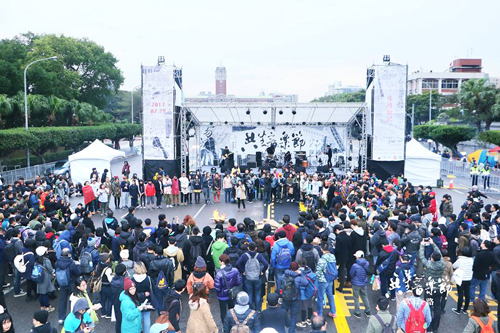


In Taiwan, a group of young people who care deeply about Taiwan's history founded the “Gongsheng Music Festival” (Gongsheng means grow together), which is dedicated to commemorating the Feb. 28 incident and is now in its ninth year. Attracting young people to learn about this history, the festival includes many organisations and scholars that perform on the topic of the Feb. 28 Incident. In the festivals, scholars are invited to talk about this piece of history from their personal experiences. In one of the annual talks, the organizer invited a literary historian, Chang Tien-wan, to share with the audience through her family's association with this period of White Terror. In particular, she told the story of how she was adopted because the police officer in charge of watching her adoptive father asked him to take care of a child that his fellow officer could not support.

- Conclusion: The Road to Transformative Justice -

Considering Hong Kong's current environment, oral history, indeed, can contribute to local history now and in the future, and even achieve the effect of transformative justice. From the Umbrella Movement to the anti-ELAB Movement, many Hong Kong people have suffered persecution and injustice, and their experiences and feelings have not been properly documented as part of the history –  those who escape to the rest of the world, who suffer from the differential treatment in the prison because of their political stance, and the 12 Hong Kong youths who were detained by Chinese authorities.

If one day someone can interview them and write down what they say, then in the future someone will be able to use this evidence to investigate the truth and to honour their memory.

20210226

Doing My Part to Protect HK: Gordon Mathews

08:03 25 Feb: Doing My Part to Protect HK: Gordon Mathews
Translated by HKCT, written by 晴韻 @ Stand News
Original: https://www.thestandnews.com/politics/%E5%B0%88%E8%A8%AA-%E6%B1%BA%E5%BB%B6%E9%80%80%E4%BC%91%E7%95%99%E6%B8%AF%E6%95%99%E6%89%B9%E5%88%A4%E6%80%9D%E8%80%83-%E9%BA%A5%E9%AB%98%E7%99%BB%E7%9A%84%E8%B3%AD%E5%8D%9A-%E5%BE%AE%E5%B0%8F%E5%9C%B0%E7%9B%A1%E5%8A%9B%E4%BF%9D%E8%AD%B7%E9%A6%99%E6%B8%AF/ 


Professor at The Chinese University of Hong Kong’s (CUHK) Department of Anthropology, Gordon Mathews conducted fieldwork at Chungking Mansions between 2006 and 2009 to study “low-end globalisation”.

Mathews, currently 65yo, could retire this coming August, move to his wife Yoko’s home country, Japan. However, he eventually chose to stay in Hong Kong; at the beginning of the month, he announced on Facebook (https://www.facebook.com/hkcolumn/posts/2868916283325752) that he already renewed his teaching contract with CUHK for the coming 3 years. Besides directing his graduate students’ research, he also remained because of his conviction of the importance of critical thinking.


His announcement on Facebook was probably a post that has garnered the most engagement and response on social media for him in recent years. He stressed that choosing to stay in Hong Kong to teach was not a foolhardy decision, but definitely not something that could be described as courageous. “Well, it’s a gamble.”


- Real Education -

Born in the US, Mathews used to teach in university in Japan, and moved to Hong Kong with his wife when he was hired by CUHK in 1994. Fluent in spoken Japanese and able to read the language, but his Cantonese remains limited to only enough proficiency to carry out a 5-min conversation with a taxi driver, such as “Do you like the Chinese government.”

In recent years, Gordon teaches subjects such as “Culture of Hong Kong”, “Globalisation and Culture”, “Humans and Culture”, and “Meanings of Life”. Though the subjects are different, they all revolve around the core of critical thinking. He emphasises that training students to think critically has always been the fundamental principle of higher education that he holds, “delineating all the facets of a topic and allowing students to select their stance and opinion according to different arguments.”


Mathews gave an example: Consider the various protests in Hong Kong over the past decade from various perspectives, and provide your personal view. He explained that the “various perspectives” must engage in discussions from Hong Kong and mainland China’s perspectives, as those two perspectives are a must, while other facets and perspectives should be used to supplement. At the same time, the response should be largely based on facts to demonstrate students’ comprehension of the topic at hand, then provide their own views based on the arguments presented, “That’s what I consider critical thinking.”

Critical thinking should not only be applied in exams or at school; Mathews hopes that students would retain this ability even when situated in a protest movement.

Mathews was one of the teaching staff who remained on campus during the battle at Bridge No. 2 in CUHK in Nov 2019. Recalling the course of events from 2 years ago, the most unforgettable moments weren’t of the fire and smoke, but the time he spent drinking beer with local and mainland Chinese students on the rooftop of the staff quarters during the siege at CUHK.

He joked, “That was the most prideful moment for me during the social movement…that’s what we should be doing. We should discuss, and of course not every person will agree with the other’s opinions, but at least there could be a civil conversation. This is most important. Critical education is what allows people to have this dialogue and rational communication.”

He often tells his students that non-violent protests and civil resistance are the ways forward. “I support the resistance movement, but I don’t agree with any form of violence, including those wielded by the police and the protesters. It’s stepping across the line, but understandable.”

Prior to Jun 2019, Mathews did not join any Anti-ELAB protests because he worried that having an American passport could fall into the trap of the CCP’s political propaganda, that of “foreign forces infiltrating Hong Kong.” However, he eventually chose to take to the streets.

“Because there were reports then that students were beaten and sexually assaulted by the police. I must be there for the students. Maybe I would only be there to observe, but to some degree it could prevent such things from happening, and students would act with more self-restraint and less violent.”

- Real Patriotism -

In 2008, Mathews, Lui Tai-lok and Eric Ma Kit-wai co-authored the book “Hong Kong, China: Learning to Belong to a Nation”. In their work, they pointed out that Hong Kong is one of the very few places in the world that does not know patriotism and did not have any patriots willing to die for Hong Kong. After the Handover in 1997, those who most stressed the identity of “Hongkonger” were also the ones most eager to emigrate. It was not until 2019 when he heard a student tell him for the first time that they would be willing to sacrifice their life for Hong Kong. Mathews felt that to a certain extent, this reflected a new feeling of “seeing Hong Kong as home.”

“Mainland has always wanted Hongkongers to learn to love their country, now Hongkongers do, but it is the wrong country. It’s Hong Kong but not China, which is very true.”

As for the Chinese government’s relentless attempts to impose a national identity on Hongkongers, Mathews finds these attempts laughable. He pointed out that most places in the world have national belonging training, such as he had to recite the Pledge of Allegiance since he was very young, and even after having left the US for decades, it’s still deeply ingrained in him. “Would that mean that I love the US? No! I hate the US, and seeing what the country has been doing the past few years, it’s clearly an evil country.”

“I’m aware that I want to remain loyal to Hong Kong…I think this feels like home, as I am emotionally connected to the city.” Could this be counted as a “patriot” for Hong Kong?

“I don’t like to use “patriots”, because I don’t feel that this world deserves to have patriots.” Mathews reiterated, “I like and value Hong Kong, but I hate the term patriotism, because it could easily turn into fanaticism.”

20210214

Police Siege of Universities: Battle Between Totalitarian & Universal Values

Police Siege of Universities: Battle Between Totalitarian & Universal Values 
Translated by HKCT, written by Sam Choi Chun-wai, originally written on 22 Nov 2019 and translated on 27 Nov 2019
Original: https://www.thestandnews.com/politics/%E8%AD%A6%E6%96%B9%E5%9C%8D%E6%94%BB%E6%A0%A1%E5%9C%92-%E6%A5%B5%E6%AC%8A%E8%88%87%E6%99%AE%E4%B8%96%E5%83%B9%E5%80%BC%E4%B9%8B%E6%88%B0/ 


[HKCT note: We are trying to back up long articles we have translated during the anti-ELAB movement and thus we are uploading them here again.]

Since the anti-extradition law protests in June, Hong Kong’s motto has evolved from “Hongkongers Add Oil” to “Hongkongers Rebel” to “Hongkongers Avenge,” reflecting the incessantly growing dissatisfaction felt among the protesters. This is all because the state violence and absurdity has been growing day by day.

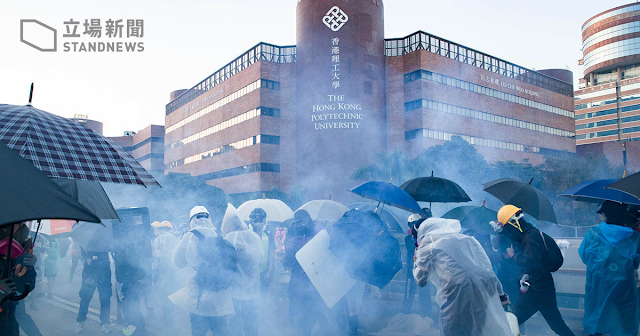
The death of HKUST student Alex Chow, who fell from a carpark amid police operation, was a trigger that ignited the grievances accumulating in the city for the past few months. Citizens once again commenced the “Citywide 3 Suspensions” (三罷), which included occupying traffic arteries near major universities. However, as is their wont, the police continued to violate convention, forcefully storming and raiding campuses. The recent bloody siege of CUHK and PolyU will become an inextinguishable page in the history of Hong Kong.

The siege of universities is an extremely serious humanitarian crisis. Over 2,000 rounds of tear gas were maniacally fired at CUHK, and the sky was aflame. China-manufactured tear gas release high levels of toxic chemicals, including cyanide gas and the carcinogen Dioxin, which is extremely hard to clean. Yet the police opened fire crazily as if to annihilate their opponents. No wonder foreign journalists accused the police, who lack conscience and morality, of being more frightening than ISIS.

The siege on PolyU continues to this day, and over 1000 people have been arrested and registered. Even though food and water rations on campus have been cut, and over a hundred citizens have been injured, the government barely moves a muscle, vowing not to end the siege until a “surrender,” treating the citizens like war criminals.

Lawmaker Ted Hui Chi-fung has experienced the conflict from within PolyU firsthand. He attempted to calmly reason with the police, but discovered that many policemen are in a euphoric, even deranged state, constantly hurling insults at the ordinary citizens trapped inside. The police were even photographed entering the campus grounds, not to arrest anyone, but to open fire at extreme proximity, treating the citizens and students as live targets. Can such vengeful means of smiting ordinary citizens be considered the actions of a public servant?

Inside the campus was panic and helplessness; outside, anxiety and heartbreak. Citizens did their best to “bloom” in various districts, attempting to “Besiege and Rescue,” but to little avail.

The police, holding submachine guns and armed with live ammunition, even loudly threatened the citizens that they would “Re-enact Tian'anmen Massacre.” In pitch darkness, masked police fired tear gas and rubber bullets in abundance, hurtling towards crowds like a speeding minibus. Smoke and flames rise everywhere in Hong Kong, as if it is a battlefield. Even without tanks, this is already a re-enactment of Tian'anmen Massacre.

The police changed their strategy of sieging PolyU, aiming to divide protesters and use various means to wear out their morale, to thoroughly crush their mentality. Looking at the bigger picture of the movement, the Siege of PolyU has gains as well as losses, but I hope that everyone can ultimately view the incident in a positive light. Citizens were terrified, but relied on completely nonviolent logic to attempt to break the siege at PolyU. Although not every protester at PolyU was successfully rescued, the incident showed that citizens continued to stand together with ties unsevered, a shared belief of unity.

Regardless of their ways, beliefs, or backgrounds, those who truly love Hong Kong remain extremely united. This home is dear to everyone’s hearts.

Hong Kong has not imposed curfew. Yet the city is dealing with the realities of martial law and warfare, and even facing biological hazards. Since June, the police have already fired over ten thousand rounds of tear gas, covering communities with deadly chemical substances. No one was spared. Can the industrious Hong Kong people still pretend to sleep, or pretend that everything is normal?

Students are the backbone of social movements, and schools are symbolically significant: they are the “home” to students and alumni, the “cradle” that will nurture the next generation, and the “bastion of knowledge and values” in a city. It is for this reason that so many protesters, whether they belong in schools or not, do all that is possible to protect these buildings.

This is something that those whose hearts lack a home, knowledge, and principles can never understand.


Sam Choi Chun-wai is a lecturer in The Education University of Hong Kong's Department of Asian and Policy Studies.

Author's Note:

It’s a pity that Pentaprism II’s critique of the Hong Kong police’s inhumane actions brought about a bunch of mean, pro-China complaints. Only after several hours of its online rerun, the video was forced to be taken down! RTHK’s staff resisted valiantly, and I also want to thank them for their hard work! 

Translator’s Note: 

1. To “bloom”  (遍地開花 pindei hoifaa) means to sprout up [i.e. have protest events] across the city in groups.

2. “Besiege and Rescue,” originally an idiomatic expression in Chinese, is a diversion tactic whereby one besieges the enemy’s home base in order to rescue those besieged elsewhere.

3. Pentaprism II (左右紅藍綠) is a current affairs programme broadcast by RTHK.

Love that Transcends Walls & Fences: Protester Vows to Wait for Arrested Lover

Love that Transcends Walls and Fences: Protester Vows to Wait for Arrested Lover
Posted on 14 Feb
Original: https://hk.appledaily.com/local/20210214/6G2T3DLKKFCLRCCDPXZ23D4LKU/ 


What’s the meaning of Valentine’s Day? Isn’t it, after all, just another commercial holiday to boost consumption? Without extravagant gifts and fancy candlelight dinners, for those protesters facing hard, cold walls while their loved ones remain beyond reach on the other side of the walls, heart-wrenching love is all that matters. When the time spent apart is longer than the time spent together, would the line connecting lovers become thinner and thinner, or more sturdy and steadfast? What sort of lover would say such folly as “I’ll wait for you even if I have to wait 10 years”? Love, perhaps, is crazy after all.

- Waiting for You, in this Desolate Classroom -

“Our time apart has been longer than our time together.” Hayley (pseudonym) and her boyfriend were both arrested; for the past year, she had been on bail while he remained remanded pending trial. They had belonged to the same small team, walking the streets together. She recalled that they met for the first time at PolyU, and since that fateful meeting, she decided that she would spend the rest of her life with him.

After they escaped from PolyU, they knew that they had long been under the watchful eye of the police, and they could do nothing more than pretending to be a couple taking a stroll at night. That night, there weren’t any pedestrians on the street, making the two painfully obvious. Before they knew, riot police began to chase them, and he held her hand tightly as they ran for their lives to escape arrest. Such dramatic scenes as if out of a movie, message exchanges in a group, and several in-person meetings, sufficed to give her the impression that this was someone who had been through thick and thin with her.

Sitting on a chair, she tightly grasped her hands, and only smiled when the reporter asked her what she liked about her boyfriend. She told the reporter that he was several years older than her, and took care of her conscientiously, “He’s a really nice guy, taking me everywhere with him. Within a short time, I had already met his parents, and he treated me as someone very important to him.”

Before they really got to know one another, they had already decided to be together, and she admitted that it was only after they officially became a couple when they really began to get to know one another. Despite participating in the social movement together, their actions weren’t always in sync, because he always felt that he should be at the frontlines, while she – due to consideration of her physical condition – could only remain in the back and take up various supportive positions. Whenever they went out, they would always turn on their location to let the other person know where they were. She had complete confidence in him, but he was constantly worried that she might have an accident.

“I know that if I were to be subdued, he would save me no matter what.” Many couples, even after being together for decades, might not have complete mutual trust, but they had only been together for several months, yet their trust was solid as a rock. Then on that fateful night, the hasty knocking crushed their sweet dream. The two were arrested, and she “worried that he would be beaten, and worried that I would not get to see him anymore.” She too had been arrested, but she did not worry about her own safety, and instead, worried that she could not do anything to help her boyfriend.

- Teaching Others the Importance of Persistence -

72 hours later, her case was mentioned in court, and she could finally see her boyfriend again. As soon as he saw her, he began to cry, “I was so heartbroken…” She tried to hold back her tears because she didn’t want to cry in front of him, didn’t want him to think that he had gotten her into the mess. Afterwards, it was nearly a year of him remaining in remand.

At the start, she did not visit him, and only passed letters to him via a friend. Because they were arrested together, she worried that there would be suspicion of obstructing justice if they met, but when the lawyer later told her that she could visit him, she began to visit him every week. This went on for quite some time, and she said that she must seize each and every opportunity, “Whatever time there is to meet, I will see him.” She was worried that after he was sentenced, she would not be able to meet him as frequently.

They were both nearly 30yo, and in the face of 10 years or more behind bars, she said that she was already mentally prepared. They could meet now several times each week, each time for 15 minutes; she said that this actually brought them closer together, and made them miss each other more; the physical separation could not divide them. He of course told her before not to wait for him, because he didn’t want to waste her youth, “I’ll definitely wait, this is something that we’ll get through together.”

When asked if she regretted participating in the social movement, and if she regretted falling in love with this man, she felt that society needed reform, and the government had forced the people to take such measures. As for this man, he was her comrade, her lover; she appreciated his sacrifice of his future and his life for the city, and she was grateful for his pure passion.

“Every person deserves to be loved and cherished, and serendipitously, we found each other.”

- Finishing the Finale in Your Embrace -

Last Valentine’s Day, they were in each other’s embrace, but this year, they are apart. However, she didn’t feel sad, and said that she was learning to live on her own, “As long as you get used to it, it’s not too bad. If one year is too much, how can I last a decade?” She then said with an air of optimism that each 15-minute visit was like charging her up for meeting the challenges in life, helping her to happily get through another week.

He told her that in his dream, he saw her and held her, but when he woke up, he found himself alone in the cell, staring at the cold, hard walls. She couldn’t bring herself to continue, since overcoming her loneliness was one thing, but bearing the other’s loneliness was an entirely different matter. At night, she could only recall the fragments of their time together, the first time they hung out like any other couple, what they ate, where they went together. She remembered all these moments deeply, “If I can’t even remember these things, then there’s nothing left to hang onto.”

She regretted that they had very few photos together, “We must take more pictures together once he returns.” During the visits, she always longs to hold his hand; remembering that the next time they could hold each other would be in ten years’ time, she falls into melancholy again, “Why must it be so hard.” After a long conversation, she did not talk much about her own case, as if it was not important, but that only he was the most important thing to her.

Won’t Refuse Young HKers for Protests or Charged under NSL: Cdn Consul General on Canada’s Lifeboat Scheme; Concern NSL’s Detrimental Effect on HK’s Rule of Law

Won’t Refuse Young HKers for Protests or Charged under NSL: Cdn Consul General on Canada’s Lifeboat Scheme; Concern NSL’s Detrimental Effect on HK’s Rule of Law
Originally posted on 11 Feb


Since the enactment of the Hong Kong National Security Law (NSL), the Canadian Government announced last November the Lifeboat Scheme to enable Hongkongers to move to Canada. The first round of work via applications began taking applications this Monday (8 Feb), in that Hong Kong residents who received a university degree or college diploma from a Canadian institution within the past 5 years or an equivalent qualification via an overseas certificate would be eligible to apply for a work visa up to 3 years, with no ceiling on the age of the applicants.

Three days after the launch of the Scheme, Canadian Consul General in Hong Kong and Macau Jeff Nankivell was interviewed exclusively by Stand News. He pointed out that the Lifeboat Scheme set a relatively lower threshold than existing immigration policies, hoping to provide young Hongkongers a “more convenience, easier” means to live and work in Canada.

Nankivell also stressed that if young Hongkongers had been charged for their participation in political activities, they would not lose out on their chance to emigrate to Canada, “We don’t want the young people who had been charged for participating in protests or for allegedly violating the National Security Law to mistaken that they would be disqualified from applying.”

“In Canada, political activity is not a crime.”

Having lived in Hong Kong for 4.5 years, Nankivell told reporters, “I have deep feelings for Hong Kong,” and that he felt that he was not the only Canadian with great passion for the city. “Many Canadians share this affection. In Canada, anything that happens in Hong Kong is big news.”

Canada had long been a choice for Hongkongers for studies and emigration. Nankivell shared that the Canadian Government’s target number of immigrants for the year was 400,000, approximately 1% of the current national population. He laughed that this was an “aggressive” target, that Canada is “one of the few countries that actively recruits such a large number of immigrants.”

Besides the first round of work visa applications that it had announced recently, the Canadian government had also previously foretold that there would be forthcoming announcements of two other means to permanent residence this year, including one for those Hong Kong residents who had at least one year’s work experience in Canada and fulfilled the language and education standards; another means would be for Hong Kong residents who graduated from Canadian tertiary institutions, with a path that would allow them to apply directly to receive permanent residence.

With a low threshold for application, it was certainly good news to young people.

Nankivell pointed out that Hongkongers can apply for the work visa via an online system, but it was still difficult at this point to estimate the number of applications, “One thing we could be sure is that many young people are interested in this scheme.”

Canadian Minister of Immigration, Marco Mendicino, previously said publicly during a parliamentary hearing last November that “no one would have their refugee application or other Canadian immigration application banned for being charged with violating the National Security Law or having been convicted for participating in peaceful protest.” As for how the Canadian government would define “peaceful protest”, would charges of unlawful assembly and rioting be excluded?

“Political activity is not a crime in Canada.”

Nankivell reiterated, “We don’t want the young people who had been charged with participating in protests or violating the National Security Law to mistaken that they would be disqualified from applying.”

He promised to young Hongkongers that Canada had a well-established vetting system and will carefully review each Lifeboat Scheme application to confirm whether the applicant has committed a crime for political reasons or some other criminal offense.

- No One Seeking Political Asylum from Cdn Consulate Generate Yet -

New Hong Kong Cultural Club, a group that assists Hongkongers in exile in Canada, pointed out last month that since the end of last year, Canada had approved refugee status for 14 asylum seekers from Hong Kong (see HKCT’s previous report here: https://www.facebook.com/hkcolumn/posts/2851808418369872). As for the number of Hongkongers in exile in Canada, Nankivell did not respond directly, but claimed that such matters were not part of the responsibility for the Consulate in Hong Kong and Macau. He also said that thus far, no one has visited the Consulate to seek any sort of asylum.

- Concerned that NSL Destroys HK’s Rule of Law -

Every time the NSL is brought up, Nankivell shows concern.

“(The NSL) clearly violates the Sino-British Joint Declaration, undermines One Country, Two Systems, is inconsistent with the Basic Law, and also counters internationally protected Hong Kong human rights.”

In the international arena, Canada has repeatedly spoken out against the NSL, first issuing a joint statement with the U.S. and U.K. condemning Beijing for pushing through the NSL in Hong Kong, then issuing a statement as a member of the G7, announcing the suspension of the Canada-Hong Kong extradition agreement, and banning the export of sensitive military goods to Hong Kong.

On the other hand, the Consulate also reminded Canadians in Hong Kong about the NSL through its website and social media.

“As soon as the NSL came into effect, we immediately updated our travel advisory to remind our nationals that mainland national security agencies will be able to legally carry out their duties in Hong Kong without local court or legal oversight, and that nationals are at risk of extradition to the mainland for trial.”

To Nankivell, however, there had been a fundamental change to both the Hong Kong judicial system and court trials.

- Fundamental Change to the Courts -

One of the most high-profile NSL cases was that the founder of Next Digital, Jimmy Lai, on charges of colluding with a foreign country or foreign forces to endanger national security." This past Tuesday (9 Feb), the Court of Final Appeal handed down the verdict on his bail appeal case, and among the long lines of people outside the courtroom that morning, there were also European Union diplomats and Canadian consulate staff waiting to enter the courtroom to observe the case.

Nankivell said that the consulate staff had attended the case as an observer in the hope of following the progress and development of the trial, but the trial was still at an early stage, making it far too early to make further interpretations of the NSL, but the Consulate would continue to closely monitor the developments.

20210202

Bauhinia Party Founder: : "Don't Really Care" If Members from CCP; Beijing Won't Refuse Blessing to Party

18:50 1 Feb: Bauhinia Party Founder - Wong Chau-chi: "Don't Really Care" If Members from CCP; Beijing Won't Refuse Blessing to Party
Translated by HKCT, written by Sophie, Ronsing Chan @ Stand News
https://www.thestandnews.com/politics/%E5%B0%88%E8%A8%AA-%E7%B4%AB%E8%8D%8A%E9%BB%A8%E5%89%B5%E8%BE%A6%E4%BA%BA%E9%BB%83%E7%A7%8B%E6%99%BA-%E9%BB%A8%E5%93%A1%E6%98%AF%E5%90%A6%E5%85%B1%E7%94%A2%E9%BB%A8-%E5%94%94%E4%BF%82%E5%92%81-care-%E7%82%BA%E6%B8%AF%E5%81%9A%E5%A5%BD%E4%BA%8B%E4%B8%AD%E5%A4%AE-%E7%84%A1%E7%90%86%E7%94%B1-%E4%B8%8D%E7%A5%9D%E7%A6%8F/ 


After the pan-democrats’ resignation en masse in November 2020, the news that caught the attention of the political circle was the establishment of Bauhinia Party — led by a number of pro-China businessmen, with a target of recruiting 250,000 members as stated in its constitution. There has been a lot of talk about the party, with suspicions that it is a formal 'surfacing' of underground members of the Chinese Communist Party in Hong Kong to establish a 'governing echelon' to replace the traditional pro-Beijing faction, or that it is Beijing's attempt to “gaitu guiliu” (read: https://www.nytimes.com/2017/06/30/opinion/china-hong-kong-xi-jinping.html) and achieve ‘Beijingers ruling Hong Kong'. The background of the 3 founders, being Li Shan, Clement JW Chen and Wong Chau-chi, led to some imaginations.

However, since the news of the founding of the party was out in December 2020, Bauhinia Party has remained low-profile, with no public activities or speeches, and no official website or dedicated page. Only a few of the founders were occasionally interviewed by the media, which gradually led to questions about whether the Bauhinia Party was more like a showy display. Jasper Tsang, the founding chairman of DAB, once laughed that the Bauhinia Party was nothing to be afraid of: “What reason is there for the Central Government to trust these ‘drifters to Hong Kong’ more than the traditional patriots born and bred in Hong Kong?”

In the past 2 months, as the news about Bauhinia Party turned from hot to cold, one of the founders, Wong Chau-chi (56yo), chairman of CMMB Vision Holdings Ltd (0471), was interviewed by Stand News. He revealed that Bauhinia Party will soon be officially launched, and it is expected to be officially operational after Lunar New Year in February.

Wong knows all the questions and speculations people have at the party. Yet, the most obvious thing is - he has no intention of distancing himself from Beijing, or even, he purposefully creates such an impression.

“There is no reason Beijing would not give their blessing to what we do,” said Wong, founder of Bauhinia Party. 

One reason why Bauhinia Party has attracted so much controversy is that it was founded by 3 people whose backgrounds are obviously close to Mainland China. According to Bauhinia Party’s constitution, the party supports One Country Two Systems, promotes universal suffrage, improves China-Hong Kong relation, supports democracy and rule of law, and also supports party members to run in elections at all levels. 

Li Shan, Clement JW Chen and Wong Chau-chi are the permanent members of the committee, and Li Shan will be the chairperson of the party in the first 5 years of the party’s founding. Li Shan is a member of CPPCC. He and Wong were both born in Mainland China, while chairman of Bonjour Holdings (0653), Clement Chen, is also the chairman of Chinese Academy of Governance (HK) Industrial and Commercial Professionals Alumni Association, which has close ties with the Liaison Office. Chen also led a group to Kwun Tong Police Station in August 2019 to join an event to support the police. 

Born in Guangzhou, came to Hong Kong at the age of 12, Wong speaks fluent Cantonese. He revealed that Bauhinia Party has 13 founding members and fewer than 100 members have been recruited for the time being. They come from different places, there are Mainland Chinese living in Hong Kong, Chinese who studied overseas and people born and raised in Hong Kong, yet most of them have ties with people in China or hold important positions in different government agencies. "We can't deny that we have a good relationship with the Mainland and understand it well", he said, describing the relationship between the party members and Mainland China as “having smooth communications”.

Wong stressed that the relationship with China would not affect Bauhinia Party's stance, that there was no need to speculate whether they had Beijing’s support, and that their goal was to protect Hong Kong's interests, return Hong Kong to stability and prosperity, and promote youth participation in politics. He said that Beijing would not refuse to support these ideals, "How could Beijing have a different position? If it’s not (for) the good of Hong Kong, what is it?” Similarly, he refused to deny whether they had Beijing’s "blessing", “but I think there is no reason Beijing would not give their blessing to what we do”. He also said that although the party had not deliberately "consulted" Beijing, there were always channels of communication, hinting implicitly that he visited "different departments" after Bauhinia Party was formed to "understand what we are about”. 

“Doesn’t Really Care” If Members Are From CPC 

By the same token, Wong refused to respond directly to whether there are CPC members in Bauhinia Party. “Which party you are from, what political inclination you have... our party doesn’t really care.” 

He only repeatedly emphasised that Bauhinia Party "does not care about political inclination, cultural backgrounds or social classes", and that its members are "Hong Kong people" who consider Hong Kong as their home, love and contribute to the city, “It is not important to us whether you are a CPC member, a member of the US Democratic Party, or whether you are from Kuomintang.”

But with the obvious Mainland background, are “Hongkongers” or “new Hongkongers” at the core of Bauhinia Party?

“The label 'new Hongkongers’ is very divisive and unjustified, because we are 'Hongkongers’,” said Wong. 

He said he came to Hong Kong from Mainland China at the age of 12 and grew up as a 'grassroots' person, he had "lived in a sub-divided flat and worked as a child labourer”. He said he had not only seen the "hardships of the people”, but also witnessed the most glorious moments of Hong Kong, “If I weren’t a Hongkonger, I don’t know who would be.” After graduating from Diocesan Boys' School after studying Form 5, he went to the United States to study. He never felt discriminated against during his time in Hong Kong, which made him "very willing" to return to Hong Kong after his studies.

Recently, President Xi Jinping and the Hong Kong and Macau Affairs Office have made it clear that "patriots should rule Hong Kong". He considered it legitimate, “Will there be an unpatriotic person running in election for presidency?” He stressed that this is only a declaration of sovereignty by the Beijing; there is little difference in reality. In his view, the essence of "Hong Kong people ruling Hong Kong" and "patriots ruling Hong Kong" are the same; the most important thing is to elect a capable person, “It is totally wrong and ridiculous to say patriots ruling Hong Kong means Hong Kong is not ruled by Hong Kong people.”

However, he did not comment on whether  Bauhinia Party was "patriotic" in the eyes of Beijing, "It should be expressed through our actions. It is the others who commend us on our patriotism, We are completely different from those who ‘suddenly become patriotic’.”

Democracy “Definitely” A Feeling; China & Singapore “Uniquely Democratic”

Throughout the interview which lasted for more than 1 hour, Wong indicated multiple times that Bauhinia Party supported “democracy”, they would “protect democracy, freedom, rule of law, human rights”. Yet, his “democracy” was far from the “democracy” which a typical Hong Kong citizen understands. For instance, Wong believed that “democracy” was “definitely not” about the balance of power, but rather, being “people-centred” and whether people’s “livelihood” was well, and democracy was “definitely” just a feeling, “democracy and freedom are the core values of every society, they are also core values of our socialism as well as Hong Kong’s core values”. 

Democracy is at the core of socialism, so according to Wong, China has its “unique democracy”, “You should visit China, many places in China have a much higher degree of democracy than Hong Kong: being protected, stable, secure, jobs, housing, all aspects of livelihood… Democracy means being people-centred, after placing people at the centre, then it’s whether people’s livelihood is good, whether they have a good life.” He cited the Constitution of the PRC, which states that democracy, freedom, openness and other values are the most important among the core values of socialism, “I don’t understand why people think the Basic Law does not provide democracy, or China does not have it.”

It follows that, Singapore, which is widely considered as authoritarian, and which the pro-Beijing camp always consider as the “model” of Hong Kong, also had democracy, it even was “the most democratic”. The reason is that Singapore ranked the last among the “4 Asian Tigers” in the 1990s, but now, its GDP is twice of that of Hong Kong, “Will Singaporeans be unhappy? Will they say they don’t have democracy? Singapore is one of the most democratic countries, but their democracy is unique of Singapore, it’s their own special kind of democracy.”

Democracy Still, after Candidates Disqualified & NPCSC’s 2014 Decision

If one understands what he meant by “democracy”, his views on other issues related to “democracy” will not seem surprising, for instance, he considered that Beijing supported universal suffrage at Hong Kong, given that its sovereignty was respected; it was also democracy that NPCSC’s 2014 decision stipulates that the Chief Executive candidate must be nominated by the controlled 1200-member committee before the public may vote. “What’s the problem? Beijing’s basic requirement is to be faithful to One Country Two Systems, love the country, many people satisfy it… Is it not democratic if Beijing stops someone who does not love the country and wish to destroy from running in election?”

When an election is still considered democratic with cherrypicking, disqualifying candidates is naturally part of Wong’s “democracy”. He believed all those disqualified had crossed the red of line subversion or treason, for instance, on former secretary-general of Demosisto, Joshua Wong, who was disqualified from District Council and Legislative Council elections, he said, “It’s his problem being disqualified, you need not rely on him for democracy, right?” He believed the disqualification of those who violated rules would not affect the acceptability of the election or the degree of democracy, “You can’t consider that Hong Kong does not have democracy based on the disqualifications, running in elections and breaking the national security law are 2 separate issues”. Even when all candidates from Civic Party were disqualified collectively, people could still form their own party to represent themselves, “Why don’t you form a political party yourself? Hong Kong is very open, why not?”

"National Security Law Functions to Restore Peace"


Therefore, Wong’s democracy is probably only about people's livelihood; the right to fair elections and does not seem to be relevant. The "democracy" and "freedom" which he said Bauhinia Party must "defend" is actually more like opposing "society being destroyed by rioters“, opposing the self-claimed "democrats" who "destroy society" with violence and incitement. “Much of the violence in the past had rid Hongkongers of democracy and freedom ...... We can't even go out, go to work, the MTR cannot operate, our economy is basically paralyzed, whose democracy is it? It's all the work of a handful of people. Where is my democracy? Where is my freedom?”

Based on this logic, the national security law is definitely something good to them, “I think it's strange that you consider the national security law as a law which oppresses your democracy, because what the national security law is for is to stop violence and end chaos.” As for those who are accused of colluding with foreign forces, subverting the state or inciting secession, be they lawmakers or social activists, they should wait patiently for the judiciary's verdict because "the rule of law in Hong Kong is one of the best places in the world.

Although he has always stressed that Bauhinia Party belonged neither to the pro-Beijing camp nor the opposition camp, that it would not participate in the "yellow-blue dispute", and that it hoped to promote communication and unite "Hongkongers”, the basic arguments of Wong and Bauhinia Party seem to not much different from the current pro-Beijing camp. The founding of this party has caused people to question whether it is to replace the current pro-Beijing camp, Jasper Tsang also made the remark noted above. 

Wong considered the remark that Bauhinia Party was to replace the pro-Beijing camp ridiculous, they “respected very much” the pro-Beijing camp’s past contributions. The party was not established to compete with the pro-Beijing camp, because the political parties in Hong Kong were not well-developed, and "even the largest party may have only 40,000 members". Although he did not name it, Wong was referring to DAB, the largest party in the pro-Beijing camp, they had 40,000 members in 2019. “More than 90% of people in Hong Kong are not affiliated to any political party”, to him, the 7 million in Hong Kong without any political affiliation were the silent majority, which was also the source from which the party recruited its members to reach the goal of 250,000, “With 7.5 million people in Hong Kong, this target is not impossible.”

Wong said that Bauhinia Party was looking for a headquarters and hiring for the secretariat. They would actively recruit party members after its operation officially starts, when the time comes, they would send members to participate in elections, “With such a big platform, we can’t say whom we want to replace.”


20210125

Paul Harris: We Mustn't Give Up; Calls HKNSL “Disgrace”, Plans to Persuade Gov to Amend even It’s Hard

20:16 22 Jan: Paul Harris Calls HKNSL “Disgrace”, Plans to Persuade Gov to Amend even It’s Hard
Translated by HKCT, written by Leung Hoi-ching, Chan Tsz-kwan, Chan Wing-chi (梁凱澄, 陳紫君, 陳詠姿)@Stand News, photography by Lau Tsz-hong (劉子康)
Original: https://www.thestandnews.com/politics/%E5%B0%88%E8%A8%AA-%E6%96%A5%E5%9C%8B%E5%AE%89%E6%B3%95%E6%81%A5%E8%BE%B1-%E6%93%AC%E4%BF%83%E6%94%BF%E5%BA%9C%E4%BF%AE%E8%A8%82%E6%A2%9D%E6%96%87-%E5%A4%8F%E5%8D%9A%E7%BE%A9%E4%B8%8A%E4%BB%BB%E5%A4%A7%E5%BE%8B%E5%B8%AB%E5%85%AC%E6%9C%83%E4%B8%BB%E5%B8%AD%E7%9A%84%E7%AC%AC%E4%B8%80%E5%A4%A9/ 


Paul Harris, 68, a veteran barrister, was elected unopposed as the new Bar Association President on 21 Jan, succeeding his predecessor, Philip Dykes.

Speaking to the media after his election that night, Harris said that the Bar Association and the rule of law in Hong Kong were facing a difficult time, adding in Cantonese, “I am worried that Hong Kong's freedom will not continue. I will try to protect freedom in Hong Kong, I will try my best. I don't know if I'll succeed.”

Taking over the baton at a time of turmoil entails an unpredictable course of challenges. In an interview with Stand News the morning after his election, he confessed that until early December last year, he had never thought about becoming chairman of the Association.

“But many senior members of the Bar came to me and asked me to run for the chairman seat, and they were very convincing. I guess they wanted my background in human rights law, and they were thinking that someone with absolutely no relatives in mainland China would be a good candidate.” As far as Paul Harris knows, no one had been willing to take over the chairmanship until he was approached by his peers. “I guess it has something to do with the fact that the situation of the rule of law is so difficult now,” he said.

After he was elected that night, he said he hoped that during his term he would be able to negotiate with the government for changes to some of the provisions of Hong Kong's national security laws. In an interview with Stand News, he also said that he hoped that fighting for the resumption of extradition agreements with European and American countries would be an incentive for the government to consider amending those provisions of the National Security Law that are clearly in conflict with the Basic Law or the spirit of the rule of law.

“But I have no illusions — this will be a very difficult, if not impossible, task," Paul Harris said, "but the constitution of the Bar Association says we have to defend the rule of law and that is what I will try to do... But I am clear in my mind, that's got to be my main task.”

- “We can’t have the rule of law if some people are above the law” -

A specialist in public and human rights law, Harris became a Senior Counsel in 2006 and was the founding Chairman of the Hong Kong Human Rights Monitor. He has acted in a number of notable cases relating to the right to freedom of expression and peaceful demonstration in the early years of handover. For example, Harris represented in the David Ma case in 1997 (arguing the legality of the Provisional Legislative Council), the Ng Kung-siu flag burning case in 1999 (arguing the legality of the restrictions on freedom of expression under the National Flag Law) and Christine Chan’s case involving a Tibetan flag in 2008 (arguing whether police arrests infringed the right to assembly). The case of Yeung May-wan [FACC19/2004], a Falun Gong member who demonstrated outside the Liaison Office in 2005, was a landmark case, as the Court of Final Appeal ruled that the arrest of Falun Gong practitioners for "street obstruction" was unlawful, as the Basic Law protects their constitutional right to demonstrate peacefully.

In the 6 months since the implementation of the National Security Law in Hong Kong, a total of 4 people have been formally charged and nearly 100 arrested for alleged national security offences. Harris criticised the recent arrests of participants and organisers of the pro-democracy primaries by the National Security Department of the police, saying that the national security law is pushing Hong Kong further towards a police state.

He said he did not agree with the concept of “mutual destruction” (laam chaau) and agreed that those who advocate it may have violated the national security law, but he noted that not every primary election participant agreed to the “mutual destruction” agenda and there was no reason for the police to arrest them simply because they were involved, “I am shocked, like most people... This is absolutely travesty.”

In the early morning of 6 Jan 2021, more than 50 pro-democracy activists were arrested at almost the same time by officers of the National Security Department, some of whom were detained at different police stations for more than 30 hours and even 40 hours before being released on bail. “This is completely unnecessary, and is another example of how the National Security Law undermines Hong Kong's freedom," he said.

“Most of them [primaries candidates] are law-abiding people. If you appoint them to go to a police station to be arrested, they will go. This seems to be a deliberate attempt to intimidate people, which is very disgusting.” said Harris.

Harris expects that after the epidemic is over, the people will have street demonstrations again, as the national security law has failed to bring real calm to Hong Kong. While he is strongly against violence and violent demonstrations, he said “It is completely untrue to say that the national security law was used to prevent violent demonstrations... Beijing is making these demonstrations out to be directed by foreign forces, and I don't see any evidence to prove it. I've met a lot of people who were involved in the demonstrations and they were Hong Kong people who had very strong opinions about what was going on, and they were definitely not instigated by any forces.”

“The Hong Kong National Security Law is designed to take away Hong Kong’s freedom, bring in more of the Mainland system to Hong Kong. It has nothing to do with maintaining public order.”

He agrees with the criticism that the national security law is a disgrace. But unless the Hong Kong Legislative Council can legislate on its own in the near future, he believes it is not realistic to call for the withdrawal of the entire national security law. In his view, a possible option is to negotiate with the government, especially the Secretary for Justice, Teresa Cheng, to amend some of the most controversial provisions of the national security law, or to add some new provisions to make the national security law more acceptable than it is now.

Why did the Hong Kong government do as Harper says? Harper believes the incentive is that 9 countries have already suspended their extradition agreements with Hong Kong. I hope this will make the government stop and think, or at least consider making some changes to reassure the public," he said. But he is not too optimistic, "Or maybe it's a total impossibility, I might hit a brick wall and (the government) refuses to have a dialogue at all, I don't know yet. I don't know the Secretary for Justice personally, I haven't met her before.” said Harris.

Harris’ main concern is that articles 14 and 60 of the National Security Law stipulate that the decisions of the Committee for Safeguarding National Security and the conduct of the personnel of Office for Safeguarding National Security of the CPG in the HKSAR are not subject to interference by the jurisdiction of Hong Kong.

“This is of paramount importance. The meaning of the provisions is that they can kidnap people at will without legal consequence, not to mention assault, burglary, intrusion into homes, and any other acts. We cannot enjoy the rule of law when some people are above the law,” he said.

Harris also cited a number of provisions in the National Security Law, such as Article 46, which provides for cases to be heard without a jury; Article 43, which empowers national security departments to require persons in possession of information to answer questions; and Article 19, which exempts national security spending from existing legal requirements. Another provision that has caused many people to worry is articles 55 and 56, which provide that if 3 specific circumstances are met, including complex circumstances involving foreign intervention, Office for Safeguarding National Security of the CPG in the HKSAR will exercise jurisdiction over the case and refer it to the People's Court of China for trial.

Harris criticised these 2 provisions as a clear violation of the Sino-British Joint Declaration's commitment to Hong Kong. “We need to acknowledge frankly that there are no independent judges in the Mainland and no fair trials as we understand them in Hong Kong. If someone can be brought back to the Mainland for trial, that's terrible and it can happen to anyone.”

- Independent ruling by the courts? Harris: confident and concerned -

Beyond the content of the legal provisions, how the court interprets them also affects their substantive impact. Harris is currently representing Adam Ma Chun-man, who has been charged with "inciting secession” for allegedly chanting slogans. In his bail application for Ma, Harris argued that the "act without the use of force" in Article 20 of the National Security Law meant a serious unlawful act, but that the defendant was only chanting slogans and "peacefully advocating secessionist ideas", and that he should be granted bail. However, the trial judge, Alex Lee, found that the provision had already stated that force was not an element of the charge of secession, and that Harris had misinterpreted the provision.

Paul Harris told Stand News that if the prosecution's understanding was that it was an offence to call slogans or write articles advocating Hong Kong's independence, this would be inconsistent with the freedom of speech guaranteed by the Basic Law. He argued that to strike a balance between the national security law and the Basic Law, the interpretation of "non-forceful acts of secession" should be narrowed to include only unlawful acts such as sabotage of infrastructure and computer hacking. But he said that the final interpretation of the national security law would have to be determined by the courts.

“But if the way the government is interpreting the law, you will be arrested if you shout for independence, it is very offensive and creates a very bad atmosphere in society.”

The new Chief Justice of the Court of Final Appeal, Andrew Cheung, responded to the media earlier, saying that the Hong Kong courts are "battle-hardened" and appealed to the public to trust the courts' ability to interpret national security laws in accordance with common law principles. Does the new Chairman of the Society have confidence?

The courts in Hong Kong have become very accustomed to having to interpret the Ordinance or the Basic Law, according to Harris, but when it comes to national security law, it depends very much on the relationship between the national security law and the Basic Law, and the answer is still very unclear. “Do they have the same legal status? Or does the Basic Law have higher status? When we ask this question, is the answer based on the Mainland law? Or is the answer based on Hong Kong law? This is undoubtedly a very unclear and difficult issue. So... I don't know what the court will ultimately decide.”

What's more, the National Security Law states that the power to interpret the law rests with the Standing Committee of the National People's Congress. “My biggest concern is not that the CFA cannot defend the interests of the people, but that it can still be overturned by the NPC Standing Committee in the end. This is one of the shortcomings of the Hong Kong system,” he continued.

In recent years, the court has ruled on sensitive political cases, with local newspapers controlled by the Liaison Office and even Mainland authorities making remarks ahead of the verdict from time to time. Before the NPC Standing Committee intervened, could judges' decisions be free from the influence of central government pressure? Harris described himself as "confident and concerned".

He also criticised the newspaper Ta Kung Pao for its absurd accusations against judges: "Most judges ignore these pressures, but they can still have an impact. Especially when people try to harass judges in their private lives and even their families, it's a horrible and disgusting campaign.”

- The call for judicial reform is to undermine judicial independence” -

In early September 2020, Henry Litton, former CFA permanent judge, wrote an article “For Hong Kong’s sake, the judiciary must regain Beijing’s trust”, in which he wrote: “consistently, the courts have subordinated the common good to the assertions of personal right” and “The courts have, in effect, helped to create the social environment leading to the mayhem wrought on the streets over the past year.” He also said ruling in the anti-mask law case last year showed “total insensitivity” to the policy of “one country, two systems”.

Litton also said, “How did it come about that Beijing has developed such mistrust of the Hong Kong judiciary? The courts have put a slant on the Basic Law, by applying obscure norms and values from overseas which are totally unsuited to Hong Kong’s circumstances.” He ended the op-ed on SCMP by calling for urgent judiciary reform.

Zhang Xiaoming, Deputy Director of the Hong Kong and Macao Affairs Office, subsequently praised the article, saying that the Hong Kong judiciary needed to be "reformed". What followed was a wave of criticism of Hong Kong courts and even attacks on individual judges from the pro-China media, the pro-Beijing camp and Mainland scholars, who accused the judiciary of using judicial independence as a pretext for being unregulated, allowing "yellow judges" to make "absurd judgments" and “let rioters off the hook”, and called for the establishment of a "Sentencing Commission" and a “Judicial Officers Supervisory Commission”.

In response to calls for judicial reform, former Chief Justice Geoffrey Ma and Chief Justice Andrew Cheung both reiterated the principle of an independent judiciary and stressed that the current appeal mechanism was more effective. In a recent interview with Stand News, the former chairman of the Bar, Philip Dykes, also reiterated the need for the legal profession to monitor unfounded criticism.

But the more important question is whether the pressure on the judiciary today is the result of systematic pressure from Beijing, or perhaps even the beginning of a complete overhaul? Harris thinks the answer is yes.

I don't think these 'concerns' about 'reform' are really about the quality of justice. The purpose of 'reform' is to undermine judicial independence, which is one of the few remaining defences against the absolute power of the executive in Hong Kong. As for the pro-Beijing legislators’ proposal to set up a 'sentencing commission', Harris said they "have no idea how the [judicial] system works.

However, in an era of extreme politicisation and sensitivity, it seems that people's understanding of the justice system is dependent on the court's decision on the case, with convictions and lenient sentences shaping people's conclusions about the current state of justice. He warned that it is "very foolish" to comment on a case simply because of a news report.

The journalists asked Harris what more the legal profession could do, given that the Judiciary and the Bar Association have issued numerous statements reaffirming the principle of judicial independence in the past, but this does not seem to have helped restore public confidence. Harris believes that it is still very important to reaffirm the right principles.

"Everyone in the legal profession needs to continue to reaffirm these principles... about how judges work, that judges should be independent, and that they get very detailed sentencing guidelines from the cases.

- Looking forward amid uncertain times -

What are the Bar Association's key issues for the coming year, apart from the National Security Law, as new officials take office? “In these uncertain times, it is difficult to say what long-term plans there are, as we do not know what is going to happen in a few months' time,” he said.

Harris said “Last year, no one expected the sudden ousting of four lawmakers, which was a shock. They are good lawmakers. But the seats were suddenly cancelled without due process, as if Beijing had just given the order.”

“I don't know how many unprecedented things will follow, I hope there will be some good news, but at the moment the road ahead looks a bit gloomy.”

Apart from the judiciary, the Bar Association itself is also a frequent target of criticism by the Communist Party’s mouthpiece. Asked if he was worried about a political score-settling one day, Harris said the Bar Association is not a political organisation, but a professional body concerned with the rule of law, which is now seen as a highly politicised issue.

“We are living in very uncertain times and it is impossible to predict what will happen [afterwards], things look gloomy.” Nevertheless, Harper says he will continue to try and sends a message to his peers: "Do not lose hope - if we give up, we lost. We have to keep on trying. Hong Kong's legal system still has resilience and it’s a good system that’s worth fighting for.”.


20210122

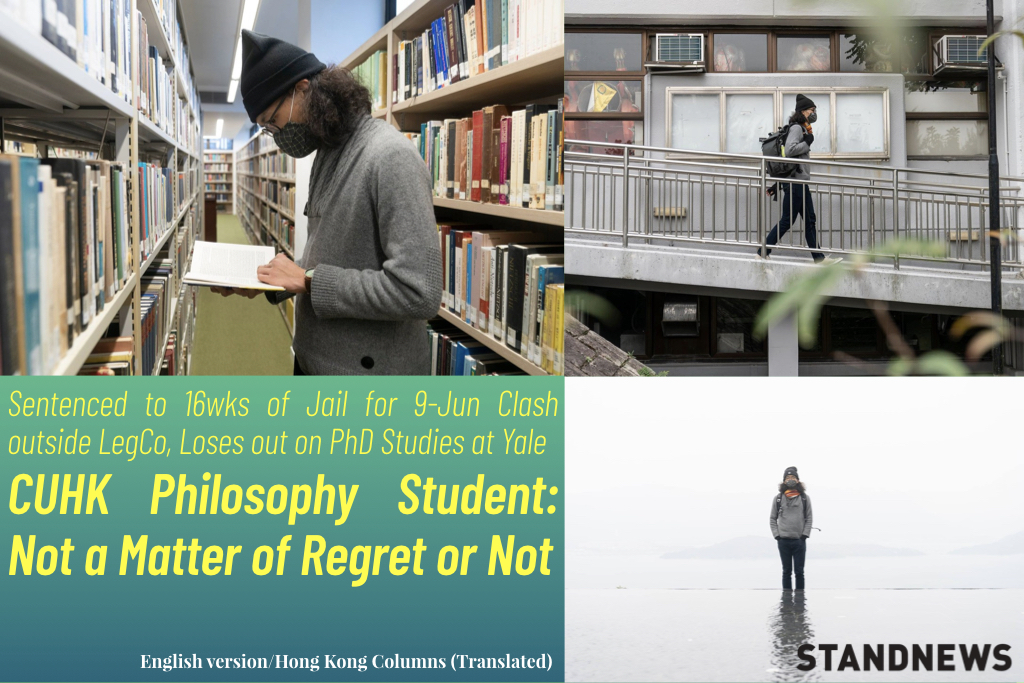
Sentenced to 16wks of Jail for 9-Jun Clash outside LegCo, Loses out on PhD Studies at Yale, CUHK Philosophy Student: Not a Matter of Regret or Not

18:37 20 Jan: Sentenced to 16wks of Jail for 9-Jun Clash outside LegCo, Loses out on PhD Studies at Yale, CUHK Philosophy Student: Not a Matter of Regret or Not
Translated by HKCT, written by Isaac@Stand News
Original: Stand News/Isaac 


“I recently bought many new books to bring with me there. I prepared (per Correctional Services Department’s guidelines) of 6 books per month. Some of them are philosophy books related to my research, while some are social science and science books recommended by friends. I want to fill in some gaps in my knowledge.”

CUHK philosophy master student Ling (pseudonym) was one of the 1.03 million people who marched in the march on 9 June 2019. After the march, having heard a cry of “We need people under the Rice Cooker,*” but shortly after reaching there, police officers broke through the blockade and swarmed in to subdue Ling and several other defendants of the same case.


The scene of “7 cops in the dark corner^” ran through his mind, and he could only use his hands to protect his head. Luckily, only his glasses became crushed. Together with 6 others, Ling was brought inside to kneel against a wall of LegCo, and he knelt there for 5 hours straight. In November 2019 when he reported to the police station, he was officially charged with unlawful assembly, accusing him of having stacked some barricades together.

A year and a half since the event, on 13 Jan this year, Ling chose to admit to the charge in court. In his defense, his lawyer said that he graduated with first-class honours, and had received 18 scholarships within 3 years, and could lose out on a chance to study a PhD degree at Yale University. CUHK Vice-President Dennis Ng also wrote a plea letter for him, saying that Ling was “one of the most brilliant student leaders he had seen.”

The Magistrate said that the plea letter was moving, hence reduced Ling’s sentence by 3 weeks. Ling was eventually sentenced to 16 weeks of jail.

- Philosophical Youth -

23yo Ling is a direct young man. When the reported sent him an invitation to interview, he agreed to it within 3 minutes. He spoke at a steady pace, often citing references. Perhaps out of habit, he would organise his speech in syllogistic arguments often used in philosophy – starting with a major premise, then a minor premise, followed by a conclusion. After the interview, he thanked the reporter with a polite, slight bow.

Although by appearance – a scholarly look about him – Ling would seem to fit the stereotypical idea of a philosophy student, he was vastly different from the common stereotype of philosophers as “all talk and no action”. Besides discussing current events and offering mutual support, many CUHK philosophy students applied their theories and principles in person during the social movement.

“By percentage, our (CUHK) Department of Philosophy had quite a few people arrested. I don’t know why, but we just kept having people arrested, haha,” he said jokingly.

“During these times, more philosophy students felt the calling from their training, feeling like they should do more, with a stronger sense that they should take matters into their hands.”

Ling said that this motivation stemmed from their common character, “We all have a sense of justice. We all feel that the pursuit of justice was very important, and we’re willing to spend the time and energy to achieve that.”

Ling was the first defendant in his case, and the 3rd defendant of the same case was also a graduate of CUHK Philosophy, who used to be Ling’s roommate.

On the day of sentencing, nearly 30 young people stood outside the court, some wearing a “PHILOSOPHY” hoodie. There were so many people that the Magistrate’s Court on a rare occasion needed to open a remote court to allow those who could not enter the designated courtroom to watch the proceedings via live broadcast.

- Political Awakening -

Ling was arrested in the wee hours of 10 Jun 2019, and was probably among the first batch of arrestees in the anti-ELAB movement.

The years of deep-seated problems between China and Hong Kong, issues with livelihoods, had already fueled the fire among citizens to the brim. On 9 Jun 2019, the anti-ELAB movement ignited the fire.

Ling said frankly that the sheer number of the crowds that turned out at the march that day made him feel “very happy”, and it was an important moment when he saw a social movement in Hong Kong blossoming and coming to fruition. He said gratefully, “I realised that the street booths that we set up over the past two months worked, and had been effective to make citizens understand this (ELAB). When citizens really understand what’s going on, you will have real political participation.”

The start of Ling’s involvement in politics began much earlier than ELAB. As early as the “Anti-National Education Storm” of 2012, he had come to realise that “As a Hongkonger, you must care for society.” He was only a student in early secondary form then.

In the Umbrella Movement 2 years later, the police launched 87 rounds of tear gas to disperse the crowd. Still a secondary school student at the time, Ling took the effort to seek out information about the police’s guidelines of use of appropriate force, and took the initiative to write an article in the student newspaper; he also shared with his fellow students under what circumstance could tear gas be used, and was considered “proportionate force”. He sometimes would walk around the occupied areas.

To Ling, participating in social movements was a form of making clear his stance, and was also a chance to reflect on his own political consciousness. “For instance, during the Umbrella (Movement), I would think a lot about what constituted the so-called ‘civil disobedience’ and ‘peaceful protest’. What did the entire movement achieve in the end? When would we feel that the movement could come to an end? Why did the Umbrella Movement fail in the end?”

These questions inspired Ling to seek out answers form books, articles, and other countries’ histories and experiences, search deep within his political consciousness, to brainstorm what sort of changes Hong Kong needed.

- Fighting Helplessness -

Change might seem too distant. Now in Hong Kong, everyone still covered their faces with masks, but the streets had become nearly deserted and shouting could rarely be heard. Some uprooted their families and taken them abroad, while others were exhausting themselves to raise their family. Some were put behind bars, while others had charges against them dropped by the Department of Justice. The laws had changed, and it now seemed that anyone could become the target of the next raid. No one knew on any day waking up how many news notifications would pop up on their phone, reporting another number of people having been arrested at their homes.

Ling watched all the latest developments, “Every little chance to demean you, they (the political regime) would not let go.”

Now, what replaced the peace on the streets was a heaviness in the heart. Since the depression after the Umbrella Movement, Hong Kong’s social movement again plunged into a phase of wordlessness and helplessness. Many asked: Where do we go from here?

Ling admitted that a perilous path laid ahead, “Too many small nations had disappeared in the course of history. Their so-called resistance and sacrifice, no one really gives a shit, and these nations had been swallowed in the sands of time.”

Nevertheless, he was not pessimistic.

The premise of despair and helplessness laid in someone really wanting something to happen but it could not happen. For the fate of Hong Kong, it would seem like the tides would not be turning anytime soon. “But I don’t think this is too important…you don’t need to say ‘We’ll see such and such happening during our lifetime’, or speaking like Simon Lau Sai-leung or Stephen Shiu Yeuk-yuen that ‘The next two weeks are crucial’. Such thoughts are completely unnecessary.”

“The movement had never talked about such things, it had always been centred on an ideal, which will become manifest through your work.”

Ling begins a series of self-questioning, “When will this be achieved? No one knows. When will we succeed? No one knows. Will we be successful? No one knows. But we still have to do it!”

If everyone worked towards a common goal in their own ways, then feelings of helplessness was just a false proposition, and that the key laid in adjusting your mentality.

- The Ideal Hong Kong -

To Ling, the question was not to chase after a certain goal, and also not “What sort of place shall Hong Kong become”. Instead, he focused on the contrary in contemplating “What sort of core values should Hong Kong retain”.

He felt that the right to rule in a place was a prerequisite for democracy, and with democracy in place, there could be civil rights and freedoms. However, the discussion on right to rule would probably be out of the discussion for the current generations of Hongkongers. “However, to me, you need to reinforce the relationship between the different stages.” This, he suggested, could be done from the personal stance, building a civil society based on the small stuff in life, protecting civil rights and freedoms.

Ling felt that as long as we all held the same core value, then there could be more possibilities for Hong Kong’s future. However, there should also be an acceptance of various differences. “There should be a minimal number of shared values, because the more shared values there are, there would be disagreements.” The reason why the Anti-ELAB movement of 2019 managed to grow to such a large scale was that it could “unite people from all walks of life and stances behind a simple value. This value, was our strive for Hong Kong people’s political freedom.”

“If you love Hong Kong’s successful, perhaps to some, a comfortable environment, and you realise that such an environment was built by freedoms in life, and you are willing to protect political freedom, which had been built upon the existing freedoms, then this is Hong Kong’s core value.”
* * *
Footnotes:
* Rice Cooker is a nickname for the protest area outside LegCo Complex

^ On 15 Oct 2014, 7 officers were filmed on live news for allegedly having beaten protester Ken Tsang in a dark alley, and the case became one of the most high-profile incidences of police brutality since the Handover, see HKCT’s previous report here: https://www.facebook.com/hkcolumn/posts/2618855044998545