20201206

"Good Money Driven out by Bad": Sacked Investigative Veteran in Cable News

"Good Money Driven out by Bad": Sacked Investigative Veteran in Cable News
Written by Cheng Sze-sze; printed and translated (partly) on 6 Dec 2020
Original: https://news.mingpao.com/pns/%E5%89%AF%E5%88%8A/article/20201206/s00005/1607192524445/%E6%A5%8A%E9%87%8F%E5%82%91-%E8%A2%AB%E5%8A%A3%E5%B9%A3%E7%8B%A0%E7%8B%A0%E9%A9%85%E9%80%90%E7%9A%84%E8%89%AF%E5%B9%A3 


40 newsroom staff at Cable News were laid off last week, including all 3 reporters working for the popular News Lancet programme, known for its investigative journalism and in-depth coverage of current affairs. One China news veteran was also laid off, which triggered all 10 of her teammates resigned in solidarity. 

Some said that the media industry had never united to fight for rights and interests, but one day, when they really made their stance clear, they still could not change the results. Reporters might not have achieved the desired results, but at least they upheld dignity.

On the day of execution, the management blamed the reporters for filming the scene where the staff demanded a reasonable explanation. An assignment editor said, "It is regrettable that this is how we can communicate with you. The sacking decision is now known to the public and the perception to the outside is really bad. I am heartbroken for Cable TV." One of the most heartbreaking scene was Yeung Leung-kit, the principal reporter of News Lancet leaving with his belongings in silence. He was the reporter who won the most awards for Cable News, who made his name known in the investigative news report sector, and the good money driven out by the bad in this era. I asked him to write an article about News Lancet, but he said it is too hard to summarise everything down to a piece of article, so here I am, writing reluctantly. Declaration: The programme began in May 2013, and a colleague and I were responsible for the first story.

News Lancet was a programme developed by then news controller William Fung. With the same resources, he cut the old feature programme and turned it into a new investigative programme. Yeung was just a "kid" in 2013 as he graduated 3 years ago. He said most of his feature stories at the beginning were following what others have followed, and he did not know much about the essence of news. Suddenly he was transferred to follow the news controller to write news stories. "I am frightened. Fung was famous for being fierce. Every Friday there was a story-selling meeting and Fung will surely ask until you cannot answer. Every week I was under lots of stress, lots of stress, lots of stress (he did repeat it for 3 times). Every Thursday night, insomnia was a matter of course. When Fung was still in place, I had never had a good sleep on Thursday night." That last for a year. Yeung, in my impression, has always been a wonderful genius but I had never imagined he was under such pressure. But anyway, insomnia before meetings with Fung was a collective memory for Cable News reporters.

Yeung Leung-kit, an award-winning investigative reporter of the News Lancet programme, was among the sacked employees.  Lancet is a tool to pinch the surface and discover the stories and answers behind it. Investigative report is only one of the tools. His team had reported on a lot of unique topics in a creative way, for example disguising as a mainlander to expose the fake marriage syndicate; discovering that "beef balls" with the strongest beef flavour actually containing no beef; pretending to be the owner of a parallel trading shop to expose the operation behind the parallel trading syndicate; exposing the $150,000 election bribery incident in the District Council [in 2015], which even led to the sentencing of 3 people. Reports also exposed LegCo members receiving degrees from universities that never existed, the suspicious allocation of CSI masks, etc. Many of the investigation reports are rigorous and detailed. Awards won by him are just too many: Cinema/Chicago Television Awards (Gold Plaque - Investigative Reporting/News Documentary), Human Rights Press Awards, Chinese University Journalism Award, Consumer Rights Reporting Awards - to name but a few.

"What makes News Lancet programme different is that it is very down-to-earth", Yeung Leung-kit said. There were always intriguing sound-bites in the programme. "I will look at all the comments on Facebook to think about what attracts viewers, what does not". After a news report, he read over 13,000 comments on Facebook because he wanted to know what part of his work attracted the audience the most.

He worked at Cable News for 10 years, and has seen changes in the senior management and turnover in the team; he was also poached by high salaries many times, but in the end, he decided to stay, but faced with a reduction in bonuses and wages and was put on unpaid leave. "I have been struggling and fighting here, and have never imagined leaving the company like this - immediate dismissal without any prior consultation. When I worked on my stories, I don't want people to spot our company's vehicle and I used mine - I drove my car, I was the cameraman, the driver and the reporter - and I followed Squatters division of Housing Department. The photos on the news showed that I was carrying the carton box with my personal belongings as I left the company. I never imagined this".

The News Lancet team boasted 8 members at its peak but continued to shrink in the past few years. By the dismissal, only Yeung and 2 fresh reporters who joined the team for half a year were there. As they leave Cable News, the only investigative report team on TV marked its end. While other desks also saw many editors and reporters resigning to show solidarity, Yeung thanked them a lot. "We all see this place as our home, but we all knew there was no way of return when we saw how the management communicated with us. The home is no longer there."

20201111

Holmes Chan: Lawmakers' Constitutional Protections? Beijing Doesn't Care!

Lawmakers' Constitutional Protections? Beijing Doesn't Care!
Written by Holmes Chan
Original: https://twitter.com/holmeschan_/status/1326432447387463680 


There is a sense of futility talking about law in Hong Kong today. Many would argue that the city's legal system is at the mercy of the NPCSC.

Nevertheless, let's have a look at HK's legal mechanism for disqualifying lawmakers.

We start with Basic Law Art. 79, which lists all the situations where the LegCo president can disqualify lawmakers.

On paper, it is not easy to dislodge a sitting lawmaker elected by popular vote - and for good reason.

Article 79
The President of the Legislative Council of the Hong Kong Special Administrative Region shall declare that a member of the Council is no longer qualified for the office under any of the following circumstances:

( 1 ) When he or she loses the ability to discharge his or her duties as a result of serious illness or other reasons;
( 2 ) When he or she, with no valid reason, is absent from meetings for three consecutive months without the consent of the President of the Legislative Council;
( 3 ) When he or she loses or renounces his or her status as a permanent resident of the Region;
( 4 ) When he or she accepts a government appointment and becomes a public servant;
( 5 ) When he or she is bankrupt or fails to comply with a court order to repay debts;
( 6 ) When he or she is convicted and sentenced to imprisonment for one month or more for a criminal offence committed within or outside the Region and is relieved of his or her duties by a motion passed by two-thirds of the members of the Legislative Council present; and
( 7 ) When he or she is censured for misbehaviour or breach of oath by a vote of two-thirds of the members of the Legislative Council present.

You might ask: What about Baggio Leung & Yau Wai-ching getting DQ-ed? BL Art. 79 didn't say anything about oaths.

In 2016 the court ruled that, because they didn't take their oaths properly, they never BECAME lawmakers in the first place.


Which brings us to today. The 4 DQ-ed democrats are sitting lawmakers whose terms were extended by the NPCSC in August, due to the election delay.

Even if we accept the fact that they were barred from re-election, that should only affect the NEXT LegCo term.

Carrie Lam tried to blur the distinction today, saying that people found unqualified to run for LegCo election are "naturally unqualified" at being a LegCo member.

But the law disagrees. Election candidates are DQ-ed one way, and LegCo members are DQ-ed in another.

TL;DR - When elected, a Hong Kong lawmaker enjoys constitutional protections which prevent them from being ousted on a whim. 

Today we are reminded once again: Beijing doesn't care.

20201109

Holmes Chan: Why run at protests?

Why run at protests?
Written by Holmes Chan
Original: https://twitter.com/holmeschan_/status/1322446473984843776 

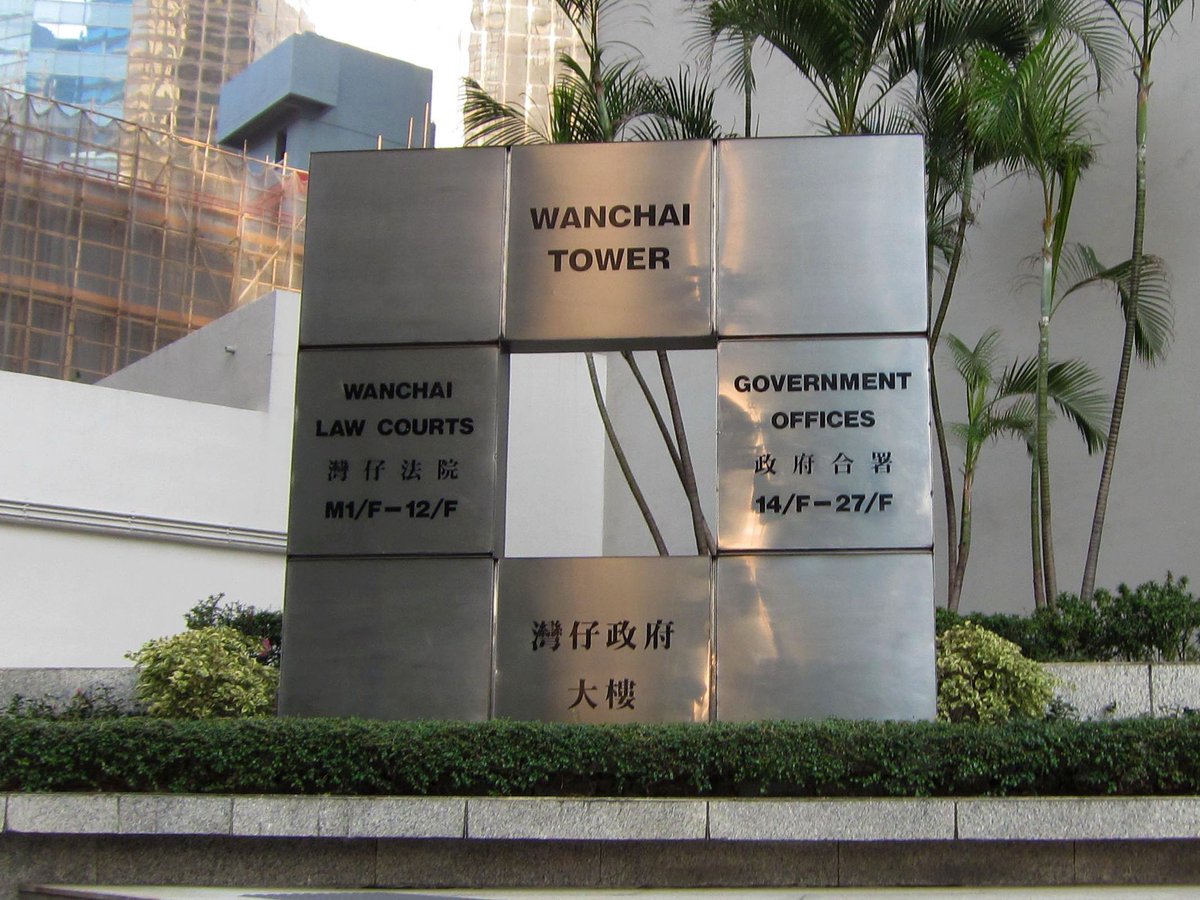
A Hong Kong court today found 7 people not guilty of rioting in relation to an Aug. 31, 2019 protest. 

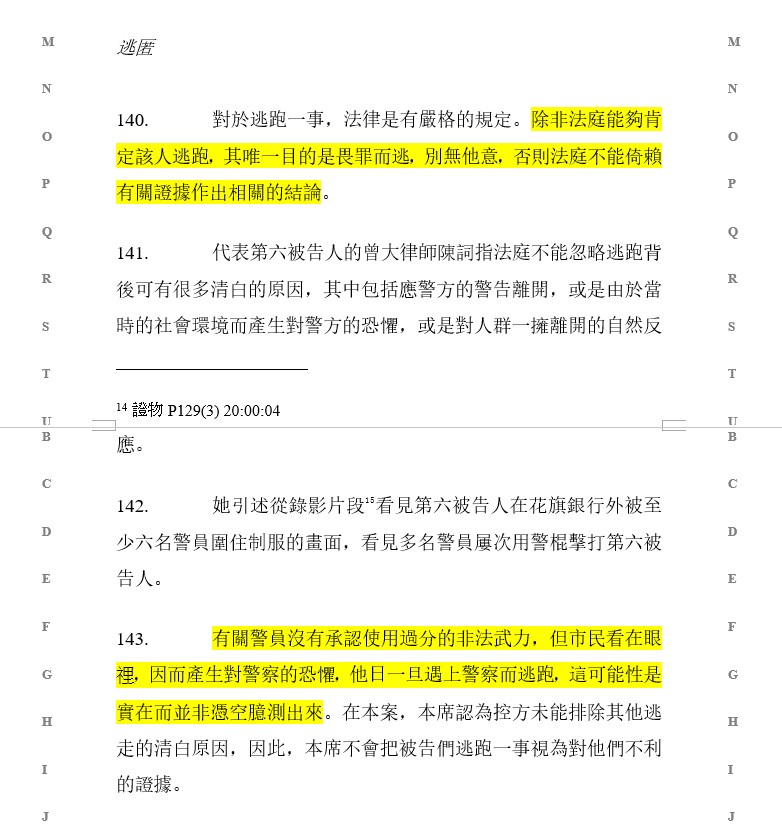
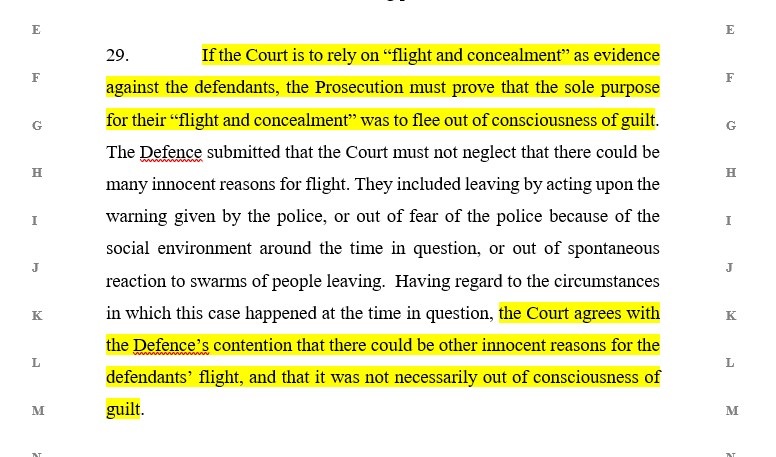
One of the issues is whether the court can use the fact that the defendant ran - i.e. "flight and concealment" - as evidence against him. (1/7)

District Judge Sham Siu-man said prosecutors must prove the defendant's sole purpose was "fleeing out of consciousness of guilt," in order to use that fact against him.

[N.B. 1st image is the original Chinese judgment, 2nd is an English summary from the judiciary] (2/7)


Notably, the judge accepted the argument that people might fear police after watching footage of police brutality, and there is a "real possibility" those people might run the next time they see the cops.

That kind of running could NOT be used as evidence against them. (3/7)

Here's the twist: the same judge said something rather different in 2017, in his guilty verdict for 3 people charged with rioting over the Mongkok Fishball unrest. 

D3, surnamed Sit, said he was an onlooker and he started running because he saw other people run. (4/7)

But the judge basically said, if you don't want to be mistaken for a protester, DON'T RUN. Just stay still on the pavement or step aside.

The original judgment is in Chinese only; I have taken the liberty of making an unofficial translation. Both are attached. (5/7)
***
(unofficial translation)
91. Let us now examine in detail the testimony of D3. He testified that he finished dinner on Lunar New Year's Day and went out with friends. He sang karaoke at Chong Hing Square, before leaving in the early hours of the next day. He saw many protesters on that section of Nathan Road and heard someone say 'the police opened fire', so he stayed on the pavement to watch as an onlooker.

92. During that time, he saw people pushing debris onto the road and throwing objects, but he couldn't see the police line in front of him. Suddenly, someone ran into his direction and he also ran because he was afraid of his personal safety. He felt he was attacked from behind and lost consciousness. When he woke up, he found he was already handcuffed and taken to the police station.

93. During examination-in-chief, D3 only said he "ran because he saw others run." But under questioning, he added that he ran because he didn't know what was happening and was concerned about his personal safety. He also agreed that he didn't want to be confused for a protester.

94. The court believes that, if D3 really was an onlooker, it is very reasonable for him to wish that he was not confused for one of the people participating in the disturbance. As he said, he was on the pavement of the northbound lane of Nathan Road. This was also a reasonable thing to do as the protesters occupied the road, and a bystander had no need to go into the midst of protesters.

95. Objective evidence shows that on one side of the pavement is the road (the northbound lane of Nathan Road), and the other side are the ground-floor shops (which were closed after midnight). He said that he suddenly so people running in his direction. Let's pause and imagine the scene at the time: on the road at least 20, 30 people were running to evade capture by the police. Someone run on the road, some will run towards the southbound lane of Nathan Road, someone run towards the pavement where D3 was. In this case, the best way not to be confused for a protester is not to do what they were doing – namely running.

96. His explanation that he was fleeing out of concern for his personal safety is unsound. "Running with others" does not necessarily preclude risks to personal safety. Aside from being confused for a protester, this court believes that D3 would have given thought to the fact that many people running together could easily lead to collision and injury. We have also occasionally heard of the chaotic scenes of a stampede.

97. D3 was located on the pavement, and he was next to a row of shops that were closed. If he did not want to obstruct the people who were running -- no matter they were fleeing protesters or officers in pursuit -- he only needed to remain still, or perhaps move a few steps towards the doorways of the shops.

98. Based on his testimony, to put it simply, this court does not accept that D3 was an onlooker that night. The question that follows is what he actually did that night.
***
It is worth noting there are factual differences between the 2017 Fishball case and the 2019 Wanchai case. Also, D3 in the 2017 case was not solely convicted on the grounds that he ran.

Nevertheless, we have an example of changing judicial attitudes. (6/7)

TL;DR - In 2020, even Hong Kong judges have to accept that there are "innocent reasons" for people to run at the scene of a protest. (7/7)


20200613

[Ming Pao] Johannes Chan: Do NPC's Draft Resolutions Comply with Basic Law?

HKU Chair Professor of Public Law Johannes Chan: Do NPC's Draft Resolutions Comply with Basic Law?
Translated by John C., edited by Karen L., written by Johannes Chan Man-mun
Original: https://m.mingpao.com/ins/%e6%96%87%e6%91%98/article/20200525/s00022/1590332595169/%e4%ba%ba%e5%a4%a7%e6%b1%ba%e8%ad%b0%e8%8d%89%e6%a1%88%e6%98%af%e5%90%a6%e7%ac%a6%e5%90%88%e5%9f%ba%e6%9c%ac%e6%b3%95-%ef%bc%88%e6%96%87-%e9%99%b3%e6%96%87%e6%95%8f%ef%bc%89 


The current draft resolution of the National People’s Congress (NPC) mandates the Standing Committee of the National People's Congress (NPCSC) to enact the National Security Law in Hong Kong. Here we are to explore whether this draft resolution complies with the Basic Law. Perhaps, it is, to some people, a self-explanatory case that needs no further clarification. Yet, as long as China intends to maintain the integrity of the rule of law, and the NPC inclines to abide by the law, but not to override it, the legislation shall not violate the Basic Law. Such is the seriousness of this subject.

There are at least 5 points to indicate why the draft resolutions of NPC do not comply with the Basic Law under the jurisprudence context.

The Basic Law Article 23 Clearly Specifies HKSAR ‘Shall Enact Laws on Its Own’

The then-proposed Basic Law Article 23 designates Hong Kong Special Administrative Region (HKSAR) ‘shall enact laws on its own’ when it comes to National Security legislations, namely that HKSAR shall enact laws according to the tradition of common law and its own legislative process. Given that Hong Kong and mainland China have separate legal systems, values, and legal concepts, the principle of the Basic Law is to allow HKSAR itself to enact laws with relevance to personal liberty and criminal liability for any highly political and sensitive situations. It should be noted that laws relating to the matter of national security have always been considered highly sensitive, and ‘shall enact laws on its own’ serves the precise purpose of protecting the completeness of the HKSAR’s common law. 

There were lots of concerns in the Hong Kong society when the Basic Law article 23 was being drafted, especially to the vague concept of national security in mainland China: the ‘counter-revolution’ charges on Wei Jingsheng were still very fresh in people’s mind as he was sentenced to 15 years’ imprisonment simply because of his speech yearning for democracy. ‘Shall enact laws on its own’ in Article 23 was then established under this historical background.

Some people suggested the possibility of coexistence between the National Security Law and the Article 23 in attempt to justify the legitimacy of the NPCSC's decision, to which they might not notice that it poses a challenge on the meaning of the presence of an Article 23 (‘shall enact laws on its own’). It's like a father giving a child $10 to buy whatever sweets he likes, but then decides to take away $4 and asks him to get chocolate, while at the same time telling the child he isn't breaking his promise to let the child make his own decision. It is in Hong Kong's duty to legislate an Article 23, but it does not inherently support the idea that NPCSC can enact laws for Hong Kong directly.

Article 18’s ‘Generic Power’ Shouldn’t Extend to Article 23

Some leap to a hasty conclusion that there is no conflict between self-legislation and the implementation of national laws in Hong Kong, whereas this is a blatant violation of the general principles of legislative interpretation. Article 18, as a generic law, allows NPCSC to apply certain national laws in Hong Kong through Annex III, while Article 23, as a concrete law, specifies that laws within its scope shall be enacted by Hong Kong itself. Under the general principles of interpretation, concrete provisions are superior to generic provisions. Thus, the generic power in Article 18 shall not extend to the legal provision stipulated in Article 23. Otherwise, Article 23 would be superfluous.

Furthermore, Article 18 Annex III is only applicable in national laws, to which some people irresponsibly claimed that they refer to all the laws passed by NPC or NPCSC, but not the ones passed by provinces and municipalities. This, under normal circumstances, could be a reasonable interpretation, but not under in Article 18. The 'national laws' in Article 18 Annex III must be relevant to national defense, foreign affairs, and outside of the sphere of autonomy. While the drafting of such national laws has not been within the power of provincial and municipal districts, national laws should be dependent on the nature of the law being applicable nationwide rather than which political body is responsible for the drafting. Under the Basic Law, Hong Kong legislature is vested with legislative power: Article 23 requires the laws within the scope of the article should be enacted by Hong Kong itself; Article 18 states the central government could apply laws related to national defense, foreign affairs, and outside of the sphere of autonomy to Hong Kong. The combined purpose of these laws and articles is to illustrate clearly that only when the matter concerned is of ‘national defense, foreign affairs, and outside of Hong Kong autonomy’ will the central government pass laws for Hong Kong. On top of that, the laws should be applicable to Hong Kong and nationwide, hence, to secure and protect different legal systems in Hong Kong and in mainland China. Thus, the central government shall not enact laws for Hong Kong under these legal conditions.

Some may argue that the Garrison Law is a precedent for the central government to enact laws specifically for Hong Kong, but they must have missed this: People’s Liberation Army Hong Kong Garrison is the key stakeholder of the Garrison Law. This article declares the responsibility of PLA personnel in Hong Kong, which is not an applicable article to the general public in Hong Kong. This time, the NPCSC's enactment of the National Security Law in Hong Kong is against the human rights and freedom of Hong Kong people, and these are what the Basic Law is meant to protect.

Constitution Article 31 & 62 Do not Empower the NPC to Disregard the Basic Law

NPC’s draft resolution on the Nation Security Law refers to its legal basis in Article 31 & Article 62 (Item 2, [13] and [15]) of the Constitution of the People’s Republic of China. Article 31 of China's Constitution Law is the legal basis of establishing Special Administrative Region (SAR), and Article 11 of the Basic Law clearly states that the SAR’s system, protection of freedom, legislative and judicial system are all based on the Basic Law. The Basic Law Article 11 is applicable on the NPC as well—NPC’s decision ought not to contravene the provisions of the Basic Law. In Article 62 of China's Constitution Law, item 2 refers to the NPC’s power ‘to supervise the enforcement of the Constitution’; Item [13] refers NPC’s power ‘to decide on the establishment of special administrative regions, and systems to be instituted there’; Item [15] refers NPC’s power ‘to exercise such other functions and powers as the highest organ of state powers should exercise’. These generic provisions do not empower NPC to disregard the Basic Law. True, it is within the NPC's power to propose amendments on the Basic Law—abolishing the provisions on ‘shall enact laws on its own’ stated in Article 23 and conferring NPC the power to legislate directly for Hong Kong—but it involves following certain procedures, not by mere decision.

The Unsettling Future of the Courts' Role

Some worrying view suggested that the NPCSC’s scope of legislation does not completely overlap with Article 23. In the NPC’s drafted resolution, NPCSC is authorised to legislate on ‘acts that seriously threaten national security, such as secession, subversion of state power, and organising terrorist activities, as well as foreign and overseas forces interfering affairs of HKSAR’. These are quite vague in scope, which could potentially cause impacts on financial, economic, and network communication, on the links between religious groups and their foreign counterparts, on the cooperation between local NGOs and foreign NGOs, on the cooperation between universities and foreign organisations, etc. As the lines that divide national security and civic rights blur, what is to be done if NPCSC passes laws that are conflicted with the protection of human rights in the Basic Law? Can the courts in Hong Kong declare that the laws passed by NPCSC shall be revoked due to the violation of the protection of human rights in the Basic Law?

What's more distressing is the role of the Courts. According to the Basic Law Article 18, provisions in Annex III shall relate to national defense, foreign affairs and outside of Hong Kong’s autonomy. All these matters are outside of the scope of the Hong Kong Courts' power of review. Unless the laws that NPCSC enacts specifically authorise the Hong Kong Courts the power of review on the matters, the Courts in Hong Kong may not have jurisdiction over cases of this kind. Even if Hong Kong Courts were to have the power of review, how would they interpret this national law? The way how mainland China drafts and interprets law is disparate from the principle of the common law. Mainland’s legal interpretation is primarily based on political consideration over legal provisions. From NPCSC's conversion of the oath-of-office requirement in the Basic Law to the eligibility for election to the Liaison Office reinterpretation of 'mainland government departments' in Article 22, mainland’s stance on legal interpretations is manifest.

I, for 100%, believe that the courts in Hong Kong will not adopt the mainland-China way to interpret or execute the Hong Kong National Security Law. However, another question arises: what if the Hong Kong courts’ interpretation of the law is not in line with that of NPCSC? Precisely, if the Hong Kong courts narrow the scope of related offence in the law in order to protect human rights, or consider certain charges as violating the protection of human rights under the Bill of Rights or the Basic Law, would NPCSC applaud or interfere? 

Beijing has time and again blasted the judgement by the Hong Kong courts, including the severe criticism on the Court of First Instance’s judgement on Emergency Regulation Ordinance. Can NPCSC intervene arbitrarily if the Hong Kong courts’ judgement is contrary to NPCSC's stance of legislative intent? Moreover, NPCSC has the power of interpretation for the Hong Kong National Security Law since it is a national law. While it is still in doubt whether such interpretation has any restrictions on the Hong Kong courts, it is possible for the Courts to bypass the NPCSC’s interpretations on the law in reality?

Establishing New Agency of National Security in SAR Do not Comply with the Basic Law

In the NPC’s draft resolution, the Central People’s Government is given permission to establish certain agencies that are related to national security in SAR, to fulfil the duty of safeguarding national security in accordance with the law. So, what exactly is this agency? It is feared that this state agency does not fall into the category of the Central Government’s 'department' in Article 22, and is thus not subject to Article 22, which only adds to more uncertainty: what power do these state agencies have? And under what supervision? Can the agency exercise the right of investigation, right to arrest, and right of interrogation in Hong Kong? The Ministry of State Security in mainland China is known to have a very wide range of power with little transparency; how does it comply with the Basic Law by allowing state agencies to carry out law enforcement activities in Hong Kong?

The Oppression Will Only Aggravates

In just a few weeks, the Liaison Office declared that it is not, in the ordinary sense of words, a ‘department of the Central People’s Government’, whilst having the power to supervise the implementation of the Basic Law. What followed was the Education Bureau pressured Hong Kong Examinations and Assessment Authority (HKEAA) to delete a question on the HKDSE history paper due to political grounds. After that, the Communication Authority (CA) ruled The Headliner, a satirical TV programme produced by RTHK, for breaching the Broadcast Code of Practice, and afterwards a direct law enactment for Hong Kong by Beijing. This series of moves naturally makes one wonder how much more autonomy is left in Hong Kong.

In retrospect, some people think: had the legislation on Article 23 passed, the present situation would not have arisen. Wishful thinking it is. There are many factors causing the current disheartening situation. Years ago, ex-Premier Wen Jiabao enjoined the then HKSAR government to deal with the deep-rooted conflicts in Hong Kong, but rather the government ignored it and stirred up the troubles, aggravating the inner conflicts. Fast forward to today, the self-opinionated government pays no heed to public opinion, and has missed the opportunities to resolve social conflicts over and over. Nonetheless, added with the ongoing trading and political contest between China and the US, this is how today's situation has become what it is. Even if the legislation on Article 23 were passed, the nowadays conflicts and clashes would be inevitable due to the clumsy handling of the most recent two governments. To most Hong Kong people, the now major issue concerns social order, and has nothing to do with national security.

To Beijing, however, whatever happens is always plots and conspiracies organised by external forces (i.e. foreign countries). Instead of holding successive SAR governments to account, it inclines to escalate the issues to the level of national security, and even adopts the approaches which will demolish ‘One Country Two Systems’. Is Beijing’s decision, at what degree, based on alarmist’s talk and people’s act of adding fuel to the fire? It is probably all down to the judgement of history. 

At the end of the day, the power lies with Beijing: such issues will not be resolved after NPCSC's passing of the National Security Law. It will be only followed by a series of prosecutions, suppressions, and restraints, with a view to turning Hong Kong into a submissive society where no one thinks and dares to question authorities. Possibly, in Beijing’s eyes, what 'One Country Two Systems' stands for is merely allowing two economic systems in a country—not enabling a civil society with independent thoughts or values that would question those with power. After all these, Hong Kong’s public freedom will be narrower and narrower with overwhelming stress of political correctness at all times. The high degree of autonomy will then exist in name only. History has taught us a lesson: oppression will only aggravate, and will never enlighten. This is an elegy of 'One Country, Two Systems'.


20200608

[Ming Pao] Speaking from Opposing Sides of Standoff, Valiant Protesters & Riot Police in Frank Conversation: Gov Still Sidestepping Problem

8 Jun: Speaking from Opposing Sides of Standoff, Valiant Protesters & Riot Police in Frank Conversation: Gov Still Sidestepping Problem
Translated by HKCT
Original: https://news.mingpao.com/pns/%e8%a6%81%e8%81%9e/article/20200608/s00001/1591554567531/%e8%a1%9d%e7%aa%81%e5%b0%8d%e6%88%b0%e5%90%84%e5%ae%88%e4%b8%80%e6%96%b9-%e9%9b%bb%e8%a9%b1%e5%b0%8d%e8%ab%87%e6%94%be%e4%b8%8b%e5%bf%83%e9%98%b2-%e5%8b%87%e6%ad%a6%e9%98%b2%e6%9a%b4%e5%b0%8d%e8%ab%87-%e6%94%bf%e5%ba%9c%e4%bb%8d%e9%81%bf%e5%95%8f%e9%a1%8c 


Since the Taiwan murder case of Chan Tong-kai sparked the Hong Kong government’s amendment of the extradition bill last year that set off an unprecedented wave of Anti-ELAB protests. In particular, the 9 June march attended by more than one million people could be seen as the start of the protests. In the face of the government’s refusal to respond to the people’s demands, both citizens who supported a peaceful, non-violent, rational protest and those valiant protesters took to the streets, engaging in a series of confrontations with the police that shook the entire city. The demands of the people evolved over time, from protesting against the proposed extradition bill amendment to eventually demanding for the disbanding of the Hong Kong Police, and even some shouting loudly and clearly for the independence of Hong Kong, which received the Chinese government’s proposed security law for Hong Kong. One year later, with what seemed to be little hope for the reconciliation between the police and citizens, Ming Pao invited a valiant protester and a riot police to engage in conversation, share their innermost thoughts and respond to the other’s doubts and questions on a range of topics from law enforcement to use of violent, means of protest, to the way ahead for the protests.

Last year, the Anti-ELAB protests spread throughout the city, and riot police Lee (pseudonym) and valiant protester and student Chan (pseudonym) were on opposite sides of the protests. On the eve of the one-year anniversary of the movement, the two were arranged for a telephone conversation. Lee appreciated that Chan cared for society, and stated that the most beautiful victory by the protesters was the use of their peaceful ballots to vote in their desired candidates in the District Council Election; Lee questioned why protesters needed to use violent means of protest. Chan, on the other hand, felt that it was because of the protests on the streets that really awakened citizens to the social problems, and that the solidarity among peaceful, non-violent, rational protesters and valiant protesters made the movement more sustainable. Chan also criticised that police were not held responsible to police brutality, which angered citizens. Despite the vastly different stances of the two, they did share a common view that the government was still evading finding a resolution to the social problems.

“Police as if Playing with Guns on 12 June”, Became Valiant Protester ever since

On 12 June last year, many citizens protested at Admiralty to stop the second reading of the extradition bill at LegCo, and sparked a severe clash with the police. Chan was among the crowd of protesters at that time. He said that he witnessed a protester being shot by the police, and was astounded by the police’s use of force, “I thought the police were acting as if they were playing with guns in a game,” and since that moment, he became a valiant protester. He believed in fighting violence with violence, that throwing bricks or petrol bombs were just means to protect himself or to slow down the speed of the police’s advance. Compared with the guns in the hands of the police, “protesters were merely bringing a knife to a gunfight, and the forces were vastly unequal.”

Lee, a frontline riot police, had attempted to subdue and arrest protesters, and had been injured by thrown bricks. He said that the harm and danger by bricks and petrol bombs were far beyond what protesters imagine, and urged Chan to think again, “If you really care about society and continue to take to the streets, I don’t think that’s a problem, but I hope that you would think about your family and yourself next time before you toss a brick or petrol bomb. Think again what the police or even citizens did to deserve such life-threatening harm before you throw another brick or petrol bomb.”

Admits Some Colleagues Quick-tempered & Overreacted, Disagrees with Lack of Regulatory Mechanism

As for why citizens were so angry with the police, Chan said that the force held public power, but officers repeatedly abused use of force but were not held accountable, “as if free and lawless.” Lee disagreed that there was a lack of regulation, because if a colleague had violated a regulation, they would have to face the consequences. He agreed that some colleagues were quick-tempered, overreacted while on duty and spoke and acted out of line, but the clashes were unprecedented, such that no matter how much training they received, it was hard for officers to not feel disturbed and afraid in such chaotic environments, so it was understandable that not all officers would act with restraint.

Valiant: Selected Law Enforcement Spawned Protesters Taking Matters into Own Hands
Police: 21 July Deployment Had Issues

The 39-minute period of no police on-site for law enforcement during the 21 July Yuen Long Incident was said to have dealt the force’s image a heavy blow. Lee disagreed that there was cooperation between the police and triads, but he admitted that the deployment and management of officers had room for improvement, such as when two officers that walked by Yuen Long Station perhaps could have used suitable force or remained on-site to report the situation, but Chan didn’t believe that the incident was simply the result of deployment issues.

During the middle phase of the movement, cases of protesters settling disputes with others using their own means and vandalising “blue shops”, which Chan viewed as reflecting citizens’ “pent-up anger”, but the actions were targeted. Chan also pointed out that the police were biased in their law enforcement when handling conflicts between yellow ribbons and blue ribbons, thus spawned the prevalence of protesters of taking matters into their own hands. Lee, however, disagreed with Chan and doubted whether this was in violation of the protesters’ pursuit of freedom and democracy, “After you win this victory, you would still need to manage people with differing opinions, so would you be silencing their voices?” Lee described the solidarity among peaceful, non-violent, rational protesters and valiant protesters was a curse, as some violent actions would alienate some protesters; Chan, on the contrary, felt that it was this solidarity that made the movement last so long.

“Do you remember the battle that you won most beautifully?” Lee asked, “It was the District Council Election, and its impact was far-reaching. It was not only a display of public opinion, but it also voiced people’s dismay against the government and changed the system. No one was arrested and jailed for voting, and you still have a chance for change.” Chan felt that besides affecting change at the councils, protests on the streets and the yellow ribbon economy were also indispensable, that “if it weren’t for the street protests, citizens wouldn’t realise that there were so many problems in Hong Kong.”

Riot Police Asks How Protesters Want Roadblocks to be Handled
Chan: There are Things that We Must Do

“Police don’t necessarily support the government. We too are very disappointed (in the government), and the police does not wish to stand in opposition to the people, but we must handle the illegal actions of protesters.” Lee said that he joined the force to serve the people, and that the police suddenly becoming the “triad police” in citizens’ minds made him very unhappy. He asked how the protesters wanted the police to handle actions such as forming roadblocks, and Chan answered, “I think that some things you must do, but there are other things we protesters must do. I only hope that the police wouldn’t hit us so severely.”

The government denied accepting the 5 Demands, including the establishment of an independent commission of inquiry (COI). Lee said that he was impartial, but some of his colleagues suspected that protesters might not be willing to give a statement, so the COI would end up only investigating the police. Chan also admitted that if he was filmed to have thrown a brick and was beaten by the police, he would not give a statement, because he could be jailed for his actions. Chan stressed that “truth does not fear contention, because of the same set of underlying facts,” and that the first step in resolving the turmoil was still dependent on the COI.

Chan felt that the government had been sidestepping in resolving the conflicts in society, which Lee agreed, and that the government would eventually have to resolve the situation. Lee hoped that as things had been cooling off, there wouldn’t be more people hurt, harmed, or arrested, “that society would really return its focus on facing and resolving the issues.”

20200528

[Ming Pao] National Security Law Expert Fu Hualing: Whole Society to Pay If Relying on Courts to Solve Political Matters

National Security Law Expert Fu Hualing: Whole Society to Pay If Relying on Courts to Solve Political Matters
Co-translated by AH and Karen Leung, written by Tsang Hiu-ling (printed on 3 May 2020 on Ming Pao) 
Original: https://news.mingpao.com/pns/%e5%89%af%e5%88%8a/article/20200503/s00005/1588444459382/%e5%9c%8b%e5%ae%89%e6%b3%95%e9%81%94%e4%ba%ba%e5%82%85%e8%8f%af%e4%bc%b6-%e4%be%9d%e9%9d%a0%e6%b3%95%e5%ba%ad%e8%a7%a3%e6%b1%ba%e6%94%bf%e6%b2%bb%e5%95%8f%e9%a1%8c-%e6%95%b4%e5%80%8b%e7%a4%be%e6%9c%83%e4%bb%98%e4%bb%a3%e5%83%b9 


The Core Value of Article 23 is against Secession

Named after the 2017 conference 'China's National Security: Endangering Hong Kong's Rule of Law?' launched by HKU Centre for Comparative and Public Law, the book included Professor Fu Hualing's article (titled 'China's Imperatives for National Security Legislation'), which, as its name suggested, probes China's desperation to enact a national security law.

The year 2017 marked the 20th anniversary of the transfer of sovereignty over Hong Kong to China; President Xi Jinping gave a speech in which he stressed the importance of “One country” in “One Country, Two Systems”, saying that, “'One country' is like the roots of a tree. For a tree to grow tall and luxuriant, its roots must run deep and strong. The concept of 'One Country, Two Systems' was advanced, first and foremost, to realise and uphold national unity,” and that “Any attempt to endanger China’s sovereignty and security, challenge the power of the central government and the authority of the Basic Law of the HKSAR or use Hong Kong to carry out infiltration and sabotage activities against the mainland is an act that crosses the red line, and is absolutely impermissible.” From there, Professor Fu who specialises in constitutional law, legal institutions, and human rights with a focus on China explained the existence of Article 23 in the context of China politics and Hong Kong's constitutional framework for the legal system, and he said, "While Article 23 mentions prohibiting acts of 'subversion' and 'secession', I think the core is more about the latter."

The Systematic Legalisation of Power

“To CCP, the connotations of national security have two aspects—politics and nationality. The ferment of such issues regarding the former translates to the subversion of the CCP-led socialism, of which I wouldn't regard as a big concern in the party's point of view.” Hong Kong is known to have a tradition of being the “base of subversion”, from Sun Yat-sen's revolutionary campaign to overthrowing the Qing dynasty, to the strategic transportation hub in the Chinese Civil War, followed by the surge of political refugees from mainland China between the 1960s and 1970s. “Hong Kong has long been considered a place for subversion. It was, during the Qing dynasty and the Republic of China, acting as a haven for the resistance.” Fu believed that the CCP understands well the denunciation it received from Hong Kong, “Socialism isn't mainstream in the global world after all; the criticism over the system has never ceased to exist.” Yet, the alert of “secession”, as he pointed out in the article, differs from that of “subversion”, for the reason that it interconnects with the matter of “nationality”. CCP premises its political logic on the historical burden it inherited—to maintaining territorial integrity—and on that account, the talks surrounding Hong Kong independence since the Umbrella Movement agitate Beijing the most.

The Target of Article 23 IS “Hong Kong Independence”  

From CCP's standpoint, the main threat to national security is “the infiltration of external forces”. Starting from 2013, Weiquan lawyers and activists [Translator's note: “Weiquan” is a non-centralised movement in mainland China that seeks to protect and defend the civil rights of the citizenry through litigation and legal activism; some translate as "right activist.] have been prosecuted in rapid succession. In 2015's 709 Crackdown, on the charge sheets were repeated emphasis on their alleged affiliation with organisations in Hong Kong and foreign countries, as well as the foreign-aid funding they were said to receive. In an attempt to unravel CCP's timeline on the course, Fu mentioned that it was in the same year of the nationwide crackdown when the Standing Committee of the National People's Congress (NPCSC) adopted the new national security law. One by one, the Counterespionage Law, Cybersecurity Law, Foreign NGO Law (so as to regulate their activities in mainland China) and Counterterrorism Law have been implemented since Xi Jinping assumed office, of which Fu commented, “The institutionalisation and legalisation of CCP's power are unprecedented. At no time was its power demonstrated through legal measures; the Xi regime's approach is rather definite.”

Thenceforth the path of Hong Kong and that of mainland China intersect. In 2018, under the Societies Ordinance, Hong Kong government banned the operation of the Hong Kong National Party. In Fu's understanding, Beijing has recognised it an opportunity to enact Article 23 as this imaginary enemy (aka “Hong Kong independence”) arises. Fu added, “The then attempt (the National Security Bill 2003) was a symbolic gesture: The Central Government of China said to give it a go, so Hong Kong government gave it a go; the people in Hong Kong didn't turn out to be pleased with it, so they accepted the result and withdrew it. Now is different, the bill serves an actual purpose for Beijing—Those advocate independence shall, from now on, be punishable by the Article. That's the clear target.”

Has the Perfect Timing for Legislation Passed? 

“In a sense, perhaps we should reflect why we were to reject the bill, and if such a move we made was right.” Fu added, “I personally felt that the wordings of the withdrawn bill were perfectly inclusive. The offence of subversion, for instance, had had enough measure to safeguarding the interests of defence on every single detail. We could either exclude the bill from the system or... Let's just say, further adjustment was not much needed.” Now that the police citing the dust-laden section 9 (seditious intention) and section 10 (offences) of the Crimes Ordinance, both of which have not been exercised for 68 years, Fu said, “The step next is to see whether the Department of Justice and the Courts will accept this. If yes, it will pose a much greater challenge to Hong Kong's rule of law than Article 23 of the Basic Law. In this case, we might as well have the latter.”

“The Law of our society is not ideal as some people deem to be. Refinement should have been made long ago; in retrospect, it would have been a better time to do it back then than now.” Fu went on to say, “A huge restriction on freedom of speech or freedom itself was it (the 2003 draft of Article 23) generally perceived. But at the same time, none of the thoughts and alterations was intended for some of the harshest provisions adopted from the colonial times.” He envisaged that if only with physical violence were to be guilty of an offence regarding seditious intention, “many people would not have been convicted.” After 17 years, once again the enactment of Hong Kong's controversial national security law is on the table. How should the starting point and the bottom line be this time around? To answer the question, Fu indicated the feasibility to use the 2003 draft as the basis, while he said, “It depends where our persuasiveness lies in the end if we are to demand higher threshold of conviction from the Hong Kong government or the Central Government of China, and to convince them to relinquish such convenient and effective governing tool.”

The Criteria for the Offence of Secession 

“Setting side by side our existing laws and a new one, I would prefer the former as a more beneficial way to maintaining the intactness of Hong Kong's legal system, especially on the protection for freedom of speech.” Fu continued, “What worries me most about such a new law is the uncertainty over the offence for succession. Back when 2003, it was stated the acts of which resisting the Central People's Government in its exercise of sovereignty over a part of the People's Republic of China “by force”, “threat of force”, or “other serious unlawful means” would make an offence, whereas in today's circumstances, as to whether or not the previous requirements fit, I'd rather not say.”

Dialogue over fights on Solving HK's Predicament

Fu examined in his article the relationship between the Basic Law and the Constitution of the People's Republic of China, “The Basic Law is not a part of the Constitution of the People's Republic of China, but it is clear to have been mandated a special constitutional status.” Today, in addition to the controversy over the re-introduction of Article 23, there is a heated debate on the interpretation of Article 22.

Does the Liaison Office of the Central People's Government in the Hong Kong Special Administrative Region (LOCPG) fall under the description “department of the Central People's Government” written on Article 22, which is specified to have no authority to “interfere in the affairs which the Hong Kong Special Administrative Region administers on its own in accordance with this Law.”? LOCPG repudiated the framework, and asserted to have supervisory power over Hong Kong, to which Martin Lee Chu-ming, the “grandfather of democracy” said the late Lu Ping would have bitten its head off, whereas Teresa Cheng Yeuk-wah, Secretary for Justice, sided with the LOCPG, and said that the office represents Beijing in Hong Kong not as a form of “central government department”.

“That should not be the focus of the discussion,” Fu commented, “The key is not whether the LOCPG is bound by Article 22. The key is to clarify what they could do or say on certain issues, and in which sense it is interfering, and in which sense it is supervising.” He elaborated, “Be the LOCPG a department defined by Article 22 or not, it does not change the fact that it is assigned by the Central People's Government, namely that it represents the Central People's Government. The Hong Kong and Macau Affairs Office of the State Council and any other institutions under the Central People's Government, as well, apply to the same implication. What's on point is whether their speeches and actions fall within the framework of the Basic Law.”

The Regime's Self-restraint

Since the NPCSC has the power of final interpretation of the Basic Law, doesn't it inherently spell the “settlement” of the dispute? “Not entirely so. The Central government has the say, but this doesn't necessarily end the case.” Fu argued that such issue is not to be explained on a legal ground, and it largely depends on the regime's self-restraint, “It involves the relationship between the Central government and the province. To Beijing, it is a matter of self-restraint. That is to say, we are not, in any way, allowed to force the process, meaning that a compromise from the Central government through legal means is not accessible. Any variation concerning the positioning of the regime is only affected by the political economy of the global environment.”

When asked wouldn't it be crying for the moon to anticipate the regime's self-restraint, Fu's advise was to “be realistic”. “The Basic Law is formulated not by us citizens, Hong Kong itself or the UK, but the National People's Congress, which equals China's sovereignty. Bearing in mind of this fact, we'll realise many such issues arise merely as the political ones.” He then added, “There will be some price to pay if any regime is to disrespect its own law. The question now is whether it is willing to pay the price and weather the aftermath.”

“One Country, Two Systems”, in Fu's views, is still alive. “The Central government has made it clear that 'One Country, Two Systems' is a mandate, and thus it is in its power to withdraw it,” he continued, “In a sense, it suggests that the future of Hong Kong will still be in our hands.” What is within our grasp? “The very concept of 'One Country, Two Systems' is established as it provides China with value. I believe it serves as a viable direction or model for China's future development. Many ethnic Chinese, including the vast majority of mainland Chinese, consider it a worthwhile pursuit for China. If China is not to adopt the Western model of separation of powers, then where should it go? The existing structure of China's system has got to evolve. It wouldn't be possible to stay the same forever simply because there's no practical solution to the predicament of internal regime change.” Fu added, “I wouldn't say 'One Country, Two Systems' is a lost cause. Some of the mechanics of political system design in Today's Hong Kong is still very much a useful reference for mainland China. I guess Hongkongers would be more likely to disagree with the practice of the constitutional principle in question than the mainland Chinese.”

In 1989, Jiang Zemin, the then Chinese President, once used the analogy “river water and well water should not mix”. [Translator's note: It was to indicate that the Chinese socialist system should not be subjected to subversive interference from Hong Kong, especially pro-democracy activities, and China would also not interfere in Hong Kong's political system.] Fu thinks the times are “long over”, and holding dialogues is the only way out. “Generally, the key to resolve the argument over constitutional theories is by 'dialogues'... The judiciary have 'dialogues' with the legislative branch of government, and vice versa: Legislators would picture how the Courts perceive the proposed bills and adjust the draft so that it isn't of no avail; the Judges would picture the implications to the LegCo if they are to declare certain laws as invalid.” Applying this to the relationship between China and Hong Kong, “Perhaps Hong Kong Courts and the NPCSC are alike, both constantly trying to avoid complications that might have arisen when exercising its own power, hence creating self-constraint of power and constructive dialogue in the process. It's like playing chess—strategising by thinking a few moves ahead.”

“Being Able to Maintain the Status Quo is a Blessing Already”

In 1983, Fu graduated from Southwest University of Political Science and Law, one of the most prestigious law schools in mainland China (alumni including Zhou Qiang, current president of the Supreme People's Court, the equivalent of China's chief justice.) He received his Master's degree from the University of Toronto in 1988 and his Juris Doctorate five years later from Osgoode Hall, a century-old renowned law school in Canada.

“My views differ from those of my colleagues,” Fu explained, “I have the greatest respect for them. Perhaps they think I'm setting the standard too low, but my understanding of the situation refers to my background.” He then continued, “Another reason is I'm a bit too realistic. For all, I think, being able to maintain the status quo is a blessing already.”

In terms of the rule of law, Fu is more optimistic than his colleague Benny Tai Yiu-ting. Comparing the disqualifications of lawmakers and the sentencing of Occupy Central leaders, Fu thinks that the Courts “had no other choice than to disqualify” after Beijing gave its interpretations of the Basic Law. However, though Beijing wanted severe punishments for the Occupy Central leaders, the judicial system in general, and the Court of Final Appeal in particular, still showed its independence and defiance and willingness to embrace liberal values… and to view Occupy Central as similar to acts of civil disobedience seen in other places with democratic systems”. It seemed that the Court of Final Appeal held the view that protesters and their leaders are worthy of sympathy and lenience, as long as the protests do not involve violence.

Too Much Political Responsibility on Judges' Shoulders

Nowadays, when the prosecution and the police are both on the government's side, many people wonder if justice can still be done. “This is the biggest problem in Hong Kong, which leads to the real worry for the future of the Law. We have put so much weight on the shoulders of judges, who are also human beings. It's not very fair to the Court for one to put all the political responsibility on the judges' shoulders and impute the unsatisfactory outcome to them. The series of events about disqualification is a case in point: Why didn't the Chief Executive or the then President of the Legislative Council take any action? With that much power, they did nothing and let all the responsibility fall on one judge. In fact, they were passing the buck in such a mindset: No one could solve it anyway, just let the judge do the job. So long as the judge decides, we will execute.” On top of that, legally speaking, Fu pointed out there is a price to pay for civil disobedience.

How did Fu see the role of judges from the Lennon Wall stabbing case in Tseung Kwan O? “Judges do have their own personal feelings. It's possible for them to sometimes mingle their political stance to the verdict. Whatever the system is, there will be bugs, errors, mistakes, and it's acceptable as long as there is room for correction. Rather than saying that the whole system is broken when one mistake is discovered, it's more preferable to deduce whether the entire system is still trustworthy.”

“Given Hong Kong's system, it's unlikely for the Court to decide that a person's not guilty out of noble intentions.” Fu supposed that pushing the Courts to the forefront of solving political problems will result in unfavourable consequences for the whole community to bear. “With the element of violence in the movement, participants are expected to face criminal liability. Considering that a fair appreciable proportion of the people have taken part in it, the entire community, together, will suffer—the Courts are up against the upcoming waves of challenges over its credibility and the possibility of losing people's trust.” Fu reminded, “It is to be noted that by the time famous figures like Martin Lee Chu-ming and Margaret Ng Ngoi-yee go to court, it is the complete political system which stands trial, not only them. Nobody has hoped for such a condition. All of them had tried to evade this political backdrop, and it is a tragedy for our society that it inevitably caught them.”

There is an unhealthy tendency to deify Laws and legal systems in us, Fu said, “The law is, in fact, a conservative, backward mechanism that only gives people basic protection provided that it can smoothly function.” As a native of Anxiang County in Hunan Province, he grew up in a rural village which “cannot be found on a map”. Having lived through the Cultural Revolution, he initially believed that “society can be changed through laws”. “A lot of us assumed the reason mainland China had the Cultural Revolution was that there was no rule of law, and conversely, with the rule of law there would be no Cultural Revolution. It was a naive conclusion. The truth is it was the lack of any concept of democracy that contributed to the Cultural Revolution.” Fu then expressed the way he approaches the law now, “Where the law can play its role uninterrupted, there is a fine system. It is good enough to have room to perfect the legal system itself; it is good enough to be able to solve problems in the relationships between individuals, maintain a balance between economic development and citizens' livelihood, keep the government rule within bounds, through the legal system. But let's not forgive that the law is under politics, and constructed by the politics. It is not very practical to  think that one can change the way politics works.”

After Dr. Li Wen-liang's death, he participated in the joint signature petition of the open letter titled “Only Change is the Best Remembrance for Dr. Li Wen-liang - A Letter to the National People's Congress, the State Council and Compatriots of the People's Republic of China”, in which he and a group of mainland scholars put forward six major demands, including the comprehensive reviews of domestic and foreign policies in recent years, of party-government relations, of government-public relations, of government-business relations, of Taiwan–Mainland China and Hong Kong-Mainland China relations and of US-China relations. Throughout the interview, Fu managed to strike a balance, without exception, by adding the angle of neutrality. He said that in hindsight it might have shown that the system of mainland China “has its own advantages” for its more effective ways in fighting the epidemic than the democratic countries, however, “The mainlander public outcry is not to be ignored, which offers a glimpse of their thoughts: The people, when being put in a critical moment,  do recognise what the real problem is. Still, in the their minds, there is a yardstick for measuring the good or bad of the government.”

Oust the Democracy alongside the Rule of Law

From the beginning to the end of the interview, Fu reiterated that an Article 23 and all social dilemmas must rely on the solutions achieved by the means of dialogue. He described himself a conservative, and said, “Benny (Tai Yiu-ting) considers it impossible for the rule of law to survive without democracy (Tai once referred the rule of law in Hong Kong as a zombie, and compared democracy to the one serum that can turn the zombie back to normal.). I tend to think that this is arguable. The worst that could happen is when the democracy is not acquired to the equation and at the same time the rule of law is out of the game.”

Under what circumstance would you determine that the rule of law is demolished? Taking a deep breath, Fu lowered his voice rather unconsciously as if he was visualising that particular moment, “Perhaps it'd be an instinct come by a certain verdict or decision... in a relatively slow process. The day when the international community gave up on Hong Kong would basically be it.” More concretely, he went on to say, “Big companies moving out of Hong Kong. Evident political control in an overwhelming manner... When the embodiment of 'rule of law' is no longer upheld within the law, but out of it. Just as birds take flight before the earthquakes even happen; that's the best sign for human beings.”

Hasn't the time come? “Not yet,” Fu continued, “I'm confident still that the rule of law is of importance to China, not so much in terms of how much the principle has been delivered by the government, but that it is essential to maintaining the country's socio-economic well-being in the long run. The regime allows the rule of law not out of love, but out of its indispensability; that, at least, the regime has awareness of.”

20200524

[The Standard/27.7.1989] Life after Tiananmen Square

Life after Tiananmen Square 
By JACKIE SAM, Features Editor, The Hongkong Standard on 27 July 1989
(Hong Kong Economic Journal)

THE ARTIST laid out four chamber pots in Victoria Park, Hongkong’s largest urban park, and invited Sunday strollers to defecate into them. As the large crowd laughed and giggled away, he dropped his pants and accepted his own invitation.

The chamber pots represented China’s four cardinal principles of socialism, Communist Party leadership, dictatorship of the proletariat and Marxist-Leninist-Maoist thought.

The artist would have gone all the way had a policeman not ordered him to put his pants on. He was not arrested and will probably try some other stunt another weekend.

Hardly a week goes by without the lunatic fringe pulling off a political stunt. No day passes without someone publicly demanding “Democracy now!”

This is Hongkong politicking at a frantic pace – without any sense of direction and no vision of the future. Worse, there is no sensible leadership in sight. The problem is compounded by a rising political consciousness among the six million people.

Hardly a week goes by without the lunatic fringe pulling off a political stunt. No day passes without someone publicly demanding “Democracy now!”. This is Hongkong politicking at a frantic pace – without any sense of direction, and no vision of the future.

The rude awakening came just before the tanks clattered into Tiananmen Square in Beijing in the early hours of June 4.

But for over 150 years under benign colonial rule, local leadership was neither needed nor encouraged. Only compradores were co-opted, both to give legitimacy to the system and to advise British bureaucrats on the ways of the Chinese. At most, they represented local business, largely Shanghainese interests.

Senior Executive Councillor (Exco) Dame Lydia Dunn and Senior Legislative Councillor Allen Lee Peng-fei, who is also an Exco member, are the largest inductees into this colonial order. Both have extensive business interests and both have family roots in Shanghai.

Dame Lydia is too closely identified with British interests to be able to offer credible leadership to a population imbued with a new-found sense of Chineseness. In any case, she does not seem interested in any significant role beyond the early 1990s.
(Books4you, 52nd edition via krislcc.wordpress.com)

Mr Lee, still harbouring some post-1997 ambitions in spite of the Tiananmen massacre, is also identified with British interests. Once touted as “the Lee Kuan Yew of Hongkong”, he has not tried to distance himself from Whitehall’s interests, though more statesmanlike in Sino-Hongkong affairs.

As Hongkong moves inexorably into China’s fold, the Whitehall luggage will be a liability. But this late in the day, politics remains at the parish-pump level, horizons remain narrow and naivete prevails. So the so-called liberals or democrats and the lunatic fringe who make the most noise have a field day.

This feature of Hongkong’s political landscape dominates the media, is the most exciting for recent tertiary institution graduates and is both the hope and bane of the Westernised elite. It is dominated by two men, Queen’s Counsel Martin Lee Chu-ming and trade unionist-school principal Szeto Wah.
(Mad Dog Daily)

Martin Lee is a very successful barrister, an articulate member of the Legislative Council, staunchly anti-communist, and idealistic to the point of arrogance. Like Dame Lydia, hs is a darling of the Western media. But his definition of democracy has not gone beyond the immediate introduction of universal franchise, and his disdain for the rough and tumble of grassroots politics makes him a poor leader.

Szeto Wah was previously suspect in the eyes of the expatriate community and the local Westernised elite. A good organiser, politically more astute than Martin Lee but with a limited knowledge of English, he was regarded as part of China’s united front on the colony. Until the student demonstrations and the June 4 massacre, he was more accommodating towards China than Martin Lee was.

Both men have spent months trying, without success, to set up a political party embracing all liberal and vested interest group.

In the past two years, these “liberals’ or “democrats” have etched out certain characteristics which will be very hard for them to eradicate in the coming years. First, no one wants to follow; everyone claims to be leader or spokesman. The result is endless squabbling, both in private and in public. They are divided by personal traits, social standing, wealth or lack of it, attitudes towards China and Britain, and education.
Secondly, this part of the political landscape is littered with pressure groups representing minority interests and mostly started for apolitical reasons. Except for a handful, they ate single-issue groups concerned with problems such as pollution, recovery of payments from bankrupt travel agencies, leaky roofs in public housing of conservancy. Their umbrella organisation, the Joint Committee for the Promotion of Democratic Government (JCPDG), embraces 101 groups.

The great majority represent only a handful of non-paying members, usually a dozen people. Most groups want to retain their separate identities while demanding an equal voice in the bigger issues. Most have about 200 members on whom little or no discipline can be imposed.

As the demand for greater political participation grows, the weaknesses of these pressure groups become more evident. They are locked into a pressure group mentally, devoting all their energies to one issue and lapsing into total inactivity till the next issue crops up.

The umbrella organisation, JCPDG, and the newly-established Hongkong Alliance in Support of the Patriotic Democratic Movement in China cannot focus on anything beyond two weeks. As one academic puts it: “Anything beyond a fortnight means trouble. They start to argue, split hairs and disintegrate. So they plan rallies, seminars, pop shows and get everyone to focus on the immediate task to create an illusion of unity.” But on the vital issue of creating a party, unity of purpose and resolve continues to elude them.

Just before the student demonstrations in China, these groups, including Martin Lee and Szeto Wah, were being dismissed as irrelevant to the whole political process.

When the protests broke out, Martin Lee and Szeto Wah seized the issue to revive their “democratic” movement.

For about a month, they wallowed in unrivalled poplarity [sic]. They got carries away. Szeto Wah and some of his close associates called for the overthrow of the Chinese leadership, publicly exulting in financial aid they had given to students in China and the “underground” groups set up to whisk to safety student leaders on China’s wanted list.

Worrying

Emotions over those demonstrations have died down and many people are now accusing these democrats, especially Martin Lee and Szeto Wah, of putting Hongkong in danger. More internal squabbling, more public rallies and provocative stunts must be expected.

All these activities are worrying to the local business community. That is why they have been quietly applauding a recent People’s Daily editorial denouncing Martin Lee and Szeto Wah as “counter-revolutionaries” and warning Hongkong people against meddling in China’s internal affairs if they want their “one country, two systems” after June 1997.

While emotions ran high in the aftermath of the Tiananmen massacre and Martin Lee and Szeto Wah hogged the limelight, conservative elements kept a low profile. They are beginning to speak out again. Some observers believe these conservatives were behind the People’s Daily editorial.

The conservatives are as divided as the democrats or liberals are. But at least they have a vision of the future and are less inclined to quarrel in public. What they seek is simply a stable Hongkong, a timid, obedient and hard-working population, and a free hand to make as much money as possible – with China as a full partner in a Hongkong Inc.

The Tiananmen massacre has given an impetus to faster political reforms before 1997. The democrats or liberals say that a quickened pace will lead to the setting up of a representative government before sovereignty returns to China. This, they insist, will stop Beijing from interfering in Hongkong’s affairs.
China’s united front network, built up over the past 50 years, is intact, though its propaganda arms, the Wen Wei Po and the Ta Kung Pao, faltered during the month-long demonstrations and immediately after the massacre. Both newspapers are now being brought back into line.

But the little publicised parts of this united front have always been more important and are now an integral part of Hongkong’s political landscape. The key player here is the New China News Agency (Xinhua), China’s unofficial representative office in Hongkong.

The agency operates on many fronts at all levels. It has been successful in winning over a few Legco members and a large section of the local business community with complete dominance of the local chamber of commerce. It also has a strong hold on the retail trade through the handful of agency houses for foodstuff and consumer goods from China. The influence exerted on a tradition-minded, Chinese-speaking community is immense.

Network


Apart from above-ground operations, there is the underground network of the Chinese Communist Party itself. Operatives have been sent into Hongkong since the 1930s. The Kuomintang claims there are between 60,000 and 80,000 underground agents. Government sources say there are 20,000 to 25,000. The media and academics accept the lower figure.

These agents live among the people, work as lowly-paid employees in the private sector or run retail businesses. According to one police source, many have moved into the lower echelons of the public service, especially the immigration service. Their role is widely believed to be to influence grassroots thinking and to keep Beijing informed of developments.

In the coming weeks, this network and the united front will be activated to give Hongkong a propaganda blitz it has never seen before. The aim is to assure the people of their future.

It will be a Herculean task. But Beijing is not overly worried if the effort fails. Since the 1970s, it has been grooming a corps of believers to run the territory. That is something that many Hongkong people fear as well.

The best hope for Hongkong as a financial and trading centre remains a combination of British-trained administrators and local business interests, with Beijing’s hand operating discreetly behind the scenes, supported by a hardworking, apolitical population.

But with the liberals and the lunatic fringe allow this? Would the newfound nationalism of Hongkong people who fear communism allow them to remain bystanders while a big chill sweeps across the mainland?

Whatever the answers, it promises to be very interesting into the year ahead.

20200511

Julian Turan: Children and Teenagers’ Blood Shed on Hong Kong Street at Mother’s Day Night

Children and Teenagers’ Blood Shed on Hong Kong Street at Mother’s Day Night
By Julian Turan


For the children of some mothers, what they have gone through tonight might be an unforgettable trauma in life that any parent wants to see the least: brutal arrests of their children covered in blood. 

Protests have started in the afternoon across Hong Kong but the crackdown intensified as night fell. Multitude of shop owners wished the ease of the coronavirus pandemic would bring customers to revive their businesses from critical conditions. However their wishes have perished tonight as Mongkok, one of the most vibrant commercial districts featuring all types of retailers in the city, became the epicentre of the Mother's Day protest.

Beside a mass arrest of more than 100 pedestrians in one of the most popular street for shopping, Sai Yeung Choi street South, it was shocking to witness how many young people, literally children and teenagers were arrested violently by Hong Kong Police tonight. 

The arrest of children started from a 13yo boy at Gateway shopping mall in the afternoon. He claimed to be reporting as an aspired journalist but subsequently pinned on the floor. It took around 100 riot police with batons and rifles in hands to arrest a boy, as passers-by gathered with shock and discontent expressed.

After 20:00, as police stormed the streets of Mongkok, a trendy shopping area favoured by most young people. More boys and girls in their teenage were seen fiercely pinned on the floor in their necks, spines and tailbones by raiding riot police and arrested. Some of them even covered in blood as reporters observed. 
Children walking with their mothers were not immune from the mass arrest. A woman in her 50s was peppersprayed directly in the face after telling policemen she was the mother of the boy they held. In the interviewed that I did with her, she said it was supposed to be a wonderful Mother’s Day after-dinner-walk. Instead of a Mother’s Day gift she was expecting from her son, she witnessed her son held captured by the riot police raiding right from the street corner. “As a mother, of course, I would simply tell them (the police) that it was a mistaken arrest, that he was my son!” She added.

Another mother (in yellow circle in this photo) was seen weeping as begging the police to release 2 of her daughters, aged 12 and 14 who were just out for desserts after dinner. The bitterness of witnessing her daughters being captured tore her heart at the festive night. 

Carrie Lam, as a mother of 2 who she sent to the UK long time ago, claimed she has always stood on the side Hong Kong young people and would unreservedly fight for their futures. As she saw children’s blood shedded on the streets of Hong Kong and heard mothers’ wails as the consequence of her commands to the police force, can she fall asleep tonight?

*This writer is a guest reporter from Mad Dog Daily of Hong Kong and an alumnus from the Moscow State Institute of International Relations

(Photo/Citizen News)