20160815

Atsuna: De-politicization and Injustice

Atsuna: De-politicization and Injustice
Translated by Karen L., written by Atsuna (written in February 2013)
Original: https://atsunablog.wordpress.com/2013/02/25/%E5%8E%BB%E6%94%BF%E6%B2%BB%E5%8C%96%E8%88%87%E5%8E%BB%E6%AD%A3%E7%BE%A9%E5%8C%96/ 


(A primary 2 student was asked if she knows what "vote" means in a documentary)

One may have noticed the recent presence of “the Sounds of Silence” in Hong Kong community. They insist that “politicisation” is not a positive attribute of any place. In their point of view, politicians are to be divisive and the post-90s citizens are too inexperienced to handle things right. To them, conflicts, regardless of any nature, will only sew discord within the city. Frowned at each sight of aggressive protestors, they seriously believe that the one and only survival way-out left for Hong Kong is “de-politicization”.

These people are not entirely formed by groups of paid Internet ghostwriters employed by the establishment camp. Many of them are made blind as a result of comfortable lives. Without realising that politics is accounted for one after another leap forward for the city, the naïveté in them allows the spread of an unascertainable belief of which Hongkongers’ political apathy contributes to the undivided attention on economics and the subsequent prosperity.

In 1949, a good number of funds and talents entered, and thus favoured Hong Kong due to the fall of China. The cold war after that drew the iron curtain that separated China from the western world, while Hong Kong connecting to both sides managed to create an economic legend with entrepôt dominance. As to the welfare system in Hong Kong, basically, it is established to prevent another wave of Hong Kong 1967 Leftist riots and to placate the widespread anger among the population. Before the deadline of 1997’s Handover, the game plan for the British Hong Kong Government was to add more bargaining chips in the political negotiations with the Chinese Communist Party.1 Suddenly, repudiated the autocracy they used to practice, the government suggested to put parliamentary democracy into execution. Had it not been stymied by the Chinese Communist Party, we would have known at first hand the benefits brought by “politicisation”: ordinary men can vote to protect themselves from dignitaries’ corruption.

Over a long period of time, the governments in charge have hypnotised Hongkongers into believing that their meaning of life is supposed to devote as politically apathetic economic animal. Subconsciously, this misleading move has rationalised the fully negative image of politics. The word “Politicisation”, similar to the slang “Kong gals”, is thought to carry only derogatory connotations. Skipping further exploration to that common idea, many gullible people fall for such casuistry. Condemning CY Leung for his unauthorized building works, to them, is “politicisation”; uploading pictures of mainland Chinese’s wrongdoings in Hong Kong society and criticizing those behaviours, to them, are applications of “politicization”; realizing the so-called integration between Hong Kong and Mainland China to be an annexation, to them, is again “politicization”... By taking a deeper thought to that, one will notice that the people with the notion to “de-politicize” turn out to take an unfathomable liking to “politicisation”. To achieve whatever purpose, an unfailing  explanation to the man-made flux of mislabeling on every opposition is the advantage attached to the surefire moral-high-ground position — one does not have to bother one’s head about making persuasive counter-arguments.

Being well aware of the above advantages, mainland China is probably the most successful representative to deploy omnipresent “de-politicization" — zero freedom to talk about politics within the country. What is more, in this world of “de-politicization", any action carrying the faintest trait of politicisation is to be oppressed by the authority. People requesting the government to implement the constitution is regarded an incitement to subvert state power; people demanding that those infant formula companies make reasonable compensation, it is public nuisance; people making petitions in an attempt to overthrow forced eviction end up in labour camps... The specifically designed search engines adoptable in the country even filter out “Communist Party” because it is too sensitive a word for its people. Such extreme is destined for an opposite extreme. Thanks to that, there’s a whole new world of politicisation born where political trickeries are so common even to kids who are far from reaching mental maturity.

(A primary 2 student said she had no idea what is democracy in a documentary)

A documentary called Please Vote for Me2 talks about an election of class monitor among some primary 2 students in Wuhan, China. It begins with a boy saying his grounds to stand for election. He says, “A class monitor represents power. The class has to stand and sit under the command of the class monitor.” At this young age, this boy has come into contact with “pork barrel” promising his classmates seats in the class association for a vote. Plus, he instigates others to “mobilise the masses” and to sabotage the talent show on the spot so other candidates wouldn’t gain advantages. There are no lengths to which this child will not go to gain power and influence. Adept politicking and aberrant enthusiasm in power, unquestionably, are nothing common to children in ordinary countries.

At the beginning of the documentary, another competitor refuses his police-officer parents’ offer to “help him do something” for more votes. To us, it seems to be an odd enough offer. And this boy does appear to have a backbone like ramrod at that time and he says, “I don’t want to control them. Let them think. They can vote for whoever they want.” But then, he suffers from a competitor’s politicking and decides to take his parents’ suggestion. Free “guanxi” trip on the railway for the whole class and distributing pre-mid-Autumn-festival presents in front of everyone before the vote bribe his way to a win.

In the end of it, interestingly, the teacher concludes with this: Be it victory or loss, every one of you has learned a "precious" lesson...  The teacher also mentions that this lesson is going to play a huge role in their growth path. The camera captured a fairly dramatic final scene: the losing candidates are required to shake hands with the winning candidate and to say a few words of blessing to him; the class is filled with claps; on the wall of that very classroom, there hangs a Chinese banner that reads "embrace integrity and bravery; be diligent and a constant thinker". I assume that those kids truly benefited a great deal. After all, now that the kids know mere politicking is far from being effective, the prudential policy to cope with villains is to be one of them — suppressing the masses — and to confuse people by giving them advantages at certain times. An unpleasant surprise is that to them, the foul measures to meet purposes can still be divided into "better" and "worse".

An almost universally accepted opinion of politics is that it is a disgust, which politicians brazenly enjoy vested interests through demagogueries. Precisely because of it, the need to eliminate the possibility of black-box operations shall not be ignored. Those sayings which advocate creating "a better world" by "de-politicization" are ridiculous lies indeed.

Yim Man-wa, an activist, was charged with an assault on a police officer (Translator’s note: On 2012’s Hong Kong 1 July demonstration, the protestors had waited for hours before they can start. Some participants demanded the police to retract the blockages at Causeway Road so as to make way for protestors. Yim hunkered and crossed the cordon line. Some police officers were there carrying her away and she bet one of them.) and had to serve her sentence in a rehabilitation centre.

Originally it was a perfectly normal school event to visit these centres as it serves as an alert so that the students are aware of the consequences if they go astray. But I wonder that if defending for a good cause continued to be looked down, these centres would eventually deteriorate into some coward factories from where the visitors would get the idea to not come forward against injustice.

The authority’s repression of dissent in modern Hong Kong has aggravated without scruple, and yet commoners should carry on the mission impossible to avoid being too “politicised”? Isn’t it an obvious means to force people to return to the “motherland”?

In the name of “de-politicization” again and again, the authority lowers the value of justice. A society where early education is about to follow the opposite direction of justice and to learn by heart all those dark unspoken rules is never a society with justice. Just as communism to mainland China, justice may seem to be theoretically acceptable, but underneath, if you talk about the true application of it, the people there will laugh their hands off. So, back to “de-politicisation”, what is it? The most powerful trick of the authority.


1. Chris Patten, a former governor of Hong Kong, suggested the 1994 Hong Kong electoral reform in an attempt to make it a more direct-election-like form. The plan is that 9 functional constituencies would be added to the Legislative Council and the employees in those industries would be entitled to vote. Beijing banned the suggestion and the primary unit of the current functional constituencies is a company. In other words, only a few employers have the right to vote in this aspect.↩

2. The Full movie of Please Vote for me with English subtitles is available in Youtube:
     1/5: https://www.youtube.com/watch?v=5pZsCg-1fQ8
     2/5: https://www.youtube.com/watch?v=qVqZz4CIDys
     3/5: https://www.youtube.com/watch?v=9ku6SVaRKx4
     4/5: https://www.youtube.com/watch?v=kTSM71a6_M8
     5/5: https://www.youtube.com/watch?v=giJNbTXYpE0
↩

20160809

[Undergrad/HKUSU] Meet the Poet Who Breaks through the Crevasse: Nicholas Wong

Meet the Poet Who Breaks through the Crevasse: Nicholas Wong
Written by Rainbow Wong (Undergrad, HKUSU, August 2016)
Nicholas Wong (photo by Donald Yiu)


Born and raised in Hong Kong, “Asia’s World City” dubbed by the local tourism board, the Lambda Literary Award winner, Nicholas Wong Yu-bon, feels that there are certain “off-ness” in his identities. He writes poems in English, his second language, and is gay in a city that does not even have anti-discrimination laws that include sexual orientation. Nevertheless, this is no obstacle to his creativity—if anything, it has opened up a world of myriad possibilities for him.

The purple book cover of Crevasse features a hole full of cross-shaped bacteria revealed by a paper crack. Inspired by a poem about gloryholes and crucifixions, he designed it with an artist from Los Angeles, as he told Time Out Hong Kong earlier. “The title Crevasse suggests a crack that opens up an originally intact surface to reveal what possibly exists beneath it,” Wong explained the name of his latest poetry collection, which earned him the US-based awards, also known as the “Lammys”, in the gay poetry category. Now in their 28th year, the awards recognize and celebrate L.G.B.T. books from a variety of genres published in the U.S. each year.  The award ceremony this year was held in early June at New York University. 

The hidden gem of English poetry

In brutal honesty, the local poetry scene has not been remarkably exuberant and it seemingly applies even more so for poetry written in the English language, which might be more challenging to read for many locals. But English poetry greatly enchants Wong: He likes the reading and writing of the genre, and is drawn to “the in-between-ness, the ambiguity, the clarity that is always defined by opacity”, as he said. As an English major at HKU, he grew used to writing many texts for each course and enjoyed doing it. But his interest in writing poetry really sparked off in his third year, when he was enrolled in a whole-year creative writing course taught by Shirley Lim, which explored the craft of poetry and short stories. It was not without difficulty, though. As he said, “The challenges, back then, were the literary vacuum, by which I meant I hadn't had the chance to read a lot of poetry—classical and contemporary. I believe that reading the right poems is the key to writing drafts that are worth keeping.  This said, the course let me know I was, to say the least, interested in creative writing, or creating per se.”

He then went on to complete a master’s degree in comparative literature at HKU. His fondest memories are the simplest ones. “I liked simply sitting in a classroom and listening to professor talk about interesting ideas that ultimately changed one's perspective in seeing things. They're sharing their lifetime wisdom and research with you in two hours. It's actually a good deal, from the economic point of view,” he said.

Against all odds

Wong also took the City University’s MFA in Creative Writing in 2010, an Asian-themed, low-residency program of which many local English writers were alumni. Unfortunately, the program was axed in the Summer of 2015 amid protests from current students, graduates and authors worldwide. Wong was among those who signed the letter against the university's decision. "That MFA program was different from any of the regular ones that run courses by semester. Therefore, it had to be funded by a different financial model. However, the management wasn't very flexible in creating a new funding model to keep the program. Their reluctance could be a shortsightedness, or a complicated administrative decision. It's ironic to close the program when the university advocated a truly global body of studentship. I have never been in a program more global than MFA," he said.

“Literature grows in Hong Kong. There are more and more quality readers and daring writers, both for the Chinese and English literary scenes. But it's almost true to say literature is marginalized because the people making important policies are not very good readers or writers themselves.” But despite all the challenges, “The more marginalized an artist, the more creative energy he has,”as Wong quoted singer-songwriter Anthony Wong Yiu-ming.

Poring over his poems, many may sense a dash of social sensitivity between the lines. Writers should make use of their discomfort as inspiration, Wong believes. "To me, politics is related to one's existence and positioning in a community," he said. "I do believe that good writings should transgress and subvert."

'Just another relationship'

Avid film watchers would be familiar with the delicate yet turbulent romance of two young souls in Wong Kar-wai's Happy Together (1997). It is something quite different from other local films of its time because of the straightforward depiction of a gay romance. Wong likes the film a lot, as he explained, “It doesn't bother explaining the homosexuality of the two protagonists. It's just another relationship. We need more films and TV dramas like this to counter the misrepresentation of queerness in Hong Kong or Asian popular culture.”

In his other interviews, he has been emphasizing that "gay poetry" is there only for the ease of categorization by the press, bookstores and the like. After all, labelling is perhaps dispensable, if the focus is on a poet's work and not his identity.

There are quite a few queer poets whom Wong admires, from across the world, including Cyril Wong (Singapore), Jee Leong-koh (Singapore), C. Dale Young (America), Timothy Liu (America), Danez Smith (America), Ocean Vuong (America), D. A. Powell (America) and Kazim Ali (America).

The collection

When asked about Crevasse, Wong said, “There are poems that are deeply personal, whereas there are some pieces that depart from the personal and try to explore the personal with the social. The worst assumption of reading poetry or any literature is that everything on the page is autobiographical.  This reading is very reductive. In fact, can we ever tell if incidents in the poem have happened? Why bother? Poetry should start with what is known and push itself towards exploring the unknown."

Although Wong does not have a favorite poem in the collection and interestingly, avoids reading the entire collection, there is a poem which holds a special place in his heart. “There is a poem called ‘Side Effects of Leukaemia’, and it's written for a dear friend who passed. He's been supportive of my dream,” he said.

We have hand-picked two poems from Crevasse with which many might resonate according to life in Hong Kong. "Postcolonial Zoology" explores the intricacies of race and colonization, while "Neighbor" looks into the intersections between one's private and public life.

Postcolonial Zoology
1997, Hong Kong

It is not the pedigreed corgis they left
at the handover, but the effigy of the Queen
on toothed stamps being self-important

in dusted albums. We bolted to banks to trade
for new coins. We went to the West, away
from communist coxswains, but were whittled

to sculptures called “second-tier citizens,”
second to terriers. Our being could start
a chapter in zoology: we are inedible

bilingual centaurs spreading swine flu
at the turn of the century, we are comrades
of a blue whale found ashore due to sonic

confusion, caribous on a cruise to Malibu.
Even what we remembered migrated to corners
invisible in brain scans. In Mandarin Oriental,

India, a TV host devoured British scones
and circumscribed cucumber sandwiches
on his sun porch that looked over to rice fields.

A butler next to him. He called the experience
authentic. So were the bees buzzing in air,
sick of their queen too lazy to move.

Words from the poet:
"I once watched a travel show on Discovery Channel late at night, and was bothered by how the white male host enjoyed being served by colored resort staff. Well, from an economic point of view, there seemed to be nothing wrong there. He paid for the service. He got it. Yet, the semiotics of the scenes is deeply troubling."

Neighbor

Every death is a local event every local

avoids. The way we zigzag our way
by the gate to avoid this spot the skull

has crushed then opened like a generous

guava.  e way we think the chalked
outline of the victim, a man, hardly

synopsizes the outlined body we carry

thus know of. The way a tent is zipped
to eclipse his plunge from public talks

because he has taken another he too personally,

privately—the myth of love bisects these he’s,
who wet their love for myths with well-meant selves.

Tomorrow, the street will reek of bleach,

will gray as if intolerant of red, and stories
of the spot be untold by bold tire tracks.

A wreath by the curb

tilts, an umbrella, unclaimed, waits
for better weather to disclose its ribs.

Words from the poet:
"People jumped from buildings to kill themselves in Hong Kong. There's a certain haunting quality in walking on the road, where the night before, someone's head might have been crushed like 'an open guava'. I don't mean haunting in the spectral sense, but how tragedies and deaths can be quickly 'sanitized' for a regular, normal life to resume its pace."

20160614

Atsuna: You'll Get Comeuppance, CCP Arse Lickers

You'll Get Comeuppance, CCP Arse Lickers
Translated by Chen-t'ang 鎮棠, written by Atsuna
Original: https://atsunablog.wordpress.com/2014/07/21/%E5%89%8D%E6%B8%AF%E5%A7%90%E7%9A%84%E6%82%9F%E6%80%A7/#more-658 

(by Lego Cheung)

Whenever pro-Beijing minions said something provocative, people like Elsie Leung would always defend them with excuses such as “they have freedom of speech too”. However, freedom of speech is not an excuse for wrong things. Even “I will defend to the death your right to say”, it does not mean that I have to “approve of what you say”. Do not cover that with your so-called freedom.

You have a right not to participate in protests, votes or even to join Caring Hong Kong Power, a pro-Beijing goons club, but freedom does not mean that you do not have to be responsible to what you do. You have freedom, and others have freedom to judge you too.

Those who did not study enough like to ask people to “study for a few more years [before making comments]”; those who defend for HKSARG like to say “opponents are stupid”. When you point out that they lack backbones, they will be another Paul Kwong – saying that you are either affected by herd behaviour or “having a brain that does not analyse”.

Before I thought it was just because of their poor education, as the saying goes, “A little knowledge is a dangerous thing”. A colleague of mine asked whether I went to protest on 1 July, and eventually the entire lunch became “City Forum”. My colleague is a smart person, and I think one does not have to be a localist to go to a protest. In turn he said, “I hate people opposing everything. Even my brainless student before said he will go to the protest for the sake of justice, is he a superman?” My colleague can mention some facts after reading. I also believed those who hate protesters are not all angry uncles in Victoria Park. But why so many people with normal IQ still so stubborn after looking at so many facts?

Buddhists use horses to describe the cleverness of people. There are four kinds of horses. For the first two kinds of horses, when they see a whip or felt pats on their tails, they will know the intention of the riders. This means – when people see others' sufferings, they will feel alarmed.

The third type of horses only know the intention of riders after a whip on themselves. This means – only when people experience the sufferings on their friends or families, they will know the pain.

The fourth kind of horses only know the pain after being stabbed. This means – only when they themselves experience sufferings, they will know the pain.

Even the first two types of good horses need to see others' sufferings before they become alarmed. If you told Hongkongers about “civil disobedience”, people will think you are an idiot. The freedom of Hong Kong comes so cheaply. We barely sacrifice and the enlightened “despotic” British administration gave Hong Kong rule of law and human rights, when compared to the hardship in Taiwan and Korea.

Those who are “immuned” in today's Hong Kong will probably be the latter two kinds of horses, especially those “community leaders” who own business in China. When they are stabbed by the CCP, they will then know the pain.

20160605

Declaration of the HKUSU on the Tian’anmen Massacre

Declaration of the Hong Kong University Students’ Union on the Tian’anmen Massacre
Patriotism only ends in hardship and panic, 

We repent to misdeeds to cling on to our lives
Translated and written by Hong Kong University Students' Union
Original: https://www.facebook.com/hkusupage/photos/a.512349045490265.1073741833.509449175780252/1080739061984591/?type=3 

(Content provided by HKUSU)

Twenty-seven years ago, China underwent a change in the midst of spring and summer, looking forward to the emergence of democracy and freedom. In contrary, the striking democratic movement ended only in suppression and bloodshed. Countless citizens and students deceased under the state apparatus. Those who were latterly reprised and put in jail or tortured were also hard to number. Starting the student movement in the name of patriotism, students would have never imagined their country to have been taken over by communist evil who harmed people for their own doing. Lies written in black and white can never disguise the bloody truth. Even though Hongkongers live in a slightly freer place, we, with conscience and justice, have never forgotten this history of 1989. Unfortunately, on the opposite shore of the river, the Chinese seem to have long been blinded by the dictators’ fine words and actions, drowning in the nouveau-riche Chinese dream. There is no one who combats the regime’s atrocity, except very few rights defence protesters. In retrospect twenty-seven years later, the Tian’anmen Massacre marked the last chance for the Chinese Communist to improve itself, which it had missed. After the Massacre, China bid her final goodbye to democracy. Human rights was ruined amid the heyday of the party authoritarian. While the authority expanded infinitely, corruption and collusion were out of limit. As the respectable culture was undermined, society reached a point of no return.

The Tian’anmen Massacre is not only a turning point for China, but also a watershed in Hongkongers building of sense of identity. On one hand, it destroys our fantasy towards China’s Reform and Opening Up, sparking the Hongkonger’s subjective consciousness; on the other, it, paradoxically, muddles up the destiny of Hongkongers and Chinese, knocking the subjective consciousness back down. Over the years, the Victoria Park vigil and patriotism have been chained up to be an inseparable pair of twins. Today, revisiting the historical meaning of the Massacre is to tell everyone that it is more important to recognise the pursuit for freedom and democracy, than the absurdity in patriotism. As we debate over freedom and democracy, they must lead us to a new subjectivity, which is exactly the self-determination that youngsters are now chanting for. As we have realised the truth of China being nothing but a party state, ‘patriotism’ and pursuit of democracy and freedom actually contradict one another fundamentally. ‘Building a democratic China’ shall thus not be included in Hong Kong political agenda. Commemoration based on patriotism shall also be put to an end. Similar to anywhere in the world, Chinese democracy should be fought for by no other but their own people. Hongkongers have no reason to take up such forced duty, let alone ‘building a democratic China’ from afar at such a cost in order to protect ourselves. Denial of the responsibility of ‘Hongkongers building a democratic China’ never means an end to interaction between civil societies of the two nations. Just like the interaction between citizens of Hong Kong and Taiwan, of course Hong Kong can share our experience with Chinese suppressed by the Communist. But the aim of such action must not be based on a non-existent ‘duty’.

The fourth of June should never be only about wailing and whining amid candlelight once every year. While some political parties and politicians keep on proclaiming their ideal to end the one-party dictatorship, they are yet bounded by the ‘Patriotic incantation of Golden Hoop’ day in, day out. They fear and worship the Communist regime. They do whatever it takes to meet officials from Peking, never even challenging a bit of the Communist legitimacy on our sovereignty. Hong Kong is always bothered by only one political problem. It is the cost that we can take. In face of the first Future of Hong Kong discussion, most Hongkongers and even politicians had failed to learn the lesson from the Massacre, lacking the imagination towards Hong Kong subjectivity, let alone the courage to take charge of our homeland. Together with the sugar-coated poison of ‘Hong Kong people ruling Hong Kong, High degree of autonomy’, Hong Kong democratisation was only delayed. Unfortunately, there is never ‘what if’ in history, but only lessons. We may not be able to alter our past, but we still have a say in our future. We shall never make the same mistake twice.

On every 4th June since today, while mourning the deceased in the Massacre from afar, we pay our silent tribute to Hong Kong, a place which has long been betrayed, pledging our strong will for self-determination towards the future after 2047. Some may argue that the Chinese Imperialism shall only make Chinese factors ubiquitous and Hong Kong can never remain uninfluenced at this small piece of land. The new generation upholding Hongkongers’ self-determination is never an attempt to deceive, but to do something that is known to be unlikely to succeed. As a result of the Communist encroachment, revolt in self-determination and independence movement in Hong Kong begin. We are more than well-informed of the realistic considerations and limitation than anyone who only douses us with cold water. Yet, it is more than clear that: for democracy, we must stand and fight, but never kneel and beg. Democracy is always a process of self-empowerment and self-realisation. We therefore must turn our sense of identity into our weapon in protests. We must struggle against the regime and seek for the most political rights for ourselves, and our next generation.

Only a few years may have gone by, but the localist ideology which was once a farce in most people’s mind has already entered the major political agenda. Indeed no one can be sure that such localist ideology can usher Hongkongers into salvation. But at this fork of our age, one way is towards the deep blue sea, and the other is towards the bloody red hell. For this we make a clear decision: we may navigate to the uncharted, but we never mix with the evils. In the meantime, we must shout at the dictators that they must pay the cost if they wish for our compliance. Hong Kong, we must protect it with our lives. 

20160604

2016 Joint Institution Declaration for the Tian’anmen Massacre

2016 Joint Institution Declaration for the Tian’anmen Massacre
Translated by Chen-t'ang 鎮棠, written by CUHK SU, CHI SU, HKSUT SU, BUHK SU, HKSYU SU, OUHK SU, HSMC SU, HKAPA SU, THEi SU, CityU SU Temporary Administrative Committee, CIHE & CBCC SU
Original: http://www.inmediahk.net/node/1042566 

The Beijing student movement in 1989 lasted for 51 days and nights, in pursuit of openness, democracy and freedom. It started from 15 April, the night of commemorating Hu Yaobang, and ended with the bloodshed at Tian’anmen Square. The carnage by PLA has shown the ferocious side of the CCP regime, and has caused a perpetual scar on the course of Chinese history.

27 years have passed. On 4 June, Chinese people around the world will commemorate this tragedy. In Hong Kong, the candlelight in Victoria Park has been ignited year after year. But at this key moment when we face “the 2nd negotiation for Hong Kong's future”, we need more reflection. The tertiary education sector has unanimously decided not to attend the vigil in Victoria Park, as the organizer, HK Alliance, has a rigid form of assembly, promoted the identity as Chinese and the goal of “building a democratic China”. However, not attending the Victoria Park vigil does not mean the tertiary education sector has neglected the Tian’anmen Massacre. 11 tertiary institutions thus organize this forum to make things clear – that is to look at the impact and significance of the Massacre towards Hongkongers from a rational and local perspective.

On 28 September 2014, tear gas was released on Harcourt Road, Admiralty. Black banners with “Disperse with Fire” were upheld by the police. The impact of the Massacre shadowed Hong Kong again. The fear was eventually a false alarm, but lots of people compared two incidents. The rise of localism trend after the Umbrella Revolution has resulted in some voices, saying that Hongkongers should sever ties with the Massacre. For years, the Massacre hovered Hong Kong: on one hand, it has formed the ideology and form of the democratic confrontation in Hong Kong; on the other hand, this is the fear of confrontation deep inside the minds of Hongkongers. Therefore, we cannot neglect the Massacre, but rather, we should know more about it. What is the relations between Hongkongers and “building a democratic China”? What is the shortcoming of traditional social movement in Hong Kong? Why did the tragedy in Tian’anmen not occurring in Hong Kong? We must face squarely to the Massacre from a local perspective.

Firstly, the dream of “building a democratic China” is as hard as a steel. The CCP is a tyrant who have absolute craze for the absolute authority. The CCP will annihilate all opposition powers at all costs, regardless of all sorts of criticisms, not to mention a carnage. Facing this ferocious regime, all Chinese have shown their staunch support to those martyrs and opposition powers, but there are fewer and fewer feedback. Generations of Hongkongers yearn for China, but the country has degraded to what it is now. The CCP regime has not changed its ferocity, yet the Chinese people has degenerated a lot. Look at what China has become now – the dream of “building a democratic China” cannot be achieved even with the aid of Hongkongers.

Secondly, CCP regime is definitely untrustworthy. Before 1989, the CCP said they will reform and open up; before the Massacre, Li Peng has a meeting with the student leaders. The twilight of a democratic China has ended in a dark night with bloodshed and carnage. Since then, we know that, promise is but a way to hide CCP’s ulterior motives on a negotiation table. We must remember that the CCP is not a modern democratic regime, with benefits and themselves in their minds and souls. No matter what kind of future Hong Kong will be after, Hongkongers should never trust a word from the CCP, not to mention any sorts of “collaboration” with the CCP. That is but silly.

The enlightenment of the Massacre is not confined to these two points. Therefore we organize this forum this year to look back on the Massacer’s significance, and look forward to Hong Kong’s future. We hope Hongkongers can really learn a lesson from history, look at our predicament today and prepare for the confrontation in the future. THE TYRANNY WILL DIE, GOD BLESS HONG KONG. 

20160601

End of "Overseas Chinese Patriotism" Marks Beginning of HK's Nation Awareness

End of "Overseas Chinese Patriotism" Marks Beginning of Hong Kong's Nation Awareness
The Epochal Significance of "Putting a Stop On Commemorating Tian'anmen Massacre"
Translated by Chen-t'ang 鎮棠, written by Tony Chui
Original: http://polymerhk.com/articles/2016/05/31/31754/ 
A newspaper headline on Hongkongers supporting students in Beijing, not to mention CY Leung's support at that time.
Since 2013, people might oppose the vigil in Victoria Park held by the Hong Kong Alliance in Support of Patriotic Democratic Movements in China (the Alliance), but people do not reject commemorating the Tian'anmen Massacre itself. Many other commemoration activities of the Massacre turned out. However, this year, there are people (who are not pro-Beijing) to propose not to commemorate the Massacre in the future. Recently, Althea Suen, the president of the HKUSU, said "I think that within one or two years, commemorating the Massacre should no longer be on the agenda of the tertiary education sector, and a period should be put there." She added that "Commemoration of the Massacre based on the 'compatriot' identity should be ended. " At the same time, Samuel Lai, Acting Chairperson at Current Affairs Committee, HKUSU Council, said, "We should put an end to the commemoration of the Massacre based on patriotism".

The "wind" that blows off the Massacre commemoration candles might not be Beijing, be it vindication or further suppression, but Hong Kong's nation awareness, or more commonly known as "localism" . In fact, in 2013, regarding whether to attend the vigil in Victoria Park, columnist Joseph Lian already said, "The year Hong Kong does not condemn the Massacre in Victoria Park, the year Hong Kong independence is full-fledged to made its existence among us [ref John 1:14]".

Where Does the Tradition of Massacre Commemoration Come From?
Before asking whether Hongkongers should continue to commemorate the Massacre, we should first ask: why are there so many people commemorating the Massacre every year? Why the number of attendants is far less in commemoration vigils in Taiwan or Macau?

Some commentators said the commemoration of the Massacre in Hong Kong is not only out of patriotism, but also out of the pursuit after democracy, freedom and human rights, as well as the persistence to justice. This is untenable: there are so many tragedies in the world, and no society will commemorate all. Choosing which tragedy to commemorate depends on whether such tragedies are significant to that society. Therefore, human rights or justice cannot be the only force for the community to commemorate an incident for such a long time so regularly, instead, specific identity and community ties can.


Why would Hongkongers supported the Beijing students' protest in 1989? Why were Hongkongers having strong reactions to the Massacre? Why were there so many large scale of commemoration vigil every year? I would like to cite an analysis written by Leung Man-tao back in 2005:

"During April to June 1989, the unprecedented passion of the Hong Kong society is related to the identity as Chinese. Songs prevalent at that time include "Be a Brave Chinese", "I am Chinese", "Descendants of Dragon" and so on [...] After two decades of growth and separation to the Mainland's political and social environment, Hong Kong and its people have a chance to know more about its motherland and to "re-identify" themselves as Chinese. Many Hongkongers might not know exactly what the Beijing students demand, but they will spend lots of time to listen to the radio and watch the TV, to discuss the trend of the movement — the way to connect China and themselves, who were in a British colony. Therefore, compared to the 1 July protest, the 1989 protest is actually an unprecedented patriotic movement.
Leung also pointed out the support of Beijing students from Hongkongers were not only because of "the patriotic mentality of overseas Chinese", but also because Hongkongers hoped that the success of China's democratic movement can ensure the freedom and autonomy of Hong Kong, and preventing Hong Kong from the "death of Hong Kong" by 1997.

"Lots of commentators have pointed out that the [then] passion of Hongkongers was built on the envisage of the future. Many Hongkongers believed that if China has started a political reform towards democracy before 1997, then the handover in 1997 would not be that fearful [...] Democracy and patriotism have since entwined with each other, thus becoming the largest momentum of the Alliance, and the political capital and background of pan-democrats, including the Democratic Party."
The ending was universally known - the Tian'anmen Massacre. Rich Hongkongers applied for emigration; poor ones demanded to accelerate the progress of Hong Kong's democracy, and hoped for an unchanged situation after 1997 with a democratic system. But at that point, many Hongkongers still see themselves as Chinese. After the 1991 Eastern China flood, Hongkongers donated HK$700 million;  in 1992 Barcelona Olympics, many Hongkongers supported Team China; in 1996, the Senkaku/Diaoyu Islands conflicts have caused many people to join protests organised by the Action Committee for Defending the Diaoyu Islands (ACDDI, and the movement is known as "Baodiao" movement), and make donations for them to go to the Islands. After David Chan Yuk-cheung, a prominent Baodiao activist who drowned around the seas of Diaoyu Islands, Democratic Party and DAB had an unprecedented joint candlelight vigil in the Victoria Park to commemorate this "Baodiao hero". Supporting the Beijing students' movements and commemorating the Massacre are ordinary examples of the "patriotic overseas Chinese mentality" by Hongkongers at that time — to be safe patriots outside China.

The Massacre Enlightens Hongkongers Politically, But Has Become Balls and Chains?
It is well known that the Massacre is the incident that enlightens many Hongkongers politically. Many Hongkongers participating in democratic movements started to care about the politics of Hong Kong and China, and started various confrontations. League of Social Democrats and ACDDI member Bull Tsang Kin-shing is one example.

When compared to recent "localist" movements, these democratic movements do not deny "Hong Kong is part of China" and "Hongkongers are Chinese", and based on these two principles, the activists supported democracy, human rights and autonomy for Hong Kong. The protest against brainwashing National Education in 2012 did not deny such principles (even they were led by new generation), and largely supported "loving China, but not loving the Party" — or "Hong Kong style patriotism". For the deliberation of the "Occupy Central with Love and Peace" and "I want universal suffrage" movement during 2013 to 27 September 2014, the main principle is not to challenge "Hong Kong is part of China". This explains why there were many youngsters who were not yet born during the Massacre went to Victoria Park Vigil during 2011-2014, and sung patriotic songs. This is because it was a stance against HKSARG and CCP. However, these democratic movements declined after the tearing gas shot on 28 September 2014.

Rumours of "cops have fired" or "PLA has came out of the barracks"" spreaded on the Internet on 28 September. Many people remembered the Massacre. In order to avoid the same tragedy in Hong Kong, they asked protesters to leave as soon as possible. On 1 October, students have formed a chain from letting other protesters barging the PRC national day flag-raising ceremony in Golden Bauhinia Square. It was said that the reason is not to give excuses for Beijing to launch a carnage. Such thoughts and moves are definitely related to the Massacre. Thus, we can say the memory of the Massacre has deterred some protesters from escalating their actions.

Whether the memory of the Massacre is a force or a hindrance to the post-Umbrella confrontation is a food for thought for you.

HK Alliance + Pan-dems = Kuomintang?; "Construct a Democratic China"="Three Principles of the People Unites China"?

The trend of Hong Kong independence has arised. Some pro-Beijing politicians said pan-democratic parties can be the "loyal opposition camp" that supports One Country, Two Systems. Then it is unavoidable to compare the development of Taiwan independence movement and Hong Kong in recent years.

If one looks at the political propaganda of KMT in the early 1980s, one can easily find out KMT often condemned Taiwan independence groups having close connections with CCP. After KMT has moved to Taiwan, they knew it was impossible to "counter-attack mainland China". After Chiang Kai-shek passed away, Chiang Ching-kuo even used "Three Principles of the People Unites China" to replace the slogan of "counter-attack mainland China". Li Teng-hui became the president in 1990s, and thus some old Kuomingtang members withdrew from KMT and formed New Party, in pursuit of ultimate unification. This move was welcomed by Beijing. In 2000, when Democratic Progressive Party started ruling Taiwan for the first time, KMT and CCP have become closer as they are against Taiwan independence. If Beijing sees the archenemy in Hong Kong as the "Hong Kong separatists", then it is important to look at whether CCP treats pan-dems in the way that CCP treats KMT as the allies of anti-secession, or Tongzhan subjects.

Chip Tsao and Ivan Choy have pointed out that what Beijing fears most is not lots of participants in the Victoria Park vigil, but rather, no participants at all. If so, commemorating the Massacre in Hong Kong may cause Beijing to be "unhappy" on the surface, but deep inside, CCP welcomes such commemoration because this is what Christopher Chung said, "being local without separation". In 1958, CCP attacked Quemoy and Matsu, the two islands held by KMT which are close to mainland China. On the surface, CCP attacked with strong weapons, and the US even asked Chiang to give up these two islands, but Chiang did not do so. CCP did not want KMT to leave, because if they did, the ties between Taiwan and mainland China will be completely severed, and the situation of Two Chinas will be formed. This is what Mao and Chiang opposed, but the US supported (Taylor, 2009). Commemoration of the Massacre might be the main emotional tie between mainland China and Hong Kong, and be treated as a tool to suppress separatism. Few years ago KMT veterans went to mainland China, and said "KMT army or PLA are all Chinese army!" By the same token, Hong Kong Alliance in Support of Patriotic Democratic Movements of China and Communist Party of China also contain the word China.

Conclusion: Re-consider About the HK-China Relationship, and One Would Doubt the Necessity to Commemorate the Massacre
After the handover in 1997, Hongkongers are no longer "overseas Chinese" under the British rule, but Chinese nationals under the (though indirect) rule of PRC. In face of Beijing's rule with HK-China integration, the difference between Hong Kong and China gradually diminishes. Hong Kong is no longer a British overseas territory with political stability with nice livelihood. Members of public having confrontation with the police force on the street is no longer something afar like the Tian'anmen Massacre, but rather places that one can easily access to. It is not only normal but also mature and responsible for Hongkongers, especially younger ones, to re-consider the Hong Kong-China relationship. Other Hongkongers are irrational and irresponsible to backfire them without rhyme or reason — especially those Hongkongers who can emigrate whenever they want and be a "patriotic Chinese"in the West.


Reference:
Jay Taylor (2009): The Generalissimo: Chiang Kai-shek and the Struggle for Modern China / End of IV 2 - Managing the Protector

20160505

AppleDaily: Forged Academic Research by PRC Prof, No Consequences

Forged Academic Research by PRC Professor, No Consequences
Translated by Chen-t'ang 鎮棠, written by Lam Wai-chung, Apple Daily reporter
Original: http://hk.apple.nextmedia.com/realtime/news/20160505/55066699 

Yang Dan, the accused professor.
[All wordings are back-translated from Chinese; not necessary original English wordings even the original documents are in English]
HKU has made the final ruling on YANG Dan, a Chemistry chair professor who has involved in a fake article scandal. Apple Daily has learnt that the school has confirmed the malpractices in the experiment, but HKU has ruled the complaint invalid as the school has satisfied that the experiments were conducted by her students, and she "knew nothing about it". The two doctor candidates (also from PRC) who were involved in the faked experiments have been ruled not guilty by a Disciplinary Committee which was not formed by scientists. The absurd result is no one has to be responsible for this fake research scandal.

Roger Wong Hoi-fung, a former assistant research professor in Dept of Chemistry HKU, revealed this to the school. Wong accused the article Yang and her team published on Journal of the American Chemical Society (JACS) on HKGreen-4 fluorescent probes for Peroxynitrite. Yang Dan and her two doctor students, Wong Nai-kei and Hu Jun were complained.

HKGreen-4 was meant to detect Peroxynitrite, a harmful substance in cell. In the experiement, Yang compare cells with and without E. Coli, and said the former cells would shine under a confocal microscope, showing that the probes can effectively detect the Peroxynitrite from the cell.

The results were handed to Wong's team to research on its application, but Wong cannot get the result Yang could, so he doubted the experiment of Yang. Wong collected original data from Yang, and saw three suspicious ways of testing, including using stronger laser settings in the microscope to deal with bacterial samples, causing a shiner image; also, compressing seven images into one, while others use five images into one, causing a shiner image. Finally, Wong found out that the pictures used in the essay were not the result from the same experiment, but rather from different dates [in 2011].

Wong started a written complaint in 2014 towards Wong Nai-kei and Hu Jun, and then complained Yang Dan. However, the two complaints were dealt separately, and the former complaint was dealt with Disciplinary Committee, which is used to tackle usual disciplinary problems; and Yang was followed up by an investigation committee on fake research.

The Disciplinary Committee convened a meeting in April 2015, and the members are all formed by members of Senate, who are all not scientists. The committee appointed Lam Yun-wah [CityU Associate Professor of Department of Biology and Chemistry], Dennis Ng [CUHK Associate Vice-President and Professor of Department of Chemistry] and Chow Kam-pui [HKU Associate Professor of Department of Computer Science] as technical consultants. The university representative also sought professional opinion from Wong Wing-tak [PolyU Chair Professor & Head of Department of Applied Biology and Chemical Technology]

Among the professional witnesses, Lam Yun-wah monitors Wong Nai-kei's reenactment of the experiment. Apple Daily gets the report, stating that Lam has discovered that with the same amount of laser, cells with and without bacteria showed the same luminance; and if laser amount increased on both cells, both cells' luminance will increase at the same time. Lam also said the complaint "appear to be valid" as Yang's team can fake the results by controlling the amount of laser. Wong Wing-tak said the samples have to be subjected under same conditions, and data from different settings and experiments are INVALID.

Yang denied the accusations, saying that the initial data of the experiment were changed and selectively handed by Roger Wong to HKU; meanwhile, when Yang replied to Retraction Watch, a website on checking the validity of essays, Yang still accused Roger Wong of changing the initial data, turning Wong from plaintiff to the accused.

In an oral evidence to the Disciplinary Committee, Chow Kam-pui said it is highly unlikely that the initial data have been changed. Chow said unless with professional training on computer and reverse engineering, otherwise the initial data cannot be changed. However, the Disciplinary Committee still rule the complaint to the two students invalid without DISCLOSING THE GROUNDS.

In July 2015, HKU vice-chancellor Peter Mathieson has decided to set up a formal committee to delve into Yang Dan, and hired chemistry professor from King's College in London, Gareth Jones, to be a professional witness. Jones, who has used the same microscope in the experiment, said the initial data cannot be changed without traces, and said comparing samples with different laser settings without stating them is "unacceptable". Therefore, the report draft of this committee satisfied that the data from Roger Wong were genuine, and confirmed the three faked situations were true.

Yang suddenly changed her tack after being found out the "change data" thing was not accepted. She admitted the samples were from different experiments, and the pictures were compressed from more than 5 pictures, but she said she is NOT FAMILIAR with biological experiment. She also passed the buck of using the confocal microscope was carried by Huang Naiqi, and Yang has not looked at the initial data before the article was published, so she did not know the problem. This committee finally said there is no sufficient evidence showing Yang was informed, so the misconduct complaint to her was unsubstantiated.

After two committees and one year probe, HKU has proved that the article was faked but no one has to bear consequences. After reading the essay, a local biological professor said the method was "certainly problematic" in the experiment. The professor added that it is inappropriate to conduct samples with different settings.

He said the investigation [latter] committee satisfied that Yang did not know about the data, but Yang, as a correspondent of the article, is the chief of the whole experiment and should know about the key data in the research. Yang, who was "sentenced no guilty", should withdraw her article as the probe has shown the experiment was forged. HKU should inform the journal after the probe.

Apple Daily journalist went to her office in HKU, but she said "I don't want to say anything to you", and demanded her students to call the police. She even pushed the journalist and yelled "ask the police to kick these three people out", without answering any questions. Peter Mathieson said the probe was internal affairs of HKU, and was completed. Currently the school is waiting for information from JACS, but he did not answer other questions.

20160430

Lewis Loud: Joshua Wong Is Patriotic. Not Surprised. But More Importantly…

Joshua Wong Is Patriotic. Not Surprised. But More Importantly…
Translated by Cesar Guarde-Paz, edited by Chen-t'ang, written by Lewis Loud [Originally written in January 2015]
Original: http://dadazim.com/journal/2015/01/drama/ 


Joshua Wong said that a revolution needs ammunition, and a “revolution” was different from the the sacred umbrella in their hands; afterwards, he joined the TV programme “Face to Face”, where he reiterated that he was patriotic or, otherwise, he would not go to Victoria Park’s candlelight vigil for June 4 Tian'anmen Massacre.

The whole picture can only be grasped when these remarks are taken all together. There were many slogans at Admiralty’s Occupy “Big Stage”. “Do not forget the original intention” is one of them. They prefer “Umbrella Movement” than “Umbrella Revolution”, and they say it’s because there was no ammunition. Again and again, they reiterate the importance of being patriotic. All of these are a hidden confession to the authorities of their true motive and position: We are not engaging in a revolution to overthrow this regime. It is just a crowd moving across the streets. We are patriotic. Beijing or our mother country, please don’t forget the “true intentions” that we Scholarism and the Hong Kong Federation of Students from the Pan-democracy Camp have. We do not actually wish to do anything!
 
What are the “real intentions” that should not be forgotten?
When they stormed into the Civic Square, even Joshua Wong himself could not have predicted that a movement by a small group of citizens would have been handled by tear gas, causing Hongkongers to take the roads for two months without reaching a mutually satisfying state in the end. Now that the movement is over and the low-pressure politics has been emerging, Joshua Wong, related the treatment he received in the police station to his future, naturally would not want the Communist Party to take him as the culprit of the disorderliness of the Occupy Central on September 28, of the in Hong Kong society, of the humiliation the Communist Party has suffered since then or of the turmoil among the factions in the Party.

“Don’t forget the original intentions” The original intentions of Benny Tai and others were to get arrested in October to achieve a greater, faster and better result, while the original intentions of Joshua Wong were to get arrested after a few people stormed into the Civic Square. But Hongkongers will not sit down waiting for their “leaders’” performance. When the tear gas was deployed, the situation became out of control, and the Hongkongers occupied everywhere, leaving Admiralty for Causeway Bay, Canton Road, and Mong Kok. The attitude in the “volunteers” and the “pickets” from Admiralty attempted to permeate these places, however, the mass stayed there against these people’s dismissal suggestion. That is when those from Admiralty started to utter things like “we need to remember the original intentions”. Or in translation, it means “we didn’t expect to go this far!”
 
Joshua Wong is a patriot. No need to be surprised. As for Joshua Wong’s self-declaration of patriotism, Ko Wai-yin, a columnist, also expressed her opposition. It doesn’t surprise me at all. Right at the beginning of the establishment of Scholarism, founders such as Joshua Wong and Agnes Chow stated in an interview by “iSunaffairs” that they have deep feelings towards China and the June 4 Massacre (See note 1).

It can be said that the members of Scholarism and that of the Hong Kong Federation of Students are fundamentally not different from the Greater Chinese democrats (the Labour Party, the Democratic Party, the Civic Party, the League of Social Democrats and so on) in terms of the attitudes towards China. In a party, you always find the shadow of another parties, and vice versa.

In 2011, Fred Lam stated his opposition against attacks to the Democratic Party. Joshua Wong supported him on Facebook. While Agnes Chow appeared in an anniversary dinner of the League of Social Democrats, a pro-Greater China party. This is their nature, and there is nothing to say about it.
Patriotism is the nature of the Scholarism and the Hong Kong Federation of Students, as well as the Pan-democrats. Therefore, it explained their hatred against the word “umbrella revolution” and their fear of the uncontrolled masses (in Mong Kok, Causeway Bay, Canton Road, and those who expect the updated means), which are their true patriotic intentions — Do not work against China. But when you get raped by it, remember to cry a little so as to show your “conscience” and “character”.
 
Do not anger the Communist Party!Everything goes back to the Associate Professor of Sociology at CUHK Chan Kin-man’s words on the reason to initiate the Occupy Central campaign: Ever since the political reform in 2011, the middlemen have stopped contacting them. Therefore, they engaged in the Occupy Central campaign wishing that Beijing would listen to their concerns (EJ Insight).

The “Big Stage”, the international journalists, the artworks, and many other demonstrations exist because the nature of this movement is a show. Precisely, it was a play for Beijing to see, somewhat hoping Beijing to take a step backward -- be it changing the original mindset for real or merely for saving face.

The so-called “original intentions” in them were like a helpless woman begging her father-in-law to take his orders back in ancient Chinese world. It was a mild persuasion, rather than a confrontation. The last thing that woman will do is to anger his father-in-law; similarly, the last thing these parties will do is to anger the Communist Party. It all makes sense then to see them against people’s idea, online or offline, to stop them from launching a protest or upgrading their means on the celebration of the Chinese “National Day” -- all of them work like a human chain preventing citizens from being out of control.

By understanding the patriotic stance of Scholarism and the Hong Kong Federation of Students -- do not anger the Communist Party -- it simply becomes clear to people as to why their actions are consistent. “Do not forget the original intentions” is after  all an empty slogan.

They termed it as “original intentions”. Reason being that they know how unacceptable it would be to many if they are being truthful as “let us all make a show under the premise of not angering the Communist Party”. It doesn’t sound good. So they keep shouting “Do not forget the original intentions”.

This slogan is in their favour. At least innocent citizens may have thought “original intentions” as some pure/truth-seeking measures without demanding for further explanations. Only their counterparts will know what it truly is.

After all the diligent work during these two years as a follow-up of Occupy Central, Chan Kin-man said with relief that after September 28, Hong Kong has come to understand “our city does not have the capital for a revolution.”

Correct me if I’m wrong. It sounds to me that he’s saying the whole point of Occupy Central was to inform Hongkongers how useless confrontation is.

Alex Chow, the former secretary general of Hong Kong Federation of Students, as well joined the escalation to prove how useless escalation can be. Same logic, same choice of word, they are both "moderate” pan-democrats, who have a tendency to surrender. The comments of Alex Chow, Chan Kin-man or Joshua Wong towards revolution are intertwined with each other -- unless you are one of them, whatever you do are wrong and useless.
 
You are just another Szeto Wah
After one Szeto Wah has finally passed away, a new Szeto Wah has been reincarnated in the figure of Joshua Wong. Voldemort are so powerful that, after death, it can divide the human soul into different parts. This is called human soul fragmentation, and thus his soul was separated into three political bodies: the Hong Kong Alliance in Support of Patriotic Democratic Movements of China, the Hong Kong Professional Teachers Union, and the Democratic Party. Similarly, the also patriotic Long Hair Leung Kwok-hung is just another one. And the young Joshua Wong is also one of those patriotic folks defending the Chinese democracy front for the Chinese democratic movement. Everything they ever did, therefore, is to avoid making the Communist Party mad. Under this framework, all their actions are reasonable indeed.

Back in the day, Szeto Wah will repress the “three strikes”, namely the workers’, students’, and the shopkeepers’ strikes, after the June 4 Tian'anmen Massacre memorial, stopping Hong Kong from “losing control” and distancing himself from the “motherland”. Today’s Joshua Wong handled the abortions of the National Education protests and the Umbrella Revolution -- comparable to his predecessors.

Szeto Wah was secretly in deals with you-know-that regime and was maintaining the democratic movement and self-awareness in Hong Kong to a controllable extent. What Joshua Wong is doing now, added with his words and deeds, is not so different from Szeto Wah.

People like Szeto Wah and Joshua Wong are popular to the mainstream “audience”. With a great political energy, a strong fund raising ability, a great deal of blind yellow-ribbon fans, and also the endorsement of Jimmy Lai – they basically have what they want. In the following chapters of Hong Kong, if the situation remains this way, surely ”democracy” will take us another 30 years… without a guarantee of success for certain, if you know what I mean.

Sacrificing Hong Kong in the name of China had happened. Although in the new high school system, history is not a compulsory subject, if we are unfortunate enough, we might see Joshua Wong making history again… just like Szeto Wah  did in the past.
 
 
Note 1: Original text from the interview by “iSunaffairs”:
Joshua Wong said, “Why do I want a Tian'anmen Massacre vindication? It is because I long for democracy in China.” He believes that June 4 is just a checkpoint, and if the government refuses to admit it, China would not have achieved democracy. “There is still a bit of freedom of speech and freedom of association in Hong Kong. so when Hong Kong can still commemorate June 4, we should stand firm and from there fight for Hong Kong’s democracy and for China’s democracy.”

Some may feel that it has nothing to do with Hongkongers whether China has democracy or not, but Joshua Wong said, “First, you have to admit that you are Chinese, and since your life happens to be in this piece of China, anything that happens in China will eventually have an effect in Hong Kong. Thus, whether or not China has democracy will have an effect on Hong Kong’s possibilities for democracy. The June 4 vindication is an opportunity for Chinese democracy, so a peaceful June 4 is also important for every Hongkonger.”
 

20160426

The Land without Law: the House of Lawmakers?

The Land without Law: the House of Lawmakers?
A Brief Discussion on Judicial Intervention in the Irregularities of the Legislature
Written by Cheong Tsz-lok, BSS (Govt & Law) & LLB II, HKU, edited by Chen-t'ang
Original: The Undergrad, April 2016 (Law Association Column)

The Financial Committee of the Legislative Council has recently passed the extra funding for the Guangzhou-Shenzhen-Hong Kong Express Railway Link (XRL) project with their votes unrecorded through the hand-raising mechanism, despite complaints by pan-democrats and protesters inside and outside the Legislative building. Some members voted both yes and no simultaneously. The motion carried.

The view that standard of our honorary representatives in the Legislature has long been disappointing is shared by supporters on both sides of the political spectrum, though the figures that came to their mind may be different. When “Voting them out” is hardly a practical solution, the Judiciary may be the last resort.

The courts of Hong Kong are justified to correct the procedural irregularities by the Legislature and the Court has currently adopted an excessive conservative approach.

The general reluctance for the Judiciary to interfere with the internal management of the Executive decisions is based on the doctrine of separation of powers. The Court explicitly stated this in a judicial review case concerning construction of railways: “[t]he Court can only apply the law. It does not run railways.” (Re Chan Kai Wah, per Reyes J)

The Court is also reluctant to step into the shoes of the Legislature. In Cheng Kar Shun, the Court ruled that the legislature had the power to determine the extent of statutory power, privileges and the degree of immunity enjoyed by the Court. As long as the procedural improprieties was not inconsistent with the Basic Law, the Court will not intervene. In the later case of Leung Kwok Hung concerning the decision to stop the filibuster, the Court has adopted a noninterventionist approach. It was held, to ensure the order, efficient and fair disposition of LegCo
business, it was both desirable and necessary to refrain from intervention. This reasoning is weak as ultimately the Court merely resorted to passive deference without further justification. 

In these decisions, the Court, as usual, relied on mainly English authorities to rationalize its deference attitude. The over-reliance on English authority has made the ruling alien to Hong Kong. Under the doctrine of parliamentary supremacy, the judiciary has no mandates to decide how the other branches should make decisions. Without a written constitution, the Parliament is the source of its own powers and all other sources of statutes and case law. The Parliament will correct itself as a fully elected Legislature. It is against such background that the UK courts are at least theoretically not permissible to intrude into the realm of the other branches.

On the other side of the globe, the wholesale adoption of British authorities does not suit Hong Kong, as a city without a fully elected legislature nor a truly functioning accountability system. The same degree of deference is unsatisfactory that the balance between the branches is not firmly entrenched and respect of separation of powers by the Executive, wielding immense administrative power buttressed by a loose pro-establishment governance alliance, is doubtful.

Professor Yash Ghai says: “Sometimes it is only by court intervention that a modicum of legality can be preserved… In Hong Kong, the point is particular pertinent since neither the Hong Kong executive and legislature is fully elected.” The Basic Law provides the basis of judicial review rather than the abstract Sovereign concept. A purposive reading of the Basic Law, taking how the Court can secure rule of law from the two branches into consideration, suggests that the Court should have inherent jurisdiction to examine the procedural irregularities of the Legislature as well. The Court must not adopt a hands-off approach for preservation of legality hinges on how willing the Court is to scrutinize executive and legislative activities.

It is true that the above proposal may open the floodgates and politicize the courts, usurping the dedicate balance between the three branches. The operation of Legislature may be severely hindered. Nevertheless, the self-imposed blanket exclusion of jurisdiction over the legislative activities does nothing to ensure true separation of powers, where the Court, as an impartial arbitrator, must bear the burdens to decide the legality of legislative activities.

The preposition that the Court can rule whether there is a power to conduct particular affairs but have no power to inquire the operation and irregularity, however reckless and excessive, is hardly a satisfactory approach.

It is time for the Court to fulfill its constitutional roles as a guardian of the rule of law and separation of powers. After all, the line between internal legislative procedures and substantive legislative power is blurred. It is hoped that the precise circumstances that the non-compliance with the rules will lead to an invalidity of the law will be outlined, and the judgment will provide, if not deterrence, to the Legislators, in the days we still have some expectations in our institutions.

20160425

Lee Yee: Opportunities and Advice for Joshua Wong

Opportunities and Advice for Joshua Wong
Translated by Chen-t'ang 鎮棠, written by Lee Yee
Original: http://hk.apple.nextmedia.com/news/art/20160425/19585321 

(Joshua Wong on Demosisto's opening ceremony, from Delight Media Hong Kong)

Demosisto, established under the brand-name effect of Joshua Wong, has been bombarded by the media, pro-Beijing camp, mild pan-dems and radical localists, and we should have some reflections on such opinion. But what comes in to my mind was the speech by Andy Chui Chi-kin, the 48-year-old winner who defeated Christopher Chung in the 2015 District Council election. Chui said in the Umbrella Movement, he felt upset when he saw students protesting on the frontline for democracy, as well as the violence from the police forece. He felt that his political apathy before has caused the dire consequences now, and the buck should be on the shoulders of middle-aged people, as he felt "a strong sense of atonement". From atonement to reflection, his friends said many candidates walk over as no one contested in that constituency, so he started to challenge Chris Chung.

If Chui felt guilty for his political apathy before, then those democrats who supported "the reunification" shall feel more guilty. From the beginning of Sino-British negotiation, I opposed the handover, but from time to time, I felt uneasy when recalling that I cannot awake the public. Now, when we see youngsters stand out against the fall of Hong Kong, middle-aged and elderly people might not be able to take the bullet for the youngster, but at least do not fuel the fire. Youngsters will err, and will be naive and immature, but chances should be given to them. Shouldn't the adults feel guilty when Joshua Wong stood out against national education when he was only 14 or 15?

I can hardly criticize people who participate in political confrontation - be it mild or radical, or regardless of their errors. Because I am only writing, but not sacrificing as those participants who have stood out. Those who comment on politics should always doubt the authority, and be lenient to opposers.

Though I am lenient, I shall remind all participants - only modesty brings progress. Even if they are young, the mistakes made by Demosisto have aroused lots of critics, including promotion, setting up bank account, web domains, not to mention the "self-determination a decade later" in response to the future of Hong Kong. Joshua Wong thinks this is a PR disaster, and said the reason behind is "the requirement and standard from the public to a political party and its figures are so different from a student organisation" - meaning Scholarism was a student organization, so public's requirement and standard were lower; now Demosisto is a party, so the requirement and standard are higher now.

This is merely shifting the responsibility. In fact, Joshua Wong was impressive when he led the Anti-national-education campaign. The standard of the public was not higher, but only with the same expectation, or even lower standard would be acceptable. In fact, the performance was way worse than before. The fundamental problem is there is no foresight nor vision in the party, but rather circumventing the target as politicians do. As a "party of young people", it fails to tell the society how they want Hong Kong to be. When compared to the clarity of Edward Leung (Hong Kong Indigenous), the ambition of Andy Chan Ho-tin (Hong Kong National Party), Demosisto has showed that they are "old".

With years of social movement experience, Joshua Wong is no longer rookie. Experience and aura can be a person's capital and his liability, and the way to get rid of his liability is genuine, instead of oral, modesty. I left in the middle of the launch of Demosisto with Denise Ho and But Ming, because this is what I want them to know.

20160420

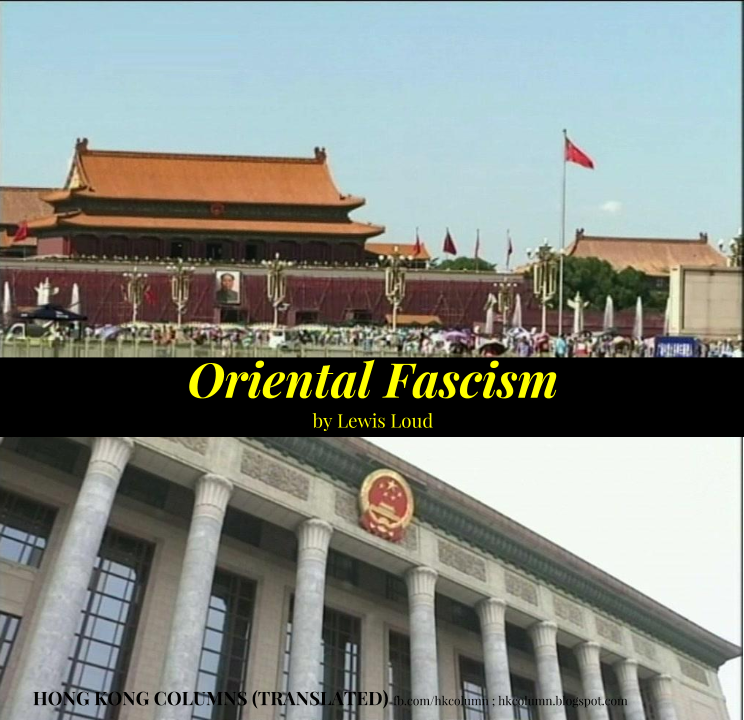
Lewis Loud: Oriental Fascism

Oriental Fascism
Translated by Ryan L, edited by Chen-t'ang, written by Lewis Loud
Original: Passion Times Vol. 41

China is a fascist country. Modern China abides by the belief in “Ein Volk, ein Reich, ein  Führer”. Modern China is an empire masquerading as a nation state.

For an ethnicity to have more than one country, like Austria and Germany, is a universal standard. Yet Chinese do not abide by this. They believe Hongkongers are Chinese, thus bound by the belief “blood is thicker than water”, therefore Hong Kong must accept Chinese rule. To mention independence is certainly treacherous, but even autonomy and localism are identified with separatist and treasonous intent. 

These beliefs are full of the elements of fascism. Westerners turn pale at the mere mention of fascism but America, ignorant and tolerant of the Communist East, supported China in opposing the Soviet Union. Hence, the largest fascist country is thriving today. Churchill once said that communism and fascism are twins that share the DNA of totalitarianism. 

90% of Hong Kong’s population are descendants of Chinese immigrants experiencing the rule from proper China since the Qin dynasty. They belong to the same ethnicity. But many entities may grow out of one ethnicity. Germanic peoples founded more than one country. The British founded America later. Once separated there was never any talk of reuniting with mother Britain.

China’s opposition to any secession through evocation of nationalist sentiments is merely hyperbole. In reality, the Chinese Communist Party cares not a wit about territorial integrity. Russia has swallowed vast chunks of Chinese territories since the Qing dynasty but Jiang Zemin signed a treaty demarcating present borders, forsaking the recovery of those lost territories. So why are the Chinese who live on these forsaken territories not traitors?

Ethnic Perceptions with Chinese Characteristics 
If China really cared about ethnicity, each province would be autonomous and establish their nationhood, then confederate to discuss matters that affected the entire region like Australia or Germany. Each province would be able to choose its own method of governance or development in accordance with the national condition yet the ethnicity would still belong to one entity. Yet China describes itself as a multiethnic yet united country. It is united so as to protect the party’s ability to monopolise all the power and profit; it is multiethnic to rationalise China’s invasive expansionism, its plundering of others’ lands. 

An ethnicity can only have one country. A country can only have one leader. Such beliefs if used in the West would be identified as hegemony, fascism and racism. Yet to the pompous westerner, eastern fascism is culturally specific to cultural complexities thus should be tolerated. This is tantamount to Westerners demanding gender equality and feminism yet tolerating the deprivation of female rights in Islam due to different values. 

Pretentiously cosmopolitan Hongkongers have very vague understanding of ethnicity. The Chinese nation (zhonghua minzu) is an artifice created by intellectuals at the end of the Qing and the beginning of the Republic era with only a century of history yet a majority of Hongkongers embrace it wholeheartedly as an earth-shattering revelation. Community eminences like Joseph Sung, Vice-Chancellor of the Chinese University of Hong Kong is an example. Yet Hong Kong with its modern meaning is already 176 years old, meaning the Hong Kong ethnicity is older than the Chinese nation by sixty or seventy years yet described as a fantasy. 

If the Hongkonger as a nation is a joke, where are the unshakeable foundations for the Chinese nation? Undoubtedly it is the mischief of power; the powers that be may have the power to define. The relationship between the signifier and the signified are unstable, artificial or arbitrary, yet, humans are the author of everything. All is silent, only power may speak. 

Hong Kong is not a nation because she says she is not. Once she decides she is, she is.